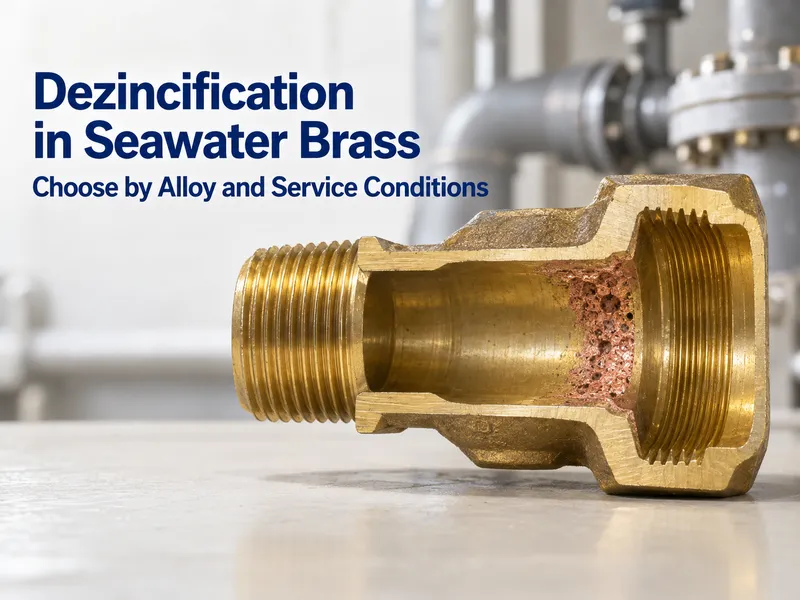
A brass valve that still looks sound after two years in seawater can split the next time it is closed. The metal has not rusted — copper alloys do not rust the way steel does.
The zinc has been selectively dissolved out of it, a process called dezincification, and what is left is a porous copper skeleton in the shape of the original part. Which grade survives this comes down to one number: how much zinc it contains.
What Dezincification Actually Does to a Part
Dezincification is a selective attack. Zinc leaves the alloy and copper stays behind, so the part keeps its dimensions while losing most of its strength. A fitting that measures correctly on a caliper can be close to perforation.
Color is the first visible clue. A wetted surface that was yellow turns pink or copper-toned as zinc leaves the outer layer, then darkens toward red-brown. Severe cases end up looking like a porous sponge rather than metal.
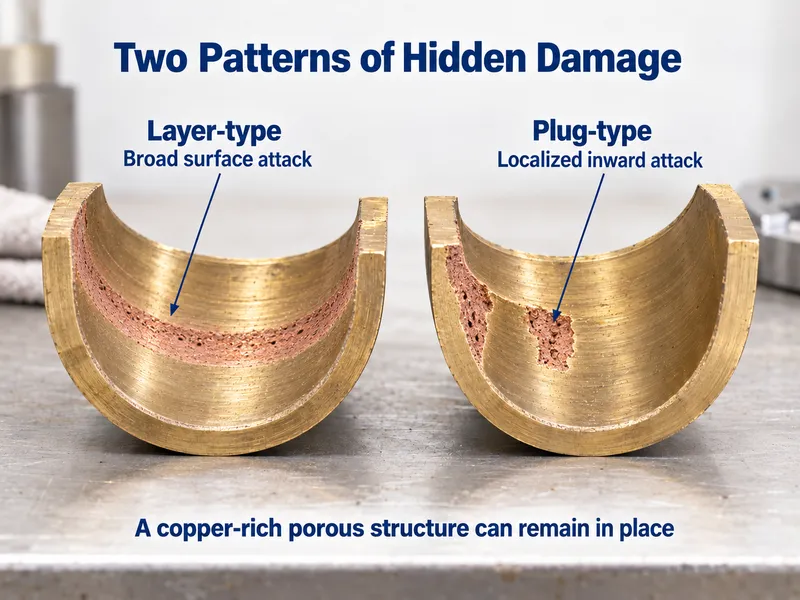
The two forms behave differently, and the distinction matters for inspection:
| Form | Attack pattern | What it looks like in service |
| Layer-type | Spread evenly across the wetted surface | Wall thickness drops gradually; the part weakens slowly |
| Plug-type | Concentrated in one spot and driven inward | A plug of porous copper forms; the part holds its shape, then perforates |
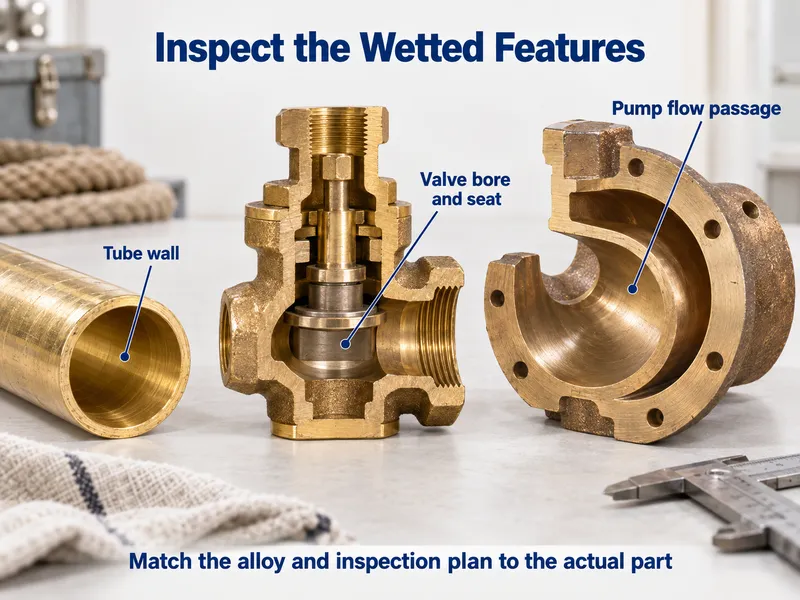
Seawater tends toward the plug-type. Valves, pump bodies, condenser tubes, and fasteners are where it shows up most often, because each combines a wetted brass surface with stagnant periods or slow flow.
Why Seawater Makes It Happen Faster
Dezincification needs two things at once: a susceptible alloy and an aggressive environment. Remove either one and the failure does not occur.
On the alloy side, zinc content sets the exposure. Copper-zinc alloys above roughly 15% zinc are at risk, and the risk climbs as zinc content rises. Below that level the alloy is effectively immune, which is why the seawater grades all sit at the low end of the zinc range.
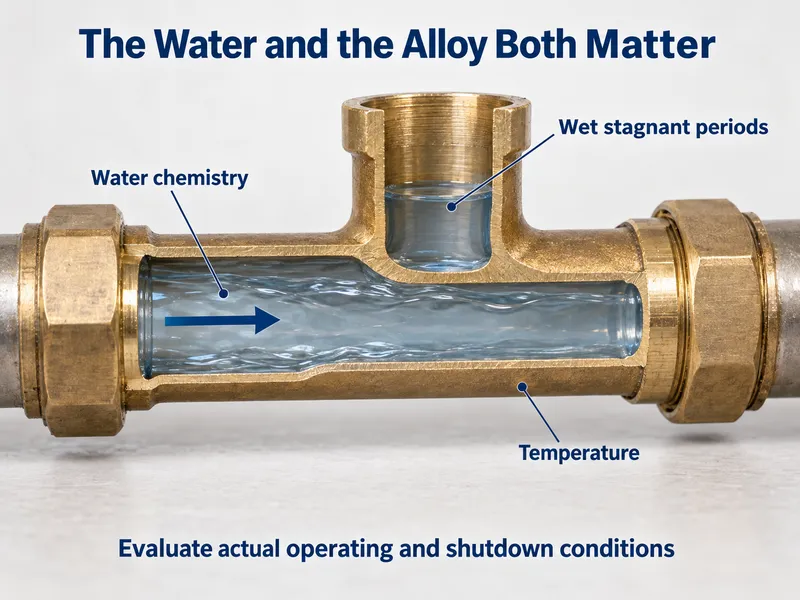
On the water side, four conditions speed it up: chloride content, temperature, low or intermittent flow, and low pH. Seawater supplies the first two at close to worst case.
Stagnation is the one variable a project can usually design out, which makes it worth separating from the rest — chloride content and temperature belong to the site, while flow belongs to the design.
Lead Content and Dezincification Are Two Separate Things
Lead does not take part in dezincification. It sits in the alloy as separate inclusions rather than in the copper-zinc solid solution, so it plays no role in the reaction that strips zinc out.
Two brasses with the same zinc content dezincify at the same rate whether or not one of them contains lead. Moving from a leaded brass to a lead-free brass of similar zinc content does not improve seawater performance, and a lead-free grade is not a substitute for a low-zinc grade.
This matters because lead is the number most brass specifications lead with. A part can meet a lead limit and still be the wrong alloy for a seawater line.
“DZR” Means Two Different Things
“DZR” stands for dezincification-resistant, and it appears in two markets that rarely talk to each other. The alloys behind the label are unrelated.
| Market | What “DZR” refers to | Lead content |
| Potable water fittings | European hot-forging brasses such as CW602N, built around drinking-water fittings and plumbing components | Typically 1.7–2.8% |
| Seawater and marine | Arsenical and antimonial brasses such as C44300, C44400, and C46500, built around tube, condenser, and seawater hardware | ≤0.07–0.20% |
A fittings brass carries lead because lead improves machinability, which high-volume fittings production depends on. A seawater brass carries arsenic or antimony instead, at trace levels, to suppress zinc removal.
Ordering “DZR brass” without naming the standard and the alloy is how a seawater part ends up made from a fitting alloy. The two families are not interchangeable.
Grade Routes for Seawater
Zinc content sorts the seawater alloys into a single descending line. Each step down buys more resistance and gives up machinability, so the useful question is where a given part stops needing the next step up.
Low-Zinc Alpha Brasses and Naval Brass
The alpha brasses hold zinc at roughly 21–28%, low enough that the alloy stays a single phase. C68700 Aluminum Brass sits at the bottom of that range and adds aluminum, which forms a protective oxide film on the wetted surface. C44300 Admiralty Brass and C44400 Admiralty Brass sit slightly higher and rely on arsenic and antimony respectively — the only real difference between them.
C46500 Naval Brass runs at roughly 39% zinc, high enough to form a zinc-rich beta phase alongside the alpha. That phase is attacked first, so this grade leans more heavily on its arsenic addition and on mill heat-treatment practice, which should be confirmed on the order. It remains a marine standard grade, supplied as rod, bar and shapes to ASTM B21, and it is the one grade in this group whose lead ceiling is 0.20% rather than 0.07%.
When to Step Up to Copper-Nickel or Bronze
Copper-nickel carries only residual zinc, which removes the dezincification mechanism rather than slowing it. The step up becomes the right call when service conditions push past what inhibited brass tolerates:
- Sustained flow above the brass range — C70600 Copper Nickel is typically rated around 3.0–3.5 m/s and C71500 Copper Nickel around 4.0–4.5 m/s; published figures vary, so confirm against ASTM B111 and the project design standard
- Polluted or sulphide-bearing seawater — sulphides break down the protective film copper-nickel depends on
- High temperature with continuous flow — condensers and heat exchangers rather than static hardware
- Parts where stagnation cannot be designed out
Where neither brass nor copper-nickel fits, the bronzes take over. Aluminum bronze and nickel aluminum bronze contain no zinc and are the usual choice for pumps, valves, and bushings in seawater.
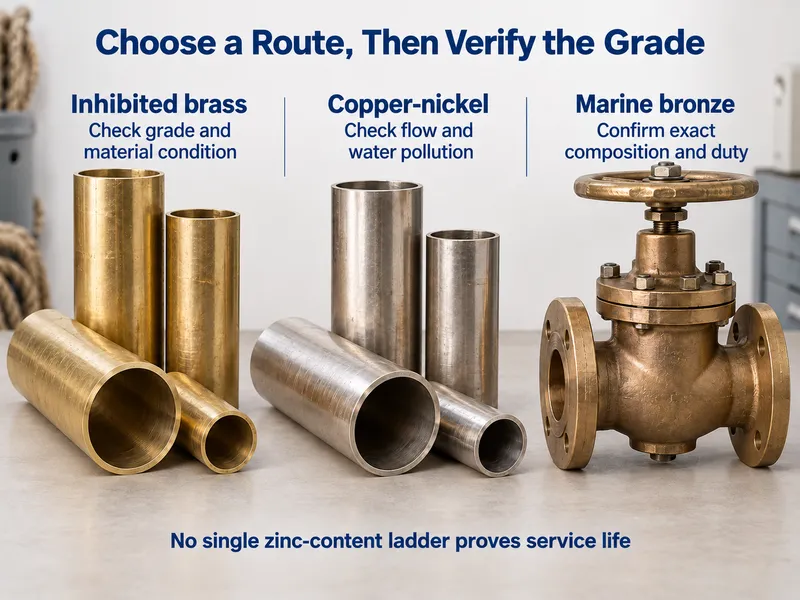
The whole ladder at a glance:
| Grade | Zinc | Structure | How it resists dezincification | Max Pb |
| C68700 Aluminum Brass | ≈21% | Alpha, single phase | Low zinc plus arsenic; a protective aluminum oxide film | ≤0.07% |
| C44300 Admiralty Brass | ≈27% | Alpha, single phase | Low zinc plus arsenic | ≤0.07% |
| C44400 Admiralty Brass | ≈27% | Alpha, single phase | Low zinc plus antimony | ≤0.07% |
| C46500 Naval Brass | ≈39% | Alpha + beta | Arsenic addition; mill heat-treatment practice | ≤0.20% |
| C70600 Copper Nickel 90/10 | Residual only | Single-phase solid solution | No zinc-rich phase to attack | ≤0.05% |
| C71500 Copper Nickel 70/30 | Residual only | Single-phase solid solution | No zinc-rich phase to attack | ≤0.05% |
Every grade in that table sits at or below 0.20% lead, so the marine brasses already meet the 0.25% lead definition used for lead-free brass in the United States.
Where Lead-Free Brass Fits in Seawater
The lead-free brasses most often specified today split into two routes, and only one of them resists dezincification on its own.
C69300 is a silicon brass. Its resistance comes from the copper-zinc-silicon structure rather than from a trace inhibitor addition, so the protection belongs to the alloy itself. That mechanism is real, but its validation history sits in potable water, tested under EN 12164 and EN 12165 bar standards — seawater service has far less long-term experience behind it than the marine grades have.
C27450 is not a silicon brass. It carries no silicon at all, just low-lead CuZn, which makes it a good machining grade at a moderate zinc level and a poor seawater choice on its own. Low lead is not dezincification resistance; the two properties are independent, and a grade can have one without the other.
This leaves the marine brasses as the route most projects land on. A specification that asks for lead-free and seawater usually ends up pointing at the same grades, because the marine brasses already meet the US 0.25% lead definition while being designed for seawater from the start. The two requirements rarely pull against each other.
What to Put on the Inquiry
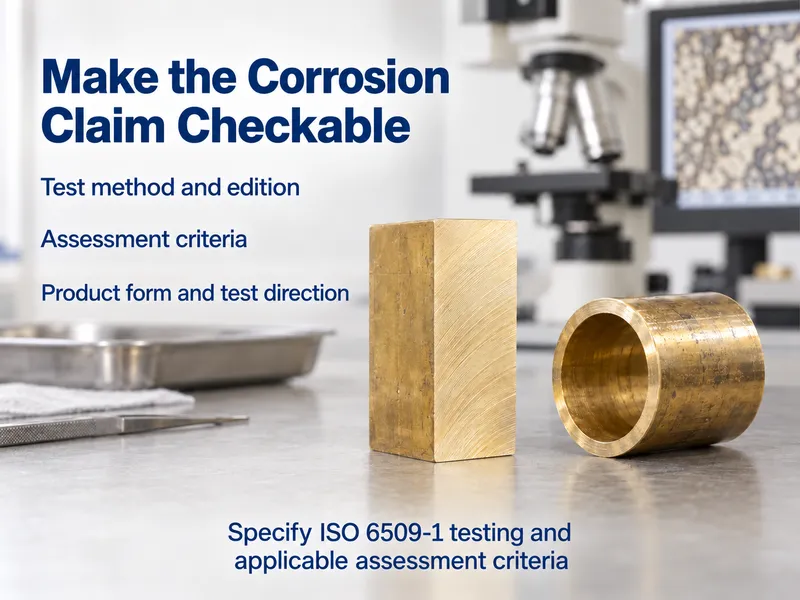
Four service conditions decide the grade, and each one changes the answer rather than just the paperwork. Report them as concrete values, not as categories:
| Condition | Report it as | What it decides |
| Medium | Full-strength seawater, brackish, or chlorinated | Whether the alloy needs inhibiting at all |
| Flow velocity | Continuous, intermittent, or normally stagnant | The grade step up to copper-nickel |
| Temperature | Ambient, or elevated in a heat-transfer duty | Whether inhibited brass still tolerates the duty |
| Stagnation | Whether the part sits wet and still for long periods | Whether the part can be designed out of the failure mode |
Verification needs the same specificity, because “passes ISO 6509” is not a checkable statement. ISO 6509 is a test method and sets no pass/fail limit of its own — the limit comes from whichever standard cites it, and those standards disagree on values, durations, and directions:
| Standard | Duration | Acceptance limit |
| ISO 6509-2 | 24 h | Forgings and castings: 100 µm average / 200 µm max. Extruded bar: 300 µm average / 400 µm max longitudinally, 100 µm average / 200 µm max transversely |
| NSF/ANSI 14 | 24 h | 200 µm max |
| AS 2345 | 24 h | 300 µm max longitudinally, 100 µm max transversely |
| UL 199 | 144 h | See UL 199 §40B.1.1 |
A certificate also stays with the form it was issued for. Drawn Brass Tube, extruded bar, and castings are not assessed the same way, even when the alloy is identical.
Two more items belong on the inquiry. Post-forming heat treatment matters because forming or brazing after supply can alter the structure that provides the resistance, so the sequence needs confirming before the order is placed rather than after. Documents matter because the grade, heat, and applicable standard have to be traceable, which means a mill test report covering the ordered form and standard.
Conclusion
The trade-off in seawater work is that resistance is bought with zinc — the lower the zinc, the better a grade holds up in seawater and the harder it is to machine. We supply the marine end of that range directly — Admiralty brass, naval brass, and copper-nickel in tube, bar, and plate form, with an MTR/MTC issued against the ordered grade, form, and standard on every order.
Send the service conditions, the alloy you have in mind, and the product form, and we will confirm the grade route and the documents that go with it.
FAQ
What does “passes ISO 6509” actually prove?
It proves the alloy met the acceptance limit of whichever standard cited the test, not that it met a universal threshold. Ask which criterion, which direction, and which product form the certificate covers.
Can a dezincified part be cleaned up and put back into service?
The part has to be replaced, not cleaned. Dezincification removes zinc from the metal rather than depositing something on top of it, so there is no layer to strip and machining the surface does not restore it. Layer-type attack has already thinned the wall, and plug-type attack runs inward while the outside dimensions still measure correctly — so re-check the grade before the replacement is ordered.
What is the minimum order quantity for a marine grade?
Minimums are kept low for non-stock items. The exact figure depends on the grade, dimensions and processing involved, and comes back with the quotation.
How long does a non-stock marine order take?
Typically 10–60 days from order confirmation, depending on grade, dimensions and processing. Stocked specifications are faster.
Can you supply third-party test reports?
Yes. SGS reports can be arranged on request at additional testing cost, covering chemical composition and mechanical properties for the ordered grade and form.

David Huang is a copper materials specialist and Sales Manager at Linsy Copper, with years of hands-on experience supporting global customers in copper and copper alloy sourcing.
He specializes in industrial copper products such as C11000 copper, C10200 oxygen-free copper, brass, bronze, copper sheets, plates, tubes, bars, and custom-processed copper components.
With a practical understanding of copper manufacturing, quality inspection, surface treatment, and export supply chains, David helps customers choose the right materials for electrical, mechanical, marine, construction, and industrial applications.