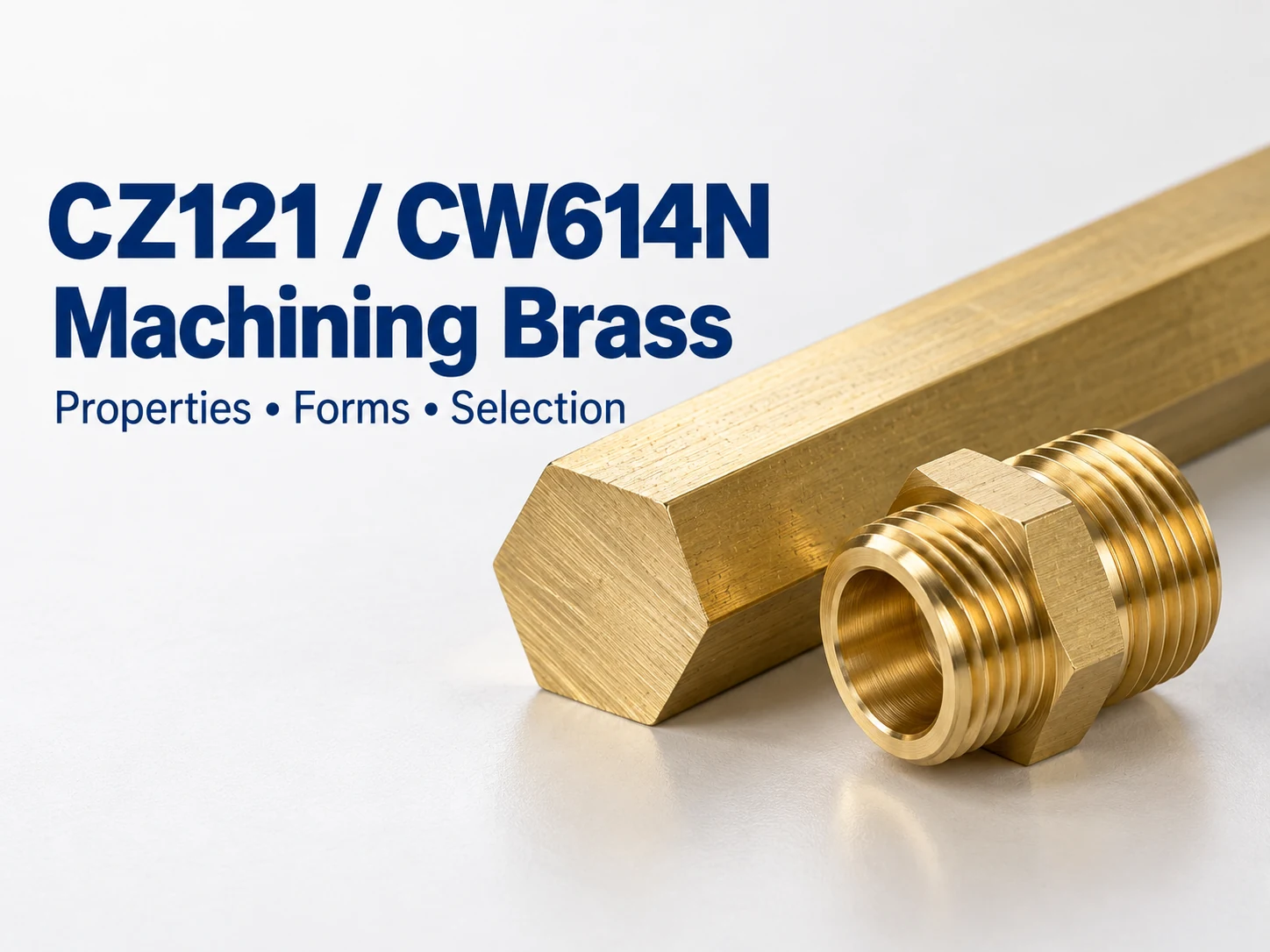
A 1998 drawing says CZ121. The quote comes back priced on CW614N, with “equivalent” in the notes. Both names are right, and neither is a purchase order.
What Is CZ121 Brass?
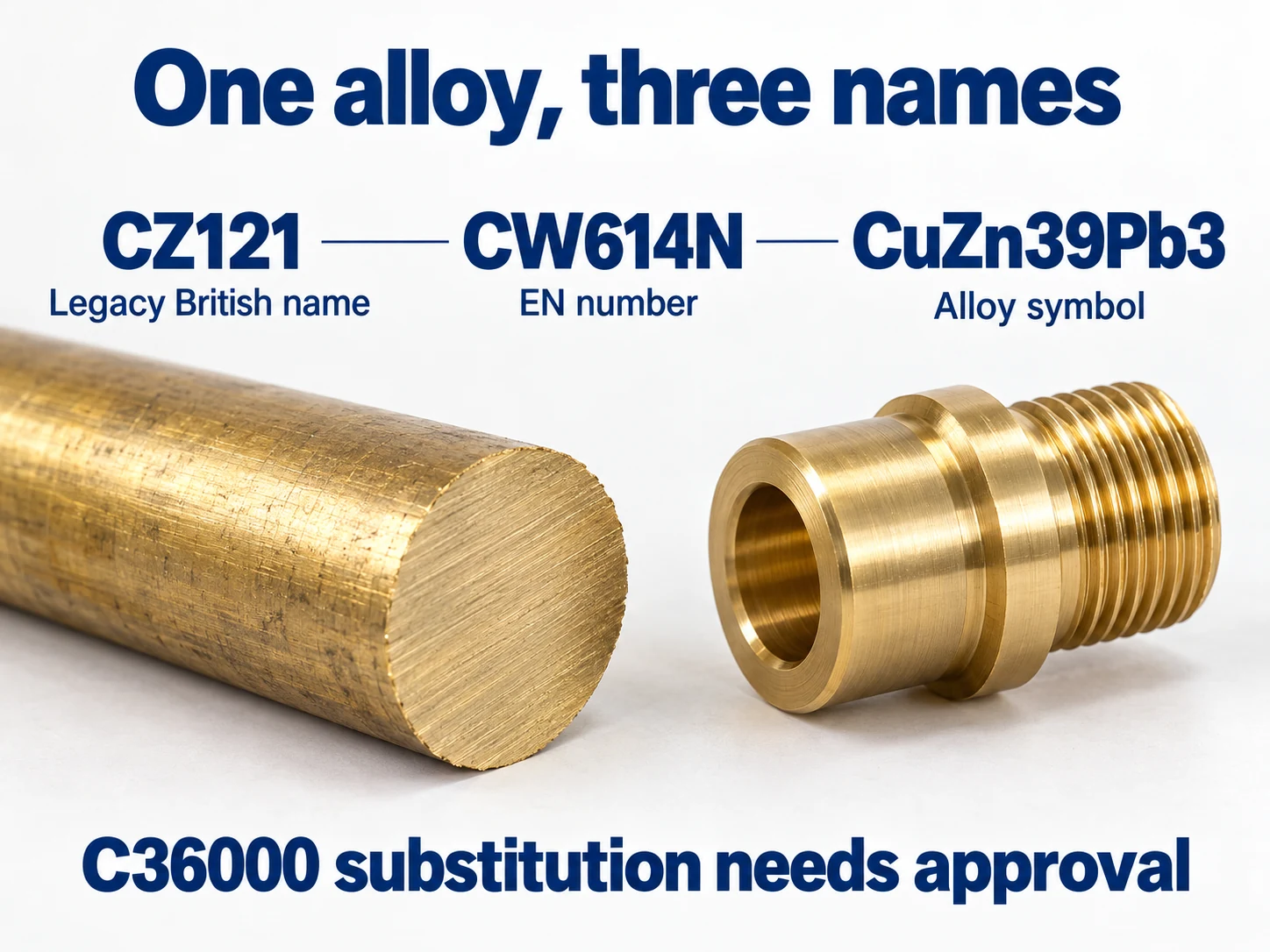
CZ121 is the British designation, carried in BS 2874 until that rod and section standard was withdrawn and replaced by the EN series. The same alloy is CW614N in the EN system and CuZn39Pb3 in symbols — 39 for zinc, 3 for lead, copper as the remainder. A drawing still reading CZ121 quotes a legacy name the mill cross-refers on the certificate, not an obsolete material.
| Standard | Product form | What it governs |
|---|---|---|
| EN 12164 | Rod for free machining | Bar for turning: condition, diameter band, tolerance, straightness |
| EN 12168 | Hollow rod for free machining | Cored bar for sleeves and bushes |
| EN 12167 | Profiles and rectangular bar | Extruded sections, not bar-fed work |
| EN 12165 | Wrought forging stock | Billet for the press, not for the lathe |
An order naming CW614N alone has named an alloy, not a delivery — the mill picks form, condition and tolerance by habit.
The US side has no identical number: the closest is C38500 (55.0–59.0% Cu), whose window contains the EN range, while C36000 — the grade usually quoted as the match — runs 60.0–63.0%.
Composition and Key Properties
| Element | CW614N (EN 12164 limits) |
|---|---|
| Copper (Cu) | 57.0–59.0% |
| Lead (Pb) | 2.5–3.5% |
| Iron (Fe) | 0.30% max |
| Nickel (Ni) | 0.30% max |
| Tin (Sn) | 0.30% max |
| Aluminium (Al) | 0.05% max |
| Zinc (Zn) | Remainder |
Lead moves between editions: EN 12164:2024 revised this alloy’s lead window, so a certificate can sit outside the band above and still be right for its own edition. The edition on the order governs.
At 39% zinc the alloy sits past the alpha limit of roughly 37%, so it is alpha plus beta — beta softens at temperature, which is why hot working is easy and cold working is not. Lead is insoluble, solidifies last and sits at the grain boundaries, which is where the machining behaviour comes from.
| Property | Value |
|---|---|
| Density | 8.46–8.47 g/cm³ |
| Melting range | 875–890 °C |
| Thermal conductivity | 118–123 W/m·K |
| Electrical conductivity | ~25% IACS |
A quarter of copper’s conductivity suits fittings, not conductors. Strength and hardness belong to the condition and the diameter, never to the grade alone.
| EN 12164 condition | Round bar dia. | Tensile Rm min | Yield Rp0.2 min | Elongation min A100 / A11.3 | Hardness HBW (H-code) |
|---|---|---|---|---|---|
| M (as manufactured, R360) | 6–80 mm | 360 MPa | — | 15% / 20% | 90–125 |
| R430 | 2–60 mm | 430 MPa | 220 MPa | 6% / 8% | 110–160 |
| R500 | 2–14 mm | 500 MPa | 350 MPa | 3% / 5% | 135 min |
The condition name is the minimum tensile strength, so R500 is a promise about a bar in a diameter band, not a grade choice. Above 14 mm it is not offered; above 60 mm only as-manufactured is. Round bar carries those bands — hexagon and square stop lower. A drawing asking for 500 MPa in 25 mm bar needs a design change, not a different supplier.
Machining CZ121 / CW614N: What It Changes in the Quote
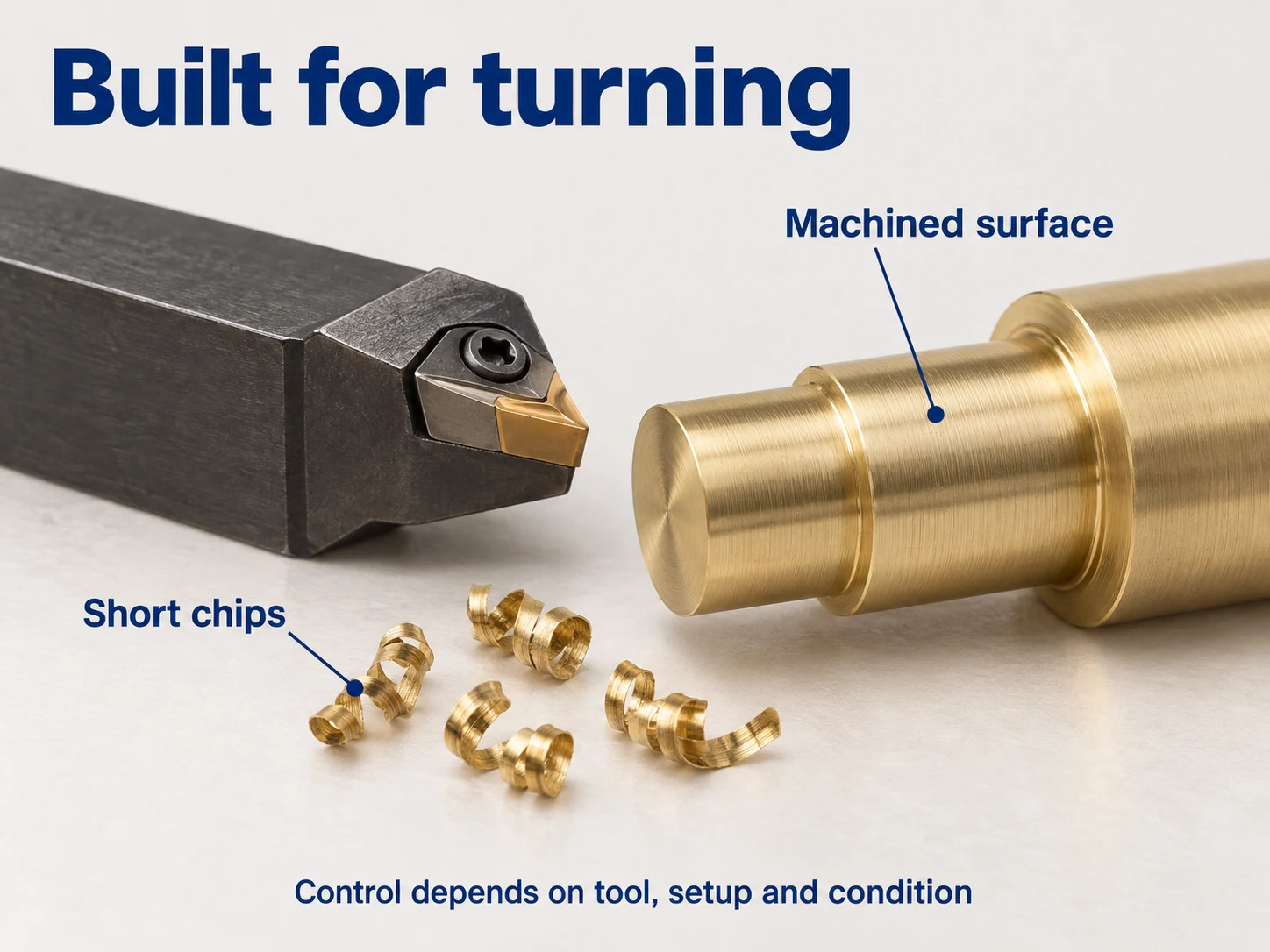
Machinability is a cost line, not a technique: unattended running, low force, tolerance held over a long run. All three come from the lead.
| What the lead does | What you see at the machine | What it changes in the quote |
|---|---|---|
| Shears ahead of the edge, so the chip breaks early | Short curled chips, no birdnesting | Unattended running, no chip-breaker insert |
| Keeps friction low on the rake face | No built-up edge; the finish comes off the tool | A light pass instead of polishing |
| Leaves with the chip, carrying the heat | Little growth over a long run | Tolerances hold without in-process gauging |
| Keeps cutting force low at 360–500 MPa | Deep cuts and form tools on a rigid setup | Fewer passes, more features per bar |
Past that, the constraint is the machine — spindle, bar feeder, acceleration — not the alloy. It is why a grade change moves the quote and a parameter change does not.
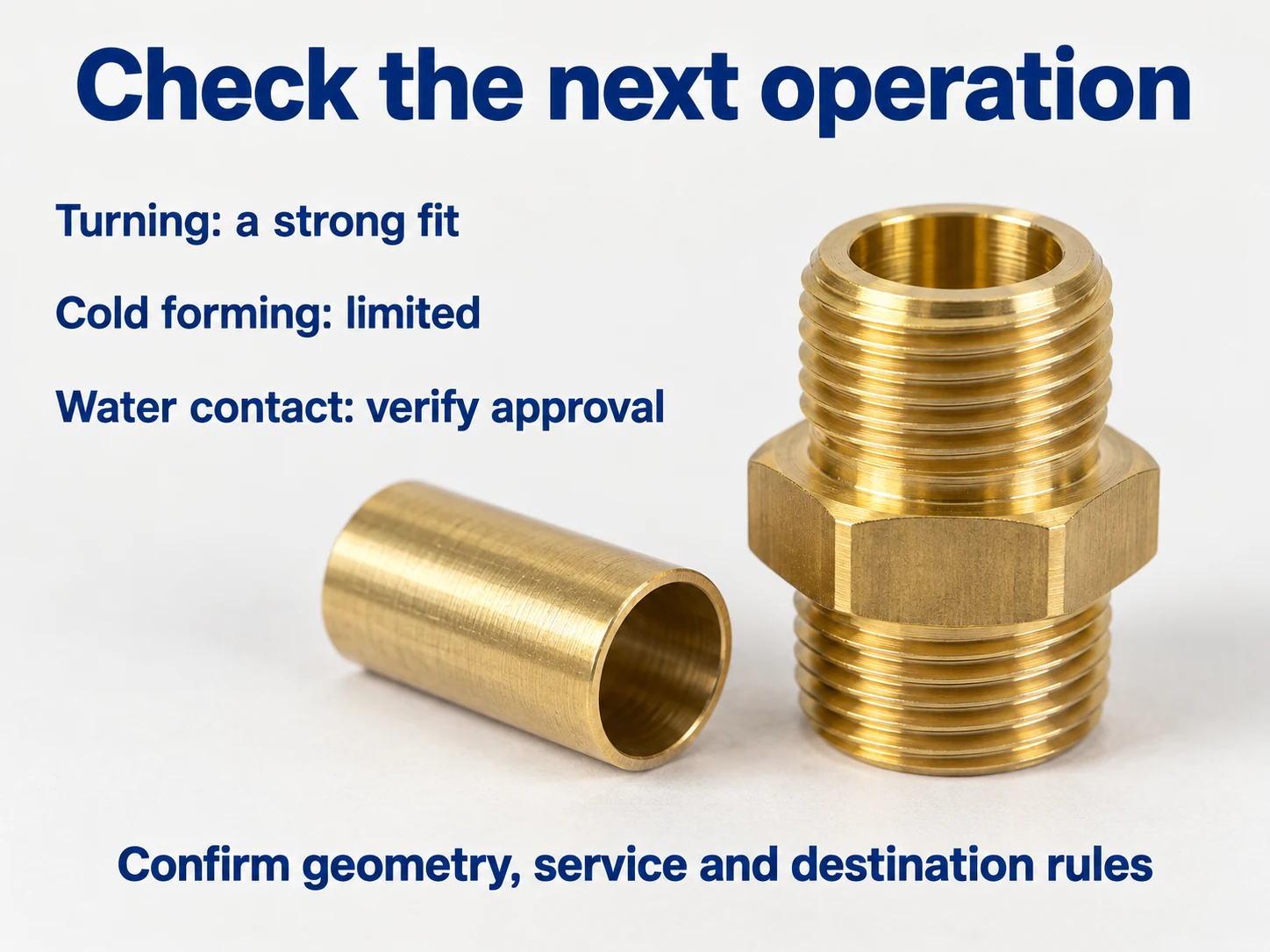
Tapping is rated good. Thread rolling sits on the boundary, because rolling is a cold-forming step on an alloy rated poor at it: a small rolled thread holds, a deep thread on a large diameter cracks, so a rolled thread earns a sample first.
Condition, tool geometry and part stiffness still move the result — soft M bar cuts clean and tears on a thin wall; R430 holds a better finish and arrives straighter.
The machinability index needs its reference: European tables set CuZn39Pb3 at 100; American tables set C36000 Free-Cutting Brass at 100 and put the nearest composition match, C38500, at 90. Without the reference it is a number that happens to match.
Forming, Joining and Finishing
Hot working is the route it does well — between roughly 630 and 730 °C the beta phase carries the deformation, so forging, extrusion and hot pressing are comfortable.
Cold forming is the one to design out. Heading, severe bending, staking and heavy thread rolling all ask for ductility the lead removed; knurling is the exception, deforming only a surface layer.
Joining is one-sided. Soldering is excellent and brazing good; welding is not recommended beyond butt joints. Brazing puts lead in the fume, so extraction is a process requirement.
Finishing is where the lead shows. Bright polishing rates only fair, because lead particles interrupt the surface; plating is routine, and a surface smeared by a dull tool shows up after plating.
Typical Machined Components
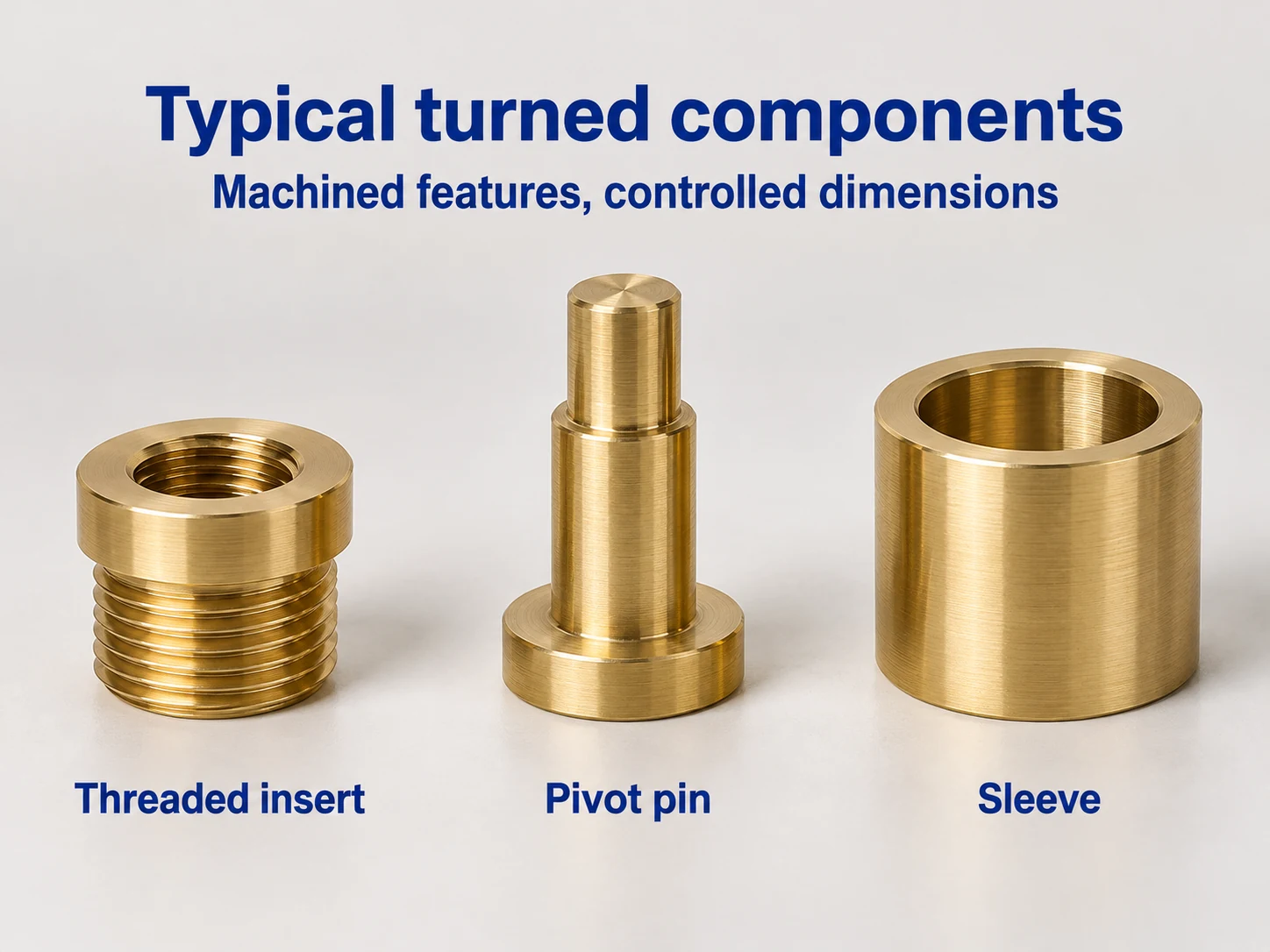
- Threaded fittings and inserts. Thread, hex and bore off one bar; short chips mean the tap does not pack.
- Pins and pivot shafts. R430 or R500 buys the wear surface and the straightness; R500 stops at 14 mm.
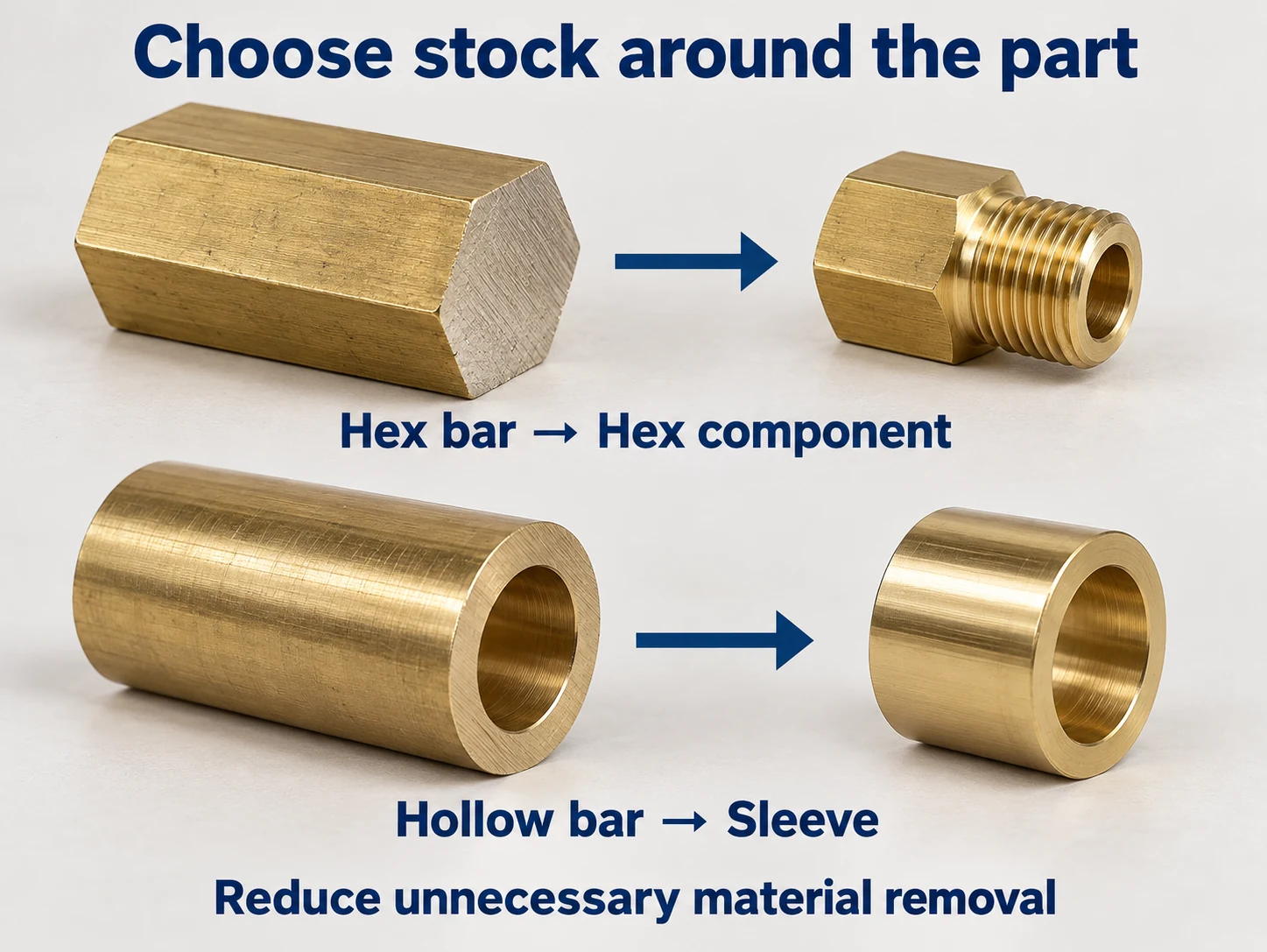
- Sleeves and bushes. Hollow rod to EN 12168 beats drilling solid bar — less material, shorter cycle.
- Lock bodies and hardware. Polish-and-plate parts with no structural duty, where finish and cycle time set the cost.
- Connector bodies and terminals. Chosen for how they machine and plate, not for current capacity.
Bar form is a cost decision too: a hex part from round bar pays to have the hex milled away.
What it is not for: anything bent or swaged after machining, heavy rolled threads, and any pressure boundary in potable water — not because of the lead alone, but because the alloy does not meet ISO 6509, so soft or chloride-bearing water takes the zinc out and leaves the part porous. Dezincification and lead-free brass in seawater covers the grades that hold.
Forms, Conditions and Supply Standards
Round bar 6–80 mm, hexagon and square 5–60 mm across flats, hollow rod, profiles, wire. Anything outside that is a drawing, not a stock item.
A bar that runs out bends the part, so straightness and sawn-end condition belong on the order alongside the diameter.
Where the part goes into electrical equipment, the RoHS exemption for copper alloys up to 4% lead (Annex III, 6(c)) runs to 30 June 2027 — a declaration that leans on it should carry that date.
Linsy Copper supplies Brass Bar in these forms, including C38500 in extruded bar and profiles, cut to length, with CNC turning on the same order. Every lot ships with an MTR/MTC; non-stock sizes run as low-MOQ custom production at a typical 10–60 days, with SGS testing on request.
CZ121 vs Other Brass Grades
| Grade | Cu | Pb | Standard | Route | Note |
|---|---|---|---|---|---|
| CZ121 / CW614N | 57.0–59.0 | 2.5–3.5 | EN 12164, EN 12168 | Turned from bar | The EN machining benchmark |
| C36000 | 60.0–63.0 | 2.5–3.7 | ASTM B16 | Turned from bar | The US benchmark; a different window |
| C38500 | 55.0–59.0 | 2.5–3.5 | ASTM B455 | Extruded bar and profiles | Closest US composition match |
| CW617N | 57.0–59.0 | 1.6–2.5 | EN 12164, EN 12165 | Hot forged, then machined | Same copper, half the lead |
C36000 fails on chemistry before performance. It requires 60.0–63.0% copper and CZ121 tops out at 59.0, so a C36000 heat against a CZ121 drawing is a nonconformance the certificate itself proves — and the reverse fails identically. Both cut at the top of their own scales, which is why the swap is proposed and why it runs until goods-in rejects it. Put the deviation in writing if a customer wants it: from then on the part is C36000 to ASTM B16.
CW617N is the same copper at half the lead, built for a different first operation. At 1.6–2.5% Pb it forges where CZ121 would rather be cut, and machines slower because the chip-breaking lead is at half the level. A hot-forged part starts there; a turned part starts at CZ121. Where the forging route is fixed, C37700 Forging Brass is the US grade doing the same job.
C38500 is the closest US entry, and the match runs one way. CZ121’s copper range sits inside C38500’s and its iron limit is tighter, so an EN heat usually certifies as C38500; check the lead against 2.5% before cross-certifying. Where the lead question has to be settled by rule and market, Leaded brass: when lead is still the right answer does that.
How to Specify CZ121 / CW614N for an RFQ
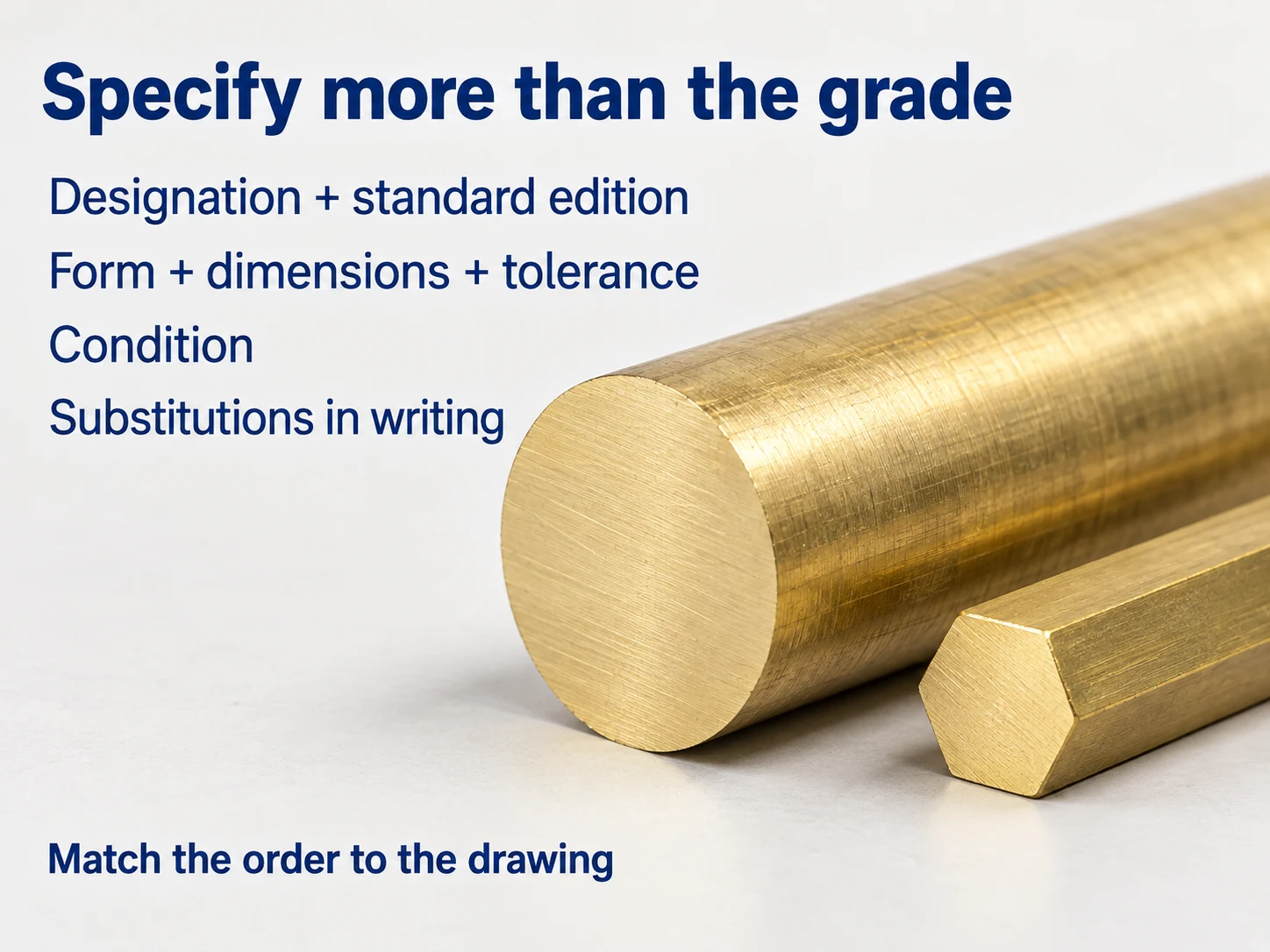
Four lines carry the risk on this grade. The rest of a purchase order is standard.
| Item | Why it changes the quote | What a usable answer looks like |
|---|---|---|
| Designation, standard, edition | CZ121 gives a legacy name; CW614N gives an alloy | “CW614N (CuZn39Pb3), EN 12164:2024” |
| Form, diameter, tolerance class | Set by diameter and straightness | “Round bar Ø20, class, straightness limit” |
| Condition | Two products at two prices | “R430” or “H110”, not “hard” |
| Substitution policy | Decides what ships without a call | “C36000 not acceptable” or “alternates in writing” |
The last row gets left off, and it decides what arrives.
Conclusion
CZ121 buys cutting speed with ductility and with 3% lead — the right trade for a part that is turned, threaded and plated, not for one that is bent, deep-rolled or on a water line.
We quote against the designation on your drawing rather than a catalogue number — CZ121, CW614N or C38500. Grade, edition, condition and diameter band are confirmed before bar is cut, with an MTR/MTC on every lot and CNC turning on the same order.
Send the drawing with the condition and the diameter you need, and we will confirm what can be held and where a substitution would need your sign-off.
FAQ
Is CZ121 the same as CW614N?
Same alloy, two naming systems. CZ121 is the British designation from the withdrawn BS 2874; CW614N is the current EN number and CuZn39Pb3 the symbol. Order by the EN designation and the product standard, and ask for the CZ121 cross-reference on the certificate.
Can C36000 replace CZ121?
Not on paper. C36000 requires 60.0–63.0% copper and CZ121 tops out at 59.0, so a C36000 heat cannot satisfy a CZ121 drawing — and the reverse fails identically. It machines acceptably, so the swap gets proposed; it still needs a written deviation.
Is CZ121 suitable for bending?
Not cold. The duplex structure and the lead leave it with poor cold ductility, so a tight bend cracks at the line. Hot bending inside the 630–730 °C window works; a part that must be bent cold belongs on a cartridge brass such as C26000.
What should the material certificate show?
The EN number and symbol, the heat number, the analysis, the mechanical values and condition supplied, the dimensions, and the standard with its edition. EN 10204 3.1 carries specific inspection results for the lot; 2.2 is a declaration without them.

David Huang is a copper materials specialist and Sales Manager at Linsy Copper, with years of hands-on experience supporting global customers in copper and copper alloy sourcing.
He specializes in industrial copper products such as C11000 copper, C10200 oxygen-free copper, brass, bronze, copper sheets, plates, tubes, bars, and custom-processed copper components.
With a practical understanding of copper manufacturing, quality inspection, surface treatment, and export supply chains, David helps customers choose the right materials for electrical, mechanical, marine, construction, and industrial applications.