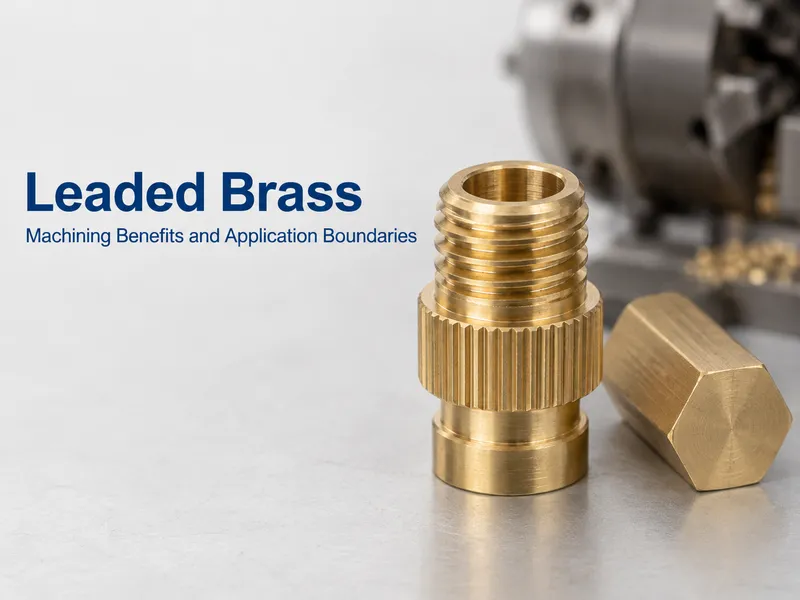
The question buyers ask about leaded brass is usually “can we still use it”, which is the wrong question. The useful one is whether the part ever gets drunk. A 0.25% lead limit governs drinking and cooking water. A separate 8% ceiling covers the rest of the water supply system, and irrigation, standalone fire suppression, and closed-loop heating sit outside the potable side altogether. Where lead is still the right answer, that boundary is the reason — not tradition.
What Lead Does in the Cut
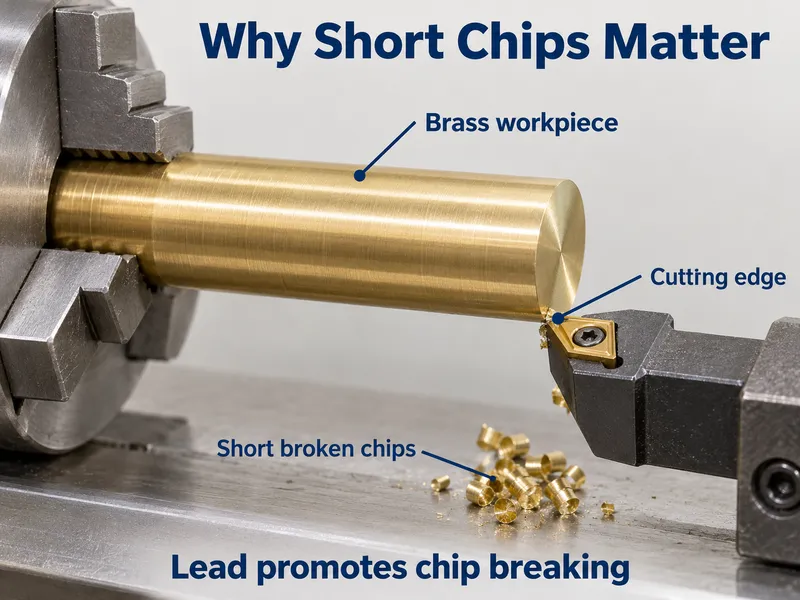
Lead is added to brass as a third phase rather than as an impurity, and it does two jobs at once. It forms soft particles that fracture under the cutting edge so the chip breaks away short, and it keeps the surrounding grain from strain-hardening as the tool passes. That pairing is why C36000 Free-Cutting Brass sits at a machinability index of 100 on the CDA scale, the reference every other copper alloy is measured against.
The mechanism is worth stating precisely, because the usual explanation is wrong. Lead does not act as a lubricant during machining. It does not melt onto the tool face either. What it does is deform into flakes that sit in the material being cut and act as crack initiation points, and that is what breaks the chip short rather than letting it pull away. It is also why lead costs you ductility — the same flakes are the crack source. Testing on real cutters, published in 2022 by Lund University and Chalmers, this settled an explanation the industry had repeated for decades. Removing lead means replacing both jobs at once, which is covered in Lead-Free Brass — silicon replaces the strength, bismuth replaces the chip breaking, and the two are not interchangeable.
The Machinability Ladder
Grades are usually listed by lead content, which makes them look interchangeable. On the CDA index they are not. The spread below runs from 100 at the benchmark down to 50 at the lowest-lead grade, and it falls faster than the lead figure suggests.
| Grade | Pb% | Cu% | CDA index | Forms | ASTM |
|---|---|---|---|---|---|
| C35600 | 2.0–3.0 | 60.0–63.0 | 100 | Flat | B453 / B121 |
| C36000 | 2.5–3.7 | 60.0–63.0 | 100 | Rod, bar, shapes | B16 |
| C34200 | 1.5–2.5 | 62.0–65.0 | 90 | Flat, rod | B453 / B121 |
| C35300 | 1.5–2.5 | 60.0–63.0 | 90 | Flat, rod | B453 / B121 |
| C38500 | 2.5–3.5 | 55.0–59.0 | 90 | Extruded | B455 |
| C37700 | 1.5–2.5 | 58.0–61.0 | 80 | Rod, shapes | B124 / B283 |
| C34000 | 0.8–1.5 | 62.0–65.0 | 70 | Flat, rod, wire | B453 / B121 |
| C35000 | 0.8–2.0 | 60.0–63.0 | 70 | Flat, rod | B453 / B121 |
| C33500 | 0.25–0.7 | 62.0–65.0 | 60 | Flat | B453 / B121 |
| C34900 | 0.10–0.50 | 61.0–64.0 | 50 | Rod, wire | B453 |
The figures are typical reference ranges for each grade. Exact limits depend on the ASTM or EN specification and the product form — the same UNS grade can carry a slightly different range under a different standard, because the standard defines the acceptance window for that form rather than the alloy itself. Final values ship on the MTC against your ordered specification.
The number to correct is C34000. Its CDA machinability index is 70, not the 85–90 that circulates in third-party material descriptions. That matters because “reduce the lead but keep the machining” is a common project requirement, and on this scale it does not hold: moving from C36000 to C34000 halves the lead range but costs 30 index points, which is the difference between short broken chips at high spindle speed and chips that have to be managed.
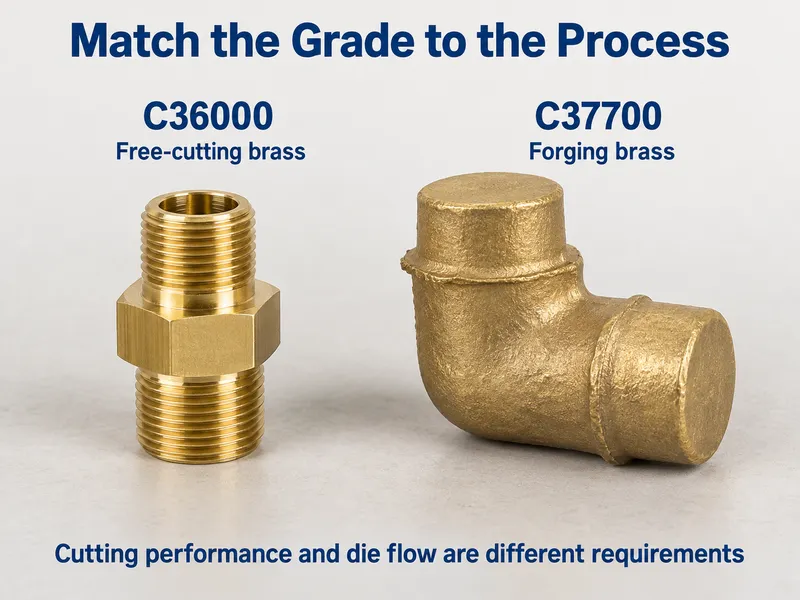
If a project needs lower lead and the C34000 Low Leaded Brass and C35000 High Leaded Brass options are being weighed, compare cycle time, not alloy price. Where the part is machined heavily and lead is the concern, C35300 Leaded Brass at 1.5–2.5% lead keeps index 90 and is usually the better compromise. Where the part is forged rather than cut, the index matters less than flow in the die, and C37700 Forging Brass is rated 100 for hot forgeability against that benchmark rather than against the machining scale.
Where Leaded Brass Is Still the Right Answer
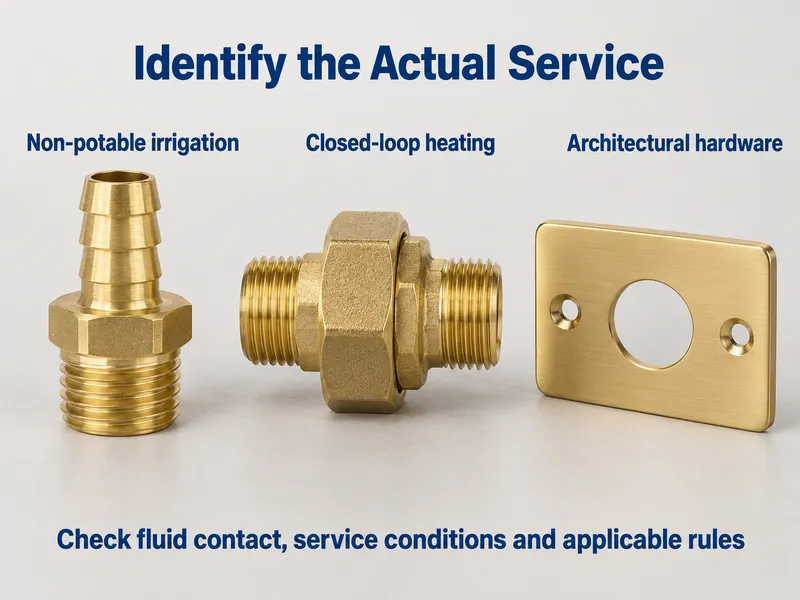
Leaded brass is not a legacy choice that has outlived its rules. In several service conditions the rules actively permit it, because those conditions are not on the potable side.
| Where | Why lead still works | Boundary |
|---|---|---|
| Irrigation and non-potable supply | The water is never consumed | IPC 605.2 caps lead at 8% |
| Standalone dry fire suppression | Water in the loop is never drunk | ⚠️ Multipurpose systems are excluded |
| Closed-loop heating | Sealed loop, no potable contact | No composition rule applies |
| Architectural and decorative parts | No fluid contact at all | ⚠️ RoHS 6(c) applies — see below |
IPC 2024 §605.2 sets an 8% lead ceiling across the water supply system. §605.2.1 is narrower: it requires NSF 372 compliance and a 0.25% weighted average lead content, and it applies only to pipe, fittings, joints, valves, faucets and fixture fittings supplying water for drinking or cooking. That scoping is what puts the four rows above outside it — a non-potable line is not a drinking water line, whatever the alloy contains.
One exception decides the fire suppression row. A multipurpose fire sprinkler system shares pipework between suppression and household supply, so it does cross into potable use and does require lead-free components; a standalone dry system does not. How each of these regimes defines its own threshold is set out in Lead-Free vs Leaded Pipe Fittings.
The 8% ceiling applies to the water supply system as a whole, so one high-lead fitting does not put a non-potable line over the line by itself. But it does not travel between systems — specifying leaded brass for the irrigation main and reusing that decision on the domestic cold-water branch changes the regulatory basis, not just the material.
The 4% Exemption Has a Date and a Size Condition
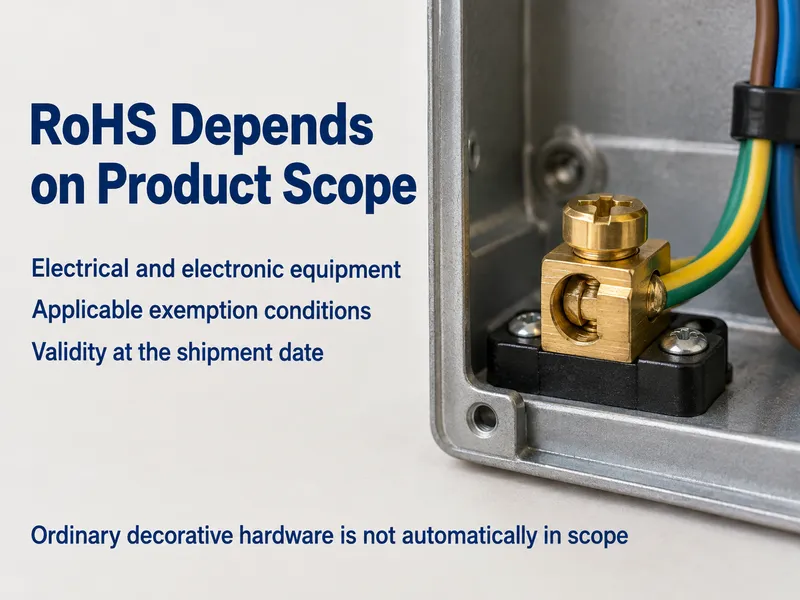
RoHS exemption 6(c) allows up to 4% lead in copper alloys, and that sentence is now missing a date. 30 June 2027 is when 6(c) expires across all product categories, set by Delegated Directive (EU) 2025/2364 of 21 November 2025. A renewal application went in on 12 December 2025, and under Article 5(5) of the RoHS Directive the exemption stays valid while that application is under review, whatever the published date says.
The same directive added a condition that is newer and less discussed. The exemption no longer covers EEE supplied to the general public where the equipment or an accessible part could be placed in the mouth by children during normal or foreseeable use — and a part counts as meeting that description if it is smaller than 5 cm in one dimension or carries a detachable or protruding part of that size. It can still be claimed if lead release stays under 0.05 µg/cm² per hour, and where the part is coated, if the coating holds that rate for at least two years. So the question stops being what the alloy contains and becomes how big the part is: a 30 mm decorative casting at 2.8% lead sits inside a 4% ceiling today and outside the exemption when the directive expires, with no change to the alloy at all.
Grade and Standard Cross-Reference
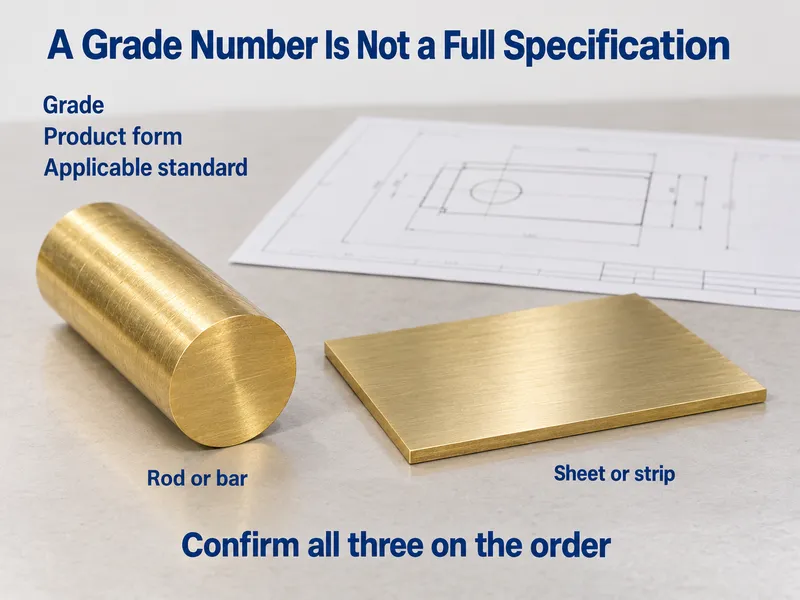
A grade number is not a specification. The same C35300 is covered by ASTM B453/B453M-26 as rod, bar, wire or shapes and by ASTM B121/B121M-23 as plate, sheet, strip or rolled bar — the same alloy, but different mechanical property sets, delivery conditions and acceptance windows. A purchase order naming only the UNS number leaves the product form open, and the mill ships whatever it holds in stock. Putting all three on the drawing — grade, product form, and standard — settles that at the mill rather than at incoming inspection, because acceptance criteria are written per product form.
Cross-border orders need one more check, because the closest European equivalent is not always the same alloy. C38500 is commonly matched to CW614N in commercial practice, and the two do not overlap cleanly on either element — C38500 runs higher in copper, CW614N starts lower in lead. A heat that sits inside one range can fall outside the other, which is where cross-border rejections come from. C38500 also carries the trade name architectural bronze, though it is a copper-zinc-lead alloy with no tin requirement and B455 classes it as a leaded brass.
One practical note on the standards themselves. B36 and B134 are both real, and both are product form standards — copper sheet and copper bar — not alloy specifications. A grade written as B36 / B134 tells you the form and nothing about composition limits. The number that settles the alloy is the grade-specific one: B453 for rod, bar and shapes, B121 for plate and sheet, B455 for extruded shapes, B124 or B283 for forgings.
Conclusion
Leaded brass is not a legacy choice that has outlived its rules, and the question is not whether to switch. It is whether the part ever gets drunk. Contact drinking or cooking water and the material changes — the comparison then becomes which capability you can afford to give up. Contact nothing and the grade can stay as it is, governed by two things instead of the alloy’s lead figure: whether the exemption will still cover it on the day it ships, and whether any dimension falls under 5 cm.
What makes this harder than it looks is that the answer is not a property of the alloy. It is a property of the alloy, the drawing, the destination market and the date the part ships. Past the potable boundary the deciding variable becomes machining cost, and the CDA index is what prices it — a grade at 100 does the same cut in less time than one at 70. Send the drawing with the destination market and whether the part contacts drinking water, and we will tell you which regime governs it, quote both the leaded and lead-free route where the drawing allows it, and flag anything that needs a size check before it turns into a compliance problem.
FAQ
What forms do you stock in C36000, and what is the minimum order?
Round, hex and flat bar in the common machining lengths, supplied to ASTM B16 with an EN 10204 3.1 mill certificate. Standard tempers are O60 and H02, with H04 available on request. Tell us the diameter and annual volume and we will confirm stock and lead time against the actual heat.
Can you supply C34000 or C35000 instead if we need to cut lead?
Yes, both are supplied in bar and rod. The point worth keeping in view is the machining cost: at a CDA index of 70 against C36000’s 100, the same cutting data will not apply, so the quote covers tooling and cycle time as well as material. Where lead is the only concern and the part is machined heavily, C35300 often lands closer to the required performance.
What documentation comes with the heat?
An EN 10204 3.1 certificate tied to the heat number, showing composition against the standard you specify. For C36000 to B16, note that for product of 1/2 inch and above, Rockwell hardness is the default acceptance criterion rather than tensile strength — state it on the order so incoming inspection checks the same thing we certified against.

David Huang is a copper materials specialist and Sales Manager at Linsy Copper, with years of hands-on experience supporting global customers in copper and copper alloy sourcing.
He specializes in industrial copper products such as C11000 copper, C10200 oxygen-free copper, brass, bronze, copper sheets, plates, tubes, bars, and custom-processed copper components.
With a practical understanding of copper manufacturing, quality inspection, surface treatment, and export supply chains, David helps customers choose the right materials for electrical, mechanical, marine, construction, and industrial applications.