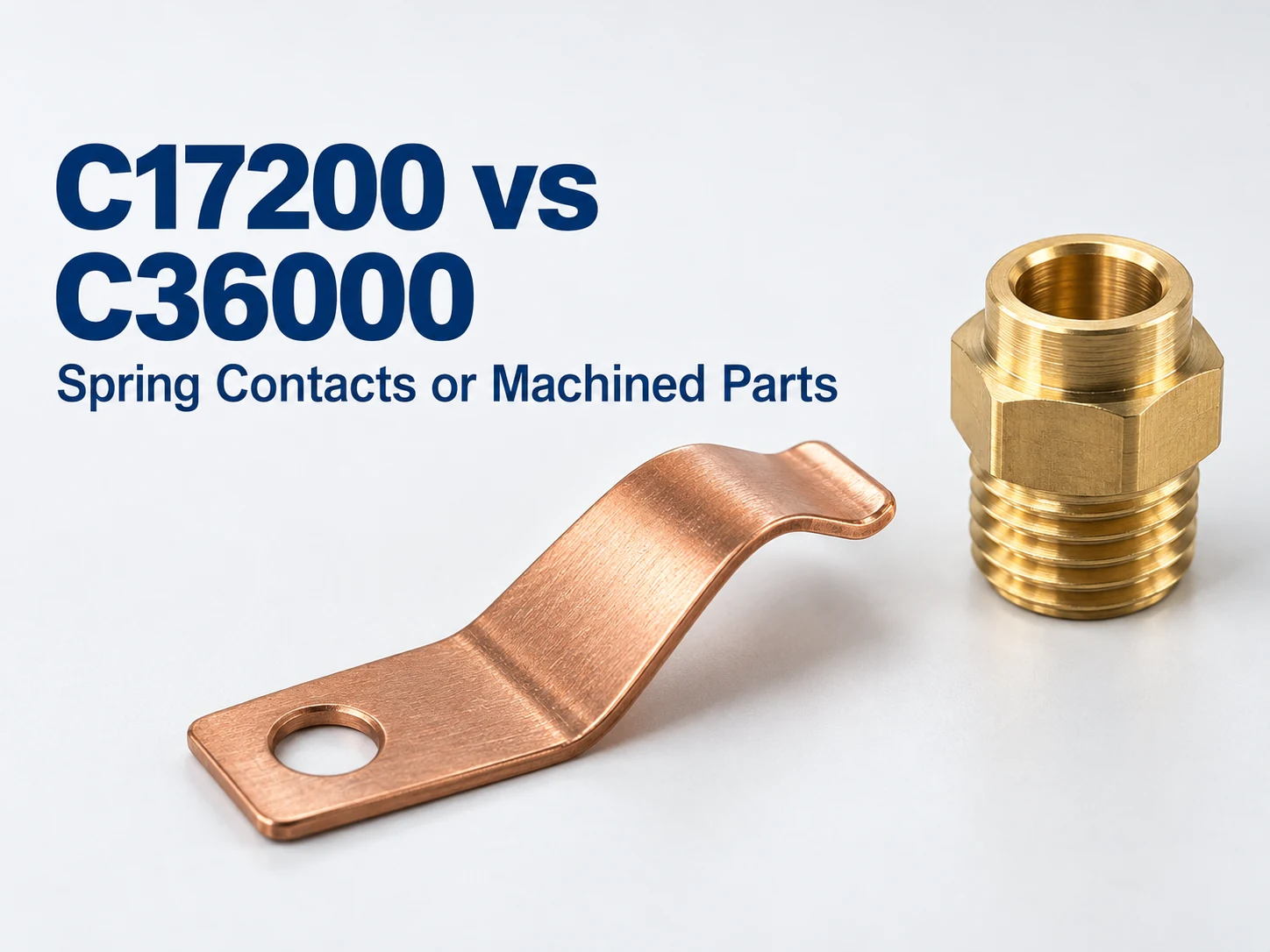
Two precision parts can leave the same shop and size, and be built from alloys that do opposite jobs. C36000 is a conductor that springs a little. C17200 is a spring that conducts. Pick on price alone and the part either relaxes out of contact or carries a strength margin nobody needed at several times the material cost. The decision starts with what the part does — rigid connection and location, or repeated elastic deflection holding a contact pressure — and works backward to the alloy.
Composition: Two Alloys Built for Opposite Jobs
C17200 Beryllium Copper and C36000 Free-Cutting Brass are both copper alloys. The resemblance ends at what was added and why.
| Element | C17200 (ASTM B194) | C36000 (ASTM B16) |
|---|---|---|
| Beryllium (Be) | 1.80–2.00% | — |
| Cobalt + Nickel (Co + Ni) | 0.20% min | — |
| Cobalt + Nickel + Iron | 0.60% max | — |
| Copper (Cu) | Balance (99.5% min with named elements) | 60.0–63.0% |
| Lead (Pb) | — | 2.5–3.7% |
| Iron (Fe) | In Co + Ni + Fe | 0.35% max |
| Zinc (Zn) | — | Remainder |
Beryllium does not sit quietly in copper. It stays in solution after quenching, then precipitates as fine beryllide particles during aging, and those particles pin the dislocations that would otherwise let the metal yield. Lead in C36000 does the opposite job: it barely dissolves, sits as discrete particles, and opens cracks in the chip so the cut breaks short.
Beryllium buys strength and gives up machinability; lead buys machinability and gives up ductility.
Strength Depends on Temper, Not Just Grade
A drawing that says “C17200” has not specified a strength. The same alloy ships soft enough to deep-draw and hard enough to rival spring steel, and where it lands depends on the temper.
| Temper | Condition | Yield (0.2%), typical | Tensile | Elongation | Conductivity |
|---|---|---|---|---|---|
| TB00 | Solution annealed | ~140–240 MPa | ~410–530 MPa | 35–60% | 15–19% IACS |
| TF00 | Solution annealed + aged | ~1000–1210 MPa | ~1140–1380 MPa | 4–10% | 22–28% IACS |
| TH04 | Cold worked + aged | ~1100–1340 MPa | ~1210–1450 MPa | 2–5% | 22–28% IACS |
| TM04 | Mill hardened | ~750–940 MPa | ~930–1040 MPa | 9–20% | 17–28% IACS |
C36000 has no equivalent ladder. Its strength comes from cold work alone — 340–470 MPa tensile and roughly 125–310 MPa yield across the common tempers — and no heat treatment will raise it.
That asymmetry drives the rest of the decision. A part needing 1,000 MPa yield cannot be made from C36000 at any temper. A part needing 250 MPa may already be satisfied by brass.
When C36000 Runs Out of Headroom
Four requirements put C36000 out of contention. Each one is a functional limit, not a preference.
The part must hold contact pressure over time. This is where brass fails first. C17200 in the TF00 temper retains 96% of its initial stress after 1,000 hours at 100°C, 88% at 150°C, and 61% at 200°C, and brass loses contact force far sooner at those temperatures — the decline reads as rising resistance, intermittent signal, or a connector that fails only after the enclosure warms up. For spring contacts under sustained deflection, the beryllium copper spring contacts rules cover section and temper choice.
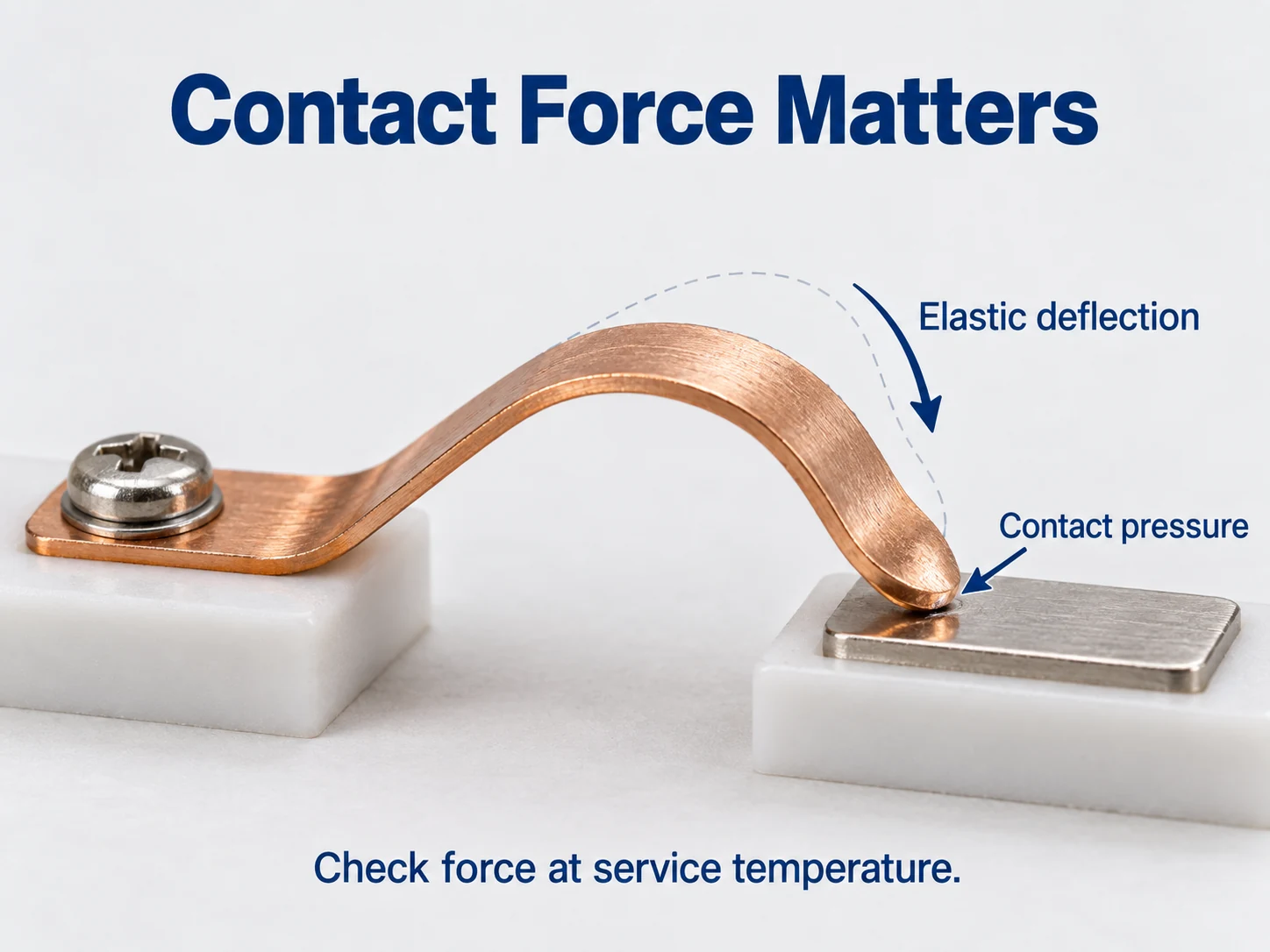
The part cycles many times. Brass contacts commonly give up usable force after a few hundred mating cycles; aged beryllium copper runs into the thousands. A latch, a probe pin, or a connector specified for repeated insertion is a fatigue decision, and brass has a low ceiling.
Service temperature climbs. Brass loses spring properties as it warms, and they do not return on cooling. C17200’s ceiling is different: approaching its aging temperature overages it permanently.
The part must be non-magnetic or non-sparking. Beryllium copper covers both; brass is non-magnetic but not specified for spark-free service.
If none of the four applies — the part locates, clamps, threads, or conducts at low stress — C36000 is already sufficient. C17200 would then cost more for margin the design never uses.
Conductivity: Where the Assumption Breaks Down
The usual assumption is that beryllium copper is the more conductive choice. It is not reliably one.
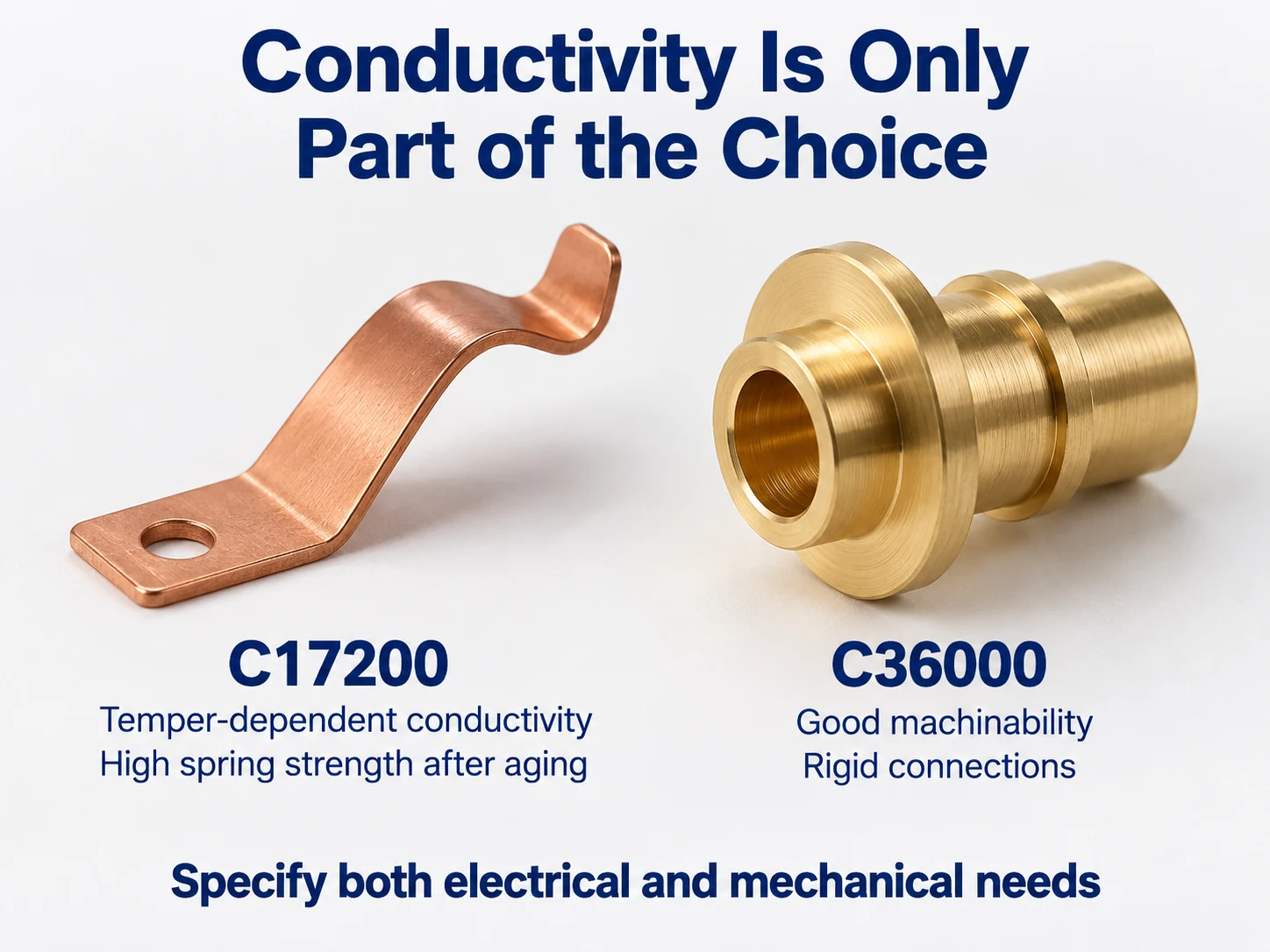
Aged C17200 runs 22–28% IACS against 26% for C36000 — the ranges overlap. In the solution-annealed TB00 state it sits lower, at 15–19%, and aging is what lifts it. Conductivity is not where beryllium copper wins.
What it wins is strength at that same conductivity: 1,000+ MPa yield at roughly a quarter of copper’s, against 125–310 MPa for brass at 26%. That combination, not the conductivity figure, is what no plain brass reaches.
The 45–60% IACS figures that circulate for copper-beryllium belong to C17500 and C17510 — different alloys, not to C17200. Treating them as one grade quotes a high-conductivity requirement on the wrong material; the C17200 vs C17300 vs C17510 comparison covers that line.
Neither is a conductor-first material. When current carrying is the primary job and spring force secondary, the answer is a high-conductivity copper such as C11000.
Machining and the Heat-Treat Route
CDA rates C36000 at 100 on the machinability index and C17200 at 20, though that figure hides a state difference. Soft TB00 and TD tempers cut gummy; aged TF00 and TH04 bar machines cleanly with carbide at moderate speed, much like a pre-hardened alloy steel. Either way the cut is slower than brass, and the tooling and cycle cost is higher.
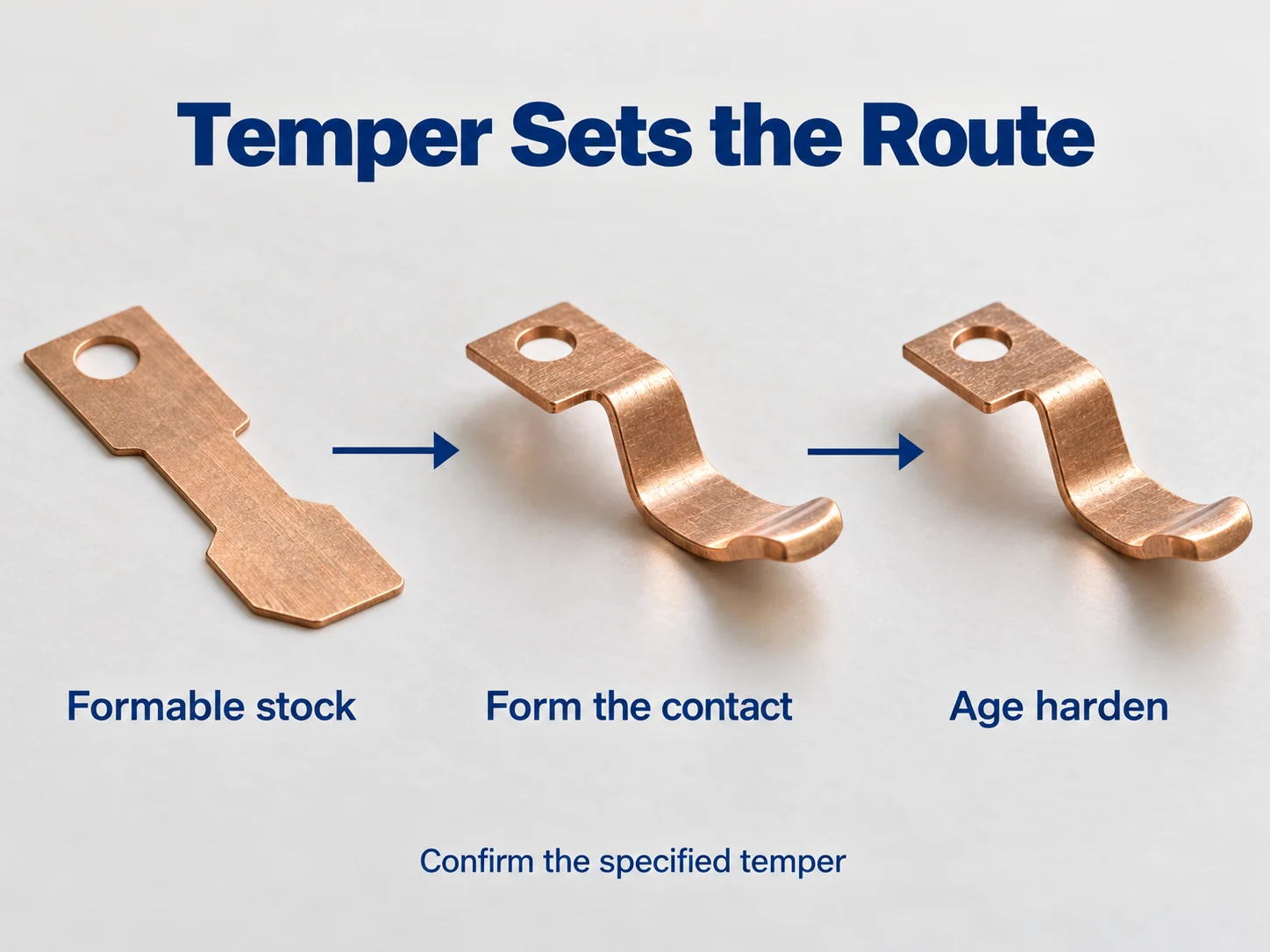
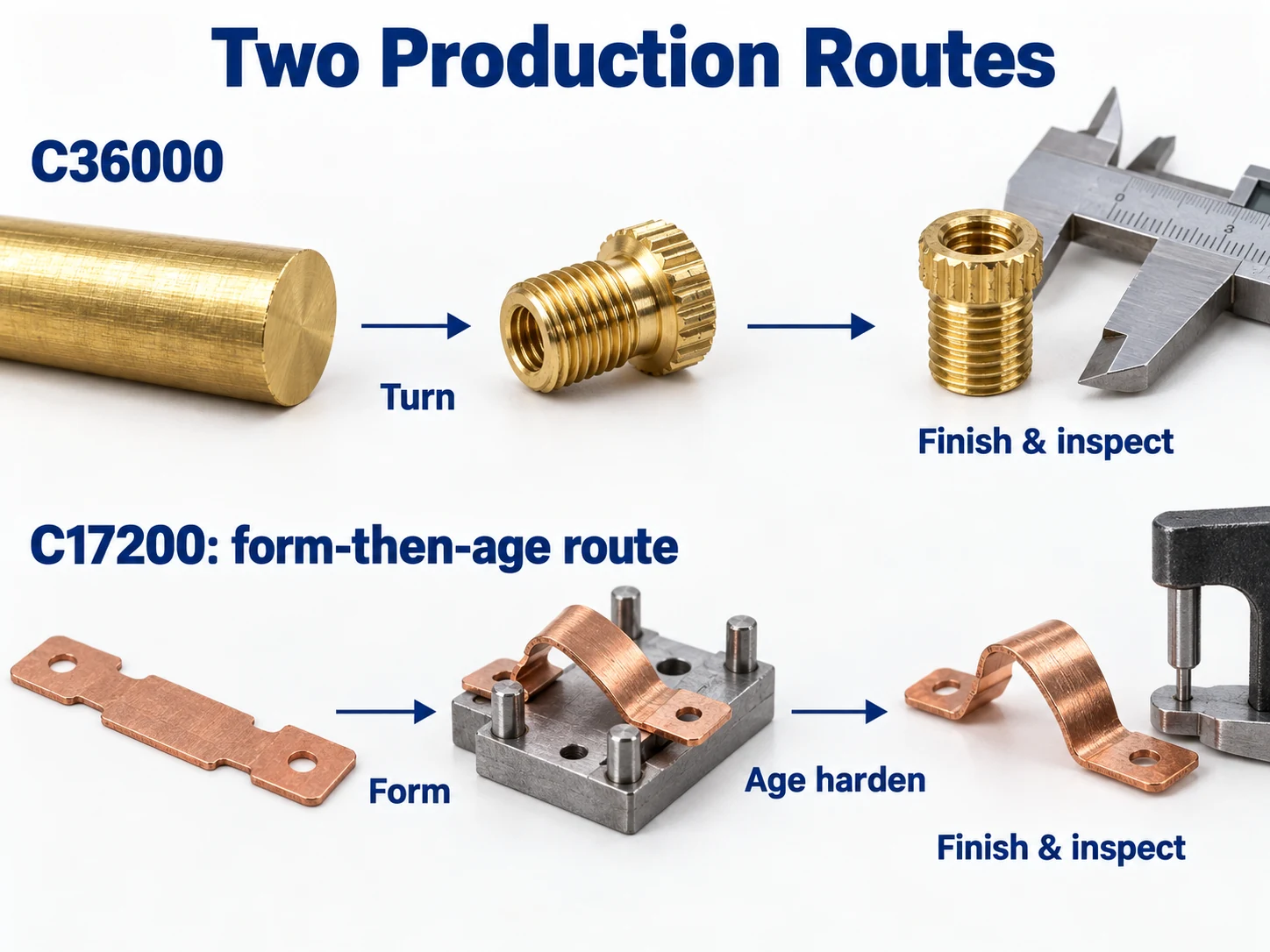
The production route differs too, and this is what changes a schedule. C17200 is normally cut and formed in the soft TB00 or TD state, then aged at roughly 315°C for 2–3 hours to develop its spring properties, then finished. Aging is a low-temperature precipitation step, not a quench, so parts do not scale or distort the way hardened steel does.
Two consequences follow. Aging still moves dimensions slightly, so tight tolerances are held after the furnace, not before. Aged material is also hard enough that only light finishing is practical afterward.
Mill-hardened tempers (TM04 upward) skip the furnace but machine harder and cost more than the soft state. For cutting data on the brass side, the C36000 Free-Cutting Brass Guide covers speeds and tooling.
Beryllium Safety Is a Process Requirement
Solid beryllium copper is safe to handle and install. The hazard is airborne dust from machining, grinding, or polishing, which can cause chronic beryllium disease — a lung condition with no cure.
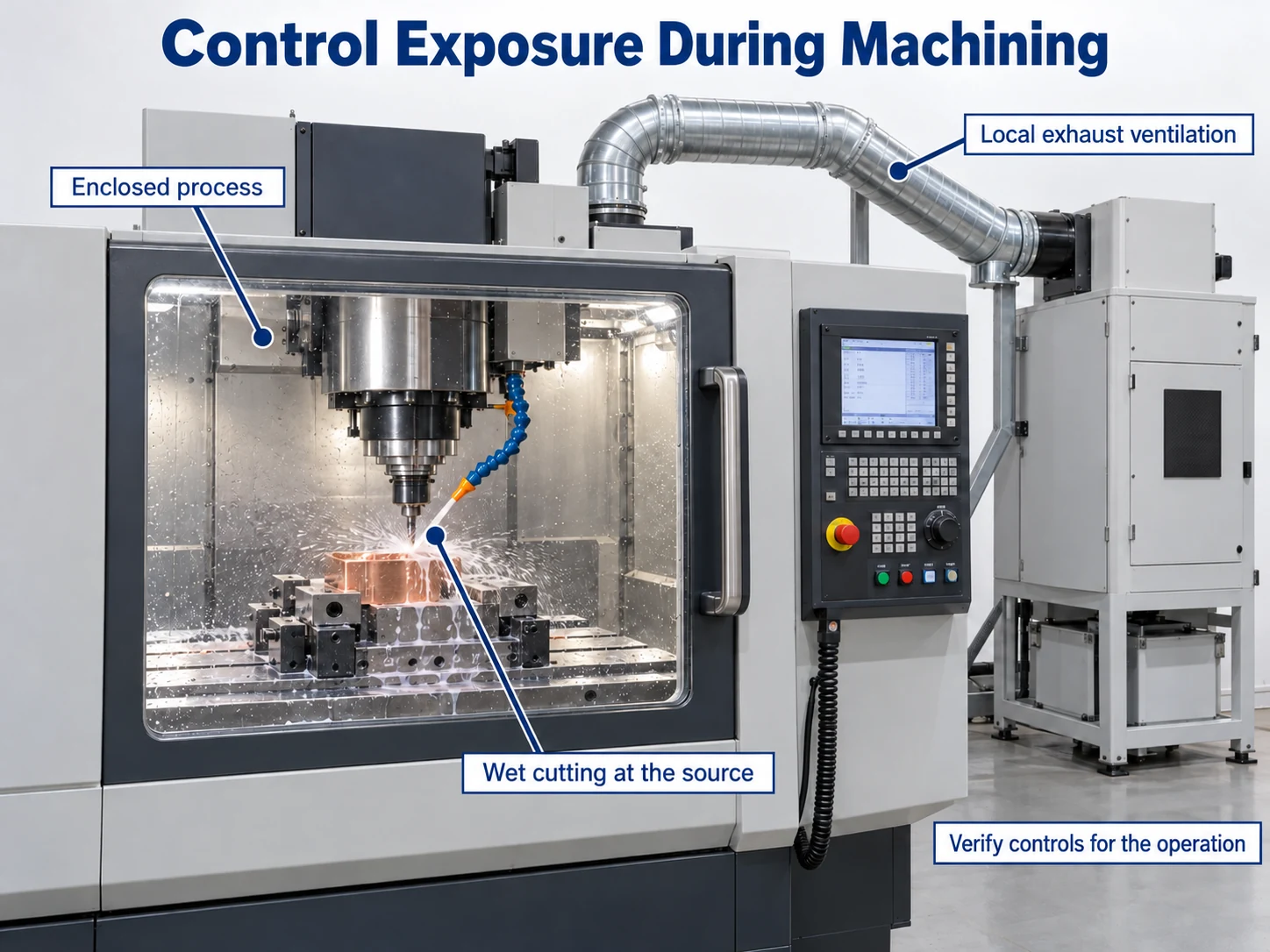
That risk is managed by process, not by material choice. OSHA sets a permissible exposure limit of 0.2 µg/m³ as an 8-hour time-weighted average, and shops running beryllium copper normally work wet, with local exhaust ventilation and respiratory protection at the operation. High-temperature arc welding is avoided because beryllium volatilizes in the arc.
None of this rules out C17200 for precision work. It does mean the shop quoting the part needs those controls in place, and a supplier who has never cut beryllium copper may price it as if it were brass. A secondary operation in your own plant — drilling a mounting hole, grinding a surface — falls under the same controls, not just the supplier’s cutting.
Total Cost Beyond the Material Price
The material price difference is not the largest line. Four costs move together.
- Material. Beryllium copper stock costs several times what brass strip costs. The multiple varies with form, temper, and quantity, so a fixed ratio is not reliable.
- Machining. At an index of 20 versus 100, the same part takes longer to cut. On a high-volume turned part this line can exceed the material difference.
- Heat treatment. Aging is a separate operation with its own handling, fixturing, and queue time, plus a dimensional step to plan for.
- Inspection. Aged beryllium copper is usually released on hardness and conductivity as well as dimensions, which is what confirms the aging cycle ran correctly.
What the premium buys is service life. A brass contact that loses force after a few hundred cycles is a replacement schedule; one that holds into the thousands is a one-time cost. For a part replaced in the field, that arithmetic usually favors C17200; for a part that never moves, it rarely does.
One risk sits on the substitution side. C36000 carries 2.5–3.7% lead, which brings lead-restriction exposure in potable water and regulated markets — a compliance problem that can arrive after the cost saving. The leaded brass application guide covers where leaded grades still fit, and a downgrade from C17200 is not automatically the lower-risk option.
Replacing C17200 With C36000: What the Drawing Must Clear
A substitution is a change to a controlled design, so it clears on requirements rather than on material cost.
| Drawing requirement | Why it decides the swap | A usable answer looks like |
|---|---|---|
| Yield strength at the specified temper | 1,000 versus 125–310 MPa is not a small margin | The value the drawing needs, not the alloy’s maximum |
| Spring or contact force over life | Brass fails by force decay, not fracture | Retention at service temperature, for a stated duration |
| Service temperature | Separates them well below either melting point | The real maximum at the contact, including enclosure rise |
| Cycle count | Brass gives out an order of magnitude earlier | Expected insertions or deflections over part life |
| Conductivity requirement | C36000 edges it; neither is conductor-first | The % IACS the circuit needs, not a material assumption |
| Temper callout | Without it, “C17200” does not define strength | A temper designation, not just the UNS number |
| Finish and plating | Aged beryllium copper finishes differently from brass | The finish, and whether it precedes or follows aging |
| Lead and compliance scope | C36000 may create a new restriction | The governing rule for the destination market |
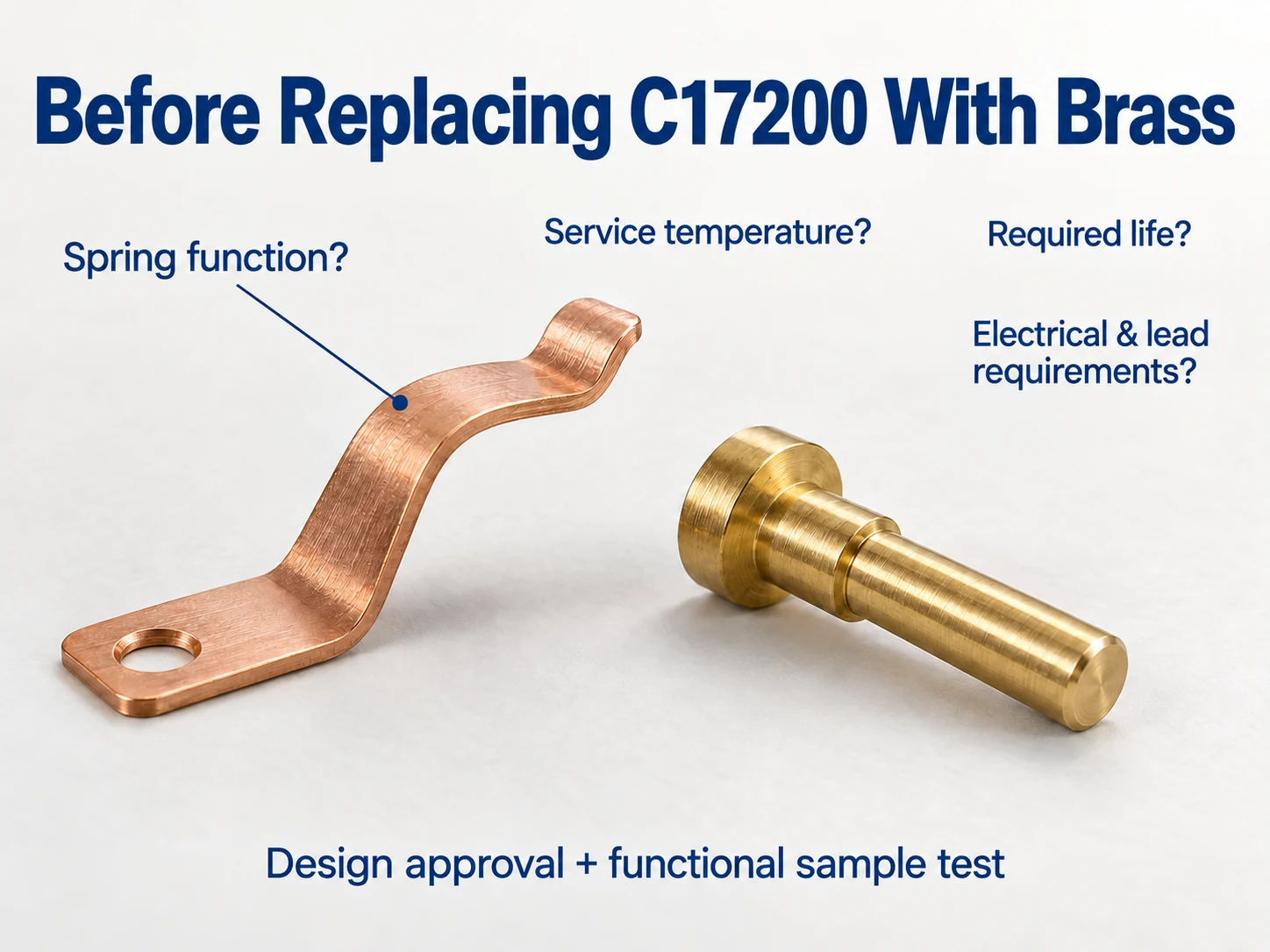
Any change from C17200 to C36000 touches strength, elasticity, and possibly compliance, which makes it a design change rather than a purchasing decision. It needs the drawing owner’s sign-off and a functional sample test — contact force, deflection, and temperature exposure — not just a dimensional check. A sample that measures correctly and loses force after a week in service has not been validated.
Sourcing C17200 and C36000
Both grades sit in Linsy Copper’s range in the forms their routes need: C17200 in strip, sheet, bar, wire, and tube for formed precision parts, C36000 in rod and bar for screw-machine work. Both are supplied to the temper the drawing names, with the MTR/MTC recording grade, chemistry, temper, and mechanical data.
SGS hardness and conductivity testing is available on request at extra cost, which matters most for aged beryllium copper, where those numbers confirm the heat-treat cycle. Non-stock sizes and tempers run low-MOQ custom production.
Conclusion
C17200 and C36000 are not a premium and a budget version of one material. One is a spring that carries current, the other a conductor that machines beautifully, and the gap between them shows up as force decay, not as a small cost difference.
We resolve that against the drawing — the temper, the force requirement, the service temperature, the compliance scope — so the material, the condition, and the documents match the part before a sample is cut. Send the drawing with the load and cycle requirements and we will return a material-and-temper assessment against both grades.
FAQ
The drawing says C17200 but we want C36000 — who has to approve that, and what has to be verified?
The drawing owner approves it, because the change alters strength, elasticity, and possibly compliance — a design change, not a purchasing one. Verify contact force and deflection at service temperature on a functional sample, not just dimensions.
Does the age-hardening step happen at your plant or ours, and how does it affect lead time?
It depends on the temper ordered: aged material arrives ready to finish, while soft TB00 or TD stock is aged after forming. State which route you want in the RFQ, since the aged route adds a process step and its queue time.
Can both materials be quoted as side-by-side samples for the same part?
Yes — quoting both grades for one drawing is routine, and it is the cheapest way to settle an open substitution question. Cut both in the tempers the drawing would use and test contact force rather than only dimensions.
Do the beryllium handling requirements change the price or the lead time?
They can, because machining beryllium copper requires wet cutting, local exhaust, and respiratory protection, and not every shop is set up for it. Ask whether the quote assumes those controls. Plated finished parts carry no inhalation risk, so the requirement sits in the shop, not your incoming inspection.

David Huang is a copper materials specialist and Sales Manager at Linsy Copper, with years of hands-on experience supporting global customers in copper and copper alloy sourcing.
He specializes in industrial copper products such as C11000 copper, C10200 oxygen-free copper, brass, bronze, copper sheets, plates, tubes, bars, and custom-processed copper components.
With a practical understanding of copper manufacturing, quality inspection, surface treatment, and export supply chains, David helps customers choose the right materials for electrical, mechanical, marine, construction, and industrial applications.