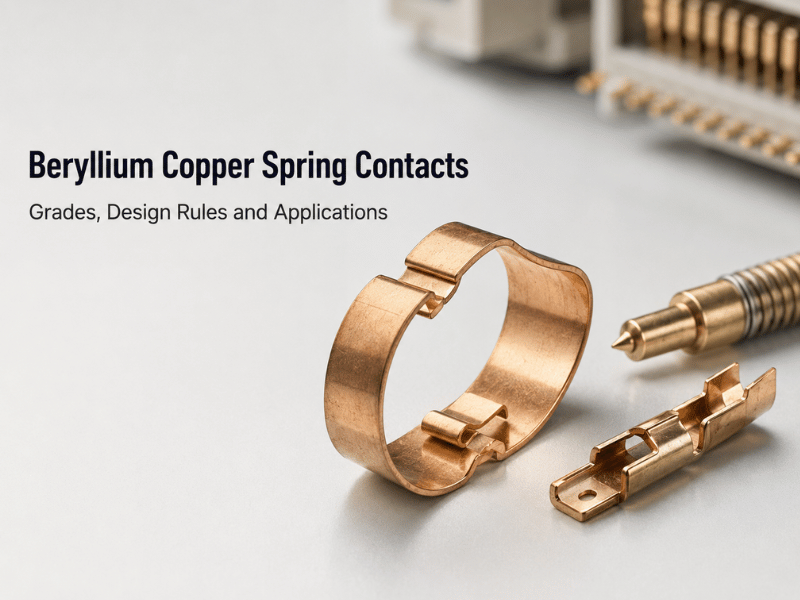
A beryllium copper spring contact is a single stamped or turned part that does two jobs at once: it supplies the spring force that keeps a connector mated, and it carries the current across the interface. That dual role — spring plus conductor in one piece — is why the base metal has to be both elastic and conductive, and why most high-reliability contacts land on beryllium copper (BeCu) rather than pure copper or phosphor bronze.
Beryllium Copper vs. Alternative Copper Alloys for Spring Contacts
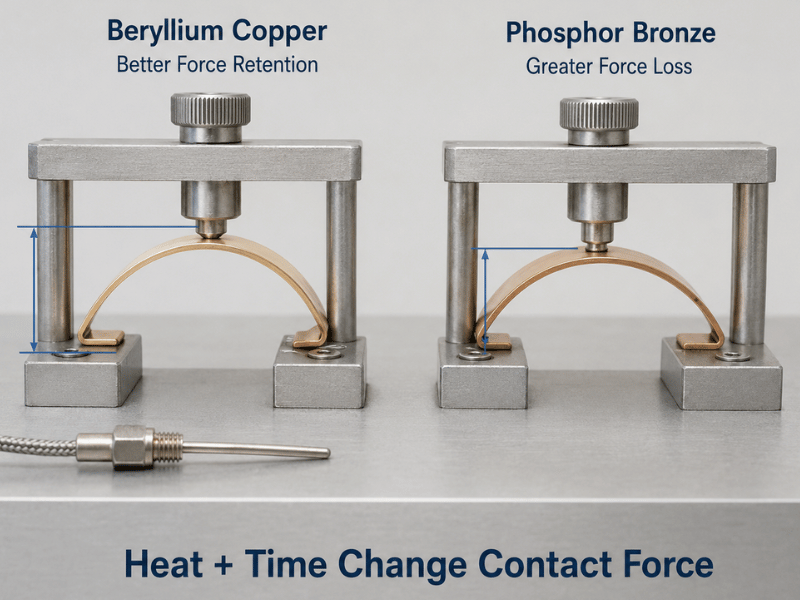
Pure copper conducts better than any copper alloy but has almost no spring memory — bend it and it stays bent, so it cannot hold normal force. Phosphor bronze holds force and conducts adequately, but it loses spring force past roughly 125°C and its fatigue ceiling caps out far below beryllium copper.
Beryllium copper resolves both limitations through age hardening (precipitation strengthening). After solution anneal and aging, the alloy reaches yield strengths of 1000–1200 MPa while keeping 17–30% IACS conductivity. Two properties make it the default for demanding contacts:
- Elastic modulus ~128 GPa — about 30% higher than phosphor bronze. A higher modulus-to-yield ratio means you can take larger deflection at the same stress, or hit the same contact force in a smaller geometry. That is what lets fine-pitch connectors shrink pitch without losing mating force.
- Stress relaxation resistance. A beryllium copper contact holds its normal force at 150°C and above; a phosphor bronze contact starts shedding force past ~125°C. For power connectors and under-hood electronics, that gap decides whether the joint stays tight over the product life.
- Fatigue life runs past 10⁷ mating cycles at room temperature in aged strip — the range that matters for connectors specified in the thousands of cycles.
Common Grades for Spring Contacts
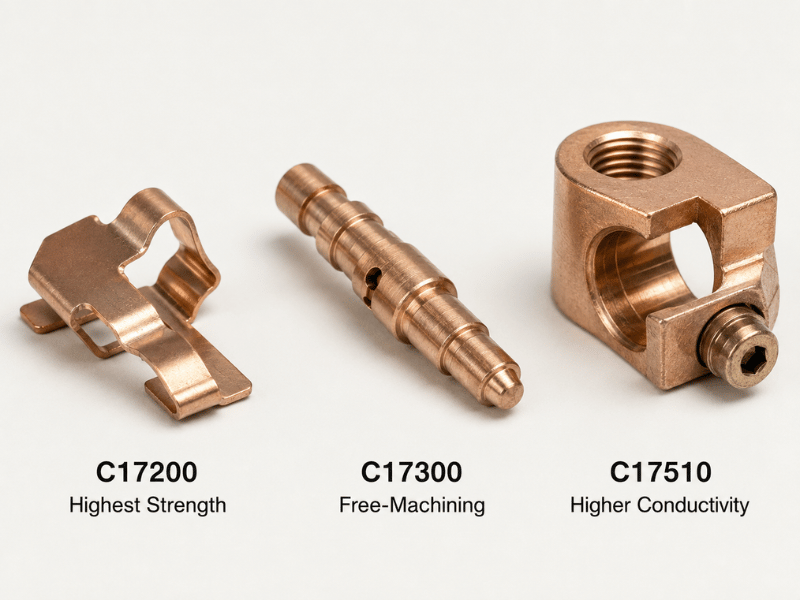
Three grades cover almost every spring-contact job. They share the copper-beryllium base but differ in the second alloying element, which changes machinability and conductivity.
| Element | C17200 | C17300 | C17510 |
| Beryllium (Be) | 1.8–2.0% | 1.8–2.0% | 0.2–0.6% |
| Lead (Pb) | — | 0.2–0.6% | — |
| Cobalt + Nickel | ≥0.2% | 0.2–0.6% | 1.4–2.2% |
| Copper | Balance | Balance | Balance |
| Property (aged) | C17200 | C17300 | C17510 |
| Tensile strength | 1100–1400 MPa | 1100–1300 MPa | 760–1100 MPa |
| Yield strength (0.2%) | 1000–1200 MPa | ≥1000 MPa | ≥700 MPa |
| Electrical conductivity | 17–30% IACS | 17–30% IACS | 48–60% IACS |
| Hardness | HRC 38–44 | HRC 36–42 | HRC 28–33 |
| Elastic modulus | ~128 GPa | ~128 GPa | ~130 GPa |
| Machinability (vs brass 100) | ~20 | ~60 | 30–40 |
| Typical form | Strip, wire, rod | Rod (screw machine) | Strip, rod |
C17200 is the reference grade for stamped contacts — the thin spring clips, blades, and probe tips where strength and fatigue dominate. C17300 is the same high-beryllium base with lead added; that lead raises machinability from ~20 to ~60, so it is the choice when the contact is a turned one-piece part with threads, bores, or multiple features. C17510 reduces beryllium to 0.2–0.6% and increases nickel content; conductivity doubles to 48–60% IACS at the cost of peak strength, which is exactly what a high-current contact needs.
Selection Criteria by Contact Requirement
Each entry below leads with the condition that decides the grade — match the part’s service conditions against these criteria.
- Operating temperature above the ~125°C phosphor bronze relaxation limit, with >1000 mating cycles and fine-pitch geometry: select C17200. Its modulus and fatigue life allow for reduced pitch while maintaining normal force; phosphor-bronze loses force with temperature.
- For high-volume automatic lathe machining with threads, bores, or multiple features, select C17300. The leaded composition cuts cleanly, and industry estimates suggest roughly 30% higher net output on Swiss-type machines versus C17200 for complex parts.
- Current loads above 50 A where conductivity and heat dissipation outweigh peak strength: specify C17510. Doubled IACS and lower resistance maintain thermal stability under sustained load.
- Low cycle count (<100), ambient temperature, cost-sensitive specification: BeCu is not the default choice. Phosphor bronze meets the mechanical requirements at significantly lower material cost.
- RoHS-restricted specification where lead content is barred: C17300 is not compliant. C17200 strip formed lead-free is the safer compliance path.
Beryllium Copper vs. Phosphor Bronze Spring Contacts
| Parameter | Beryllium Copper (C17200) | Phosphor Bronze (C52100) |
| Yield strength (aged) | 1000–1200 MPa | 550–700 MPa |
| Elastic modulus | ~128 GPa | ~100–110 GPa |
| Stress relaxation at 150°C | <5% force loss over 1000 h | >20% force loss |
| Fatigue life (strip) | >10⁷ cycles | ~10⁵–10⁶ cycles |
| Conductivity (IACS) | 17–30% | 15–20% |
| Cost per kg (approx.) | 3–5× phosphor bronze | Baseline |
| Best use window | >125°C, >1000 cycles, fine pitch | <125°C, <100 cycles, cost-driven |
The split is strength, relaxation, and life — not conductivity alone. Beryllium copper exceeds phosphor bronze on spring force retention, fatigue, and stress relaxation at temperature, and it supports smaller geometries through its higher modulus. Phosphor bronze offers a lower-cost alternative: adequate on every axis, excellent on none, and prone to force loss past ~125°C.
That gap defines the selection boundary. If the contact sees high cycle counts, elevated temperature, or tight pitch, beryllium copper pays for itself in avoided field failures. If it sits in a low-cycle, ambient, price-driven product, phosphor bronze is the rational choice.
Plating Systems for the Contact Interface
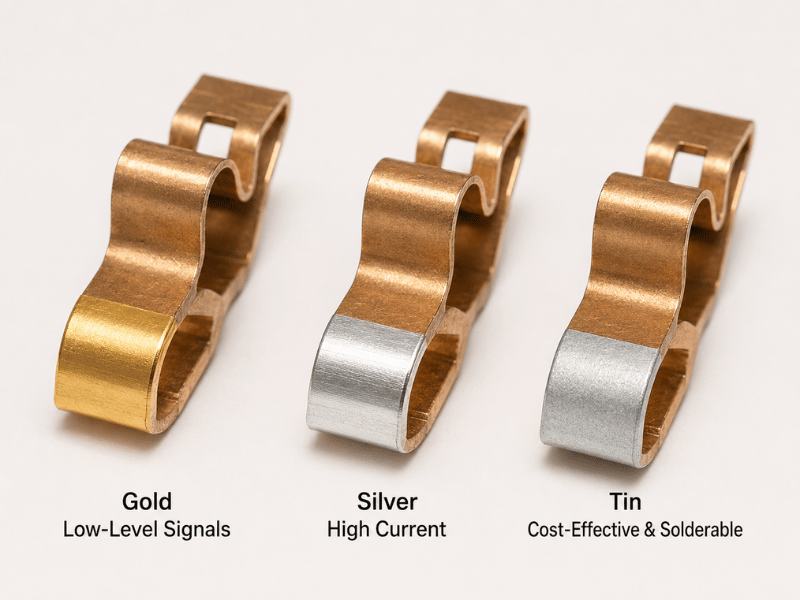
The base alloy supplies spring force and bulk conductivity; the plating decides the actual interface behavior — contact resistance, wear, and corrosion. Match the finish to the signal class.
| Plating | Typical Use | Key Advantage | Limitation |
| Gold (Ni underplate) | Low-level signal, high-reliability connectors | Stable contact resistance (<5 mΩ at 0.1–0.3 μm flash) | Highest cost; reserve for signals where micro-ohms matter |
| Silver | High-current, RF contacts | Very high conductivity | Tarnishes in sulfurous air; needs wiping action or controlled environment |
| Tin | Power, board-to-board contacts | Economical, solderable | Prone to fretting corrosion and whisker growth; moderate cycle life |
| Nickel (underplate) | Diffusion barrier under gold or tin | Hard barrier prevents intermetallic diffusion | Not a standalone signal surface |
Forming and Processing Notes
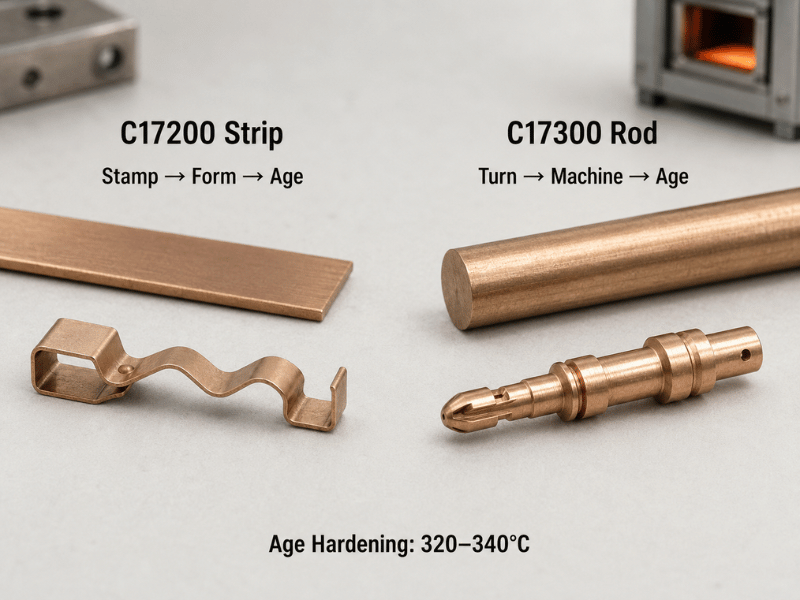
- Stamping vs turning. C17200 in thin strip (0.05–0.15 mm) is blanked and formed into clips and blades; fine blanking holds shear finish to Ra ≤0.4 μm. C17300 comes as rod and is screw-machined into one-piece turned contacts.
- Mill-hardened temper avoids post-form distortion. Age hardening after forming can warp a finished part. Specifying mill-hardened strip (pre-aged at the mill) removes the heat-treat step and its distortion risk, at a small cost to peak strength.
- Heat-treat window. Full age hardening runs ~320–340°C for 2–3 hours; dimensional change is small and predictable, so finish-machine slightly undersized and let aging bring the part to tolerance.
- Machining safety. Cutting, grinding, or polishing beryllium copper generates toxic fumes and dust. Containment, ventilation, and OSHA 29 CFR 1910.1024 controls apply to production machining — the finished, solid part presents no exposure hazard.
Where Beryllium Copper Spring Contacts Are Used
The parts below show where each grade lands physically — the selection criteria above cover the grade decision logic.
- Connector spring clips — male/female elastic contacts in board-to-board, SIM, and Type-C connectors; the highest-volume use of C17200 strip.
- Battery contacts and charging pins — spring-loaded tabs and pogo pins where repeated insertion demands fatigue life.
- Relay and microswitch blades — internal conductive springs carrying signal or modest power.
- Test and probe contacts — ICT fixture probes and semiconductor/PCB test heads, where C17200 gives the elastic tip and C17300 gives the turned base.
- High-current elastic clamps — EV connector terminals, breaker springs, and busbar clamps built from C17510 for conductivity under load.
- Non-sparking switch contacts — explosive-environment equipment where BeCu’s non-sparking property is a safety requirement.
Standards and Traceability
Beryllium copper spring materials reference ASTM B194 (strip), B197 (wire), and B196 (rod), with UNS designations C17200 / C17300 / C17510. Aerospace contacts often call out AMS 4533 / AMS 4596. Require a material test report / certificate (MTR/MTC) per lot so composition and mechanical properties trace back to the heat, and confirm the actual aged temper — peak properties only exist after the specified age-hardening cycle.
Sourcing Beryllium Copper from Linsy
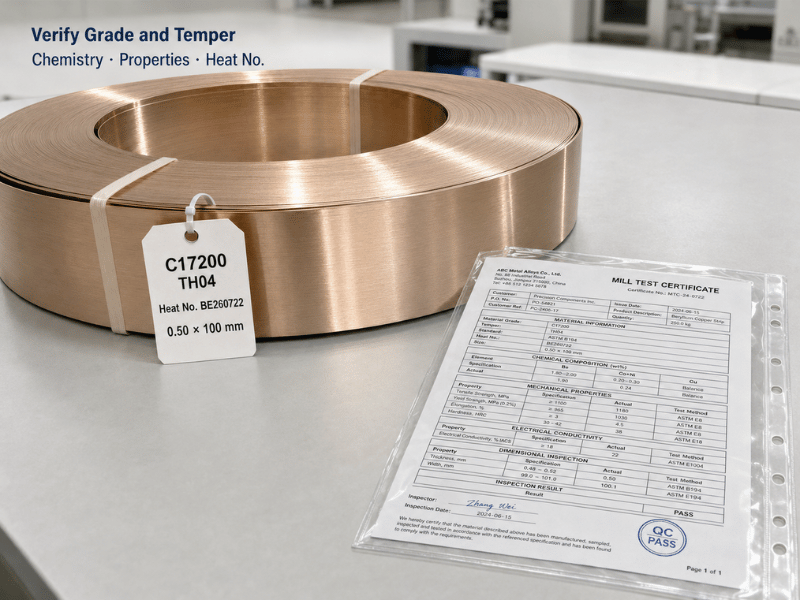
Linsy supplies C17200, C17300, and C17510 in strip, wire, and rod. Because beryllium content drives the aging response, heat-lot traceability matters — every order ships with MTR/MTC documentation including chemical composition data, so the aging window is verifiable per lot. For C17300 specifically, the 0.20–0.60% lead content raises compliance questions in some regions; SGS RoHS and REACH SVHC reports are available on request. Low-MOQ custom production runs process in 10–60 days depending on size and specification — practical for prototype contacts and pre-production validation before a volume commit.
Conclusion
Beryllium copper is the appropriate choice for spring contacts that operate beyond phosphor bronze’s limits — fine pitch, high cycle counts, and temperatures above 125°C, where its higher modulus and stress-relaxation resistance hold normal force over the product life. The grade call is mechanical, not promotional — C17200 for stamped clips, C17300 for turned parts, C17510 for high-current contacts. The trade-off is that beryllium copper, especially high-Be grades, is tighter at most mills, and leaded C17300 triggers compliance checks in some regions. Linsy supplies C17200, C17300, and C17510 in strip, wire, and rod with full MTR/MTC per lot and low-MOQ custom production (10–60 day lead time), so the grade decision does not stall on availability or traceability. Send the drawing or specification for a grade-fit review and quote, or compare C17200, C17300, and C17510 options side by side with Linsy’s technical team.
FAQ
-
Its elastic modulus is about 30% higher and it resists stress relaxation at 150°C and above, where phosphor bronze starts losing spring force past ~125°C. That holds normal force through high cycle counts and elevated temperature — the failure modes that matter in connectors.
-
C17200. It is the reference grade for thin stamped contacts — highest strength and fatigue in strip form, and it forms cleanly in the annealed and lightly cold-worked tempers.
-
When the contact is a turned one-piece part with threads, bores, or multiple features run on automatic lathes. The lead addition raises machinability from ~20 to ~60, but it also adds lead — avoid it where RoHS restricts lead content.
-
No — it is a different trade. C17510 cuts beryllium to 0.2–0.6% and raises nickel, doubling conductivity to 48–60% IACS at the cost of peak strength. Use it for high-current contacts where heat dissipation matters more than maximum spring force.
-
For signal contacts, yes — gold over nickel underplate keeps contact resistance stable and low (below ~5 mΩ with a 0.1–0.3 μm flash). High-current contacts often use silver. The base alloy conducts, but the plating defines the interface.

David Huang is a copper materials specialist and Sales Manager at Linsy Copper, with years of hands-on experience supporting global customers in copper and copper alloy sourcing.
He specializes in industrial copper products such as C11000 copper, C10200 oxygen-free copper, brass, bronze, copper sheets, plates, tubes, bars, and custom-processed copper components.
With a practical understanding of copper manufacturing, quality inspection, surface treatment, and export supply chains, David helps customers choose the right materials for electrical, mechanical, marine, construction, and industrial applications.