When setting up high-volume production for precision components, machinability directly controls unit costs and cycle times. C36000 brass, widely known as free-cutting brass, serves as the industry benchmark for machining efficiency, offering the ideal balance between rapid material removal and dimensional stability. This guide details the chemical composition, material properties, and processing characteristics required to specify C36000 correctly, helping procurement and engineering teams maintain continuous CNC production cycles and control raw material expenditures.
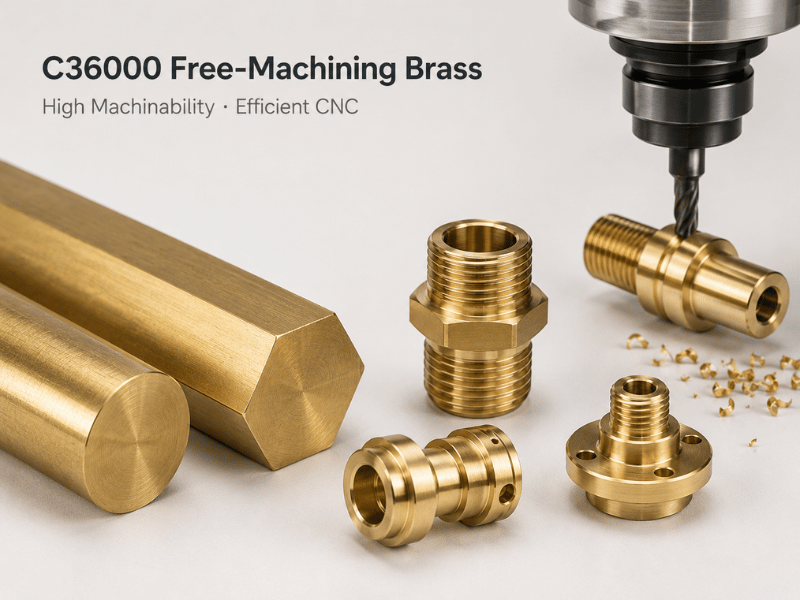
What is C36000 Free-Machining Brass?
C36000 is a leaded brass alloy engineered specifically for high-speed machining operations. The baseline machinability rating for all other copper alloys is measured against C36000, which has a standard rating of 100%. This makes it the absolute standard reference point for evaluating metal removal rates across the entire metalworking industry.
The exceptional machinability of this grade comes from its controlled lead content. During machining, the internal lead acts as an internal lubricant, causing the metal to fracture into small, brittle chips. This unique chip-breaking action prevents material from wrapping around the tooling, significantly extending tool life and allowing for maximum spindle speeds.
Due to its consistent behavior in automated equipment, C36000 remains the preferred choice for screw machine parts and complex turned components. It is the practical choice when premature tool wear or long cycle times are driving up production costs.
Brass C36000 Chemical Composition
The performance profile of C36000 brass relies on a precise ratio of copper, zinc, and lead. The standard brass C36000 chemical composition limits are defined by widely accepted ASTM standards, including ASTM B16. Maintaining iron and other impurities below maximum thresholds is critical to prevent hard spots that could damage cutting tools.
The table below details the specific elemental breakdown and the corresponding metallurgical role of each element in the alloy matrix.
| Copper (Cu) | 60.0 | 63.0 | Provides the base structure and general corrosion resistance. |
| Lead (Pb) | 2.5 | 3.0 | Ensures machinability by acting as an internal lubricant. |
| Iron (Fe) | – | 0.35 | Must be limited to prevent hard spots and tool damage. |
| Zinc (Zn) | Remainder | Remainder | Increases the overall strength and hardness of the material. |
Brass C36000 Material Properties
Engineers must review brass C36000 material properties to ensure the alloy will withstand the physical and environmental demands of the final application. The mechanical strength of C36000 depends heavily on its temper, with half-hard (H02) being the most common condition for bar stock. Proper temper selection ensures the metal meets load-bearing requirements without sacrificing its cutting behavior.
Mechanical Properties (Typical H02 Temper)
While C36000 is optimized for cutting, it provides structural integrity suitable for high-pressure fluid fittings and load-bearing fasteners. The standard mechanical values below represent typical half-hard bar stock. These values offer a reliable baseline for mechanical design and stress calculations.
| Tensile Strength | 400 – 470 MPa (58,000 – 68,000 psi) |
| Yield Strength | 310 – 380 MPa (45,000 – 55,000 psi) |
| Elongation at Break | 15% – 20% |
| Hardness (Rockwell B) | 70 – 80 HRB |
| Machinability Rating | 100% |
Physical Properties
C36000 offers reasonable electrical and thermal conductivity, making it viable for certain non-critical electrical hardware. Its specific density must be accurately calculated when estimating the weights of raw materials for large production runs. Understanding these baseline physical traits helps purchasing teams accurately forecast shipping weights and raw material costs.
| Density | 8.50 g/cm³ (0.307 lb/in³) |
| Electrical Conductivity | 26% IACS |
| Thermal Conductivity | 115 W/m·K (67 Btu/sq ft/ft hr/°F) |
| Melting Point (Liquidus) | 900°C (1650°F) |
C36000 Equivalent Grades
When managing global supply chains or interpreting international drawings, buyers must identify valid C36000 equivalent materials. While chemical compositions may vary slightly across different regional standards, the following grades function as direct equivalents for high-speed machining applications. Correctly identifying these equivalents prevents sourcing delays when domestic stock is unavailable.
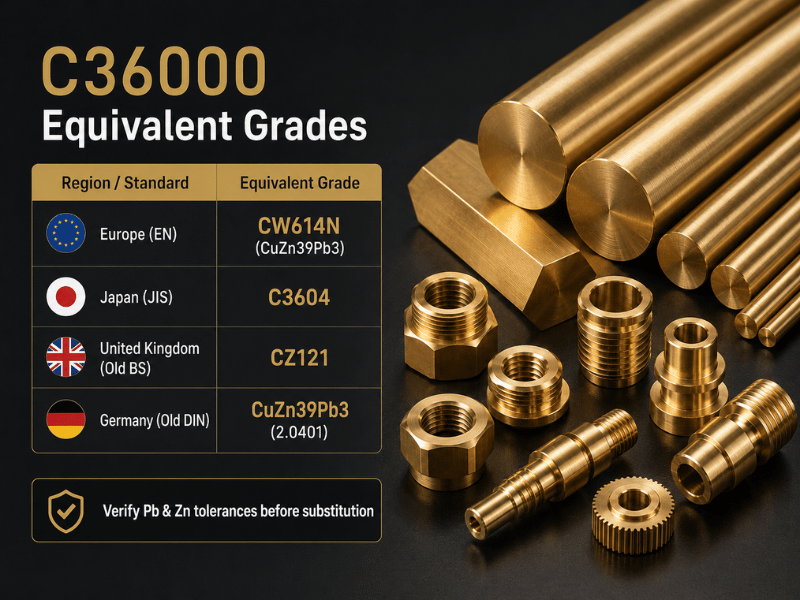
- Europe (EN): CW614N (CuZn39Pb3)
- Japan (JIS): C3604
- United Kingdom (Old BS): CZ121
- Germany (Old DIN): CuZn39Pb3 (2.0401)
Always compare the specific tolerance ranges for lead and zinc when substituting a regional equivalent for C36000. For strict aerospace or automotive requirements, confirm that the equivalent grade meets the specific testing criteria called out on the print. Failure to verify chemical tolerances can result in rejected batches during quality control inspections.
Form Selection: C36000 Free Machining Brass Flat Bar, Hex Bar, and Round Bar
Raw material form directly impacts machining time and material waste. Purchasing the correct starting profile minimizes the number of milling or turning passes required. To maximize efficiency, select C36000 in flat, hex, or round bars that most closely match your component’s final geometry.
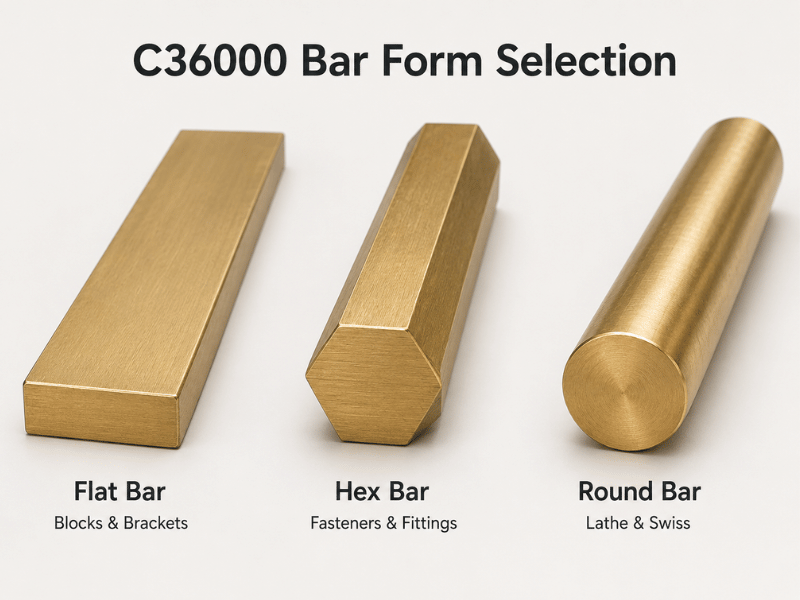
- Round Bar: The default choice for CNC lathes and Swiss-type screw machines. Round bar feeds smoothly through bar feeders and requires no initial roughing passes to achieve a cylindrical profile.
- Hex Bar: Selected for manufacturing fasteners, threaded hex standoffs, fluid fittings, and valve bodies. Using a hex bar eliminates the need to mill wrench flats on a lathe, significantly reducing cycle time.
- Flat Bar: Used for manifold blocks, base plates, and structural brackets. Flat bar stock requires less face milling to achieve rectangular dimensions compared to squaring off a round bar.
Machining and Fabrication Guidelines
The high lead content that makes C36000 easy to cut also creates strict limitations for other fabrication steps. Proper processing requires understanding its dual nature
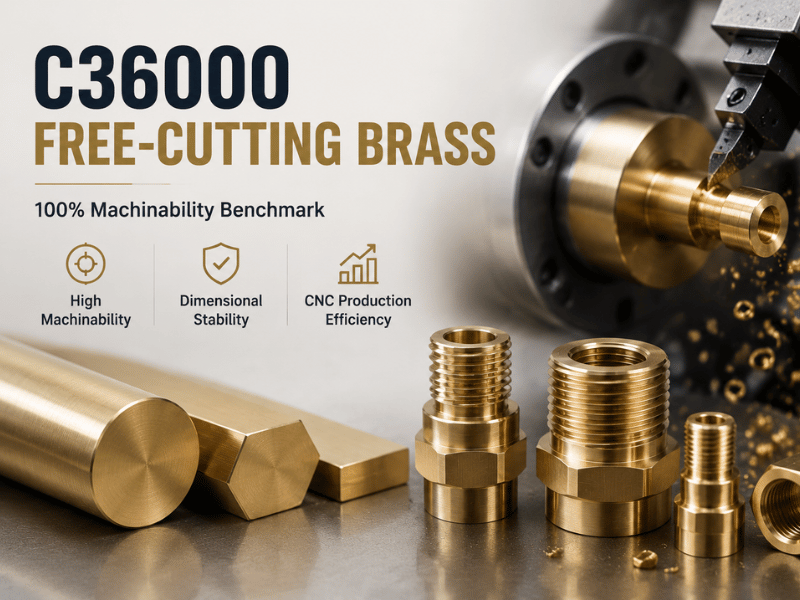
Machining & Tooling (100% Baseline Rating)
C36000 defines the 100% machinability standard. The dispersed lead particles act as an internal lubricant, forcing the brass to shear into short, brittle fragments.
- Tooling & Speeds: Machinists can run maximum spindle speeds with relatively low feed pressure. Both high-speed steel (HSS) and carbide tooling perform exceptionally well.
- Chip Control: The short chip-breaking action prevents long, stringy material from tangling around tooling, eliminating dangerous heat buildup. Standard water-soluble coolants or cutting oils are sufficient for heat dissipation.
Forming & Cold Working (Strictly Limited)
C36000 has poor cold-working properties. The same lead particles that aid machining act as crack initiation points under significant deformation.
- Avoid: Deep drawing, heavy bending, cold heading, or flaring.
- Design Rule: Parts made from C36000 must be shaped via material removal (milling/turning), not deformation.
Joining & Welding (Soldering Only)
Joining methods must account for the alloy’s low melting point additives:
- Welding: Strictly not recommended. The extreme heat of welding vaporizes the internal lead, resulting in highly porous, failed welds and the release of toxic lead fumes. Use mechanical fasteners or soft soldering instead.
- Soldering: Excellent compatibility for plumbing and electrical assemblies.
Surface Treatment and Corrosion Performance
While C36000 serves as an excellent substrate for industrial finishes, its high zinc and lead content create specific environmental and processing limits.
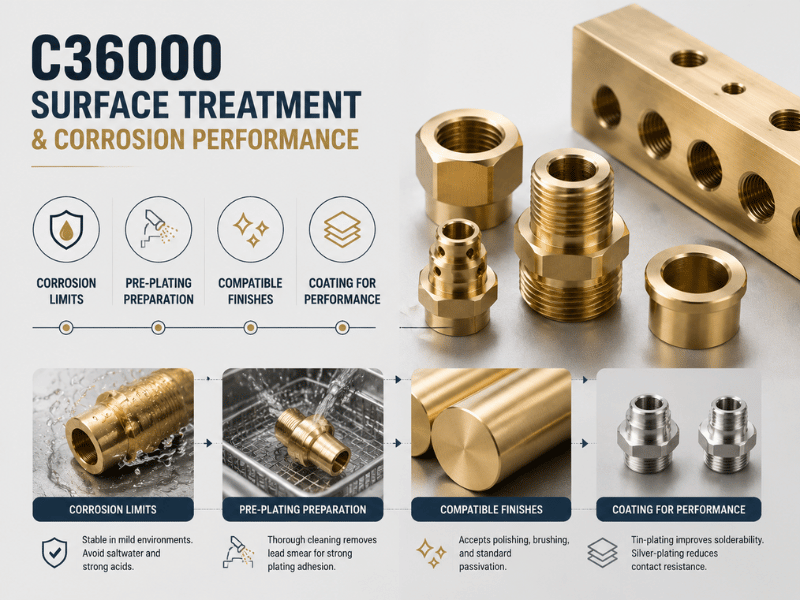
- Corrosion Limits: C36000 provides stable resistance to indoor moisture, non-potable water, and neutral fluids. Avoid saltwater or highly acidic environments, as the high zinc content makes it highly susceptible to catastrophic dezincification.
- Pre-Plating Preparation: Because high-speed machining can cause microscopic lead smearing across the part’s surface, thorough alkaline cleaning is required before any plating or coating process to ensure uniform adhesion.
- Compatible Finishes: Once properly cleaned, the brass readily accepts bright polishing, brushed finishes, and standard passivation.
- Coating for Performance: C36000 cannot be thermally hardened. To improve surface wear or electrical performance, it is frequently tin-plated (to improve solderability and prevent oxidation) or silver-plated (to reduce contact resistance in switchgear).
Typical Industrial Applications
The balance of rapid machinability, corrosion resistance, and dimensional stability places C36000 in nearly every industrial sector. It is the default material for high-volume, complex geometries where tool wear would otherwise drive up costs. Designers rely heavily on it for parts that require tight thread tolerances and intricate internal features.
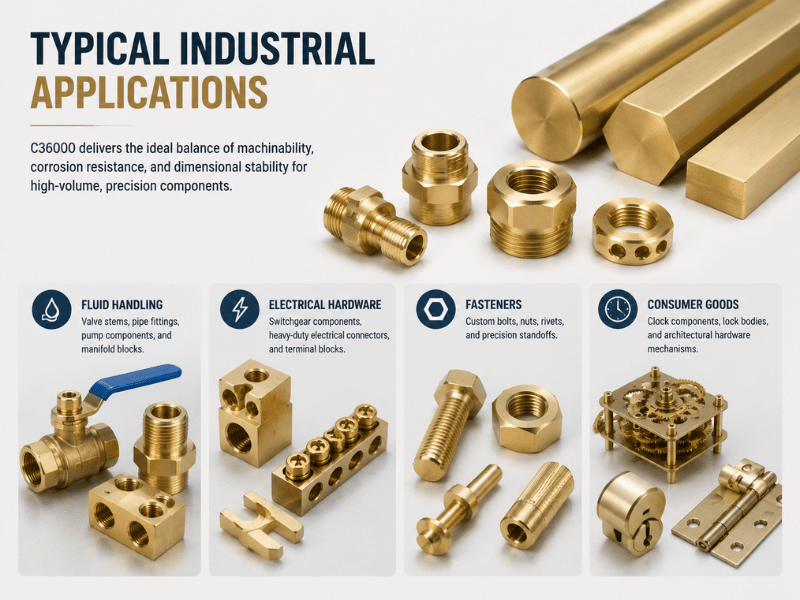
- Fluid Handling: Valve stems, pipe fittings, pump components, and manifold blocks.
- Electrical Hardware: Switchgear components, heavy-duty electrical connectors, and terminal blocks.
- Fasteners: Custom bolts, nuts, rivets, and precision standoffs.
- Consumer Goods: Clock components, lock bodies, and architectural hardware mechanisms.
Sourcing C36000 Brass with Linsy Copper
When procuring C36000 materials or managing downstream processing, sourcing from an integrated manufacturer streamlines production timelines. Linsy Copper operates as a Shenzhen-based copper factory with more than 20 years of industry experience. We combine inventory availability with flexible, custom production to meet standard and project-based requirements. Consolidating material procurement and initial processing steps reduces logistical delays.
- Material Supply: We supply pure copper, brass, bronze, cupronickel, and special conductive copper.
- Product Forms: Available forms include copper sheet, plate, bar, tube, wire, coil, profile, and block.
- Custom Production: We support low-MOQ custom production for non-stock items. Typical custom lead times range from 10 to 60 days, depending on the grade, dimensions, processing requirements, and order complexity.
- Processing Capabilities: Our facility provides CNC machining, laser cutting, stamping and bending, TIG welding, and silver brazing.
- Surface Treatment: We offer in-house surface finishing, including bright polishing, brushed finish, sandblasting, passivation, tin plating, and silver plating.
- Quality Documentation: We provide an MTR/MTC for every order, issued under Linsy Copper after production.
- Third-Party Testing: For clients requiring additional verification, SGS test reports are available upon request at an additional cost.
Frequently Asked Questions
-
It contains 2.5% to 3.0% lead, which acts as a built-in lubricant during machining. This lead content causes the brass to form small, broken chips rather than long stringers, keeping the cutting tool clear and allowing for maximum cutting speeds.
-
C36000 has very poor cold-forming capabilities. The lead content that aids in machining makes the alloy brittle under stress, meaning it will likely crack if subjected to heavy bending, flaring, or cold heading operations.
-
While C36000 has good general corrosion resistance, it is susceptible to dezincification in harsh saltwater environments. For critical marine applications, engineered bronzes or special dezincification-resistant (DZR) brass grades are typically preferred.
-
Standard C36000 contains intentional lead additions that exceed the baseline limits of the standard RoHS directives without an exemption. Buyers requiring strictly lead-free materials for environmental compliance must evaluate alternative lead-free brass alloys, such as C46400 or C69300.

David Huang is a copper materials specialist and Sales Manager at Linsy Copper, with years of hands-on experience supporting global customers in copper and copper alloy sourcing.
He specializes in industrial copper products such as C11000 copper, C10200 oxygen-free copper, brass, bronze, copper sheets, plates, tubes, bars, and custom-processed copper components.
With a practical understanding of copper manufacturing, quality inspection, surface treatment, and export supply chains, David helps customers choose the right materials for electrical, mechanical, marine, construction, and industrial applications.