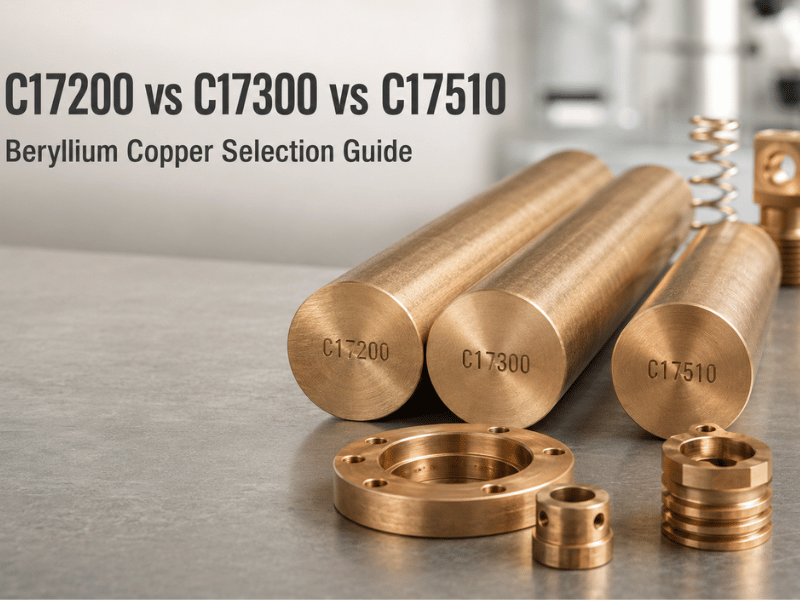
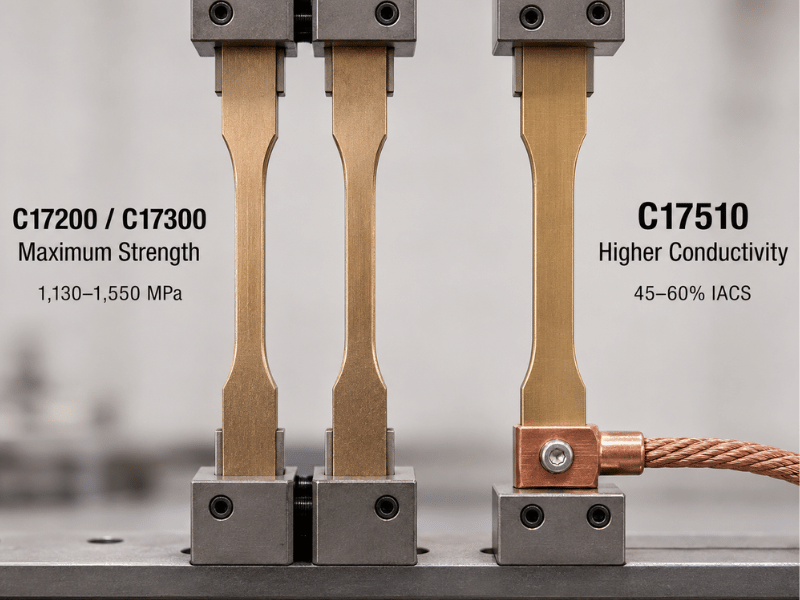
C17200, C17300, and C17510 divide into two property camps — high-beryllium (≈2% Be) for maximum strength and fatigue resistance, and low-beryllium nickel-beryllium (CuNi2Be) for conductivity and thermal performance. C17510 sits in a separate band: roughly half the strength of C17200/C17300, but double the conductivity. Selection depends on the primary constraint: load, fatigue cycles, machining volume, service temperature, or current capacity.
Composition: What Actually Separates Them
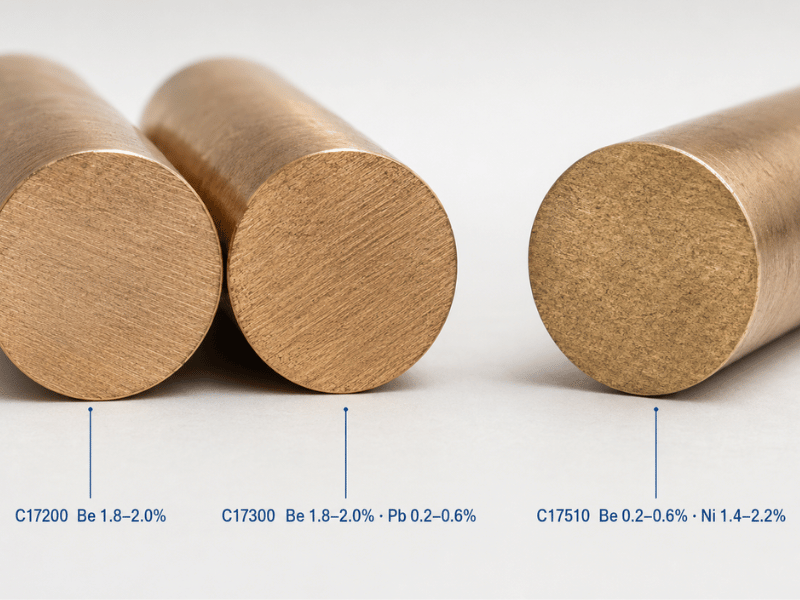
| Element | C17200 | C17300 | C17510 |
| Beryllium (Be) | 1.80–2.00% | 1.80–2.00% | 0.20–0.60% |
| Nickel (Ni) | 0.20% min (as Co+Ni) | 0.20–0.60% (Co+Ni) | 1.40–2.20% (ASTM wide band; some sources quote 1.80–2.20%) |
| Cobalt (Co) | Part of Co+Ni, ≤0.60% total | Cobalt-dominant in Co+Ni | ≤0.30% |
| Lead (Pb) | None | 0.20–0.60% | None |
| Copper | Balance | Balance | Balance |
Two camps, one dividing line. C17200 and C17300 are both CuBe2-class alloys — same 1.8–2.0% beryllium, same precipitation-hardening mechanism, same strength ceiling. C17300 only differs by adding 0.20–0.60% lead as an internal lubricant, which is what makes it the free-machining member of the family. C17510 (CuNi2Be) drops beryllium to 0.20–0.60% and pushes nickel to 1.40–2.20%. Nickel, not beryllium, does the strengthening — so it lands in a completely different property band.
Property Comparison (Age-Hardened Typical)
| Property | C17200 | C17300 | C17510 |
| Tensile strength | 1,130–1,550 MPa | 1,130–1,400 MPa | 750–970 MPa |
| Yield strength (0.2%) | 890–1,240 MPa | ~1,030–1,240 MPa | 650–870 MPa |
| Hardness | 36–45 HRC | 36–43 HRC | 28–33 HRC (≈ HRB 92–100) |
| Electrical conductivity | 18–28% IACS | 17–28% IACS | 45–60% IACS |
| Thermal conductivity | ~105–135 W/m·K | ~105 W/m·K | ~167–260 W/m·K |
| Density | 8.25–8.36 g/cm³ | 8.25–8.40 g/cm³ | 8.75–8.83 g/cm³ |
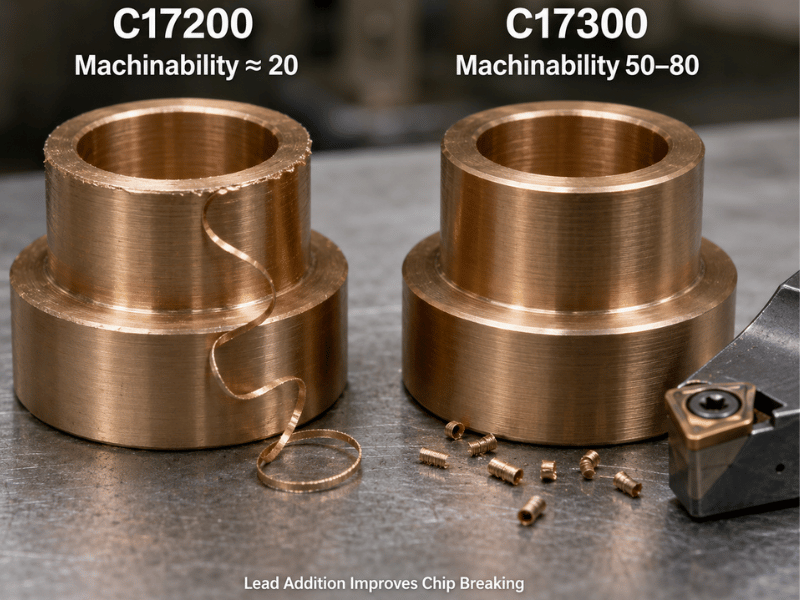
| Machinability (vs brass 100) | ~20 | 50–80 | 30–40 |
| High-temp / stress relaxation | Good | Better (Co-rich) | Fair (softens above ~250–300°C) |
| Elasticity / fatigue | Top-tier | Near C17200, better hot fatigue | Moderate |
C17200 and C17300 share the same tensile and hardness ceiling; the real difference is machinability — C17300 jumps from rating ~20 to 50–80. C17510 is the outlier: about half the tensile and yield of C17200, but its conductivity (45–60% IACS) and thermal path (up to ~260 W/m·K) roughly double the high-Be grades. That is the entire reason it exists — carry current and heat while still holding a load.
Go/No-Go: Which Grade for Your Job
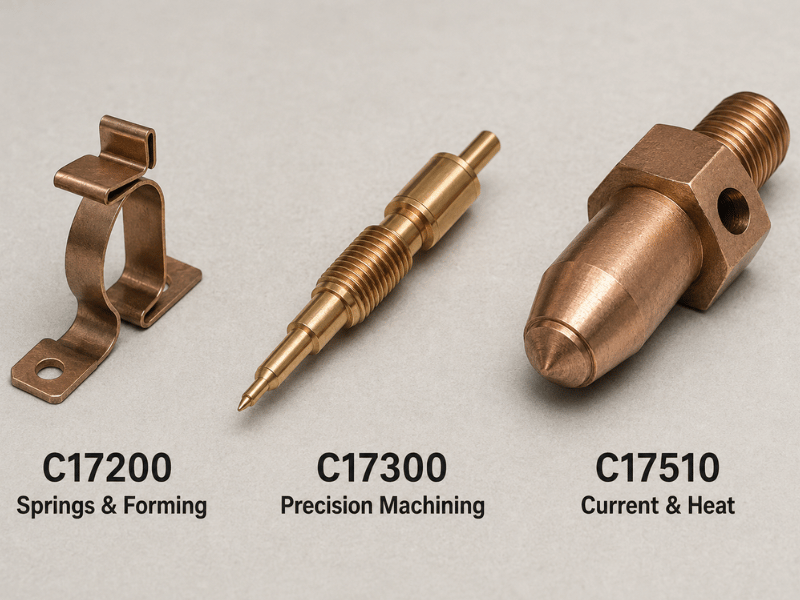
Each entry gives the trigger condition. Check whether your part hits it.
- Stamping, bending, or forming with minimal machining, and the highest strength/elasticity is required → select C17200. Forming does the work; machining stays light. This is the highest elastic performance in the comparison.
- C17200-level strength needed, but the part will be turned, milled, drilled, or threaded in volume on automatic lathes → select C17300. The 0.20–0.60% lead addition breaks chips and cuts tool wear. Automatic-lathe efficiency jumps versus fighting C17200’s gumming and burr formation.
- Elevated-temperature spring duty where preload must hold over time → select C17300. Its cobalt-rich chemistry relaxes slower at temperature than C17200, so it keeps preload where the base grade would creep.
- Significant current or heat dissipation required alongside a structural load → specify C17510. This is the only one of the three that pairs moderate strength (750–970 MPa) with 45–60% IACS and a strong thermal path. If the part must carry current or shed heat while holding shape, nothing else in this lineup works.
- High-cycle precision spring where conductivity is irrelevant → select C17200 (or C17300 only if heavy machining is also involved). C17510 is the wrong call — its fatigue ceiling and elasticity sit a tier below.
Machining and Heat Treatment
All three grades follow solution-anneal → quench → age-hardening, but the temperature windows and shop-floor behavior diverge enough to change the manufacturing plan.
| Parameter | C17200 | C17300 | C17510 |
| Solution anneal | ~790°C | ~790°C | ~790°C |
| Age-hardening | ~315°C, 2–3 h | ~315°C, 2–3 h (cited as wider window) | ~340–360°C |
| Machinability (vs brass = 100) | ~20 — gums tools, large burrs | 50–80 — lead breaks chips cleanly | 30–40 — no lead, no gumming |
| Formability (annealed state) | Stamps and bends well | Stamps and bends well | Good — low Be keeps it ductile |
| Solder / braze compatibility | Fair | Fair | Better (higher Ni content) |
| Manufacturing fit | Poor fit for automatic turning; avoid if design needs many drilled/tapped features | ~30% higher throughput on Swiss-type parts (industry estimate); best for multi-feature precision parts | Moderate — below C17300 but above C17200 |
Where They Land in Production
The Go/No-Go above answers “should I use it?” This section maps each grade to its typical deployment areas once the part function is known.
C17200 (highest-volume high-strength BeCu): phone and connector springs, switch contacts, plastic-injection mold inserts, non-sparking tools, bellows, aerospace flexures, general-purpose probes.
C17300 (precision-machined high-strength BeCu): micro probes, medical micro-parts, downhole oil-and-gas tools, automatic-lathe terminals, multi-cavity mold details, parts requiring frequent drilling and tapping.
C17510 (high-conductivity nickel-beryllium): high-power connectors, EV current-carrying terminals, die-casting plunger tips, resistance-weld electrodes, heat-sink bases, semiconductor fixtures, high-current switch contacts.
Standards and Traceability
| Grade | ASTM Designations | European Equivalent | Temper Codes |
| C17200 | B196 (rod/bar), B441 (bus bar/shapes) | CW101C | TB00 (solution-annealed), TF00 / TH04 (age-hardened) |
| C17300 | B196 (rod/bar), B441 (bus bar/shapes) | CW101C † | TB00, TF00, TH04 |
| C17510 | B937 / B944 (tube), B870 | CW110C (CuNi2Be) | TB00, TF00, TH04 |
C17300 shares CW101C with C17200; lead addition does not change the EN designation.
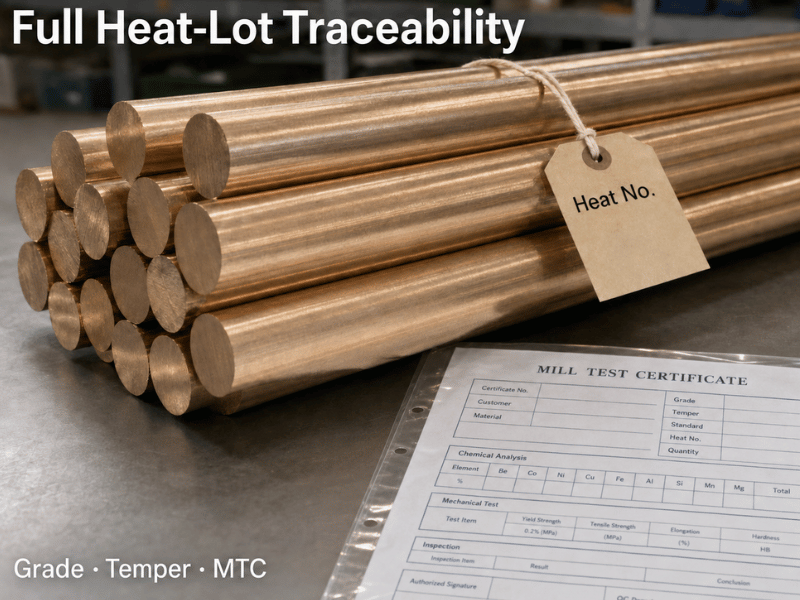
Always specify: grade, temper, and MTR/MTC per lot — beryllium content drives the aging response, so heat-lot traceability matters for reproducible strength.
Sourcing Beryllium Copper from Linsy
Linsy Copper is ISO 9001/14001/45001 certified and supplies beryllium copper across C17200, C17300, and C17510 in sheet, plate, bar, and tube forms. Because beryllium content drives the aging response, heat-lot traceability matters: every order ships with full MTR/MTC documentation including chemical composition data, so the aging window is verifiable per lot. For C17300 specifically, the 0.20–0.60% lead content raises compliance questions in some regions — SGS RoHS and REACH SVHC reports are available on request to confirm regulatory status. Low-MOQ custom production runs process in 10–60 days depending on grade, size, and specification, which fits trial batches of spring strip, machined probes, or weld electrodes before volume commitment.
Conclusion
C17200, C17300, and C17510 are not three flavors of the same alloy — they split into a high-strength camp and a high-conductivity camp, and the cost order runs C17300 > C17200 > C17510 (more beryllium costs more). C17200 is the default for maximum strength with light machining; C17300 is that same strength with automatic-lathe machinability; C17510 is the half-strength, double-conductivity grade for parts that must also carry current or heat.
The trade-off is that beryllium copper stock is tight at most mills — high-beryllium grades face supply constraints, leaded C17300 triggers compliance checks in some regions, and trial quantities are hard to source without a mill relationship. Linsy stocks C17200, C17300, and C17510 in sheet, plate, bar, and tube, with low-MOQ custom production (10–60 day lead time) and full MTR/MTC documentation per lot — so the grade decision doesn’t stall on availability or traceability. Send the drawing or specification for a grade-fit review and quote, or compare C17200, C17300, and C17510 options side by side with Linsy’s technical team.
FAQ
-
Beryllium content is identical (1.8–2.0%). C17300 adds 0.20–0.60% lead, which is an internal lubricant that breaks chips and cuts tool wear. Same strength ceiling, far better automatic-lathe machinability. C17300 is the free-machining version of C17200.
-
Only if conductivity or heat dissipation matters more than load. C17510 runs roughly half to two-thirds the tensile and yield of C17200, so it will not survive the same spring, fatigue, or wear duty. Use it where current path or thermal management is the primary job, not where strength is.
-
Finished solid C17300 parts pose no known health risk in normal handling. The hazard is airborne dust from machining, grinding, or welding — and C17300 adds lead dust on top of beryllium particulate. Use ventilation and follow OSHA 29 CFR 1910.1024 during fabrication.
-
C17300. Its cobalt-rich chemistry resists stress relaxation better than C17200, so it holds preload at elevated temperature — downhole tools and engine-bay springs are its primary application range. C17510 softens the soonest above ~250–300°C.
-
No. C17500 is a high-conductivity, high-beryllium grade (low nickel); C17510 is CuNi2Be — low beryllium, high nickel. Different UNS numbers, different chemistry, different tempers. They are not drop-in substitutes, and C17510 is the one covered in this guide.
-
Yes — Linsy supplies C17200, C17300, and C17510 in sheet, plate, bar, and tube forms with full MTR/MTC documentation per lot. Reach out with your grade, form, and temper requirements for lead time and documentation options.

David Huang is a copper materials specialist and Sales Manager at Linsy Copper, with years of hands-on experience supporting global customers in copper and copper alloy sourcing.
He specializes in industrial copper products such as C11000 copper, C10200 oxygen-free copper, brass, bronze, copper sheets, plates, tubes, bars, and custom-processed copper components.
With a practical understanding of copper manufacturing, quality inspection, surface treatment, and export supply chains, David helps customers choose the right materials for electrical, mechanical, marine, construction, and industrial applications.