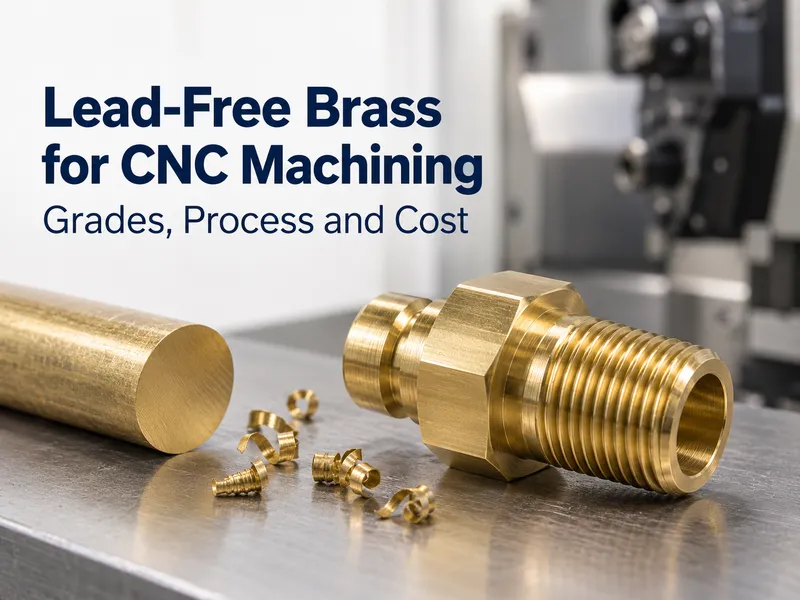
The drawing says lead-free and the process sheet still says C36000. What changes at the spindle is smaller than the index number suggests, but it does not change the same way in every lead-free grade. Four things move: cutting speed, chip form, edge wear, and the secondary operations that follow the lathe. Reading those four correctly is what separates a trial that converts cleanly from one that scraps a week of parts.
The Machinability Index, Read Correctly
A machinability index is a comparison, not a material property. C36000 Free-Cutting Brass is the reference at 100, and every other copper alloy is scored as a share of it.
Four things the number does not carry:
- Which scale it sits on. US datasheets rate against C36000. European datasheets rate against CuZn39Pb3 (CW614N), a different free-cutting brass. A 70 from one source and a 70 from the other are not the same 70.
- Which form it was measured in. The figure is normally quoted for drawn rod. A casting or an extrusion runs differently, and the number does not travel with the form.
- Which temper it was measured in. Lead-free grades are more sensitive to condition than C36000, so a soft and a hard temper of the same grade do not machine alike.
- Whose datasheet it is. Published figures for one grade spread by 5–15 points, which is a whole cutting condition rather than a rounding difference.
| Grade | Route | Index, C36000 = 100 | Typical form |
| C36000 | Leaded reference | 100 | Rod, bar |
| C69300 | Silicon, wrought | ~80–85 | Rod, bar, forging |
| C87850 | Silicon, cast | ~70–85 | Casting |
| C87860 | Silicon plus zirconium, cast | ~70 | Casting, forging |
| C27450 | No additive | ~70 | Rod, bar, forging |
Use the index for direction and a rough ratio, then take the starting speed from the datasheet of the actual grade and temper. It is an input to a trial cut, not a line on a specification.
What the Index Drop Does to a Real Cycle
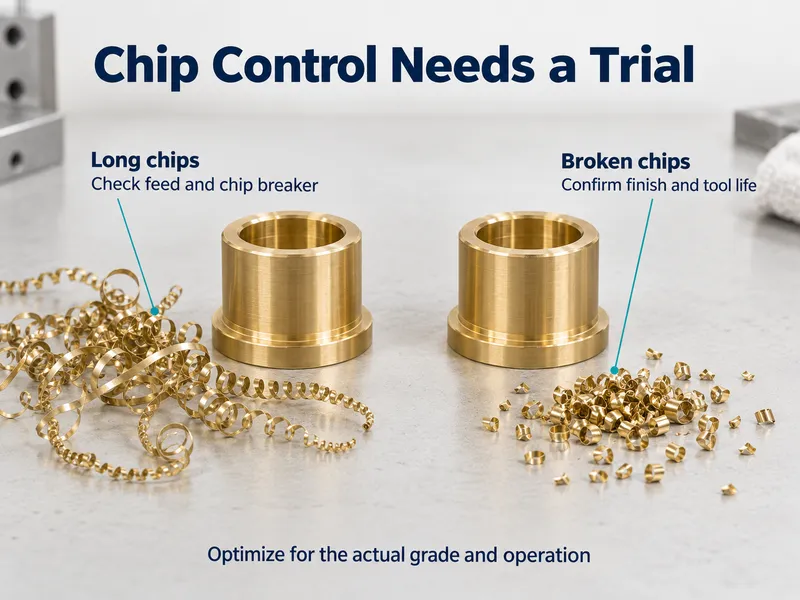
Lead does its work mechanically. It stays largely undissolved in the copper-zinc matrix as fine dispersed particles that break the chip as it forms and lubricate the cutting edge, so removing it changes the friction and the chip at the same time. The first move is surface speed down, because heat is what shortens edge life on these grades. Feed per tooth is the separate lever that decides whether the chip breaks, and it usually goes up, not down.
That second point is the counterintuitive one. Backing off the feed to go gently thins the chip and makes it stringier, and a trial that fails on chip control is often one that ran too light rather than too hard.
| First-run symptom | What it usually means | First correction |
| Long chips wrapping the tool and the work | Chip too thin to fracture | Raise feed per tooth; open the chip breaker |
| Torn finish that looks like a feed fault | Built-up edge welding and releasing | Adjust edge geometry or surface speed; check where coolant lands |
| Threads tearing on the flank | Material smearing instead of shearing | Sharper edge, more positive rake, cutting oil instead of emulsion where the process allows |
| Edge failure on small-diameter work | Heat with little material behind the edge to carry it away | Lower surface speed, shorten overhang, raise coolant pressure |
Three levers recover chip control and they are not substitutes for one another: silicon grades fracture chips harder than the no-additive route, a sharper edge with an open breaker does most of the tooling work, and coolant delivered at pressure and aimed at the chip clears what the geometry breaks. Edge geometry is where the compensation actually gets made, because a sharp edge with a controlled nose radius cuts cooler than a heavier edge at the same surface speed.
A missed Ra target usually signals material that welded to the edge rather than a feed error. Overhang is the cheapest correction on the list — a long tool on small-diameter work loses rigidity twice, to the diameter and to the length, and the flexure shows up as a finish problem before a dimensional one.
Grades for Lead-Free Machining
Four grades cover most lead-free machining work, and they split into two families.
| Grade | Copper | Lead | What fractures the chip | Form | Index | European designation |
| C69300 | 73–77% | ≤0.09% | Silicon | Rod, bar, forging | ~80–85 | CW724R / CuZn21Si3P |
| C87850 Lead-Free Brass | 75–78% | ≤0.09% | Silicon | Casting | ~70–85 | — |
| C87860 Lead-Free Cast Brass | 75–79% | ≤0.09% | Silicon plus zirconium | Casting, forging | ~70 | — |
| C27450 | 60–65% | ≤0.25% | Nothing added | Rod, bar, forging | ~70 | — |
Silicon family. C69300 is the wrought member and the one that covers bar-fed turning work. C87850 is supplied as sand, permanent-mold and continuous castings for water valve bodies, faucets and fittings, while C87860 adds a zirconium addition for grain refinement that lifts forgeability to about 95 with the cutting index unchanged at 70.
No-additive route. C27450 holds lead at ≤0.25% with no silicon or bismuth. It forges and thread-rolls well and returns to a conventional brass scrap stream, at the cost of the lowest cutting index in the table.
European designations are not a substitution table. C69300 maps cleanly to CW724R (CuZn21Si3P) under EN 12164 and EN 12165. The low-lead EN family does not map one-to-one onto the UNS codes — CW510L (CuZn42) is a hot-forging grade on a different copper band, not a C27450 twin, and CW511L (CuZn38As) contains arsenic. Where a European drawing arrives, match on composition and certificate rather than on a code row.
Machined Parts by Application
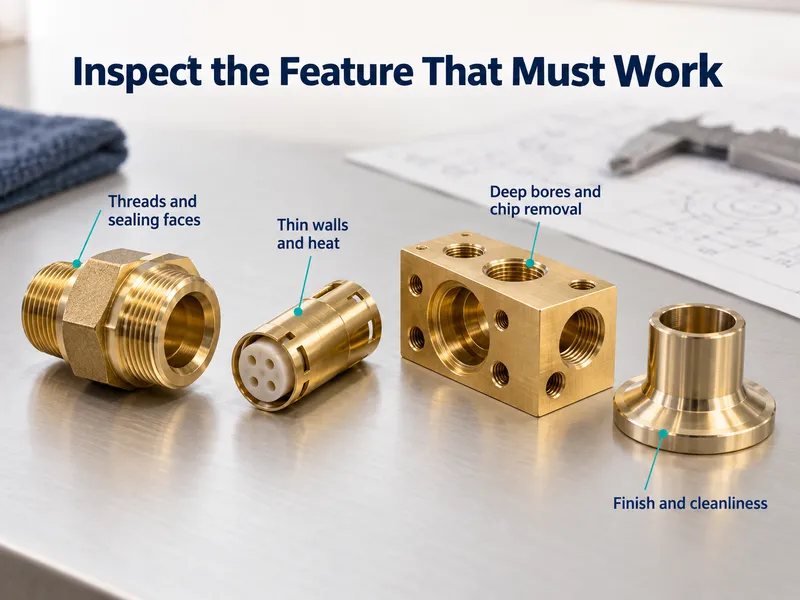
The same grade behaves differently from part to part, and the difference is set by which feature has to work.
| Part type | What is hard about it in lead-free | Where the correction lands |
| Potable-water fittings: valve bodies, connectors, spindles | Sealing faces and external threads are the functional surfaces, and both are where smearing shows first | Thread flank finish, thread rolling or chasing rather than single-pointing to depth |
| Electrical terminals, housings, contact bodies | Small diameter and thin wall leave little material to carry heat away | Lower surface speed, shorter overhang, higher coolant pressure |
| Medical and food-contact hardware | Surface finish and cleanliness are the release criteria, not just dimensions | Ra control through edge geometry, then deburring and cleaning before packing |
| Hydraulic and pneumatic bodies | Deep bores and blind pockets decide whether the chip leaves or stays | Peck cycles, through-tool or high-pressure coolant, chip-breaker geometry |
| Forgings finished on the lathe | Interrupted cuts over hot-formed stock remove material unevenly | Enter and exit strategy, and a feed that keeps the chip breaking through the interruption |
That table maps where a grade is used. Whether a given part should be converted at all is a different question, and it is answered further down under When Lead-Free Is Not the Right Call.
Where Lead-Free Actually Costs More — and Where It Doesn’t
Material Price Against Cycle Time
Lead-free rod is normally dearer per kilogram and slower per part, so both effects push the same way on unit cost. What settles a conversion is total landed part cost, and the shop controls every line of it except the first.
Three things quietly break a two-quote comparison:
- Cycle time borrowed from the old program. A lead-free quote built on C36000 speeds understates the cost by the amount the trial exists to find. Both routes must be quoted on their own parameters.
- Tooling left out of one side. Insert grade, breaker geometry and any specials belong in both quotes or in neither.
- Scrap priced at the wrong rate. First-run scrap is the real risk on a converted part, and a quote that assumes mature yield hides it.
A fourth applies to regulated parts. A switched part carries a first-article and composition check the incumbent grade did not need, and that inspection is a cost line rather than an overhead.
Scrap Credit and Recycling
Turnings are the largest recoverable cost in a machining job, and lead-free grades split into different streams. Silicon-bearing turnings go back as a separate melt and keep a silicon-grade credit rather than a leaded-brass one. C27450 carries no silicon or bismuth, so it returns to a conventional brass melt at a normal credit.
Kept separate, each stream has a buyer; mixed into one bin, the lot drops to the value of its cheapest component. Chip segregation is the cheapest item on this page and the easiest to lose on a busy floor.
Form, Temper and Tolerance: What to Fix on the Inquiry
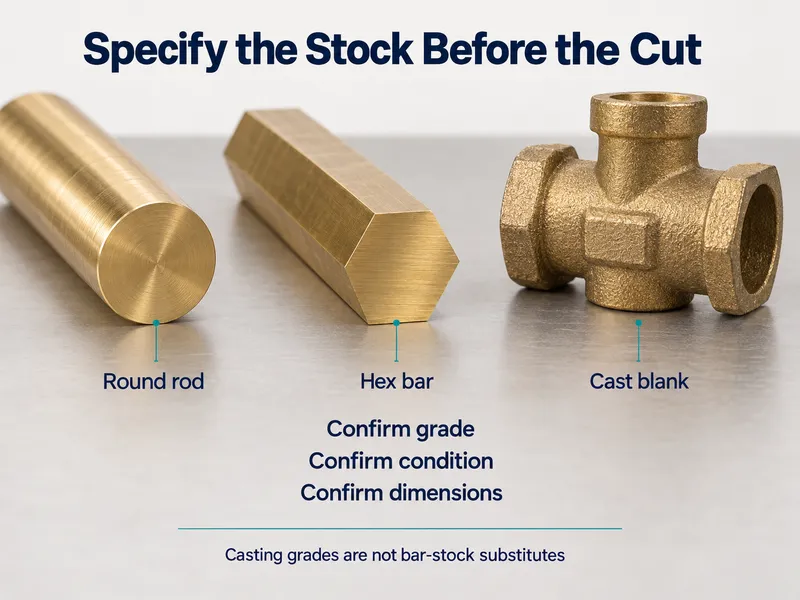
What the bar arrives as changes what the machine has to do, so these are settled at the inquiry rather than on the shop floor.
- Form. Round, hex or flat bar sets the number of operations before the part is cut. A hex or near-net flat form removes the first turning pass on mostly-round parts. Brass Bar covers the leaded and lead-free options; the shape family sits under Copper Bar.
- Temper or condition. Drawn rod ships in named conditions — R360, R430, R500 under EN, or a hardness range under ASTM. Lead-free grades machine more differently across those conditions than C36000 does, so the temper is a machining variable, not just a strength one.
- Diameter and straightness tolerance. Drawn rod tolerance classes differ between the EN and ASTM systems. On bar-fed machines, straightness and length matter as much as diameter, because they set how the bar enters the collet.
Specify all three against the drawing numbers, and confirm the standard the mill will certify to — C36000 rod runs under ASTM B16, while C69300 runs under ASTM B371.
Secondary Operations: Thread Rolling, Tapping, Deburring, Plating
The lathe is not where a conversion succeeds or fails. Most of the cost that surprises a first quote sits in the operations after it, and each one moves for a different reason.
- Thread rolling. Rolling follows formability rather than the cutting index, so a low-index grade can still roll well — but silicon grades usually need the blank diameter reset, which is a tooling change carried on the quote.
- Tapping. Lead-free chips smear instead of shearing, so taps are changed and cycle time rises on every tapped hole. On small taps the difference shows as breakage rather than as slow running.
- Deburring. Silicon-bearing grades leave a harder, more abrasive burr, so a tumbling cycle carried over from C36000 takes longer or needs different media — a cost that appears after the quote rather than in it.
- Plating. Adhesion turns on the alkaline clean before the plate, not on the base alloy. Where plating is specified, that preparation belongs in the quotation as its own line.
When Lead-Free Is Not the Right Call
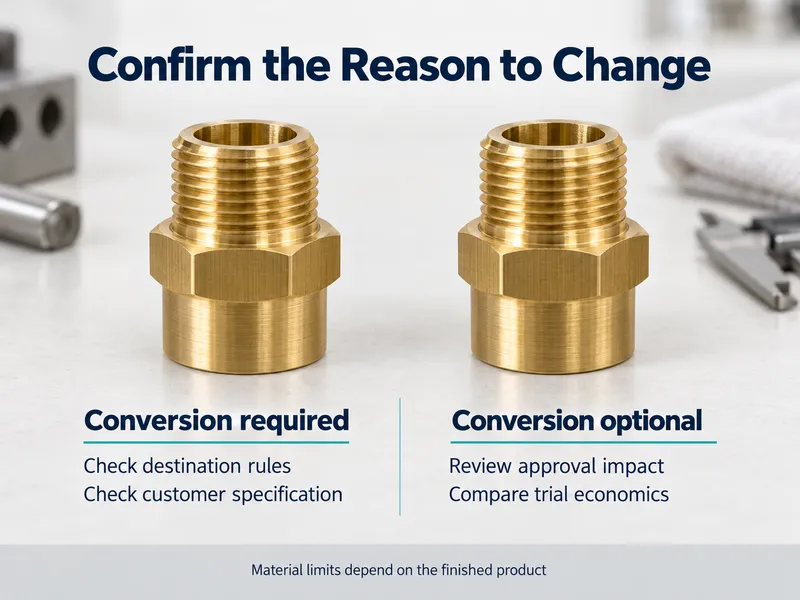
A conversion is worth doing when something requires it. Without that driver, the switch buys cost and risk instead of compliance.
Reasons to stay leaded:
- Nothing in the requirement calls for it. No lead limit in the destination market, no potable-water contact, no lead-free wording on the drawing — none of that in play means the switch costs money and buys nothing back.
- The part is approved, or safety-related. Changing the material on an approved part opens a change-control file, and requalifying usually costs more than the machining saving is worth.
- Deep, small-diameter holes dominate the geometry. Chip evacuation is already the tightest constraint on the part, and the lower index takes away the margin that was keeping the bore clean.
- The volume will not fund a trial. A conversion is only priced properly after a trial batch, and a job that never repeats has nothing to amortise it against.
- The finish already sits at the limit of the process. Lead is what holds that margin today, so it is the first thing to go.
Reasons to switch:
- Something requires it. A potable-water order into a regulated market has no leaded option at all, and the cost is the price of entry.
- A low-lead grade already covers the part. Where the ceiling is a low-lead figure rather than zero, C34000 Low Leaded Brass keeps most of the free-cutting behaviour at 0.8–1.5% lead, usually for less than a full switch.
- The job repeats at volume. A repeating job pays the trial back, and the numbers it produces then run for the life of the program.
What a Trial Actually Settles
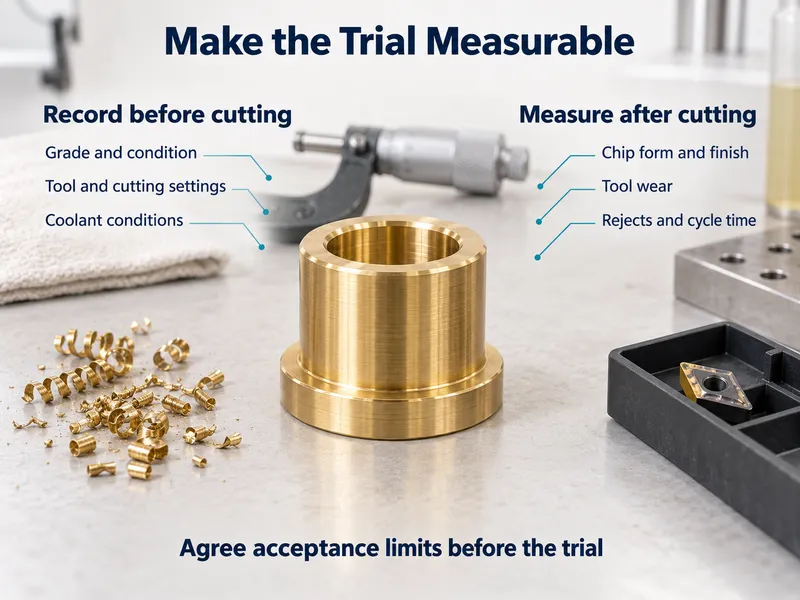
Cost lands in cycle time, tooling and first-run scrap, and none of it can be read off an index table. It settles on one batch of the same part, cut on both grades against thresholds fixed before the cut.
Two groups of record, and the difference is the point: what you fix beforehand makes the trial a fair test, what you measure afterwards turns parts into a number the quote can carry.
Fix before the cut
- Grade, heat number, temper — the certificate the customer reads, and the condition the data depends on
- Insert grade, geometry, breaker — whether the result transfers to the next tool order
- Surface speed, feed per tooth, depth of cut — the parameters that get copied into production
- Coolant type, concentration, pressure — the variable most often left out
Measure after the cut
- Chip form at each operation — what changes first, and what fails first
- Finish sample per critical feature — whether parts pass inspection
- Edge wear at fixed intervals — tool life as a number, not an impression
- Parts scrapped and why — the first-run cost the quote has to carry
Agree the thresholds with the shop before the cut: chips breaking within the cycle, finish holding on the critical features, edge life at or above an agreed share of the C36000 baseline. That share is a commercial figure the buyer signs rather than a technical fact to look up, which is why it has to be written down first.
Machining Both Grades With One Supplier
Linsy Copper supplies the bar route on both sides of the comparison. Leaded grades include C36000; lead-free covers C69300, C87850, C87860 and C27450. The full family sits under Brass Grades.
Bar stock and in-house CNC machining come from the same order. A trial batch is quoted as material plus machining, so the cycle-time and tooling difference arrives as a figure rather than an estimate assembled across two suppliers. The bar and the finished component then carry one responsibility instead of a tolerance split between a mill and a machine shop.
Every order ships with MTR/MTC covering grade and chemical composition, and SGS reports are available on request at additional testing cost. Non-stock sizes run as low-MOQ custom production with a typical lead time of 10–60 days.
Conclusion
The cost of going lead-free rarely lands in the alloy price. It lands in cycle time, tooling, first-run scrap and the secondary operations after the lathe — and none of those can be read off an index table before the parts are cut. That is the gap that makes the decision stall: the number the buyer needs is the number only a trial produces.
Send the part drawing with the annual volume and the destination market. We will return a material-plus-machining assessment for both the leaded and lead-free routes, where the part allows it.
FAQ
Can lead-free brass run at the same cutting speed as C36000?
No. Surface speed comes down to control heat, while feed per tooth goes up so the chip still fractures. Start from the datasheet of the actual grade and temper.
Does switching to lead-free brass need different tooling?
Usually insert geometry rather than the machine itself — a sharper edge, a more open chip breaker, and a grade change where heat resistance needs it. General-purpose geometry carried over from a leaded program is what fails first.
Can Linsy supply the bar and machine the parts on the same order?
Yes. Bar and in-house CNC machining are quoted together, so a trial batch arrives as one material-plus-processing figure rather than two separate estimates.
Which documents come with the material?
Every order ships with MTR/MTC covering grade and chemical composition. SGS third-party reports are available on request at additional testing cost.
What are the lead time and minimum order quantity?
Non-stock sizes run as low-MOQ custom production, typically 10–60 days depending on grade and dimensions.

David Huang is a copper materials specialist and Sales Manager at Linsy Copper, with years of hands-on experience supporting global customers in copper and copper alloy sourcing.
He specializes in industrial copper products such as C11000 copper, C10200 oxygen-free copper, brass, bronze, copper sheets, plates, tubes, bars, and custom-processed copper components.
With a practical understanding of copper manufacturing, quality inspection, surface treatment, and export supply chains, David helps customers choose the right materials for electrical, mechanical, marine, construction, and industrial applications.