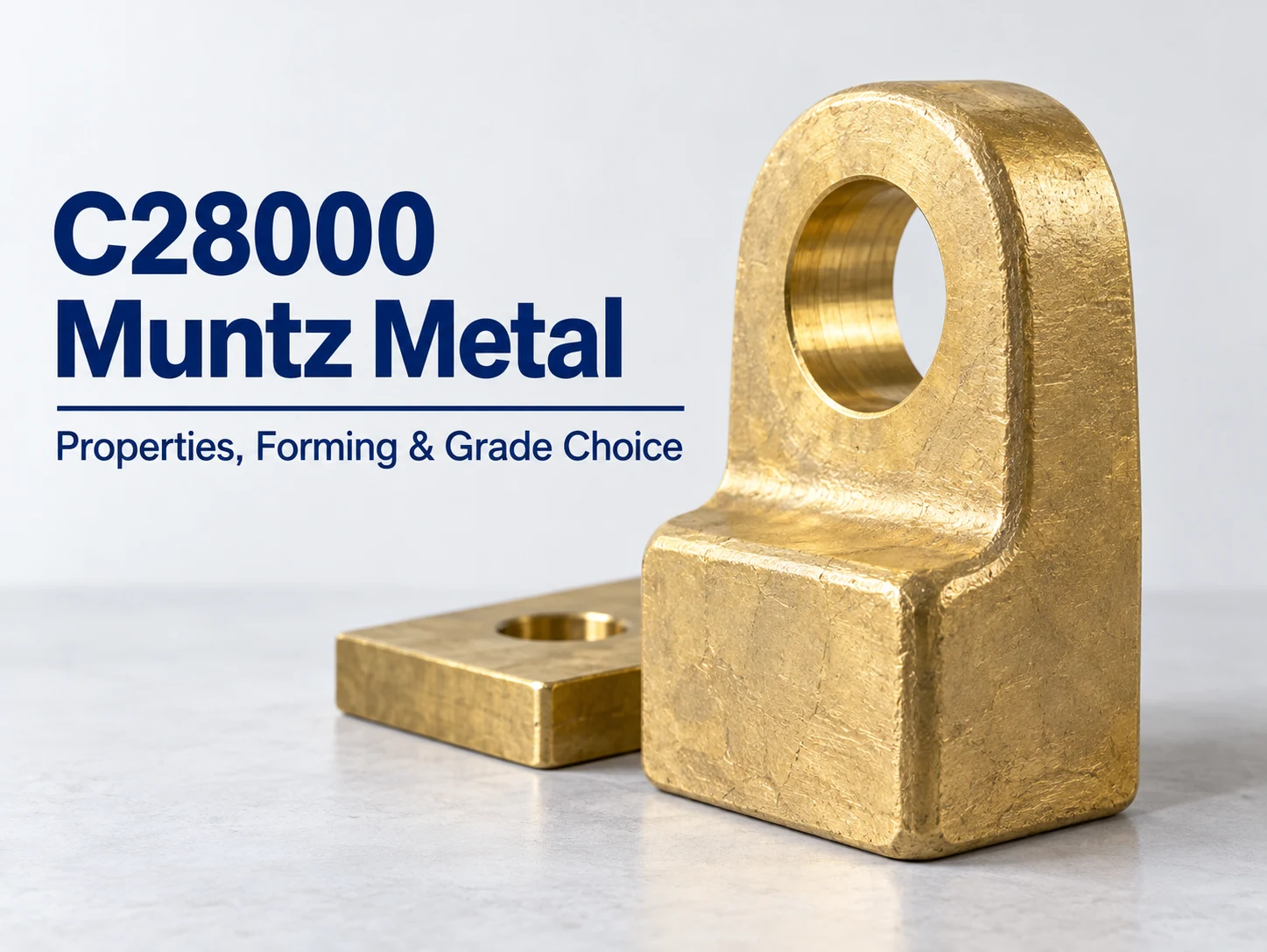
Muntz metal carries a reputation that gets it specified for the wrong jobs. Sixty percent copper and forty percent zinc buys real strength at low material cost, and the alloy hot-works more easily than any other common brass — which is where “good forming” enters the conversation and the trouble starts. C28000 forms well hot and forms poorly cold, and it dezincifies in water. Before the properties, two questions decide whether it belongs on the drawing at all: is the forming you need hot or cold, and does the part ever see water?
What Is C28000 Muntz Metal?
Three names point at the same alloy: C28000, Muntz metal, and 60/40 brass, with CuZn40 as the EN designation. The trade name survives from an 1830s patent for ship-sheathing plate, and the composition has barely moved since.
| Element | C28000 (ASTM B36, sheet/plate/strip) |
|---|---|
| Copper (Cu) | 59.0–63.0% |
| Lead (Pb) | 0.30% max |
| Iron (Fe) | 0.07% max |
| Zinc (Zn) | Remainder |
That 40% zinc figure puts C28000 Muntz Metal past the alpha limit, so the structure carries two phases rather than one. Alpha grains supply ductility; beta grains supply strength and go soft and plastic when heated. That mixture explains the rest of the alloy’s behavior: more strength than 70/30 brass, excellent hot working, poor cold drawing.
Exact limits depend on the applicable standard and product form, and the heat-number certificate is what governs the lot you receive.
C28000 is a structural and hot-working brass, not a general-purpose replacement for cartridge brass or free-cutting brass.
Properties That Affect Material Selection
A generic property table for this alloy is nearly useless on its own, because the numbers move with temper. Read the structure first, then the temper.
| Structural feature | What it produces | What it means for a part |
|---|---|---|
| Beta phase present | Higher tensile and yield than alpha brasses | Load-bearing and structural parts can be thinner and lighter |
| Beta phase softens when hot | Forgeability rating 90 (CDA scale) | Large sections can be forged, extruded, or hot-bent economically |
| Coarse two-phase structure | Cold ductility well below C26000 | Deep drawing and tight cold bends crack rather than flow |
| Trace lead (0.30% max) | Machinability 40 against C36000’s 100 | Conventional turning is fine; high-speed automatic work is not |
Typical mechanical values, by temper:
| Temper | Tensile | Yield (0.2%) | Elongation |
|---|---|---|---|
| O (annealed) | ~350–430 MPa | ~120–150 MPa | 25–40% |
| H02 (half hard) | ~400–485 MPa | ~320–370 MPa | 20–30% |
| H04 (hard) | ~490–530 MPa | ~420–480 MPa | 10–15% |
Those are typical mill ranges, not guaranteed minima, and two things follow for selection. The strength advantage over C26000 is modest at equal temper, and it disappears if C26000 is ordered hard while C28000 is ordered annealed. An elongation figure without a temper attached also cannot be checked against a forming requirement: “Elongation 25%” describes neither an annealed sheet that will bend nor a hard sheet that will crack, but an average of both.
Forming and Machining Considerations
What matters is not how these processes run — the shop doing them knows that. It is whether the alloy supports the route the part needs, and what that route costs you.
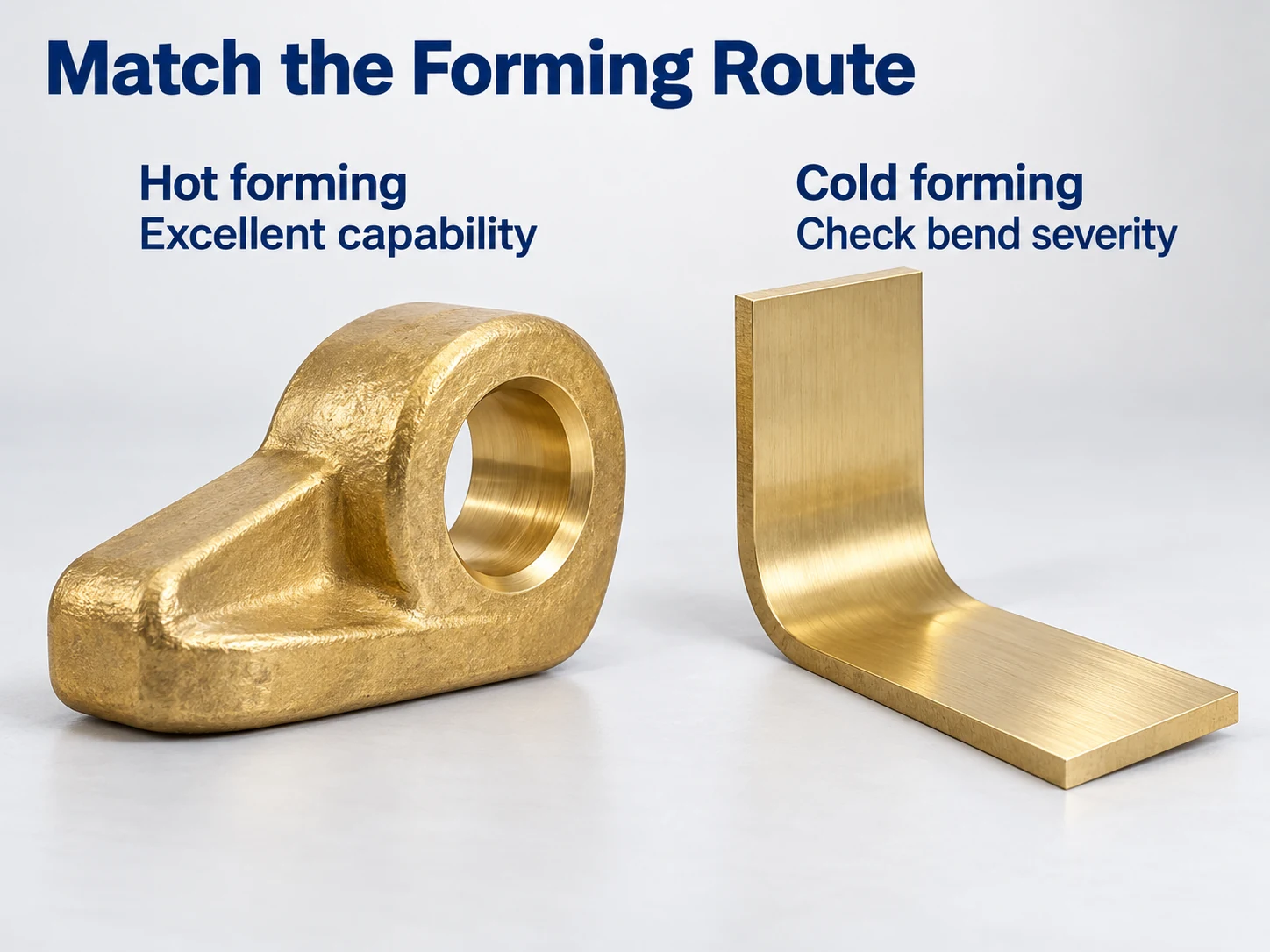
Hot forming is the route this alloy exists for. A forgeability rating of 90, on the scale where free-cutting brass machines at 100, is why thick simple sections get formed rather than cut from bar. That step also happens outside the material supply: a shop tooled for cold stamping will subcontract it or decline, and either outcome lands on your price and lead time.
Cold forming is where it stops. Cold work rates only fair — blanking, moderate bending, and light stamping are fine, while deep drawing and tight-radius bends crack at the bend line. A drawing near that edge is asking for an alpha brass such as C26000, and no temper adjustment closes the gap.
Machining and joining are secondary operations, priced accordingly. An index of 40 means slower cuts and faster tool wear — tolerable on a mostly formed part, expensive on a mostly turned one, where free-cutting brass wins and the C36000 Free-Cutting Brass Guide has the cutting data. Soldering and brazing rate excellent; arc welding is fair at best and fumes zinc.
Confirm three things with the shop that will form the part before the grade is fixed: whether they hot-form at all, the tightest cold bend the drawing actually calls for, and how much machining stock the route leaves behind.
Selecting the Form and Condition
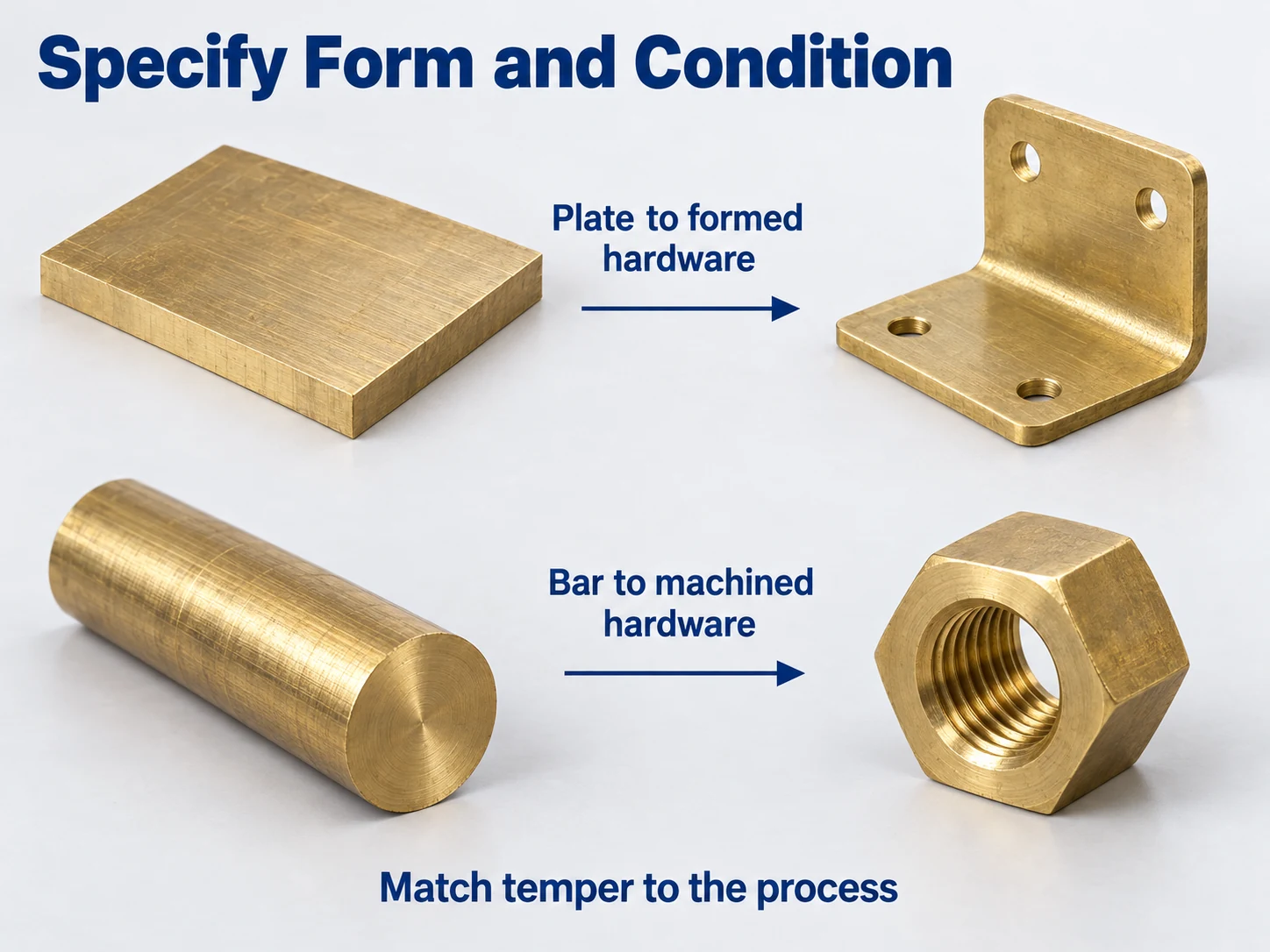
Product form should follow the part, and the temper should follow the order of operations. Getting the first right and the second wrong is the most common sourcing error on this grade.
| Form | Fits |
|---|---|
| Plate, sheet, strip | Blanked and hot-formed hardware, architectural panels, structural brackets, tube sheets |
| Rod and bar | Machined hardware, heavy fastener blanks, large-bore flanges |
| Tube | Condenser and heat-exchanger service on the fresh-water side |
| Forgings | Large simple shapes where die cost is spread over volume |
Condition, then, is a scheduling decision:
- O (annealed) — when the part is formed first and machined after. Maximum ductility is available for the forming step, and the machining allowance survives it.
- H02 (half hard) — when the part is formed lightly but must hold shape and flatness afterward. Some ductility is spent to buy dimensional stability.
- H04 (hard) — only where machining dominates and forming is minimal. Bending a hard temper is how parts crack at the brake.
A purchase order reading “C28000 sheet, 2 mm” has not specified a material. The mill cannot know whether to ship stock that will draw or stock that will hold tolerance, and the shop finds out at the press.
Applications and Service Limits
C28000 holds up where the job needs strength per unit cost, a large hot-worked shape, and no aggressive water.
- Condenser and heat-exchanger tube sheets and end plates on the fresh-water or demineralized side, where the plate is thick, the geometry simple, and cost matters.
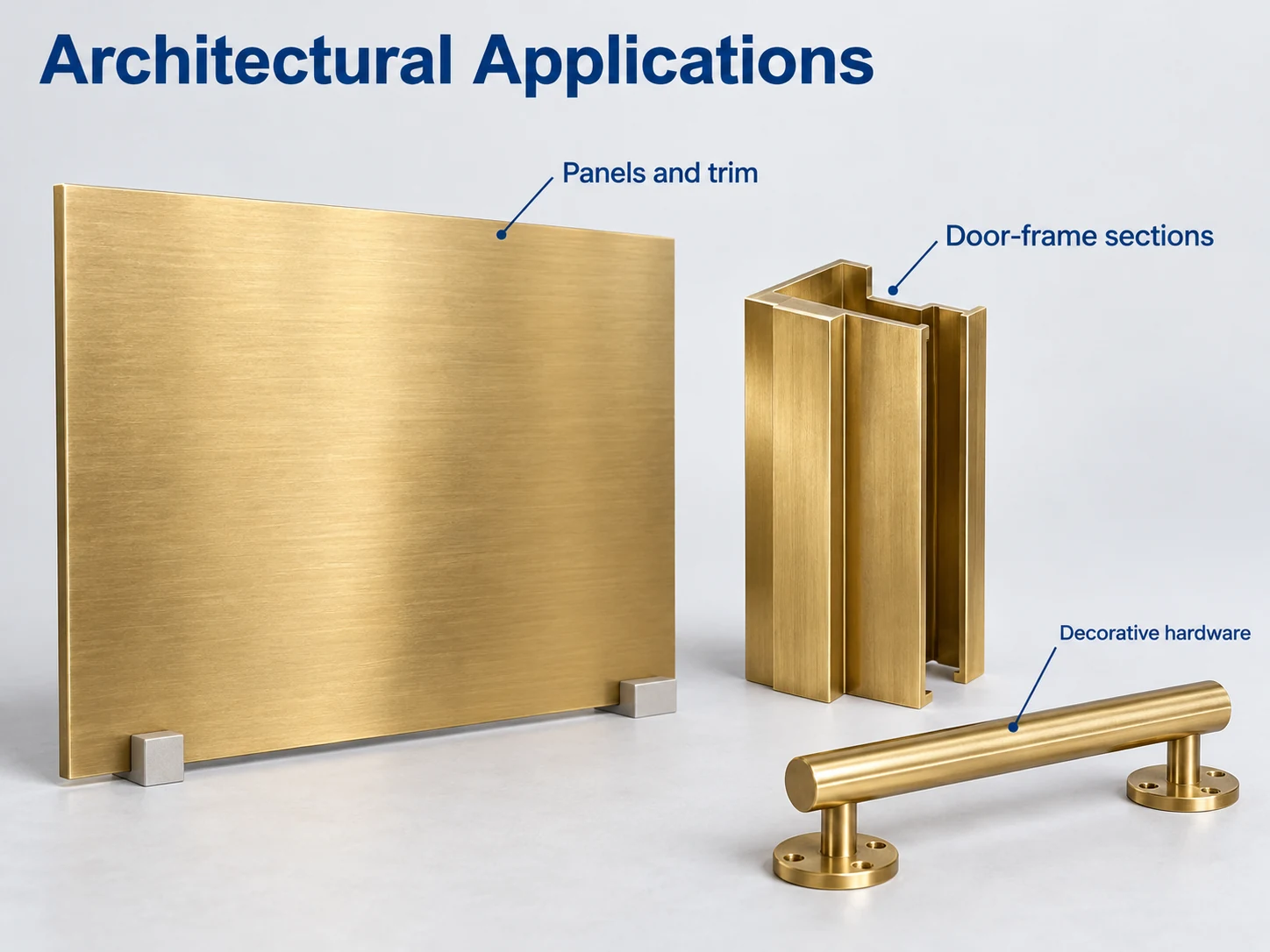
- Architectural sheet, panels, and structural hardware — the alloy’s original market, and still its best fit: atmospheric exposure, decorative finish, load-bearing sections.
- Large-bore flanges, heavy fastener blanks, and structural fittings for industrial service away from potable water.
- Ship hull plate framing and cladding supports — structure, not wetted surfaces.
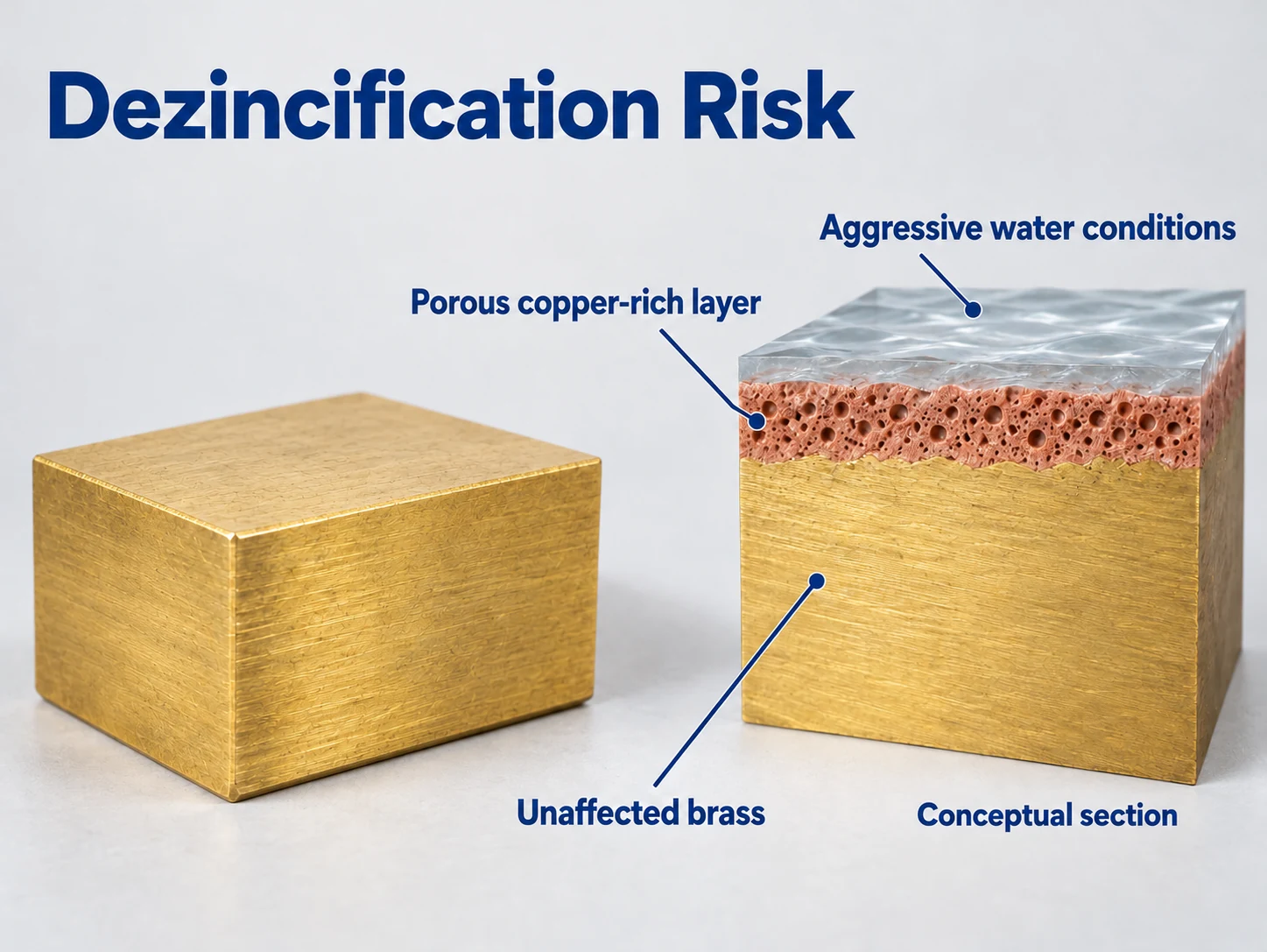
The limit that ends most of these conversations is dezincification: zinc dissolving preferentially out of the alloy and leaving a porous copper residue that looks sound and carries no load. The beta phase goes first, which is why a high-zinc two-phase brass is more exposed than single-phase cartridge brass at 30% zinc.
Three conditions together trigger it — chloride in the water, temperature above roughly 50°C, and stagnant or low flow that lets zinc ions concentrate at the surface. Cooling-tower water, brackish service, and dead legs in a potable line usually meet at least two of the three. Screw machining a part from C28000 does not change any of this; the risk is in the environment, not the process.
For wetted or marine service the inhibited grades are the answer, and the inhibitor is what does the work rather than the base composition. C46400 adds about 0.75% tin, and C46500 Naval Brass adds arsenic to the same base for stronger resistance. DZR grades such as CW602N go further for potable water.
The dezincification in seawater comparison sets out which grade protects which exposure, and compliance by destination market covers the water-contact rules that decide the grade before cost does.
A history of marine use is not a service approval. Hull sheathing moved to other materials long ago; what survived is dry and structural.
When to Consider Another Brass Grade
Four grades cover the decisions this alloy gets asked to make.
| Grade | Cold forming | Hot forming | Machining | Environment |
|---|---|---|---|---|
| C28000 Muntz metal | Fair — moderate bends only | Excellent (forgeability 90) | 40 | Dry, atmospheric; not water |
| C26000 Cartridge Brass | Excellent — deep drawing, tight bends | Fair | 30 | Good in most atmospheres |
| C36000 Free-Cutting Brass | Fair | Good | 100 benchmark | Dry; lead-restricted in water |
| C46400 Naval brass | Fair | Good | 30 | Seawater, with tin inhibitor |
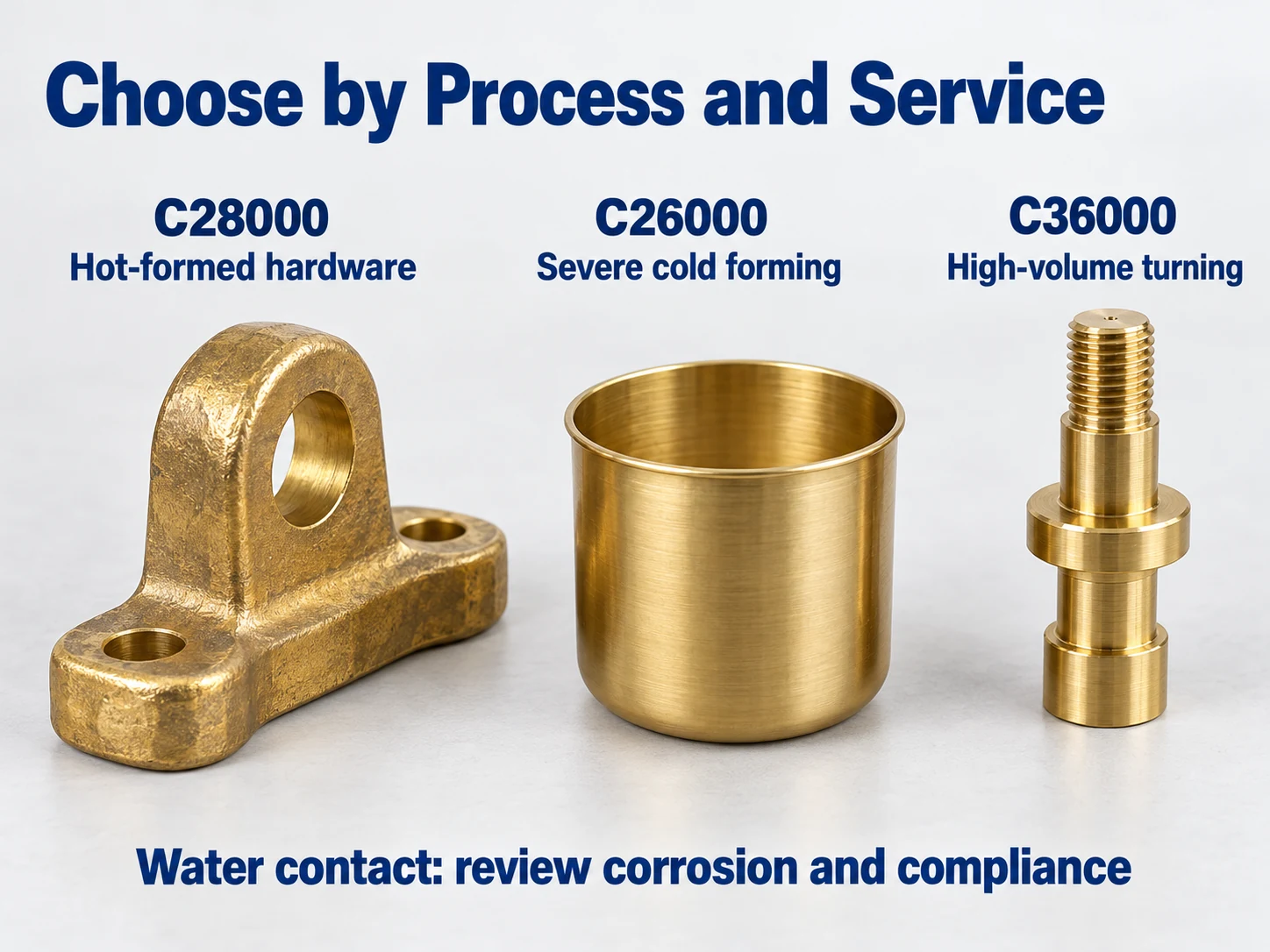
The split is quick to apply. Cold drawing or tight cold bends put the part in C26000, the reference alloy for that work; high-volume turning puts it in C36000, where the machining index is worth more than the strength difference. Anything wetted, warm, or chlorinated moves to C46400 or an inhibited equivalent.
C28000 keeps the job only when the forming is hot and the service is dry — and when a thicker, stronger section at the lowest material cost is the point.
What to Specify When Ordering
Seven items turn a material decision into an order that arrives usable.
- Grade and name — UNS C28000, with “Muntz metal” or “60/40 brass” to remove ambiguity at the mill.
- Product form — plate, sheet, strip, rod, bar, tube, or forging stock.
- Dimensions and quantity — thickness, width, length or diameter, plus the piece count.
- Temper — O, H02, or H04, matched to whether forming or machining comes first.
- Standard — ASTM B36 for plate, sheet, strip, and rolled bar; B453 for rod, bar, and shapes; B124 for forgings. The form decides the standard, not the grade.
- Tolerance and finish — thickness tolerance class, edge condition, and surface requirement.
- Inspection — MTC issued by Linsy Copper for every lot, with chemistry and mechanicals, plus any third-party testing the drawing calls for.
Omitting item 4 or 5 produces a shipment that measures correctly and cannot be processed. Item 6 deserves the same care: a plate tolerance class is not a strip tolerance class, and a formed part built to a loose gauge will show it at the die. Non-stock tempers and forms run low-MOQ custom production.
Conclusion
C28000 is a good alloy in a narrow lane: hot-formed, thick-sectioned, dry-service parts, where its strength per unit cost beats everything else on the shelf. Take it into cold drawing or into a water line and the same alloy becomes the expensive choice — cracked at the brake or dezincified in service.
We resolve that against the drawing and the process route together, because the temper and the standard follow from whether the part is formed first, machined first, or both. Send the drawing with the forming route and the service environment, and we will confirm grade, form, temper, and standard against what the part actually has to survive.
FAQ
What temper should I order if the part is formed first and machined after?
O (annealed) is the usual answer, because forming consumes the ductility and the machining allowance still has to survive the press. H02 suits a part that is formed lightly but must stay flat. Name the temper on the order — the mill ships to the drawing, not to the intended process.
Can C28000 be used for a part that sees water?
Not in potable, seawater, or warm stagnant service — dezincification is the failure mode and it does not show until strength is already gone. Dry, atmospheric, and non-wetted structural use is where the grade belongs. Wetted parts move to C46400, C46500, or a DZR grade.
Can C28000 and C26000 be quoted side by side for one part?
Yes, and it is the cheapest way to settle a forming question that the drawing leaves ambiguous. Quote both in the temper each would actually be formed in, and confirm the forming route before comparing — a cold-drawn part will not price out of C28000 at all.
Is small-batch cold forming worth trying, or is C28000 the wrong alloy from the start?
The failure is predictable rather than marginal: moderate bends at generous radii may run, deep draws and tight bends crack. When the geometry is genuinely borderline, form a sample in both tempers before committing the lot.

David Huang is a copper materials specialist and Sales Manager at Linsy Copper, with years of hands-on experience supporting global customers in copper and copper alloy sourcing.
He specializes in industrial copper products such as C11000 copper, C10200 oxygen-free copper, brass, bronze, copper sheets, plates, tubes, bars, and custom-processed copper components.
With a practical understanding of copper manufacturing, quality inspection, surface treatment, and export supply chains, David helps customers choose the right materials for electrical, mechanical, marine, construction, and industrial applications.