Introduction
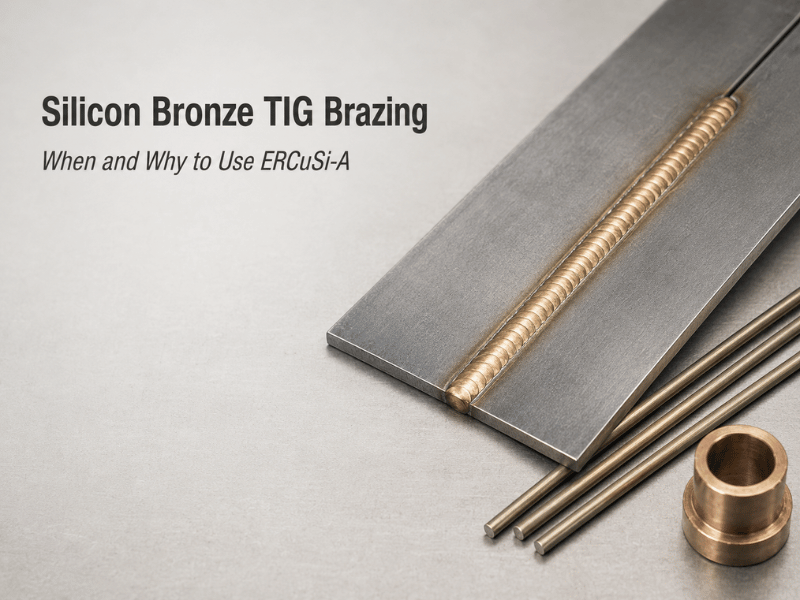
Fabrication projects stall when the metals are incompatible — steel to copper, galvanized sheet, thin-gauge material. TIG brazing with silicon bronze filler avoids all three problems. The filler rod melts around 1,020°C, roughly 400°C below steel’s melting point. The base metal never liquefies, so the joint forms by capillary wetting rather than fusion — and steel-to-copper, galvanized sheet repair, and cast iron restoration become routine rather than experimental.
When specifying materials for a fabrication run, the key questions are: which filler grade, what base metals it works with, where the process fits versus fusion welding, and where to source the consumables.
What Is TIG Brazing?
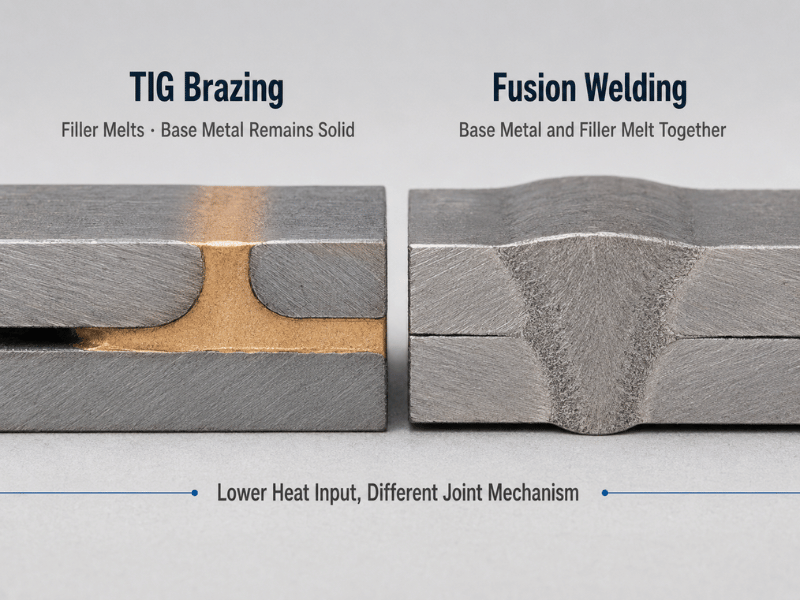
TIG brazing uses a standard TIG welding setup — DC power supply, argon shielding gas, tungsten electrode — but replaces the steel filler rod with silicon bronze (AWS ERCuSi-A). The arc heats the workpiece enough for the filler to melt, wet, and flow, but not enough to melt the base metal.
The lower melting point means less total heat input. Less heat means less distortion, less zinc damage, and the ability to join metals that would form brittle phases if melted together. The trade-off: joint strength caps at roughly 50,000 psi — adequate for sheet metal, automotive panels, art fabrication, and non-structural repairs, but insufficient for load-bearing chassis or pressure vessel welds.
| Fusion TIG Welding | TIG Brazing (ERCuSi-A) | |
| Base metal melted? | Yes | No |
| Filler melting point | ~1,480°C (ER70) | ~1,020°C |
| Joint mechanism | Metallurgical fusion | Capillary wetting + adhesion |
| Dissimilar metals (steel to copper) | Problematic — brittle intermetallics | Reliable |
| Galvanized steel | Zinc vaporizes, porosity, fumes | Zinc coating preserved |
| Thin-sheet distortion | High risk | Low risk |
| Joint tensile strength | 70,000+ psi | ~50,000 psi |
ERCuSi-A: The Filler Rod Specification
AWS class ERCuSi-A, also classified as RCuSi-A under the brazing standard AWS A5.27, is the industry-standard silicon bronze filler. It was historically sold under the trade name Everdur.
Chemical Composition (AWS A5.7)
| Element | Content |
| Copper (Cu) | Balance (~95%) |
| Silicon (Si) | 2.8–4.0% |
| Manganese (Mn) | ≤ 1.5% |
| Tin (Sn) | ≤ 1.0% |
| Zinc (Zn) | ≤ 1.0% |
| Iron (Fe) | ≤ 0.5% |
| Lead (Pb) | ≤ 0.02% |
Mechanical Properties (As-Deposited)
| Property | Value |
| Tensile Strength | ≥ 50,000 psi (345 MPa) |
| Elongation | Up to 65% |
| Brinell Hardness | 80–100 |
| Melting Point | ~1,020°C (1,866°F) |
| Color | Golden bronze, matches cast bronze and brass |
Standard Diameters and Forms
ERCuSi-A filler is available in three standard diameters. 1/16″ (1.6 mm) and 3/32″ (2.4 mm) are produced as both TIG rod and MIG wire, typically packaged in 1 lb, 5 kg, or 10 lb tubes. 1/8″ (3.2 mm) is produced as TIG rod only, sold per-weight in tubes.
Matching Filler to Base Metal Grade
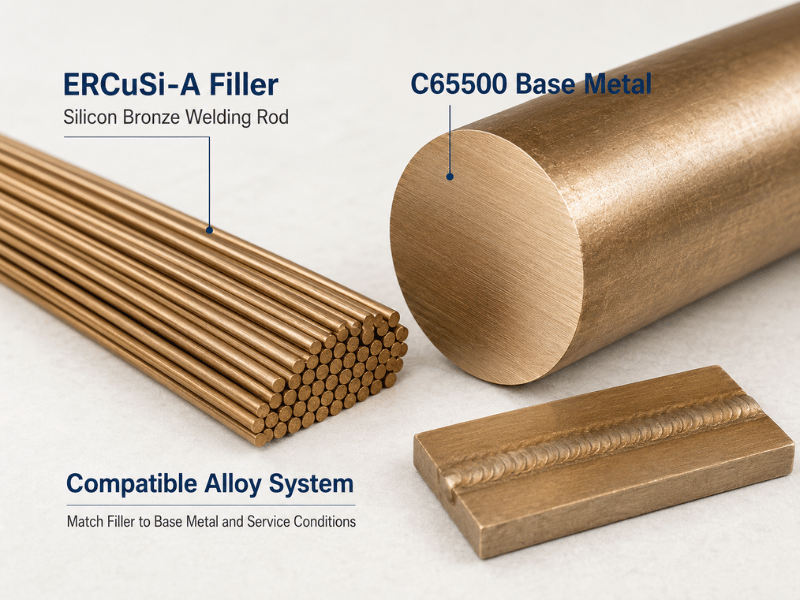
ERCuSi-A chemistry overlaps closely with the C65500 (High Silicon Bronze A) and C65100 (Low Silicon Bronze B) wrought alloy compositions. The filler spec (2.8–4.0% Si per AWS A5.7) and C65500 wrought alloy spec (2.8–3.8% Si per ASTM B98) share overlapping silicon ranges. When repairing a C65500 marine casting or joining C65100 architectural bronze components, the filler chemistry matches sufficiently for both structural and visual compatibility.
For bronze grades outside the silicon bronze family — aluminum bronze (C95400, C95800), phosphor bronze (C51000, C51900), or tin bronze — ERCuSi-A works as a joining filler, but the color and corrosion profile will differ from the base metal. Structural repair of aluminum bronze pump casings with ERCuSi-A is technically viable; visible architectural work on phosphor bronze may call for a closer color match.
Why the Low Melting Point Changes the Game
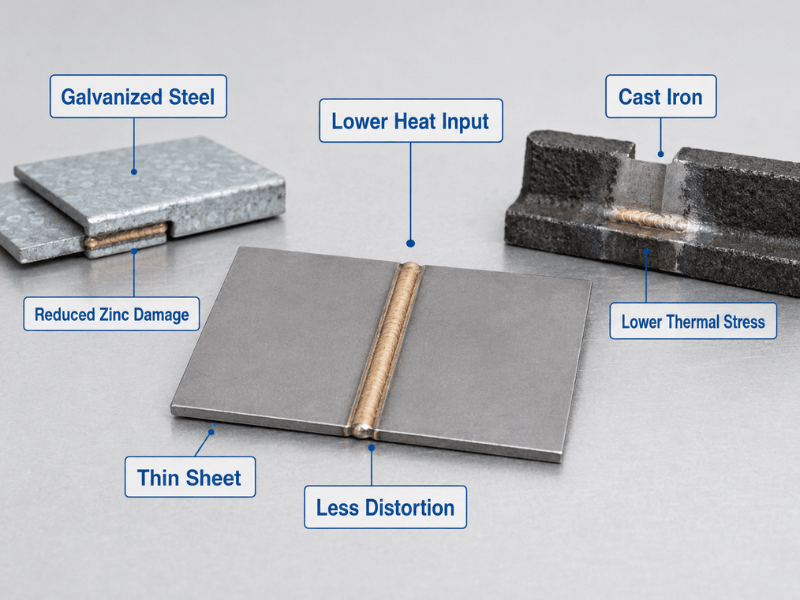
Three fabrication scenarios become practical with a 1,020°C filler that are difficult or impossible with a 1,480°C steel rod:
Thin-sheet repair without burn-through. Silicon bronze can join 20-gauge steel without blowing through — the base metal never reaches melting temperature. In auto body panel replacement, silicon bronze joins 20-gauge steel without distorting surrounding metal.
Galvanized steel with the coating intact. Zinc coatings begin degrading around 900°C. With controlled heat, the zinc adjacent to the braze survives. No porosity, no white zinc-oxide smoke, no post-weld re-coating. HVAC ductwork and galvanized enclosures are the primary use case.
Cast iron without the cracking risk. Fusion-welding cast iron demands 300–500°C preheat and a controlled cooling curve measured in hours. TIG brazing needs only a light preheat to drive off moisture. The cast iron stays below its brittle phase-transition range, eliminating the thermal-shock cracking risk that makes cast iron welding a specialist skill.
What Materials Can Be Joined
| Base Metal Combination | ERCuSi-A Compatible? | Notes |
| Mild steel to mild steel | Yes | Thin sheet and tube. Not for structural. |
| Mild steel to stainless (304/316) | Yes | Common in exhaust and ductwork fabrication |
| Steel to copper | Yes | No brittle intermetallics — capillary wetting avoids the problem |
| Steel to brass (C26000, C36000) | Yes | Preserves brass color at the joint |
| Steel to bronze (C65500, C95400) | Yes | Direct match for C65500; compatible with aluminum bronze |
| Galvanized steel | Yes | Zinc coating survives adjacent to the braze |
| Cast iron (grey, ductile) | Yes | Minimal preheat required |
| Aluminum | No | Requires AC + 4043/5356 filler |
When to Choose Brazing Over Welding
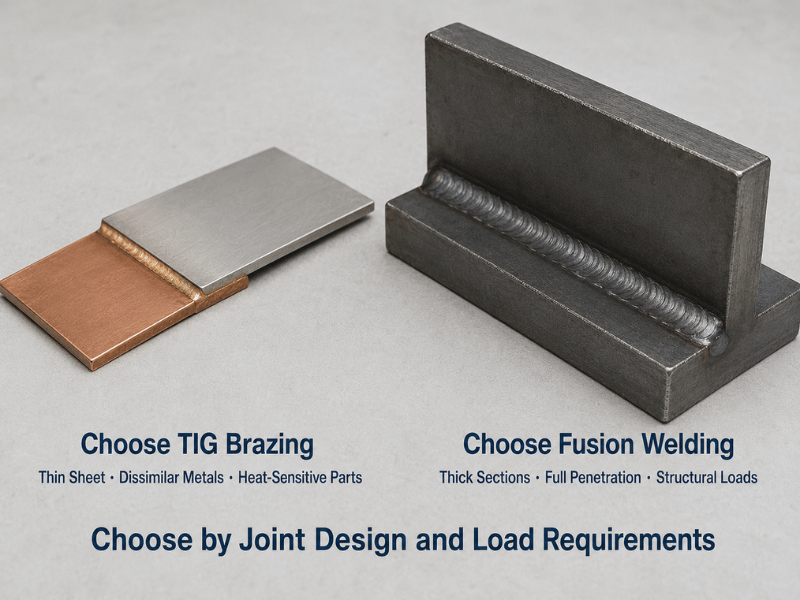
The selection boundary is straightforward: if the joint needs full base-metal strength, fusion-weld it. If the primary requirements are sealing, appearance, corrosion protection, or joining incompatible metals, TIG brazing is usually the better path.
| Decision Factor | Choose TIG Brazing (ERCuSi-A) | Choose Fusion Welding (ER70) |
| Metals are dissimilar | Steel to copper, steel to brass, steel to bronze | Both are carbon steel |
| Material thickness | Under 3 mm — distortion risk | Over 3 mm — sufficient heat sink |
| Base metal coating | Galvanized — preserve the zinc | Bare steel — coating damage acceptable |
| Joint function | Cosmetic, sealing, non-structural repair | Structural, load-bearing, safety-critical |
| Heat sensitivity | Nearby seals, bearings, or paint | No heat-sensitive components adjacent |
| Post-weld finishing | Sandable, paintable, no grinding needed | Grinding and dressing acceptable |
Common Problems and Their Root Causes
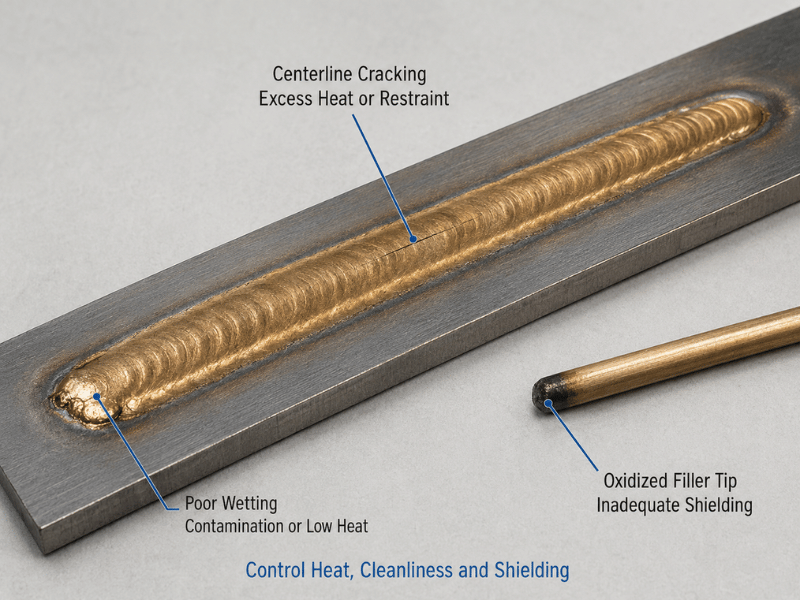
Hot cracking — the centerline crack. The most frequent issue with ERCuSi-A. The filler overheats and the bead center pulls apart during cooling. Root cause: excessive heat input, slow travel speed, or insufficient cooling between passes. Prevention: keep the bead narrow, move at a steady pace, and allow the workpiece to cool to below 65°C (150°F) between passes.
Poor wetting — the filler fails to flow and forms isolated droplets. Silicon bronze will not flow onto a dirty surface. Oil, mill scale, rust, and paint must be removed mechanically and chemically before brazing. Acetone wipe followed by grinding to bright metal is the minimum prep standard.
Oxide contamination. If the filler rod tip leaves the argon gas shield while still hot, it oxidizes instantly and contaminates the next dip. Keep the rod tip within the gas envelope at all times during the pass.
Strength loss at elevated temperature. Brazed ERCuSi-A joints lose strength above approximately 200°C. Do not use for exhaust headers, boiler components, or any joint with sustained service heat.
Typical Applications
| Application | Why ERCuSi-A |
| Auto body panel repair | No distortion; sandable; paintable |
| HVAC galvanized ductwork | Preserves zinc coating; clean joint |
| Cast iron manifold and housing repair | No cracking risk; minimal preheat |
| C65500/C65100 marine hardware restoration | Filler matches base metal chemistry and corrosion resistance |
| Sculpture and architectural metalwork | Golden color match; steel-to-bronze joinery |
| Corrosion-resistant surface overlay | Bronze cladding on steel for marine/chemical exposure |
| Steel-to-copper dissimilar assemblies | No brittle intermetallic formation |
Conclusion
When fusion welding creates brittle intermetallics, destroys protective coatings, or warps thin-gauge workpieces, TIG brazing with ERCuSi-A fills the gap — joining dissimilar metals, repairing cast iron without thermal shock, and working galvanized sheet without coating loss.Review the ERCuSi-A specification for chemical composition limits, mechanical properties, and available diameters, or contact Linsy Copper to confirm silicon bronze stock availability for your brazing application.
FAQ
-
No. ERCuSi-A deposits reach approximately 50,000 psi — about 70% of a typical ER70 fusion weld. Sufficient for sheet metal, body panels, ductwork, and non-structural repairs. Not suitable for chassis, lifting equipment, or pressure boundaries.
-
ERCuSi-A is the AWS classification. The filler rod itself is silicon bronze with ~3% silicon. It is chemically nearly identical to C65500 wrought silicon bronze — the rod is essentially C65500 drawn into welding wire form.
-
Yes, as a joining filler. But color and corrosion behavior will differ from the base metal. For C95400 aluminum bronze pump repairs, structural compatibility is usually adequate. For visible phosphor bronze (C51000, C51900) artwork, a closer color-matched filler may be preferred.
-
Brass brazing rods contain 15–40% zinc, which vaporizes during heating — producing toxic fumes and creating porosity in the joint. ERCuSi-A contains less than 1% zinc. The low zinc content eliminates the fuming and porosity issues that make brass rod difficult to work with.
-
Yes. The bronze deposit sands smoothly and accepts primer and paint like the surrounding steel. For plated finishes, the bronze surface can be prepped for nickel or chrome plating, though the copper-rich substrate may require a barrier layer depending on the plating chemistry.

David Huang is a copper materials specialist and Sales Manager at Linsy Copper, with years of hands-on experience supporting global customers in copper and copper alloy sourcing.
He specializes in industrial copper products such as C11000 copper, C10200 oxygen-free copper, brass, bronze, copper sheets, plates, tubes, bars, and custom-processed copper components.
With a practical understanding of copper manufacturing, quality inspection, surface treatment, and export supply chains, David helps customers choose the right materials for electrical, mechanical, marine, construction, and industrial applications.