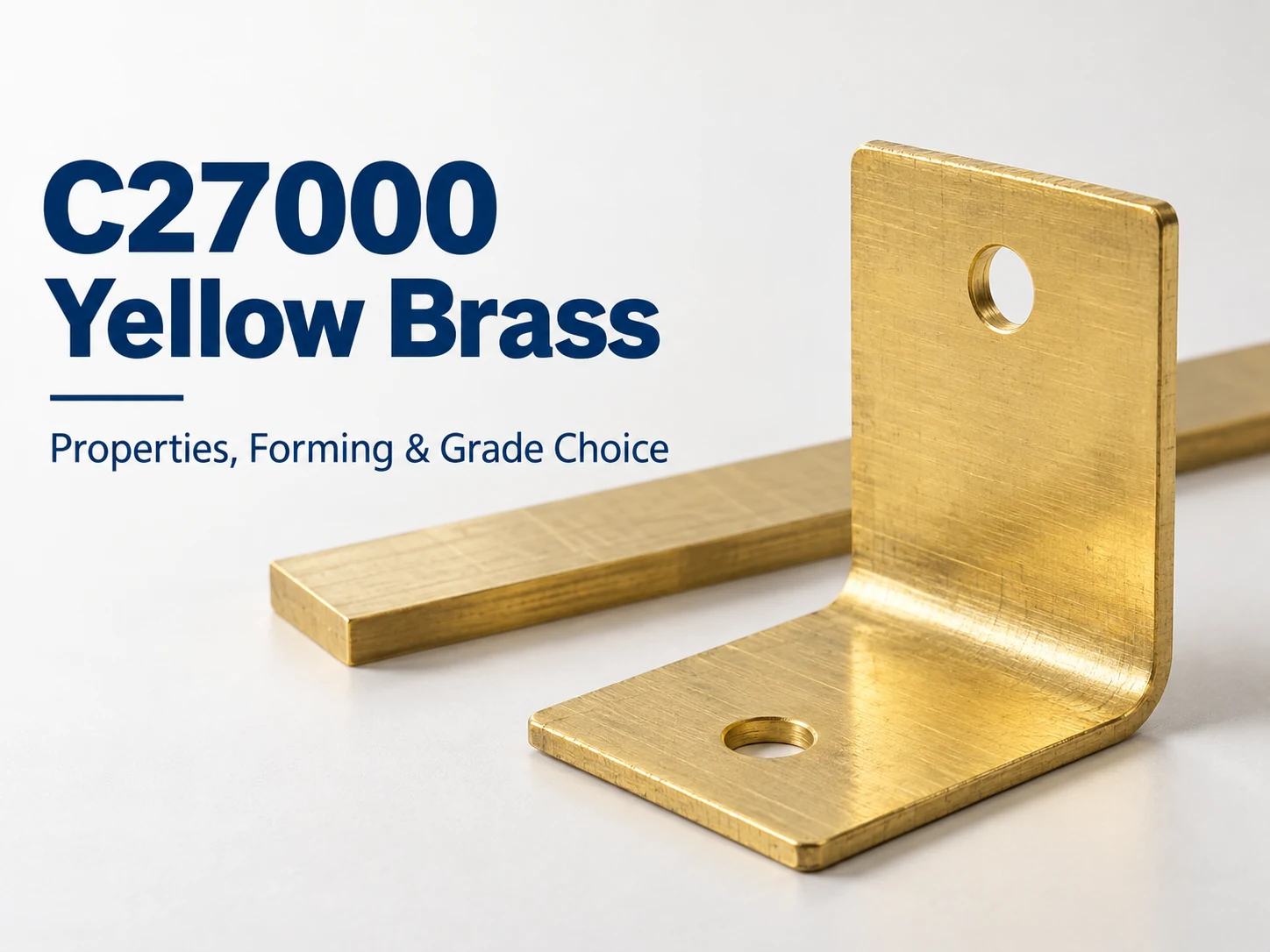
Sixty-five thirty-five is the brass a buyer reaches for when the drawing says “brass” and the part is ordinary — a stamped bracket, a cold-headed rivet, a polished handle. It is cheaper than the 70/30 grade by five points of copper, and it looks the part. What it is not is a better version of C26000, and treating it as one is how a forming job ends up with cracked parts and a material saving nobody collected.
What Is C27000?
C27000 Yellow Brass is a wrought copper-zinc brass sold as 65/35 brass, with CuZn35 as the conventional alloy name and CW507L as the nearest EN designation. The limits below come from ASTM B36 for sheet, strip and plate.
| Element | C27000 (ASTM B36, sheet/strip/plate) |
|---|---|
| Copper (Cu) | 63.0–68.5% |
| Lead (Pb) | 0.09% max |
| Iron (Fe) | 0.07% max |
| Zinc (Zn) | Remainder |
Two things about that table. The copper band is five and a half points wide, so two heats both sold as 65/35 can differ enough to change how a tight bend behaves. And lead and iron are impurity ceilings, not additions — nothing was put in to help this alloy cut.
At 65% copper the alloy sits inside the alpha field, single-phase at room temperature. Alpha brass forms by slip, uniformly, which is why the annealed condition reaches 50–65% elongation.
Properties That Decide the Part
Four numbers carry most of the decision.
Strength is a temper decision. There is no single tensile figure for C27000; the same coil covers a 2:1 range depending on condition.
| Condition | Tensile | Yield (0.2%) | Elongation | Hardness |
|---|---|---|---|---|
| Annealed (O) | ~270–350 MPa | ~90–130 MPa | 50–65% | 55–75 HV |
| Half hard (H02) | ~360–500 MPa | ~240–380 MPa | 10–30% | 100–130 HV |
| Hard (H04) | ~500–600 MPa | ~450–520 MPa | 5–10% | 150–180 HV |
Stiffness. Modulus runs about 105 GPa, against 110 for C26000 and 97 for C36000. It is the lowest of the three, which matters on a part sized for deflection rather than stress.
Machinability is 30 on the CDA scale where free-cutting brass is 100. That is the same rating cartridge brass carries, and it is the figure most misread when a part moves here expecting easier cutting.
Conductivity is ordinary — roughly 24–28% IACS and about 116 W/m·K. Adequate for terminals and radiator cores, well short of a conductor-first copper.
Forming: Where It Sits Against C26000
This is the section that decides most jobs, and the answer is not flattering.
C26000 forms better, and it is not close at the margin. Cartridge brass carries 70% copper, reaches 50–65% elongation in the annealed condition and a 3–66% band across tempers, and has the depth capacity to draw a cup deeper than its own diameter in one stage. C27000 will do that for moderate geometries and gives up first at tight radii, thin walls, and multi-stage draws that need the last of the ductility.
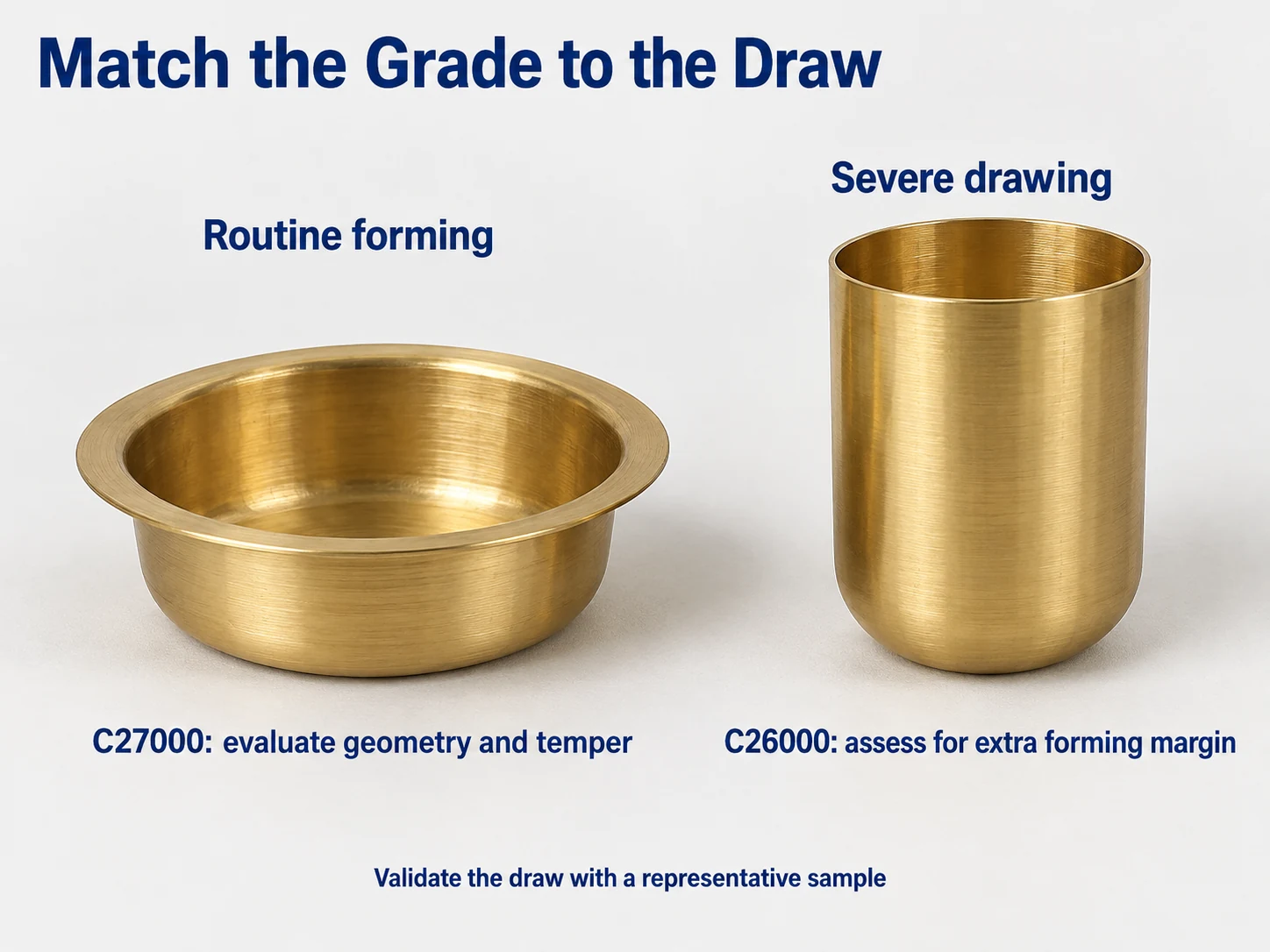
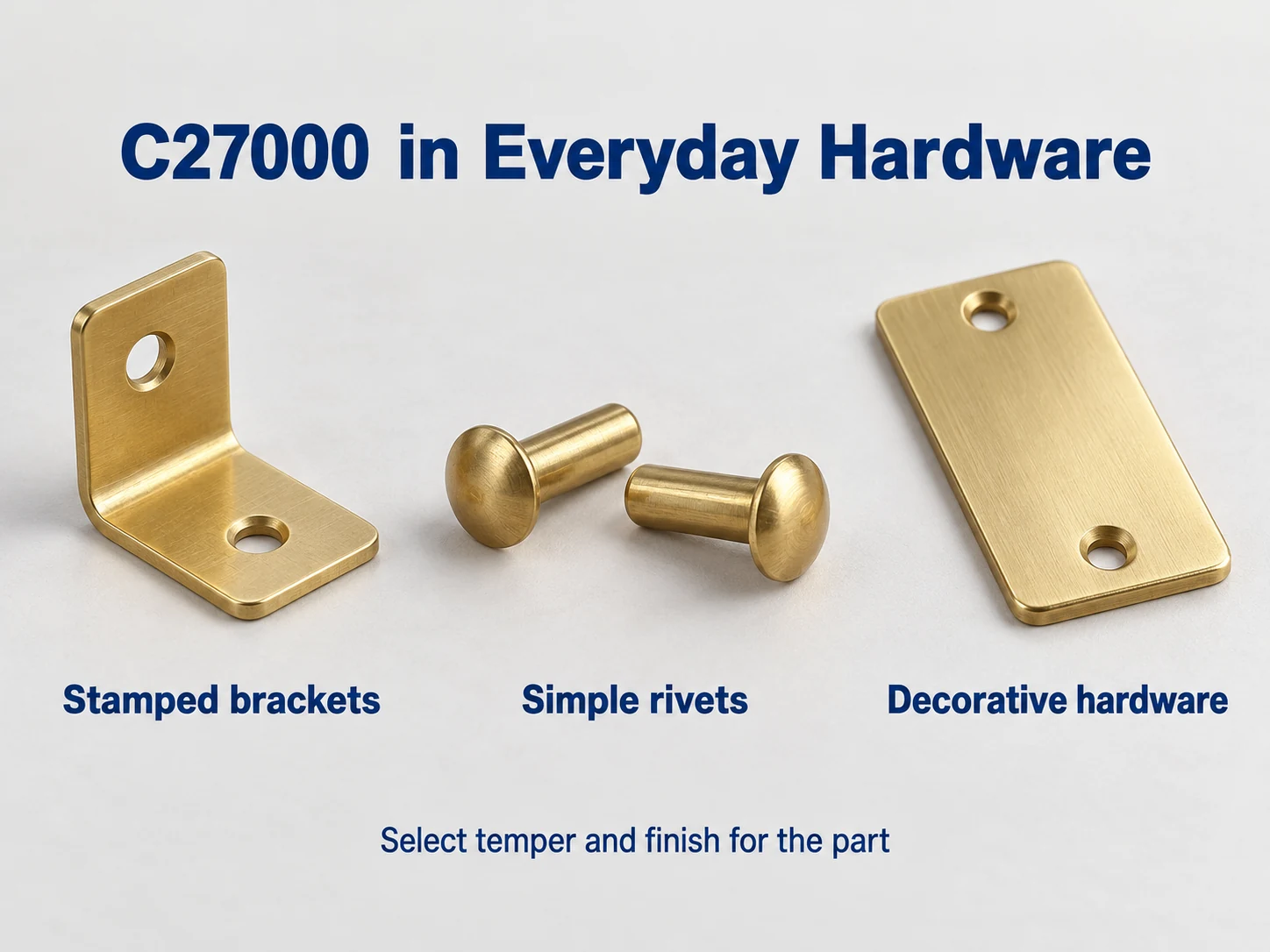
On stamping, bending and cold heading it is adequate, not marginal. Blanking, moderate draws, coining, and headed fasteners all run. What it delivers in exchange is real: roughly 5% more tensile than C26000 at a matched temper, at five points less copper.
The cold-heading claim needs calibrating. C26000 remains the reference grade for severe cold heading — the standard choice for wood screws and mass-produced rivets. C27000 is the general-purpose alternative where the head is less demanding and the balance of strength and cost matters more. Calling it the heading grade would overstate it.
Hot forming is where it quietly wins. C27000 enters the alpha-beta field when heated, so it hot rolls, forges and extrudes more readily than C26000, which stays single-phase. A part that gets hot worked before finishing belongs on this grade rather than 70/30 — and this advantage is usually left out of the comparison.
Temper, Form and Finish
Standards follow the form, not the grade.
| Form | Standard | Note |
|---|---|---|
| Plate, sheet, strip | ASTM B36 | C27000 is in the alloy scope |
| Wire | ASTM B134 | Confirm on the enquiry |
| Seamless tube | ASTM B135 | Confirm grade coverage |
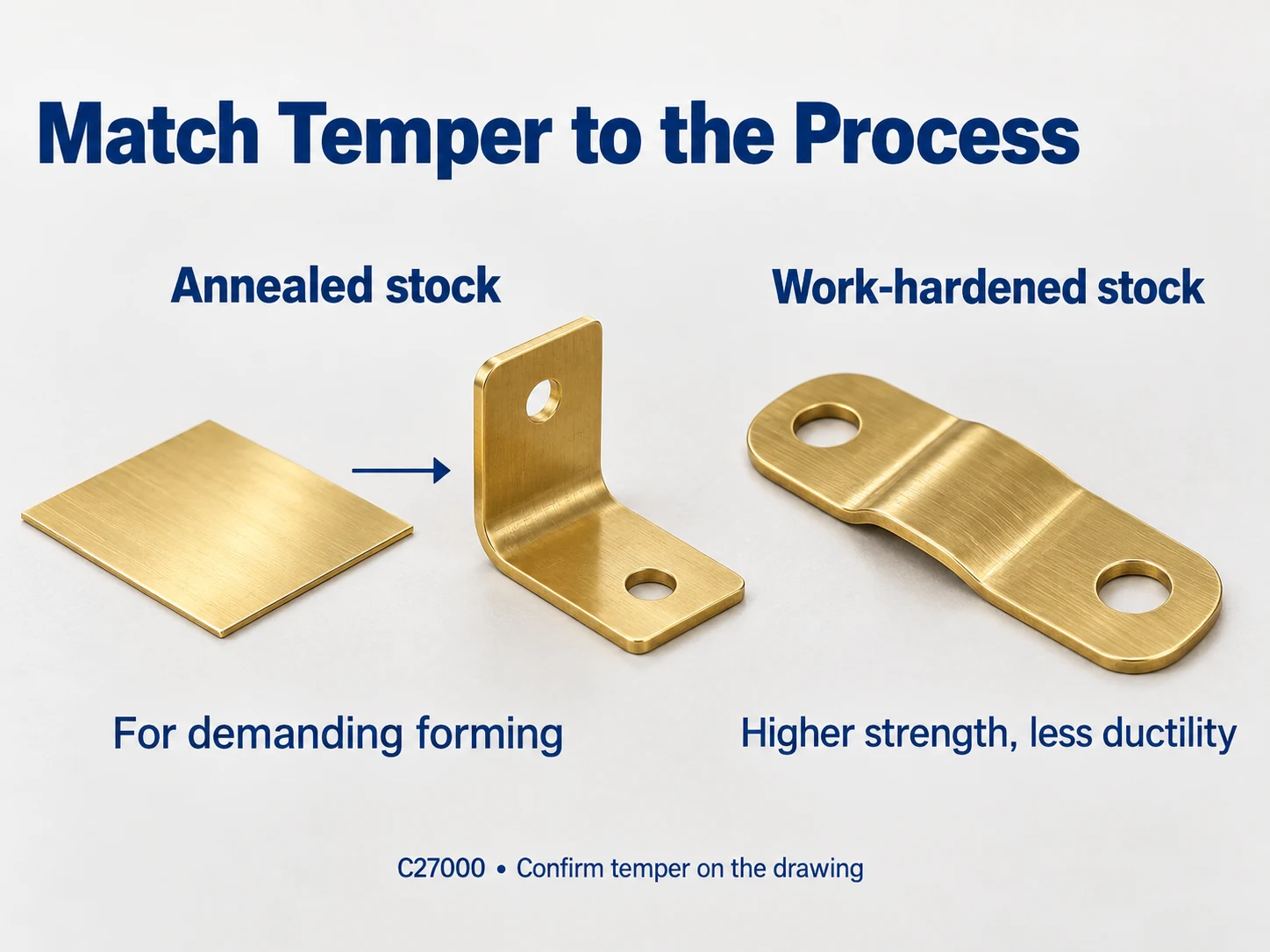
Temper has to be chosen by the order of operations, and decorative parts add a step most tables ignore. Annealed (O) for a part that is formed and then polished; H02 where the stamped shape must stay flat afterwards; H04 only where nothing is formed after the press.
Linsy Copper supplies C27000 as sheet, strip and plate to the temper the drawing names, with an MTR/MTC for every lot. Stamping and bending plus surface finishing run on the same order, so a part that is formed and then bright-polished stays on one document package. Non-stock sizes and tempers run low-MOQ custom production.
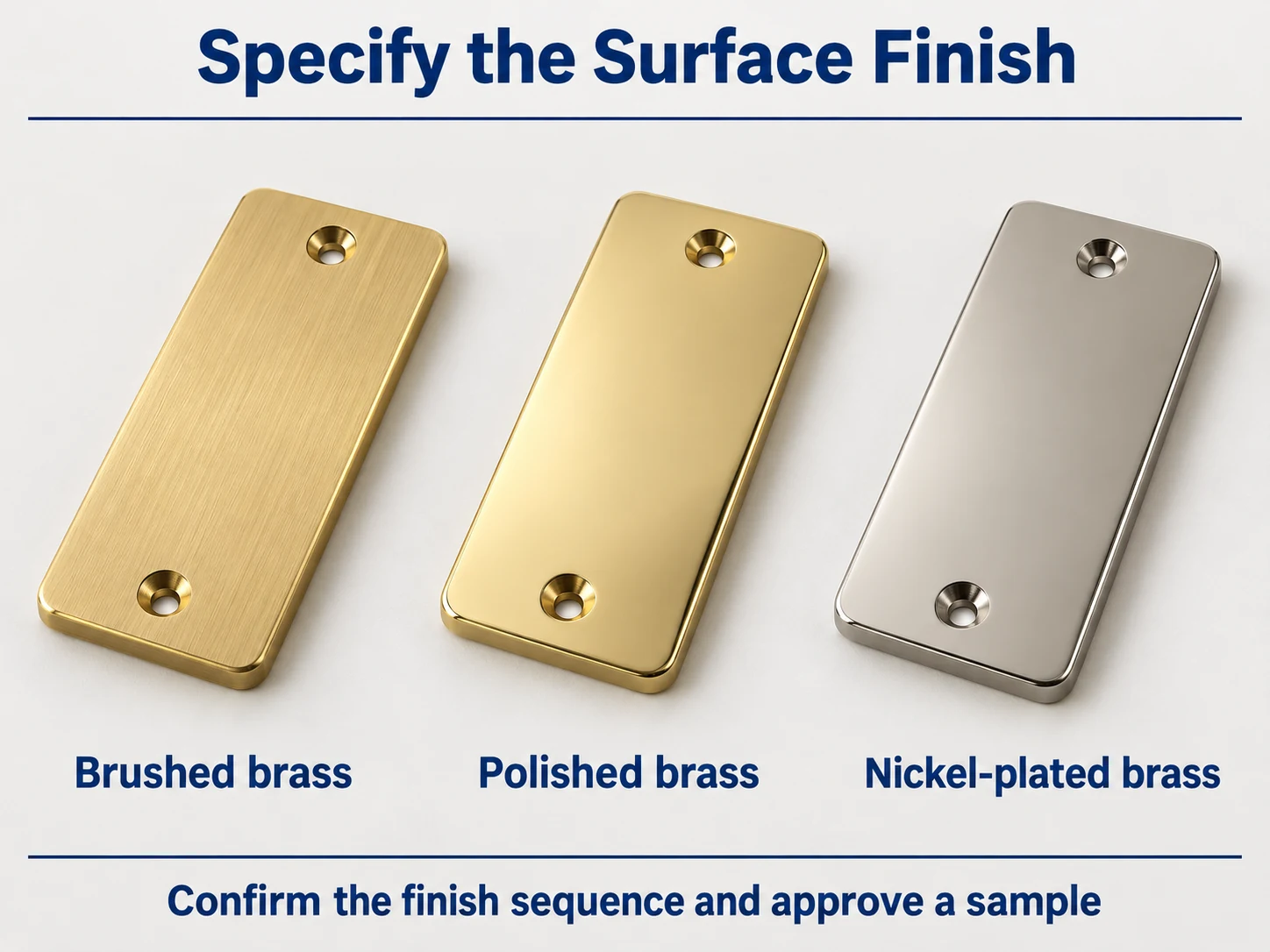
On a visible part the finish is a material decision, not a coating decision.
Polished and brushed finishes show the base alloy, so a heat at the low end of the copper band reads slightly redder than one at the high end — enough to be visible on a batch of handles standing side by side. Plating hides that, but adds a step where adhesion depends on how clean the surface was before it went in. Either way the finish and its sequence belong on the drawing, alongside the temper.
C27000 vs C26000 and C27400
| Grade | Cu | Pb | Cold forming | Hot forming | Machinability | Modulus |
|---|---|---|---|---|---|---|
| C27000 | 63.0–68.5 | ≤0.09 | Good | Good | 30 | 105 GPa |
| C26000 Cartridge Brass | 68.5–71.5 | ≤0.07 | Excellent | Fair | 30 | 110 GPa |
| C27400 Yellow Brass | 61.0–64.0 | ≤0.10 | Excellent | Poor | 35 | 105–110 GPa |
Against C26000 the trade is explicit: five points of copper and some forming margin given up, in exchange for strength and cost. One grade sits outside this comparison — the C36000 Free-Cutting Brass at 100 on the machinability scale is not a forming grade at all, and a part whose cycle time is set by turning belongs there rather than here.
C27000 and C27400 overlap, and it is worth knowing where. Their copper bands intersect between 63.0 and 64.0, so a single heat at 63.5% satisfies either grade, and the properties run close: both are alpha-forming brasses with modest machinability. The distinction is not in the name but in the number you order. Specify the copper band on the drawing rather than the grade alone, and the overlap stops being a problem.
Limitations
It is not the deep-drawing grade. Moderate draws and tight bends are fine; a geometry that asks for the last of the ductility cracks at the bend line, and no temper change recovers ductility the composition does not contain. That job is C26000’s.
It is not a free-cutting brass. An index of 30 means continuous chips and a low speed ceiling. A quote built on C36000 cycle times will miss, and high-volume turned work should not move here.
It corrodes like a plain brass, because it is one. No inhibitor is added, so dezincification — zinc leaving the alloy and leaving a porous copper residue — is a live risk in warm, stagnant or chloride-bearing water. This grade does not belong in potable-water or seawater service, and the fact that it carries low lead does not change that.
Residual stress is a hazard in the wrong atmosphere. Cold-worked C27000 cracks in ammonia-bearing, amine and mercury service unless stress-relieved after forming, so a formed part headed for that kind of environment wants an anneal.
When to Choose C27000
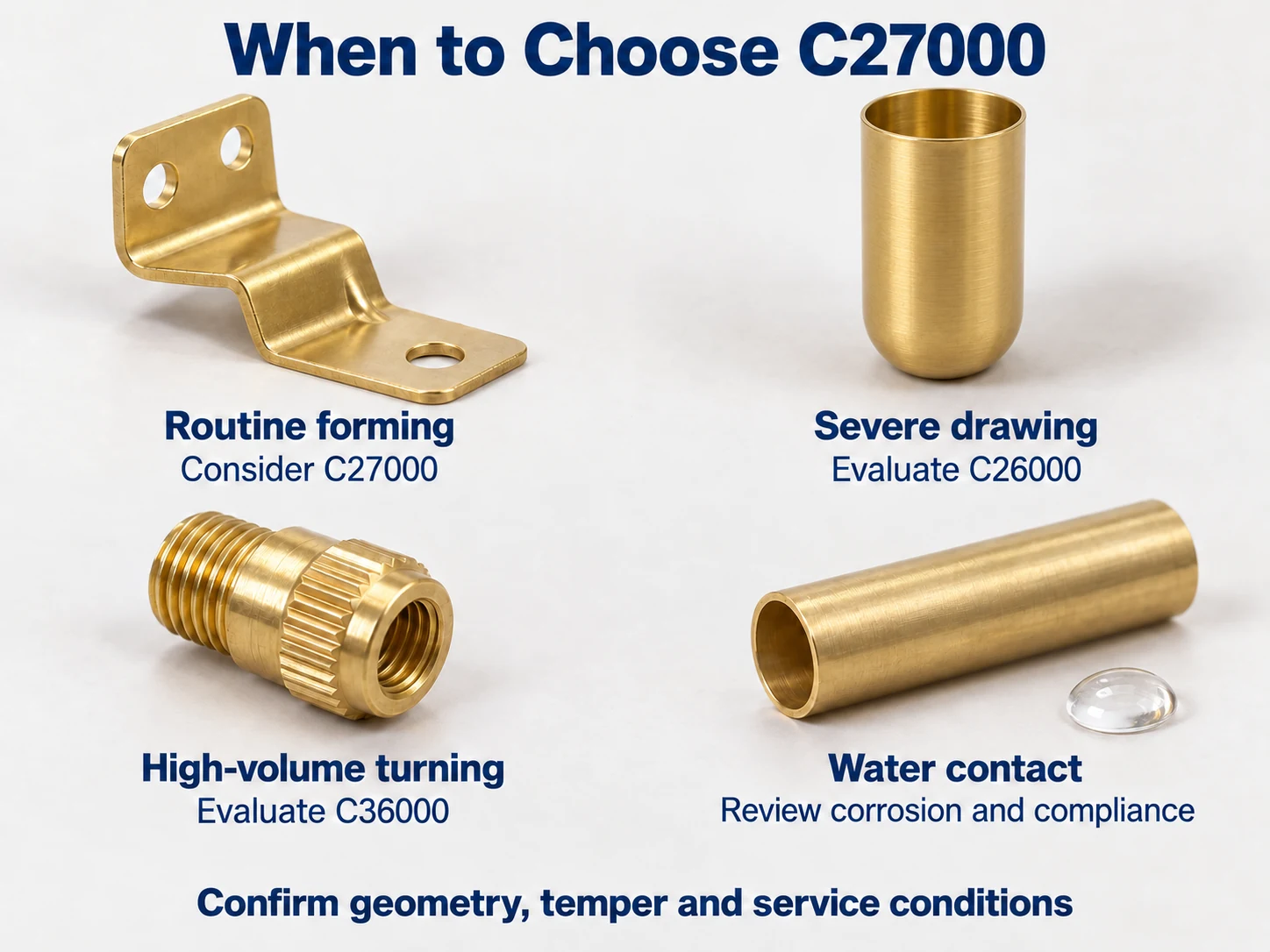
Choose it when the part is stamped, bent or headed to a moderate severity, the finish is visible or the material cost matters, and 300–500 MPa is enough at the temper you need.
Move to C26000 when the draw is deep, the radii are tight, the walls are thin, or the forming step is the one that worries you. The extra copper buys margin you cannot get back any other way.
Move to C36000 when machining sets the cycle time. The threefold gap in machinability outruns the material saving every time.
For a quote, send the UNS number with its common name, the product form, the temper matched to the order of operations, the standard for that form, the copper band if your process is sensitive to it, and the finish with its position in the sequence.
Two of those get skipped most often, and both cost money. The copper band matters because five and a half points is wide enough to change a bend result, and a mill will ship anywhere inside it unless you narrow it. The finish sequence matters because plating after forming and plating before forming are different processes with different rejection rates, and the drawing rarely says which one was quoted.
Conclusion
C27000 earns its place on cost, color and hot working — not on being a stronger C26000, which it is not. Used for moderate forming and visible hardware it is the economical answer; used where the draw is severe, it is the expensive one, because the saving arrives as scrap.
We will check both against your drawing on the values that govern it: forming severity where the press sets the limit, temper where strength does, and finish where the part is seen. Send the drawing with the forming step and the finish marked and we will confirm grade, temper and form.
FAQ
Is C27000 good enough for deep drawing, or do I need C26000?
Moderate draws are routine; a draw near the alloy’s ductility limit is not. C26000 carries more margin at five points more copper, and no temper adjustment recovers margin the composition does not have. When the geometry is borderline, form a sample in both.
Can C27000 be used for potable-water or marine fittings?
No. It is a plain alpha brass with no dezincification inhibitor, and warm, stagnant or chloride-bearing water attacks it. Low lead content does not make it water-safe — those are two separate questions.
How do I keep color consistent across decorative batches?
Pin the copper band on the drawing rather than relying on the grade name, since five and a half points is wide enough to show on a polished surface. State the finish and whether it is polished or plated, and check the first article under the final finish.
What temper for a part that is stamped and then polished? Annealed (O) where the stamping is the demanding step, because polishing removes very little and cannot fix a shape that sprang back. H02 where the stamped form must hold flatness through finishing. Name it on the order.

David Huang is a copper materials specialist and Sales Manager at Linsy Copper, with years of hands-on experience supporting global customers in copper and copper alloy sourcing.
He specializes in industrial copper products such as C11000 copper, C10200 oxygen-free copper, brass, bronze, copper sheets, plates, tubes, bars, and custom-processed copper components.
With a practical understanding of copper manufacturing, quality inspection, surface treatment, and export supply chains, David helps customers choose the right materials for electrical, mechanical, marine, construction, and industrial applications.