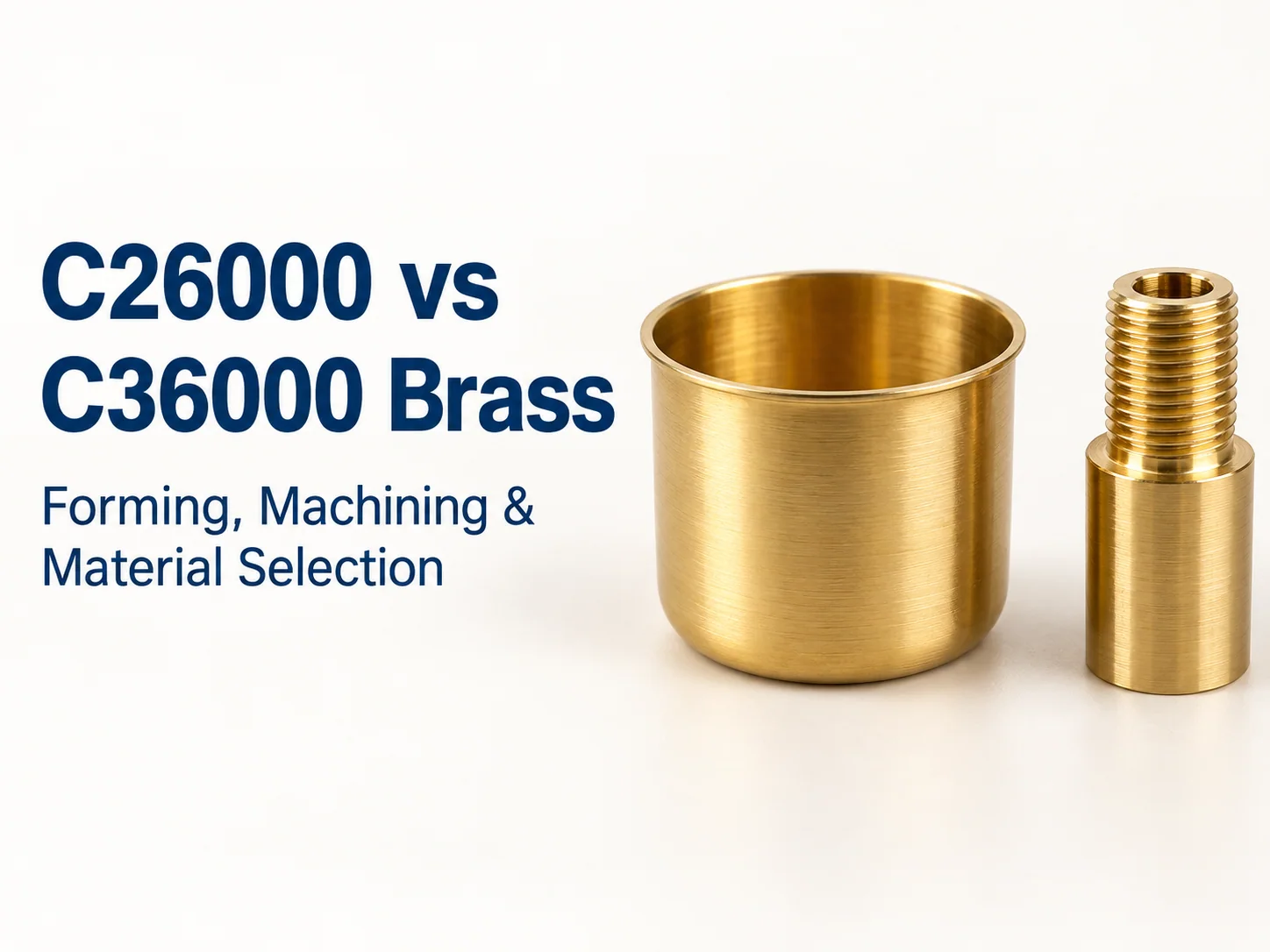
C26000 vs C36000 brass compared: composition, stiffness, strength by temper, forming, machining and lead considerations.
Both alloys are yellow brass, both turn up on drawings that just say “brass”, and both cost roughly the same per kilo. The differences that matter sit in three places: how much copper is in them, how stiff they are, and how much lead was added to make them cut. Everything else follows from those three, and one of them — stiffness — decides parts that the usual machinability-versus-formability argument never reaches.
Composition: Eight Points of Copper and a Lead Band
C26000 Cartridge Brass and C36000 Free-Cutting Brass differ by roughly eight points of copper and by the presence or absence of a deliberate lead addition. The limits below come from the specification governing each alloy’s main product form: ASTM B19 for C26000 sheet and strip, ASTM B16 for C36000 rod and bar.
| Element | C26000 (ASTM B19, sheet/strip) | C36000 (ASTM B16, rod/bar) |
|---|---|---|
| Copper (Cu) | 68.5–71.5% | 60.0–63.0% |
| Lead (Pb) | 0.07% max | 2.5–3.0% |
| Iron (Fe) | 0.05% max | 0.35% max |
| Zinc (Zn) | Remainder | Remainder |
Nearest EN designations are CW505L (CuZn30) for C26000 and CuZn36Pb3 (CW603N) for C36000.
Two readings of that table. The lead row is categorical rather than a matter of degree: 0.07% max is an impurity ceiling, while 2.5–3.0% is an alloying addition put there on purpose. The copper row is arithmetic — the eight points C36000 gives up are replaced by zinc, which is cheaper.
Every measurement below descends from those two facts.
Physical Properties: Where They Actually Diverge
Manufacturers publish these two side by side so often that the rows look interchangeable. They are not, and one row in particular separates them by more than a rounding error.
| Property | C26000 | C36000 | Practical effect |
|---|---|---|---|
| Density | 8.53 g/cm³ | 8.50 g/cm³ | Negligible — 0.35% apart |
| Melting range | 915–955 °C | 885–900 °C | C36000 is the lower-melting alloy by ~30 °C |
| Modulus of elasticity | 110 GPa | 97 GPa | C36000 is 12% less stiff at the same section |
| Thermal conductivity | 120 W/m·K | 115 W/m·K | Close; neither is a heat-sink grade |
| Electrical conductivity | 28% IACS | 26% IACS | Close; both near a quarter of pure copper |
| Thermal expansion | 19.9 ×10⁻⁶/K | 20.5 ×10⁻⁶/K | C36000 grows ~3% more per degree |
The modulus row is the one that changes designs. A part sized for deflection rather than strength — a spring finger, a thin bracket, a probe body, a contact beam — deflects about 13% more under the same load and support conditions, within the elastic range in C36000 than in C26000, at identical geometry and identical tensile numbers. Two drawings can agree on strength and disagree on stiffness, and the spec sheet will not warn anyone because most comparison tables omit modulus entirely.
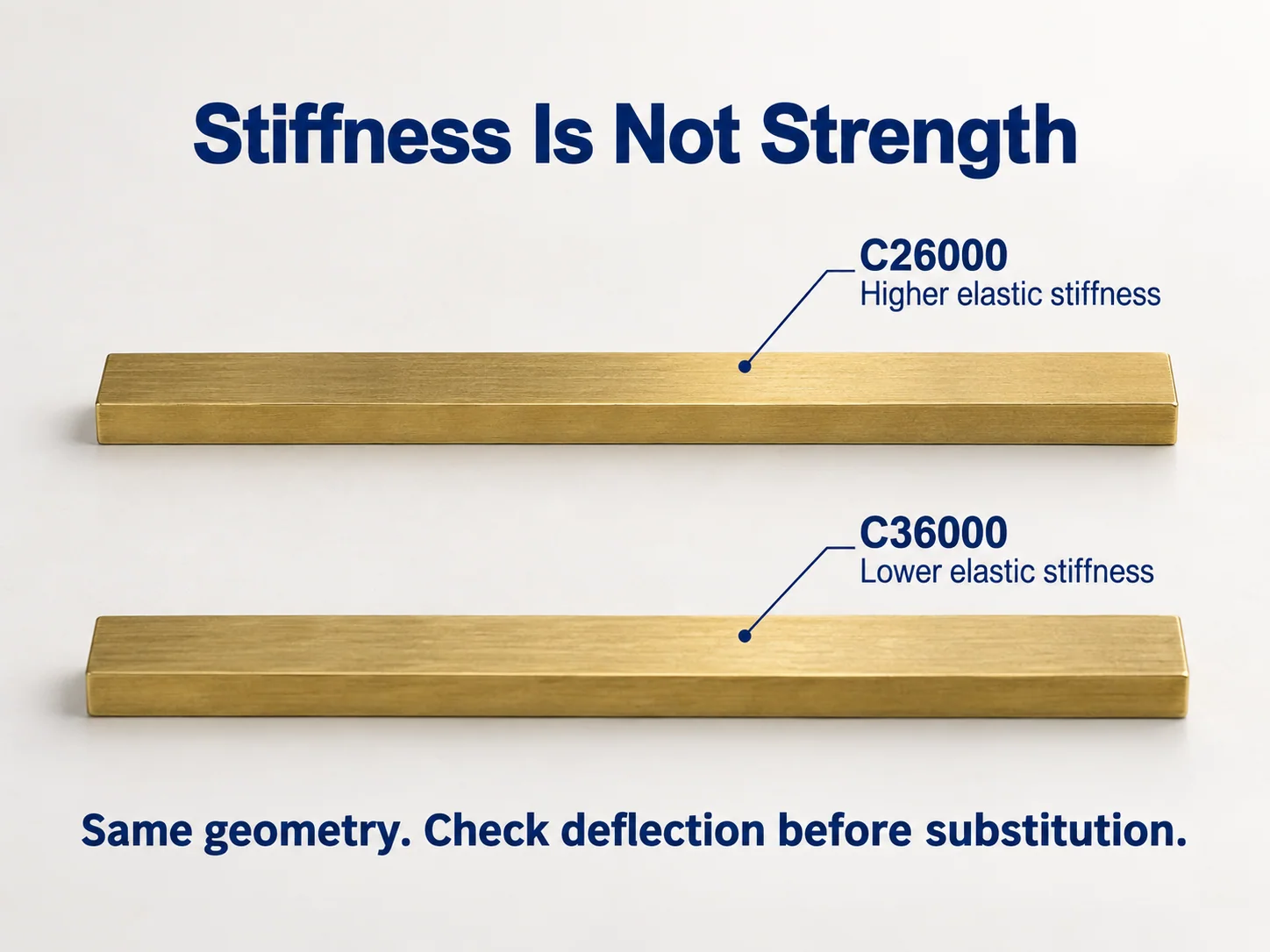
Melting range is the second useful row. The lower melting range reduces the temperature margin available during joining; it does not by itself establish that C36000 is easier to braze.
Conductivity and density are the rows that genuinely do not decide anything. A two-point spread in %IACS does not change a connector design, and 0.35% in density does not change a freight calculation.
Mechanical Properties: Temper Moves Them More Than Grade Does
Strength in both alloys is a function of cold work, and the temper range inside one grade is wider than the gap between the two grades.
| Condition | C26000 tensile | C26000 yield (0.2%) | C36000 tensile | C36000 yield |
|---|---|---|---|---|
| Annealed (O) | ~315–345 MPa | ~90–125 MPa | ~338–380 MPa | ~124–140 MPa |
| Half hard (H02) | ~425 MPa | ~360 MPa | ~415–470 MPa | ~165–345 MPa |
| Hard / spring | ~585–650 MPa | ~450 MPa | ~450–485 MPa | ~180–380 MPa |
| Hardness | 55–65 HRF annealed; ~70 HRB H02; ~82 HRB H04 | ~50–60 HRB annealed; ~75–85 HRB H02; 80–90 HRB H04 |
Read down a column, not across. C26000 ordered hard is stronger than C36000 ordered annealed, so any claim that one alloy is “stronger” is really a statement about which tempers are being compared. These are typical mill values across conditions, not guaranteed minima — the certificate for your lot is the authority.
What the table does show across the full range: C26000 reaches higher tensile and yield at its hardest tempers, because it can absorb more cold work before it needs annealing. C36000 tops out lower and gets there with less work, which is the same property that makes it cut freely.
Why the Two Behave Differently
The composition gap produces two different crystal structures, and the structure explains the rest.
At 70% copper, C26000 sits well inside the alpha field — a single-phase solid solution, face-centred cubic throughout, with no second phase to interrupt deformation. That is what allows the 50–65% elongation in the annealed condition and reduction in the region of 65% between anneals. Alpha brass draws.
At 60% copper, C36000 sits at the alpha-beta boundary, so a beta phase appears alongside the alpha grains. Beta is harder and stronger than alpha at room temperature, and it also resists the kind of uniform slip that deep drawing depends on. The alloy gains strength and loses the ability to flow.
The lead then does its own work. It is insoluble in the matrix, so it sits as discrete particles, and under a cutting edge those particles open cracks in the chip ahead of the tool — the chip breaks short instead of running on.
It is not a lubricant; the effect is fracture, not slipperiness. Which is why the same addition that makes C36000 cut cleanly is what makes it crack under a heavy draw.
One addition, two consequences. That is the whole trade in a sentence.
What That Means for the Part
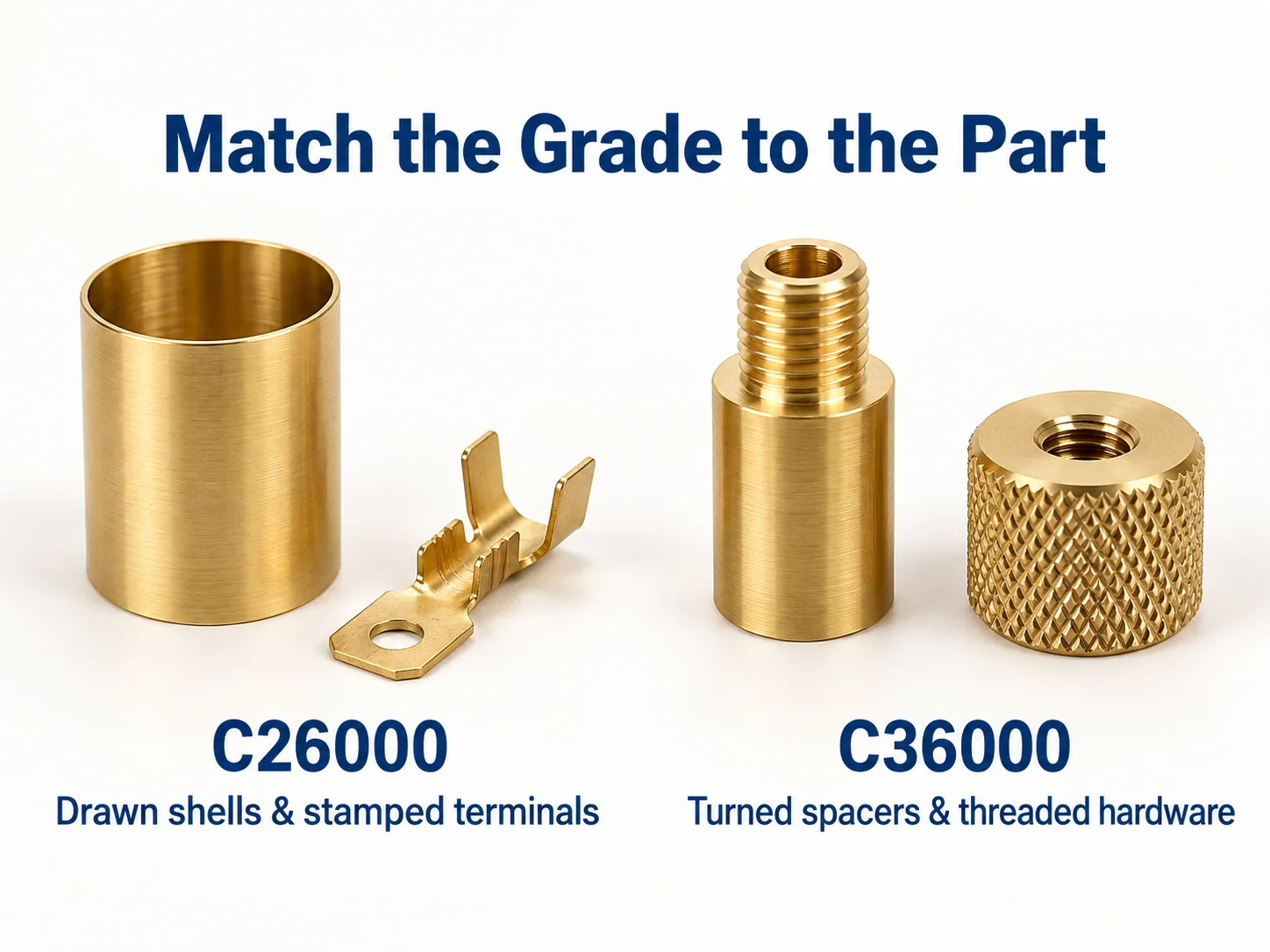
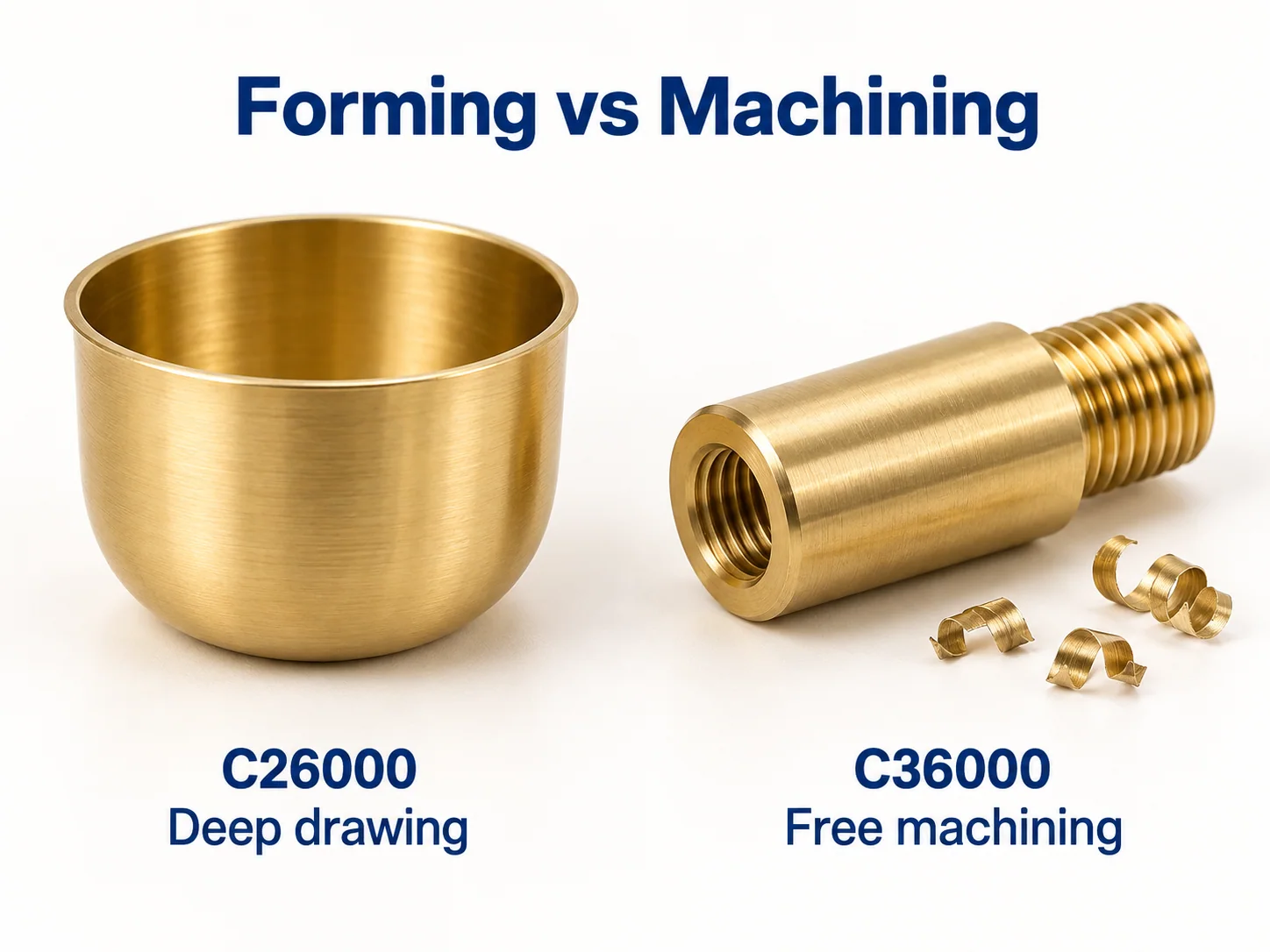
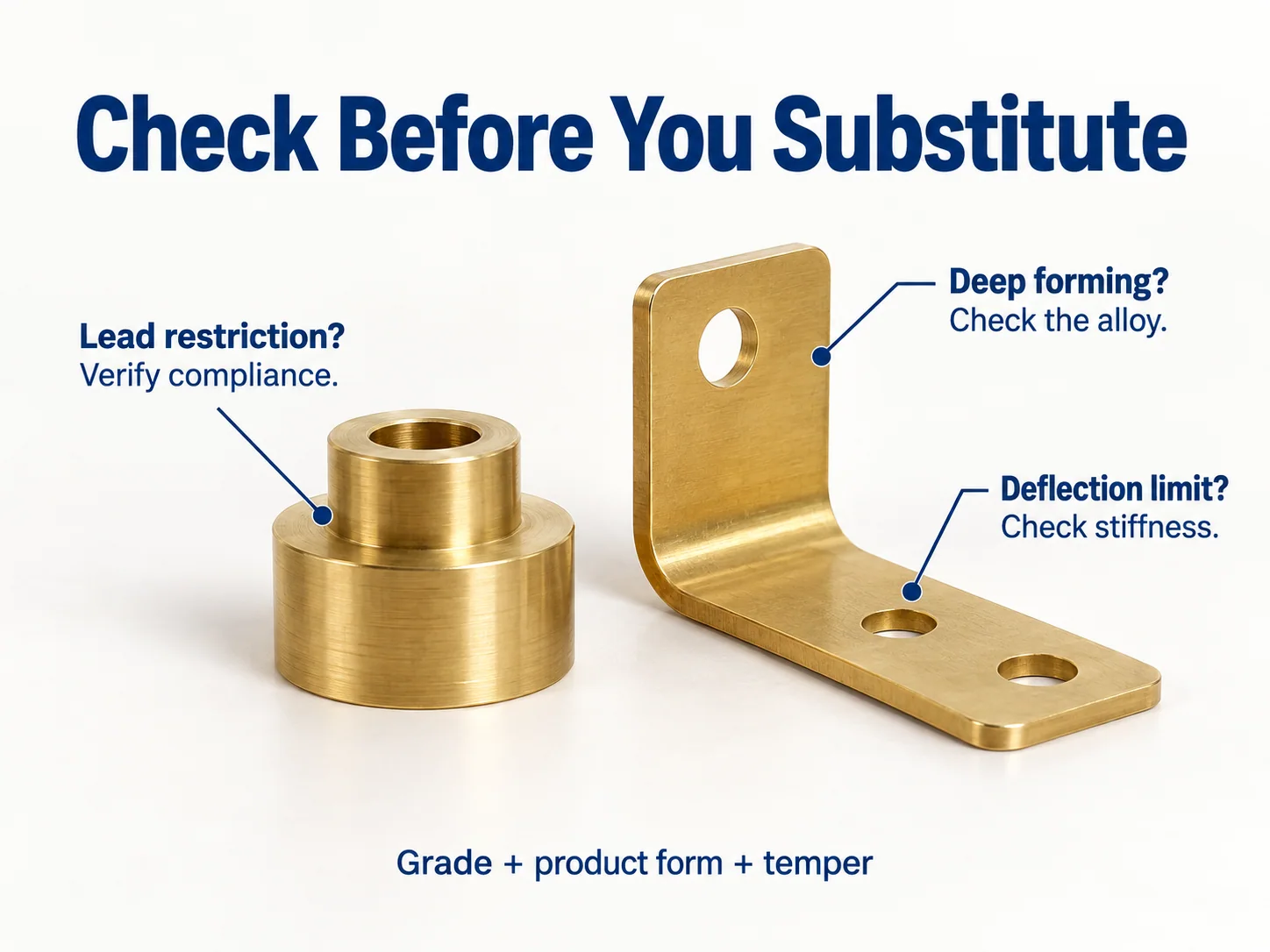
Forming. C26000 is the reference alloy for cold drawing: deep cups, spun shells, tight-radius bends, multi-stage draws with intermediate anneals. C36000 takes light forming — a shallow bend, a staked feature — and cracks when pushed into the deep-draw territory C26000 handles routinely. A drawing that needs a cup deeper than its own diameter is not a C36000 part regardless of how the strength numbers read.
Machining. C36000 is the benchmark at 100 on the CDA scale; C26000 rates 30. The gap shows at the spindle as chip behaviour — short fragmented chips that fall clear against long stringy ones that nest in the work zone and stop the cycle for clearing.
On an automatic screw machine that is throughput. On a drawn shell with a few drilled holes it is a nuisance, not a reason to change grade. Cutting data for the free-cutting route sits in the C36000 Free-Cutting Brass Guide.
Stiffness. The 110 versus 97 GPa modulus matters wherever deflection is the design constraint rather than stress. A part that must not move more than a set amount under load needs the stiffer alloy, and no amount of temper adjustment recovers stiffness — modulus is a property of the alloy, not of the cold work.
Joining. Both solder and braze well. CDA rates C26000 as excellent for brazing and C36000 as good. Joining suitability and process temperature must be checked for the specific alloy; a lower melting range does not by itself make brazing easier. Both can produce zinc fumes during arc welding.
Lead and Where It Puts Each Grade
The lead row in the composition table is the one that can end a project.
C26000 carries 0.07% max — an impurity level, not a functional addition. C36000 carries 2.5–3.0%, which puts it outside drinking-water rules and inside the copper-alloy RoHS exemption that currently runs to 30 June 2027.
Rules differ in what they measure as well as in where they apply. Some cap lead in the composition; others cap what the finished part leaches into water, and a lot can clear the first and fail the second.
For machined parts facing a lead limit, the Lead-Free Brass for CNC Machining guide covers the substitutes; for thresholds by market, see compliance by destination market.
Water service adds a second variable. Dezincification — zinc dissolving preferentially out of the alloy — depends on zinc content, temperature and flow, not on which grade machines better. Higher-zinc C36000 is the more exposed of the two.
Standards and Forms
The grade name does not tell a mill which acceptance table applies; the product form does.
| Form | C26000 | C36000 |
|---|---|---|
| Rod, bar, shapes | B453 | B16 (screw machine stock) |
| Plate, sheet, strip | B19 (also B36) | B121 |
| Seamless tube | B135 | — |
| Wire | B134 | — |
Order by UNS number, form, and temper together. “C26000 sheet” without a temper tells the mill nothing about the strength or the formability the part needs, and the same grade under two standards carries a slightly different acceptance window.
Every lot ships with an MTR/MTC tied to the heat number. The certificate, not a catalogue range, is the final word on the chemistry and mechanicals you actually received.
Sourcing C26000 and C36000
Both grades sit in Linsy Copper’s brass range, supplied to the temper the drawing names with an MTR/MTC for every lot. Stamping and bending and CNC machining both run in-house, so a part that forms a shell and then drills it can hold one document package across both steps. SGS chemical, mechanical and conductivity reports are available on request at extra cost, and non-stock sizes and tempers run low-MOQ custom production.
Conclusion
C26000 and C36000 differ in copper content, in stiffness and in lead — and those three differences decide forming, machining and compliance between them. Choosing on colour or on a single strength number gets the part wrong in a way the spec sheet will not flag.
We will compare both against your drawing on the values that govern it: modulus where deflection sets the limit, temper where strength does, and lead where the market does. Send the drawing with the governing requirement marked and we will confirm grade, form and standard before material is cut.
FAQ
Is C26000 stronger than C36000?
At their hardest tempers, yes — C26000 reaches roughly 585–650 MPa tensile against 450–485 MPa for C36000. At matched tempers the gap narrows and in the annealed condition C36000 is the stronger of the two. Compare at one temper before drawing a conclusion.
Can I substitute C36000 for C26000 to cut machining cost?
Only where the part does no deep forming and stiffness is not the constraint. C36000 is 12% less stiff and cracks when pushed into deep draws. A shallow-bend part with light turning is the realistic case for that swap.
Do the two grades have the same elastic modulus?
No — 110 GPa for C26000 against 97 GPa for C36000. Most published comparison tables omit the row, so a deflection-critical part can be moved between them and fail on stiffness while every strength figure still checks out.
What are the lead limits on each grade?
C26000 carries 0.07% max, an impurity ceiling. C36000 carries 2.5–3.0%, a deliberate addition that puts it outside drinking-water rules and within the copper-alloy RoHS exemption running to 30 June 2027. Confirm the governing rule against the certificate for your lot.

David Huang is a copper materials specialist and Sales Manager at Linsy Copper, with years of hands-on experience supporting global customers in copper and copper alloy sourcing.
He specializes in industrial copper products such as C11000 copper, C10200 oxygen-free copper, brass, bronze, copper sheets, plates, tubes, bars, and custom-processed copper components.
With a practical understanding of copper manufacturing, quality inspection, surface treatment, and export supply chains, David helps customers choose the right materials for electrical, mechanical, marine, construction, and industrial applications.