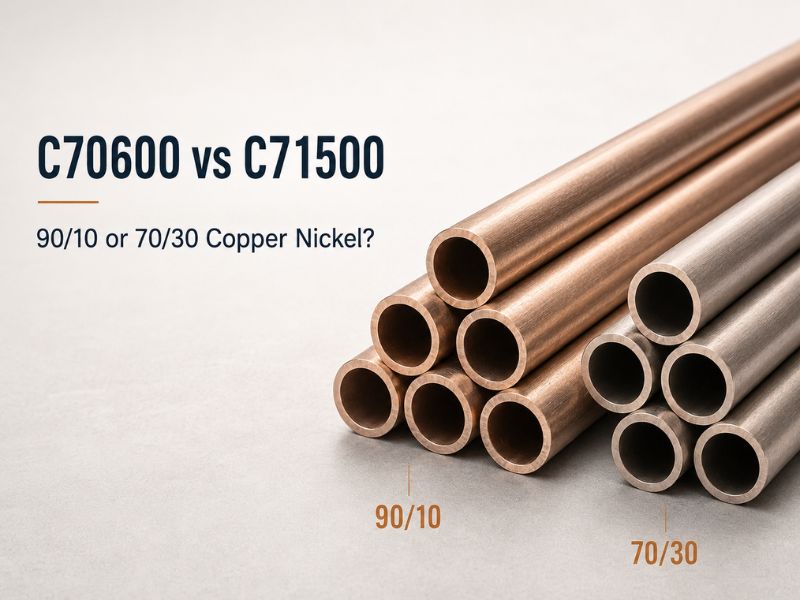
C70600 (90/10) and C71500 (70/30) are the two dominant copper-nickel alloys for seawater service. Both resist corrosion, both are weldable, and both provide chloride SCC immunity in hot seawater where 316L cracks. The question isn’t which is better — it’s where the cost-strength-corrosion trade-off tips for a given project.
Chemical Composition — Side by Side
ASTM B122 limits for both grades (weight %):
| Element | C70600 (90/10) | C71500 (70/30) |
|---|---|---|
| Cu (incl. Ag) | Remainder | Remainder |
| Ni (incl. Co) | 9.0 – 11.0 | 29.0 – 33.0 |
| Fe | 1.0 – 1.8 | 0.40 – 1.0 |
| Mn | 1.0 max | 1.0 max |
| Zn | 1.0 max | 1.0 max |
| Pb | 0.05 max | 0.05 max |
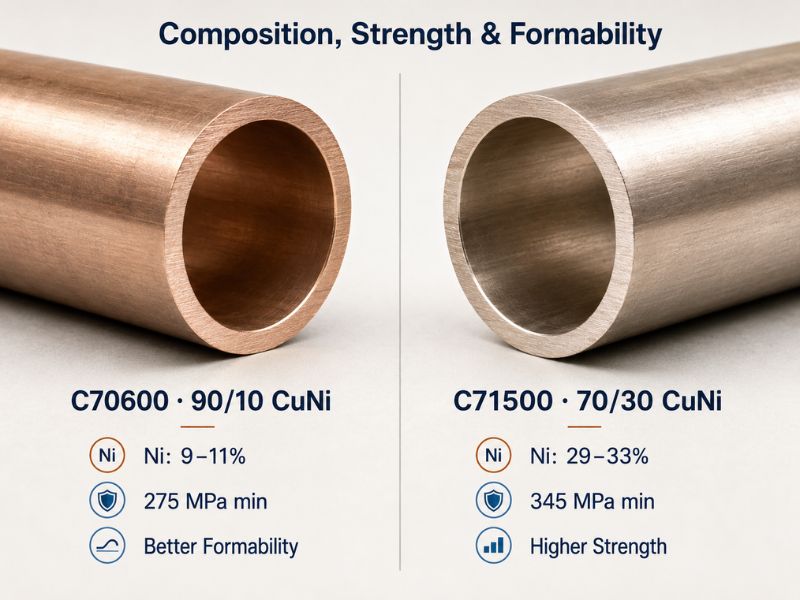
C71500 carries roughly three times the nickel. The higher iron range in C70600 (1.0–1.8%) vs C71500 (0.4–1.0%) compensates somewhat for the lower nickel by boosting the protective oxide film. But the sheer nickel content in C71500 ultimately provides superior corrosion resistance at higher flow velocities.
Mechanical Properties Comparison
| Property | C70600 (Annealed) | C71500 (Annealed) |
|---|---|---|
| Tensile Strength (MPa) | 275 min | 345 min |
| Yield Strength (MPa) | 105 min | 125 min |
| Elongation (%) | 30 min | 35 min |
| Hardness (Rockwell B) | ~35 | ~45 |
C71500 gives roughly 25% higher tensile strength. In practical terms: a C71500 tube wall can be thinner than a C70600 tube wall for the same pressure rating, which offsets some of the weight and material cost penalty.
C71500 work-hardens faster. If your forming process involves tight-radius bends, flaring, or expansion, annealed temper is mandatory for both grades — but it’s especially critical for C71500 in half-hard condition.
Corrosion Resistance in Seawater
| Factor | C70600 (90/10) | C71500 (70/30) |
|---|---|---|
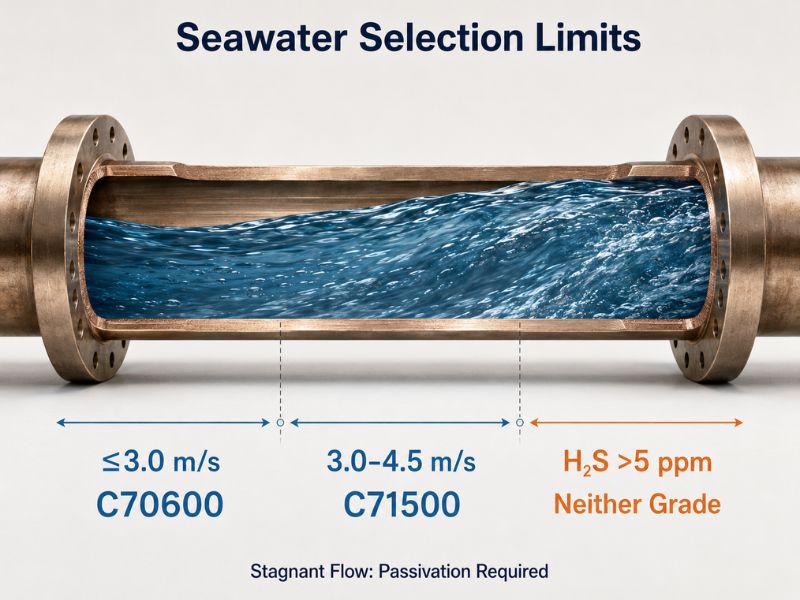
| Seawater velocity limit | ~3.0 m/s | 4.5 m/s (max 5.0) |
| Resistance to impingement | Good | Excellent |
| Pitting under stagnant flow | Moderate risk | Lower risk, but still requires passivation |
| Chloride SCC | Immune | Immune |
| H₂S / polluted seawater | Susceptible | Less susceptible, but still limited |
Both alloys share the same advantage over stainless steels: immunity to chloride stress corrosion cracking. 316L in hot seawater will crack. C70600 and C71500 do not.
Go/No-Go Selection Rules
Use this quick reference to decide which grade fits your seawater service.
- Flow velocity above ~3.0 m/s (up to 4.5 m/s design, 5.0 m/s max with proper design) → C71500. Impingement attack at tube inlets and U-bends will erode C70600 beyond safe limits.
- Stagnant or intermittent flow → both grades require a commissioning passivation run. Neither alloy tolerates dead-leg service without conditioning.
- H₂S above 5 ppm in seawater → neither grade is recommended without water treatment. Consider super-austenitic stainless or titanium.
Thermal and Electrical Conductivity
| Property | C70600 | C71500 |
|---|---|---|
| Electrical Conductivity (% IACS) | ~11 | ~4.6 |
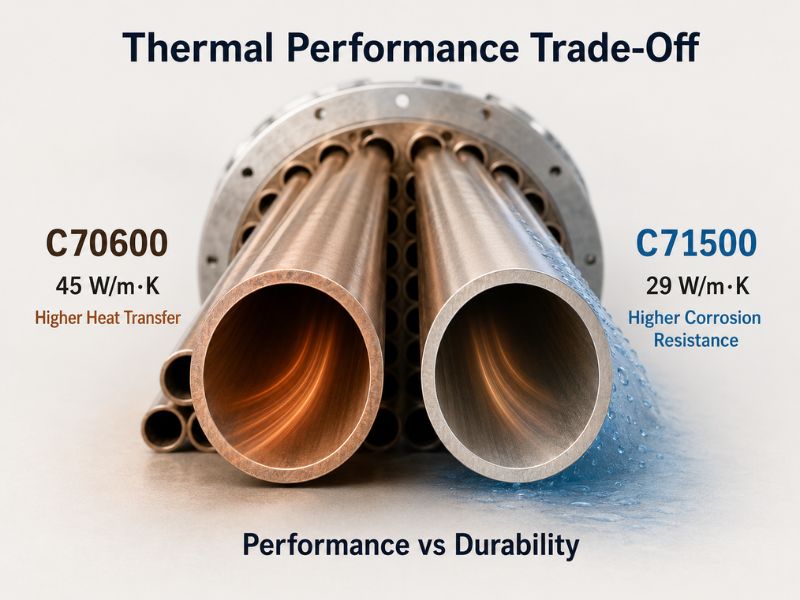
| Thermal Conductivity (W/m·K) | 45 | 29 |
Neither alloy is specified for electrical or thermal conductivity — pure copper occupies that application space. But C70600’s thermal conductivity is roughly 55% higher than C71500’s. This matters in heat exchanger design: because tube-wall conduction is not the only resistance in a real exchanger, the practical surface-area penalty for C71500 is closer to 35% (not the full 55% conductivity gap) to achieve the same heat transfer rate, all else equal.
For most marine heat exchangers, this cost penalty is acceptable because the tube material cost is a small fraction of the total exchanger cost. The more corrosive the cooling water, the more C71500’s thermal penalty becomes worthwhile.
Weldability and Fabrication
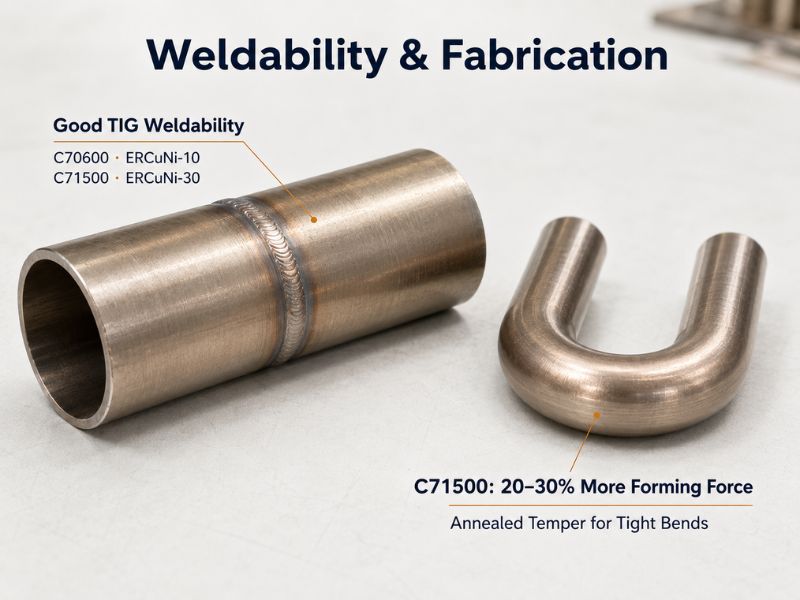
Both grades weld well with GTAW (TIG) using matching filler wire:
- C70600 (90/10) → ERCuNi-10 class filler
- C71500 (70/30) → ERCuNi-30 class filler, or ERNiCu-7 (nickel-copper wire)
Key fabrication differences:
- C71500 needs about 20–30% more force for the same bending or forming operation compared to C70600 in the same temper. Tooling designed for C70600 may stall or produce incomplete bends with C71500.
- Both grades are hot-workable, but C70600 has a wider hot-working window (~850–1050°C vs ~900–1000°C for C71500). This rarely matters for end-users but affects mill pricing and lead times.
- Neither requires post-weld heat treatment for most service environments. For pressure vessel code work, check ASME Section VIII requirements for your specific service condition.
Cost and Availability
| Factor | C70600 | C71500 |
|---|---|---|
| Material cost (per kg) | Baseline | +20–30% |
| Stock availability (tube) | High | Moderate |
| Typical lead time (mill run) | 4–6 weeks | 6–10 weeks |
| Common forms in stock | Tube, pipe, plate | Tube, plate (less pipe) |
The nickel content drives the cost difference. When nickel prices spike, the gap widens further. C70600 is the cost-effective default for general marine service; C71500 is specified when velocity, water chemistry, or code requirements demand the higher-nickel grade.
Sourcing note: many service centers carry C70600 tube as a stock item. C71500 tube in non-standard sizes is frequently a mill-direct order. Linsy supplies both grades across sheet, plate, and tube — contact Linsy Copper for current stock availability and lead times for your specific size and quantity.
Application Fit — Which Grade to Choose?
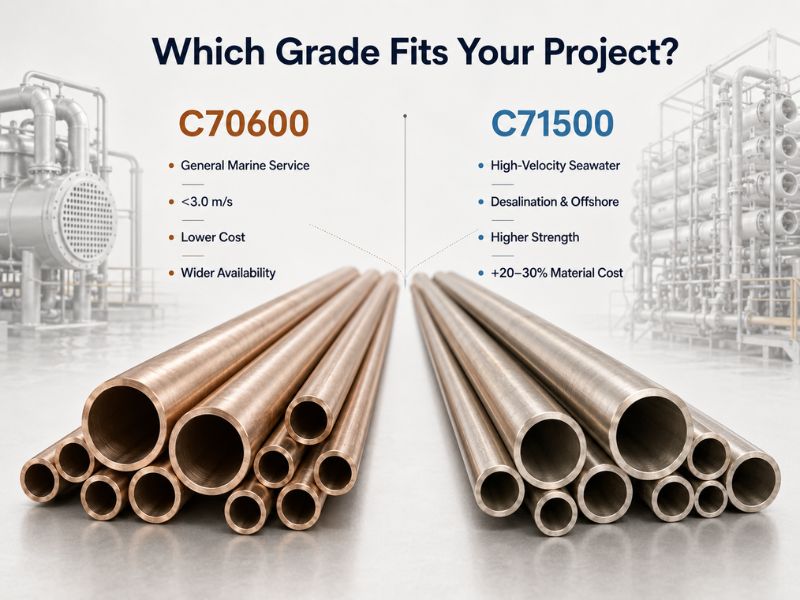
| If your application involves… | Choose |
|---|---|
| General marine seawater piping at < 3.0 m/s | C70600 |
| Heat exchanger / condenser with clean seawater at < 3.0 m/s | C70600 |
| Desalination brine heater or evaporator | C71500 |
| Offshore platform seawater at > 3.0 m/s | C71500 |
| Naval vessel main seawater systems | C71500 |
| Budget-constrained project, moderate corrosion | C70600 |
| High-velocity firewater or ballast piping | C71500 |
| Condenser tube replacement where OEM specified C70600 | C70600 (match existing) |
If you’re unsure: start with C70600. It covers the majority of marine CuNi applications and costs less. Move to C71500 when velocity exceeds 3.0 m/s, when the water chemistry imposes higher corrosive stress, or when the spec explicitly calls for 70/30.
Conclusion
C70600 handles most general marine services at a lower cost and with wider availability. C71500 provides higher tensile strength, higher velocity tolerance, and greater resistance in corrosive seawater — at a 20–30% material cost premium. Linsy Copper supplies both grades across sheet, plate, and tube with MTR documentation. Send the drawing for a grade-fit review, or request a side-by-side quote on C70600 and C71500 to compare cost and availability for your project.
FAQ
-
Only if flow velocity stays under 3.0 m/s and no spec requirement mandates 70/30. Substituting C70600 for C71500 in a high-velocity condenser risks impingement failure within months.
-
Both weld well with GTAW/TIG using matching ERCuNi filler. The practical difference is in forming: C71500 requires 20–30% higher bending force and work-hardens faster, so annealed temper is mandatory for tight-radius bends or flaring. C70600 tolerates half-hard temper in less demanding forming operations. For field welding itself, the difference is negligible.
-
Neither requires PWHT for most service conditions. For ASME pressure vessel applications, check the applicable code section.
-
If your seawater velocity is above 3.0 m/s, or the service is desalination brine / offshore splash zone, yes. Below 3.0 m/s in clean seawater, the extra cost rarely pays back.
-
C70600 — it’s more widely stocked, especially in tube form. C71500 in non-standard sizes is typically a mill-direct order.
-
Yes. Linsy carries C70600 and C71500 sheet, plate, and tube in standard and custom dimensions, with MTR documentation for every order.

David Huang is a copper materials specialist and Sales Manager at Linsy Copper, with years of hands-on experience supporting global customers in copper and copper alloy sourcing.
He specializes in industrial copper products such as C11000 copper, C10200 oxygen-free copper, brass, bronze, copper sheets, plates, tubes, bars, and custom-processed copper components.
With a practical understanding of copper manufacturing, quality inspection, surface treatment, and export supply chains, David helps customers choose the right materials for electrical, mechanical, marine, construction, and industrial applications.