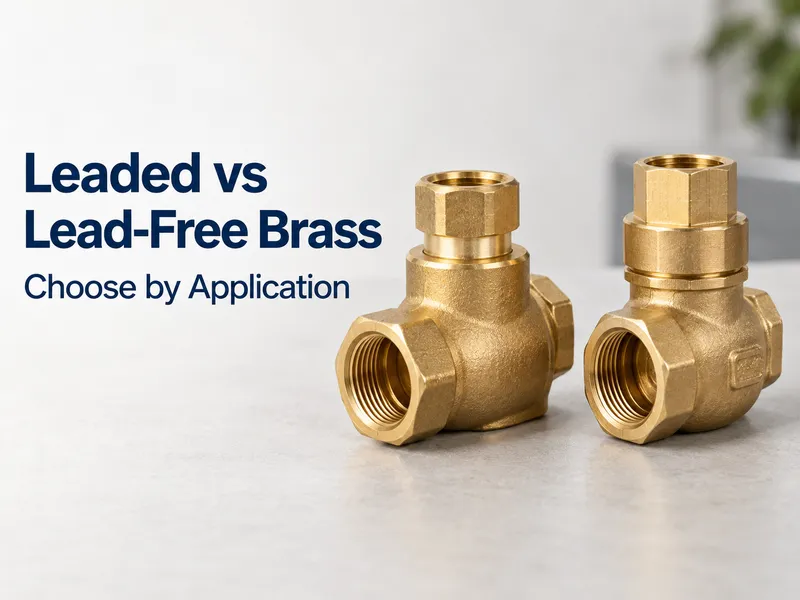
A drawing specifies a free-cutting brass, the order ships to Germany, and the release stops on one question: does this part have to be lead-free? The alloy name alone does not answer it. What decides the answer is the market the part ships into, the fluid it touches, and the documents the order has to carry.
What “Lead-Free” Actually Means — and Why There Is No Single Threshold
“Lead-free” has no global definition. At least three different numbers are in circulation, and two of the rules that decide the most orders are not numbers at all. Which rule applies depends on the destination market and on whether the part touches drinking water.
The 0.25% Wetted-Surface Rule in the US
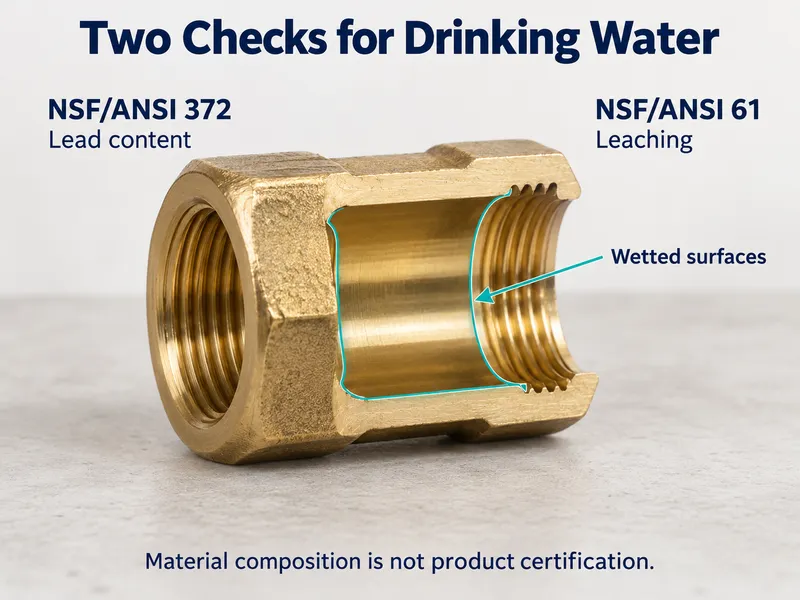
The US definition is a weighted average, not a whole-part figure. Lead across every surface that contacts drinking water must average ≤0.25%, weighted by wetted surface area, under the Safe Drinking Water Act and verified through NSF/ANSI 372.
That weighting decides what passes. A large fitting with a small wetted area can clear the limit while a compact part with a wide wetted face fails it, on the same alloy. The calculation applies to the finished component, not to the rod it was machined from.
Two certificates get confused here. NSF/ANSI 372 verifies lead content in the material that contacts water. NSF/ANSI 61 covers what leaches into the water. They answer different questions, and neither substitutes for the other.
One further number belongs on the US side rather than the alloy one. The US lead action level is 15 µg/L at the tap under the Lead and Copper Rule, and the 2024 revision (LCRI) tightens it to 10 µg/L from 1 November 2027. It is enforced on the water system, not on the alloy.
Japan Tests Leaching, Not Composition
Japan is the one market that does not test composition at all. Water supply fittings are regulated on leaching — a limit of 5 µg/L at terminal fittings such as taps, and 50 µg/L everywhere else in the line. The test is administered under the Ministry of Land, Infrastructure, Transport and Tourism’s performance standards, and no certificate is issued for the material itself.
Where a number does travel with the material, it is a convention rather than a law. The silicon lead-free grades built as replacements — C69300 among them — are specified at Pb ≤0.09%, and 0.09% appears as the reference maximum in copper-industry material data for lead-free brass rod. That level matters for a second reason: copper alloys sit under RoHS exemption 6(c), which allows up to 4% lead, but an alloy below the 0.10% general threshold does not depend on the exemption at all. When an exemption comes up for renewal, a grade that never needed it is not exposed.
The EU: a Positive List, Not a Percentage
Inside the EU, the drinking-water route is moving away from a single lead percentage toward an approved-materials list. Lead-containing brass is not on that list.
In the EU, the water-side limit tightens as well: 10 µg/L today, falling to 5 µg/L in 2036. National approved-material lists run through a transition period into the early 2030s, so the changeover date differs by member state.
For an EU drinking-water order the practical question changes shape. It is no longer “how much lead is in this alloy” but “is this alloy on the approved list for this member state.” That answer comes from material documentation, not from the grade code.
RoHS Is Not a Lead Ban
RoHS limits lead to 0.1% with a general expectation that compliant parts avoid it. Copper alloys are the exception: Annex III exemption 6(c) permits up to 4% lead, which is why leaded brass remains legal in electrical and electronic equipment.
The two rule sets govern different things. RoHS covers what goes into electrical and electronic products. Drinking-water rules cover surfaces that contact potable water.
A part can be fully RoHS-compliant and still be unusable in a potable-water system.
Machining, Cost and Corrosion: Where Leaded Brass Still Wins
Compliance and production give different answers. Where no potable-water rule or RoHS scope applies, leaded brass still holds the advantage in the shop, and that advantage is worth measuring before committing to a substitution.
Machining: the 100 vs 85 vs 70 Index
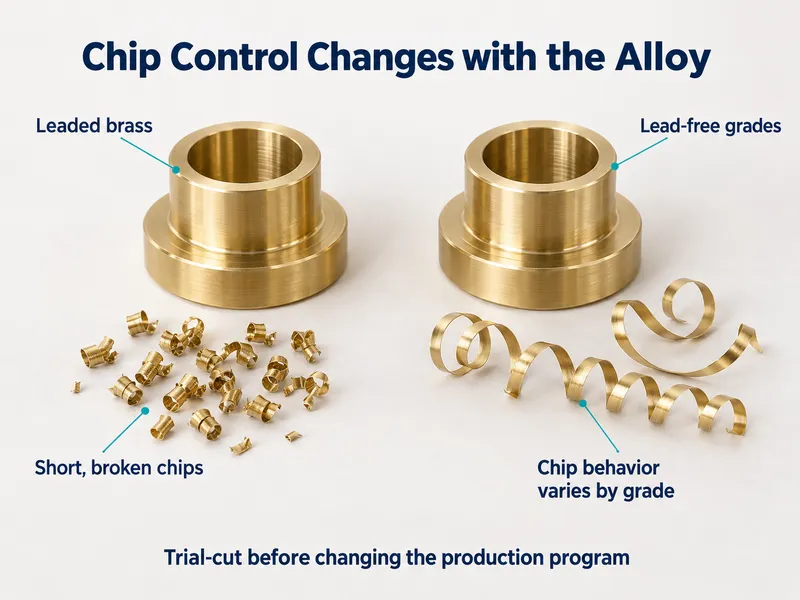
Machinability ratings are relative. C36000 Free-Cutting Brass is the reference at 100, and other copper alloys are scored against it.
What the lead does is mechanical rather than chemical. It stays largely undissolved in the copper-zinc matrix, forming fine dispersed particles that break the chip as it forms and lubricate the cutting edge. Remove it and chips run longer and hotter.
The lead-free routes recover chip control in different ways, and why they differ is set out in Lead-Free Brass; the cutting data for a specific grade is in Lead-Free Brass for CNC Machining.
| Grade | Index (C36000 = 100) | How chip control is recovered |
| C36000 | 100 | Lead particles act as a built-in chip breaker |
| C69300 | ~80–85 | Silicon additions; supplier datasheets vary |
| C27450 | ~70 | No silicon or bismuth; lead simply held low |
The index drop shows up in four places:
- Surface speed. Lead-free grades run slower for the same tool life.
- Chip control. Chips stay continuous, so birdnesting and chip wrap become the first failure, especially in deep bores.
- Built-up edge. Higher friction promotes material welding to the edge, which appears as a torn finish rather than a dimensional error.
- Tool life. Heat and friction shorten edge life, and the effect compounds in small-diameter work.
The compensations are ordinary shop practice: sharper edge geometry, higher-pressure coolant aimed at the chip, shorter tool overhang, and closer control of nose radius. Trial-cut parameters need to come from the new grade rather than from the C36000 program it replaces.
Cost: Unit Price Against Cycle Time and Tooling
Leaded rod is usually cheaper per kilogram, and it machines faster. Those two effects push the same way, so the real gap between the routes is wider than the price difference on a quotation.
The figure that settles the decision is total landed part cost, where metal price is only the first line:
Two items move against lead-free and one moves the other way. Cycle time rises because the index is lower, and scrap risk rises on the first run before parameters are dialled in. Against that, grades that add neither silicon nor bismuth, such as C27450, can go back into a conventional brass melt, so the turnings keep a normal scrap credit; silicon-bearing grades are a separate scrap stream.
The hidden delta sits in secondary operations. Tapping, thread rolling, deburring and plating all behave differently once the lead is gone, and thread rolling follows the material’s formability rather than its cutting index. A short trial batch prices the change more reliably than any index table.
One cost sits outside machining altogether. Where the part is safety-related or covered by customer approval, the substitution is a change-control item rather than a shop-floor adjustment.
Corrosion: Dezincification Is a Separate Test
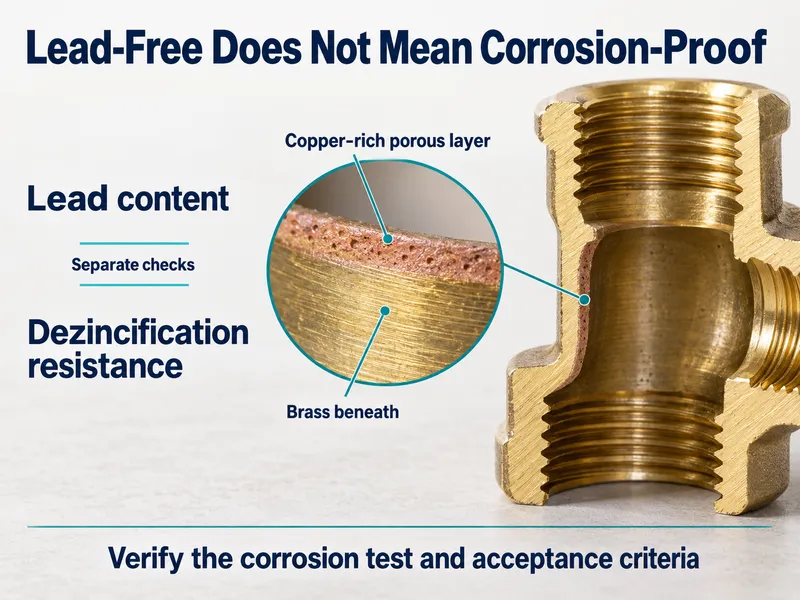
Lead content says nothing about how a brass behaves in water. Dezincification — zinc dissolving selectively out of the alloy and leaving a spongy copper residue — has its own test and its own acceptance figure.
Three conditions have to line up: zinc above roughly 15%, an aggressive water chemistry, and a susceptible microstructure. Break any one of them and the risk drops.
ISO 6509 is the reference method. It returns a penetration depth, and the acceptance figure belongs to the specification rather than to the alloy name. Several markets require it independently of lead — concealed fittings in the UK, Australia and the Nordic countries are the common cases.
The trap is treating the two requirements as one. Some leaded brasses resist dezincification, and some lead-free brasses are not released against it:
- C46500 Naval Brass carries up to 0.20% lead and is still dezincification-resistant, because arsenic in the alloy suppresses zinc loss.
- C27450 satisfies the 0.25% lead rule on lead alone. Whether a given mill’s material is released to ISO 6509 is a separate question, and one the mill certificate should answer rather than the grade code.
- Silicon grades such as C69300 resist by structure: high copper content with a single-phase alpha microstructure leaves little free zinc to attack.
Selection Table by Application
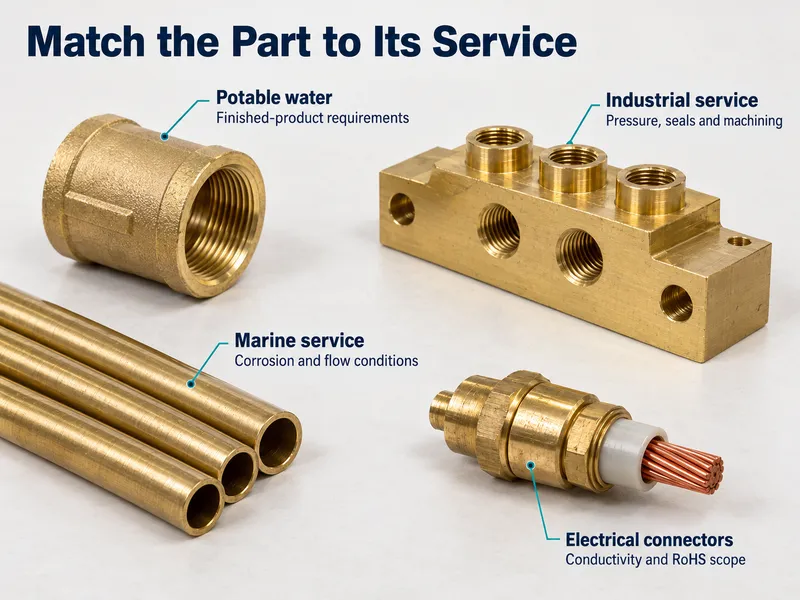
The three dimensions above set the trade-off. The table below maps that trade-off to service conditions, and the full grade family sits under Brass Grades.
| Service condition | Lead requirement | Grade route | What decides the grade |
| Potable water, food contact, children’s products | Mandatory lead-free | Silicon or low-lead lead-free grades | Market threshold plus finished-product certification |
| Industrial, pneumatic, hydraulic | No potable constraint | Conventional leaded free-cutting grades | Cycle time, tool cost, and RoHS scope |
| Marine and seawater | Rarely the deciding factor | Arsenical admiralty and naval brasses; copper-nickel above their velocity limits | ISO 6509 release and flow velocity |
| Electrical and connectors | RoHS route, not potable water | High-conductivity copper for current-carrying parts; brass for housings and terminals | Conductivity target, plating, and exemption 6(c) status |
Potable Water, Food Contact and Children’s Products
Lead is not an option here, it is a release condition. The two routes are silicon grades such as C69300 and the low-lead route at C27450.
The step that trips orders is that compliant material does not make a compliant product. Composition is proven on the mill certificate; NSF/ANSI 372 and 61 certification attaches to the finished component, stamped after assembly. Material supply and product certification are separate links in that chain, and material suppliers work on the first link.
Food-contact and children’s-product items sit outside the plumbing standards and follow their own consumer-safety rules, but the direction is the same: no deliberate lead addition.
Industrial, Pneumatic and Hydraulic Service
With no potable contact, leaded grades stay legal and usually cheapest per finished part. Valve bodies, manifolds, fittings and machined hardware in industrial service are the classic case.
The scope check is RoHS. Once the machined part goes inside electrical or electronic equipment, RoHS applies to the equipment, and copper alloys are covered by exemption 6(c) at up to 4% lead. For long-life products that exemption status is worth confirming rather than assuming.
Pressure rating, sealing face quality and thread integrity decide the grade here. Lead content does not.
Marine and Seawater
The lead question is mostly already settled in this service, because the brasses used in seawater work typically hold lead at ≤0.07–0.20% in their ASTM compositions.
The live requirement is ISO 6509. Arsenical grades resist through the arsenic addition; silicon grades resist through their microstructure. Above the velocity limits of brass, the route moves to copper-nickel rather than to another brass.
Electrical and Connectors
Current-carrying parts use high-conductivity copper. Brass appears around them as the structural and housing material, which is why lead content rarely decides the grade in this service.
On the brass side, plating usually matters more than base-alloy composition. Tin plating supports solderability and limits oxidation; silver plating becomes relevant where contact resistance is the constraint.
RoHS governs, and copper alloys sit under exemption 6(c). That is time-limited permission, not a permanent exemption from the category.
Low-Lead Grades You May Already Be Using
Some brasses already carry a low lead ceiling in their standard composition, which means a part may clear a 0.25% wetted-surface test without anyone marketing it as lead-free.
| Grade | ASTM lead max | Why it is already low |
| C44300 Admiralty Brass | ≤0.07% | Arsenical marine grade; lead was never part of its function |
| C46500 Naval Brass | ≤0.20% | Arsenical; dezincification-resistant |
| Aluminum brass | ≤0.07% | Marine grade for higher-velocity seawater |
The verification step is the same in every case: read the certified composition on the mill certificate rather than the alloy name. An ASTM limit is a maximum, and a heat analysis that sits well below it is what a compliance reviewer will actually read.
This is also where the two requirements separate cleanly. Admiralty and naval brasses pass a lead rule and a dezincification requirement at the same time, but for different reasons — low lead by specification, dezincification resistance by the arsenic addition. Neither property implies the other.
Sourcing Leaded and Lead-Free Brass From One Supplier
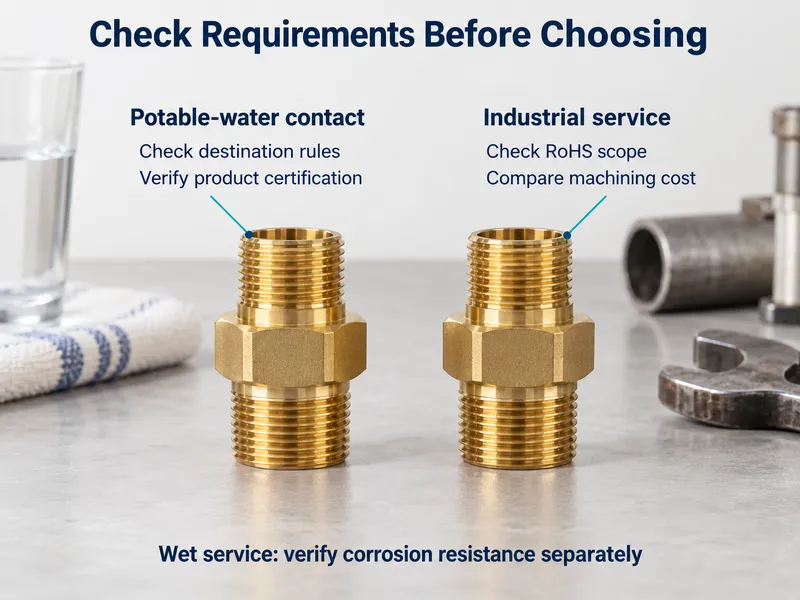
Linsy Copper is a Shenzhen-based copper factory, and the brass range covers both routes: leaded grades such as C36000, C35300 and C34000; low-lead marine grades such as C44300 and C46500; and lead-free grades including C87850 and C87860. C69300 and C27450 are supplied as well.
Sourcing both routes from one place changes the comparison itself. A project deciding between a leaded and a lead-free version of the same part gets one supplier quoting both, with the cycle-time and price difference reported rather than estimated across two quotations. A trial batch can also be quoted as material plus in-house machining, which turns first-run tooling cost into a number on the quote instead of an assumption.
Every order ships with MTR/MTC. SGS reports are available on request at additional testing cost, covering chemical composition, mechanical properties, and RoHS plus REACH SVHC — third-party testing on request, not a company certification.
Non-stock items run as low-MOQ custom production. The base material range sits under Brass.
Conclusion
The cost of going lead-free is rarely in the alloy price. It is paid in cycle time, tooling and first-run scrap, and the threshold that triggers the change differs by market — 0.25% weighted average in the US, an approved-materials list in the EU, a leaching test in Japan. Dezincification sits on a separate axis again, which is why a lead-free grade is not automatically the right answer for wet service. What each of those regimes actually asks for is set out in Lead-Free vs Leaded Pipe Fittings.
Both of those costs land before the first production run, and neither shows up on a price list. That is the gap we close. Instead of a comparison the buyer has to assemble and a first-run cost they have to estimate, both arrive as figures to check.
Send the drawing with the destination market, the fluid the part touches and the annual volume. We will confirm which route fits and return a quote for both grades where the part allows it.
FAQ
Do you stock both leaded and lead-free grades?
Common specifications ship from stock, and both routes are covered. Availability for a specific grade and size is confirmed against the drawing rather than assumed from the grade list.
What is the minimum order quantity?
Minimums are kept low for non-stock items. The exact figure depends on the grade, dimensions and processing involved, and comes back with the quotation.
How long does production take?
Typically 10–60 days from order confirmation, depending on grade, dimensions and processing. Stocked specifications are faster.

David Huang is a copper materials specialist and Sales Manager at Linsy Copper, with years of hands-on experience supporting global customers in copper and copper alloy sourcing.
He specializes in industrial copper products such as C11000 copper, C10200 oxygen-free copper, brass, bronze, copper sheets, plates, tubes, bars, and custom-processed copper components.
With a practical understanding of copper manufacturing, quality inspection, surface treatment, and export supply chains, David helps customers choose the right materials for electrical, mechanical, marine, construction, and industrial applications.