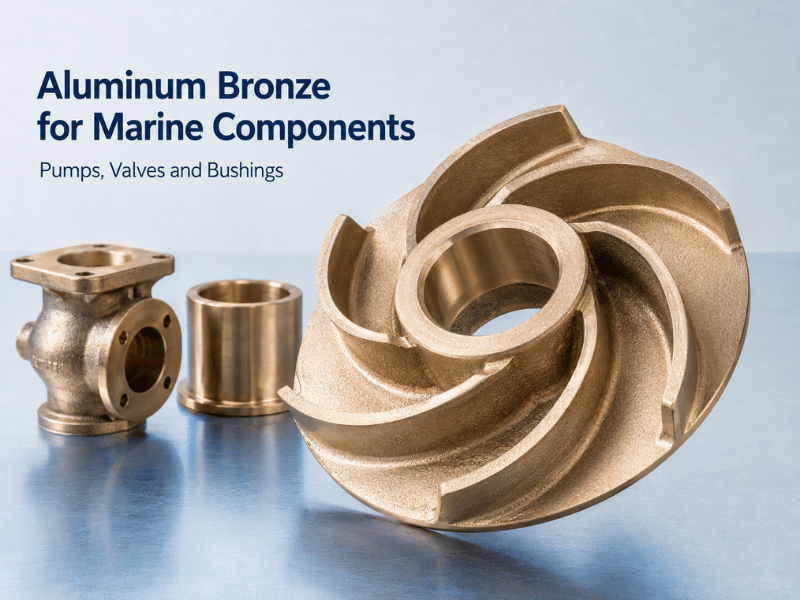
Aluminum bronze is a sound choice for marine pumps, valves, and bushings. The distinction is that “aluminum bronze” spans two material classes with fundamentally different seawater behavior.
Plain aluminum bronze — led by C95400 — is a freshwater and inland alloy. It serves river craft, potable-water loops, and non-ocean-going auxiliary fittings. In long-term seawater, it pits, then fails by dealuminification and cavitation erosion. Service life drops well below the design target.
Nickel aluminum bronze (NAB) — C95800 cast and C63000 wrought — is the seawater and offshore standard. Nickel stabilizes the microstructure against dealuminification, so these grades hold up in open ocean, subsea, and offshore platform service. For any pump, valve, or bushing exposed to salt water, NAB is the standard selection.
Why aluminum bronze fits pumps, valves, and bushings
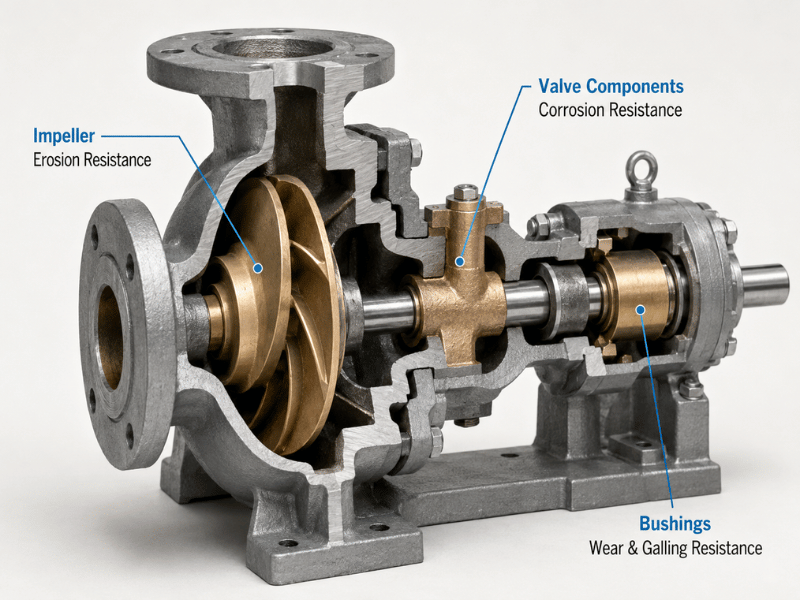
Five properties line up with the failure modes these parts actually see:
- Wear resistance and self-lubrication. High hardness plus a low-friction surface keeps pump impellers, valve trim, and bushings from seizing under high sliding speed.
- Strength and impact resistance. The alloy absorbs flow erosion and cavitation shock without cracking — the cyclic cavitation and flow-erosion loads typical of seawater pump impellers.
- Non-sparking. Safe in shipboard gas and oil-tank atmospheres where a spark means an incident.
- Anti-biofouling. NAB resists marine organism attachment better than plain aluminum bronze, slowing the slime-and-shell buildup on submerged surfaces.
- Castability. Complex pump housings and valve-body flow paths form cleanly in one cast piece, reducing weld and assembly points.
Plain aluminum bronze — freshwater and inland service only (C95400)
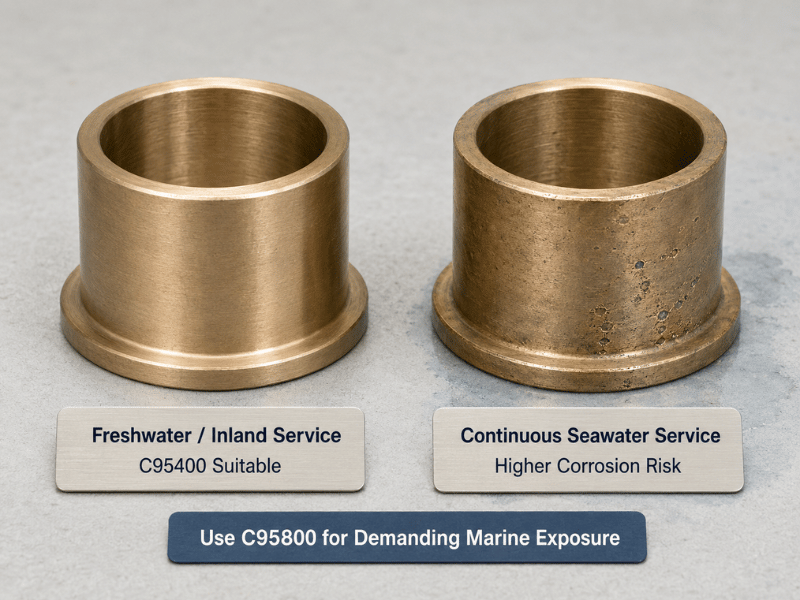
C95400 carries the composition Cu–Al11–Fe with near-zero nickel (ASTM caps Ni at 1.5% max). That makes it cost-effective, hard-wearing, and easy to cast.
Suitable applications: freshwater pumps on river and inland vessels, fresh-water piping valves, cabin fresh-water system bushings, and liners for non-ocean-going auxiliary machinery.
Unsuitable applications: ocean-going seawater pumps, subsea valves, and seawater cooling systems. In salt water, expect pitting within the first corrosion cycles and cavitation-perforated walls before the design life is reached.
| Property | C95400 (cast, as-sand/continuous) |
| Aluminum | 10.0–11.5% |
| Iron | 3.0–5.0% |
| Nickel | ≤1.5% (max) |
| Tensile strength | 515–690 MPa |
| Yield strength | 205–310 MPa |
| Elongation | 12–18% |
| Brinell hardness | 150–190 HB |
Nickel aluminum bronze — the seawater and offshore standard
NAB adds 4–5.5% nickel to the Cu–Al–Fe base. The nickel stabilizes the microstructure against dealuminification — the selective leaching that destroys plain aluminum bronze in chloride environments. That single change is why NAB is the default marine grade.
C95800 — cast NAB for pump and valve bodies
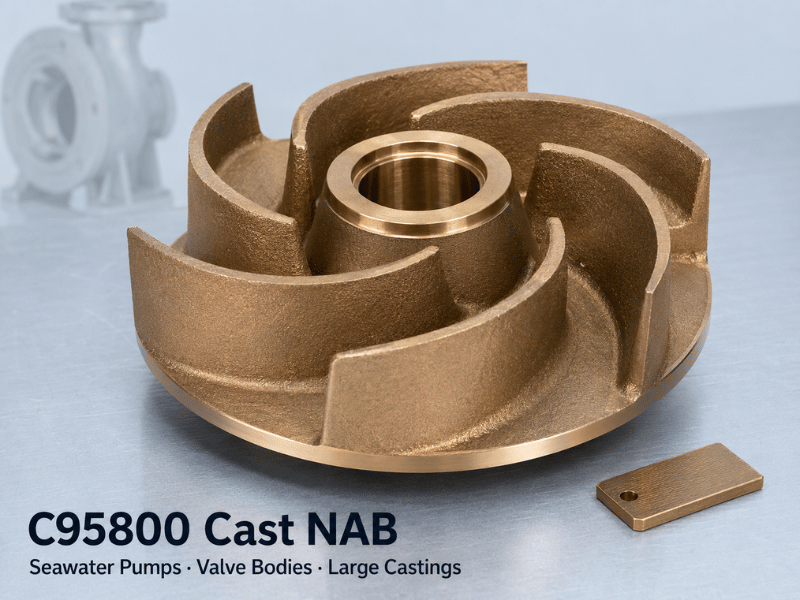
C95800 (Cu–Al9–Ni5 nominal) is the primary cast marine grade. Seawater corrosion rates typically run 0.02–0.05 mm/year — significantly lower than austenitic stainless steel in the same environment.
Typical marine uses: seawater pump housings and impellers, subsea seawater gate and check valves, seawater cooling valve bodies, marine propeller hubs, seawater piping liners, and offshore-platform pump and valve components. It is the standard cast material for ocean-going and offshore service.
| Property | C95800 (cast) |
| Aluminum | 8.5–9.5% |
| Iron | 3.5–4.5% |
| Nickel | 4.0–5.0% |
| Tensile strength | 585–760 MPa |
| Yield strength | 240–345 MPa |
| Elongation | 15–25% |
| Brinell hardness | 150–190 HB |
C63000 — wrought NAB for precision bushings and stems
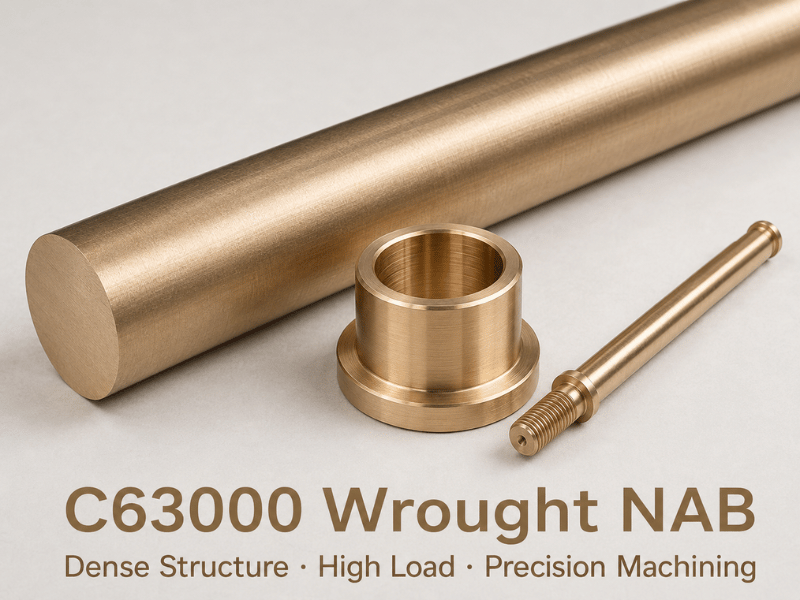
C63000 is extruded, forged, or rolled bar and plate. The working step closes porosity, giving a denser, more uniform structure than a casting — higher fatigue resistance and tighter machinable tolerances.
Typical marine uses: marine transmission shaft bushings, high-pressure seawater valve stems, hydraulic pump wear sleeves, heavy-duty sliding bearings, and the precision internal wear parts of small seawater valves.
| Property | C63000 (wrought, HR50) |
| Aluminum | 9.0–11.0% |
| Iron | 2.0–4.0% |
| Nickel | 4.0–5.5% |
| Tensile strength | 690–900 MPa |
| Yield strength | 345–550 MPa |
| Elongation | 5–15% |
| Brinell hardness | 180–250 HB |
Quick selection guide
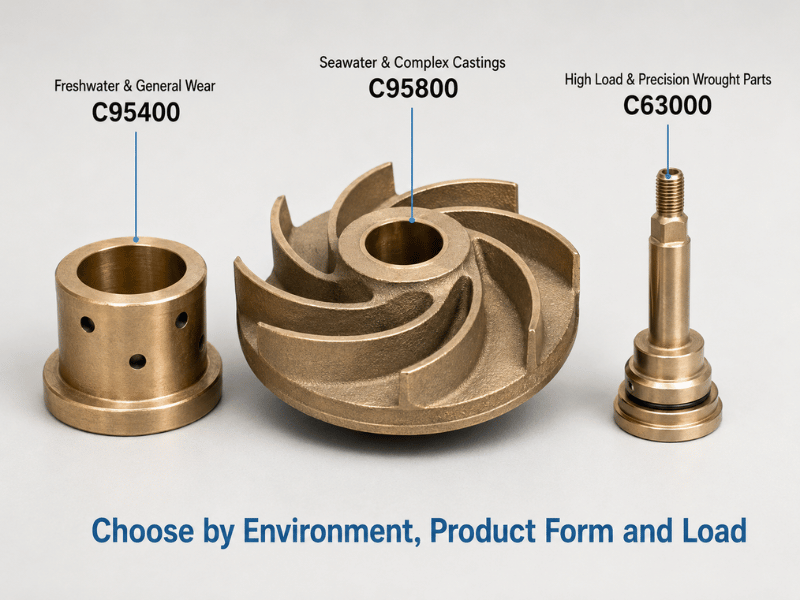
| Service | Grade | Form | Reason |
| Freshwater pump, valve, bushing — cost-controlled | C95400 | Cast | Cost-effective, wear-resistant; no seawater exposure |
| Ocean-going seawater pump, subsea valve, offshore casting | C95800 | Cast NAB | Seawater corrosion and cavitation resistance |
| Precision bushing, high-pressure stem, heavy-duty sliding bearing | C63000 | Wrought NAB | Dense structure, tight machining, fatigue strength |
If the part never sees salt, plain aluminum bronze avoids the nickel addition without performance loss. The moment seawater, cavitation, or subsea duty enters the spec, C95800 (cast) or C63000 (wrought) becomes the required grade.
Property comparison at a glance
| Property | C95400 (plain) | C95800 (cast NAB) | C63000 (wrought NAB) |
| Density | ~7.5 g/cm³ | ~7.6 g/cm³ | ~7.6 g/cm³ |
| Electrical conductivity | ~7–12% IACS | ~7–12% IACS | ~7–12% IACS |
| Thermal conductivity | ~50–60 W/m·K | ~36–40 W/m·K | ~38 W/m·K |
| Magnetic permeability | Non-magnetic | <1.05 (non-magnetic) | <1.05 (non-magnetic) |
| Seawater corrosion | Poor (dealuminifies) | 0.02–0.05 mm/yr | Comparable to C95800 |
| Non-sparking | Yes | Yes | Yes |
Both families are dense, poor conductors, and non-sparking. Plain aluminum bronze offers better thermal conductivity; NAB trades that for seawater immunity and non-magnetic behavior suited to naval and sonar-adjacent service.
Conclusion
Aluminum bronze belongs in marine pumps, valves, and bushings — the grade just has to match the water. C95400 covers freshwater and inland duty at the lowest cost; C95800 and C63000 nickel aluminum bronze carry seawater, subsea, and offshore service where plain aluminum bronze would fail by dealuminification. The trade-off is that NAB grades carry higher material cost and narrower general stock availability. Linsy supplies C95400, C95800, and C63000 with low minimum order quantities, full MTR/MTC documentation, and SGS reports on request — so the stock constraint rarely blocks a project. When the specification demands a marine-grade aluminum bronze, send the target grade, form, and condition for a grade-fit review and quote.
FAQ
-
No for long-term service. C95400 resists fresh water well but pits and dealuminifies in salt water, leading to cavitation-perforated walls well before design life. Use C95800 or C63000 nickel aluminum bronze instead.
-
Both are nickel aluminum bronze, but C95800 is cast (pump housings, valve bodies, offshore castings) and C63000 is wrought bar/plate (precision bushings, valve stems, sliding bearings). C63000’s worked structure is denser and machines to tighter tolerance.
-
Nickel stabilizes the microstructure against dealuminification — the selective aluminum leaching that destroys plain aluminum bronze in chloride water. It is the single change that makes the alloy a seawater standard.
-
Measured rates run 0.02–0.05 mm/year, versus 0.1–0.3 mm/year for 316 stainless steel in the same environment. That is why it is the default cast grade for ocean-going and offshore service.
-
Yes. Aluminum bronzes are non-sparking, so they are accepted in shipboard gas and oil-tank atmospheres where a spark could ignite vapor.
-
Linsy supplies C95400, C95800, and C63000; send the target grade, form, and temper for availability confirmation. Every order ships with MTR/MTC documentation, and SGS reports are available on request.

David Huang is a copper materials specialist and Sales Manager at Linsy Copper, with years of hands-on experience supporting global customers in copper and copper alloy sourcing.
He specializes in industrial copper products such as C11000 copper, C10200 oxygen-free copper, brass, bronze, copper sheets, plates, tubes, bars, and custom-processed copper components.
With a practical understanding of copper manufacturing, quality inspection, surface treatment, and export supply chains, David helps customers choose the right materials for electrical, mechanical, marine, construction, and industrial applications.