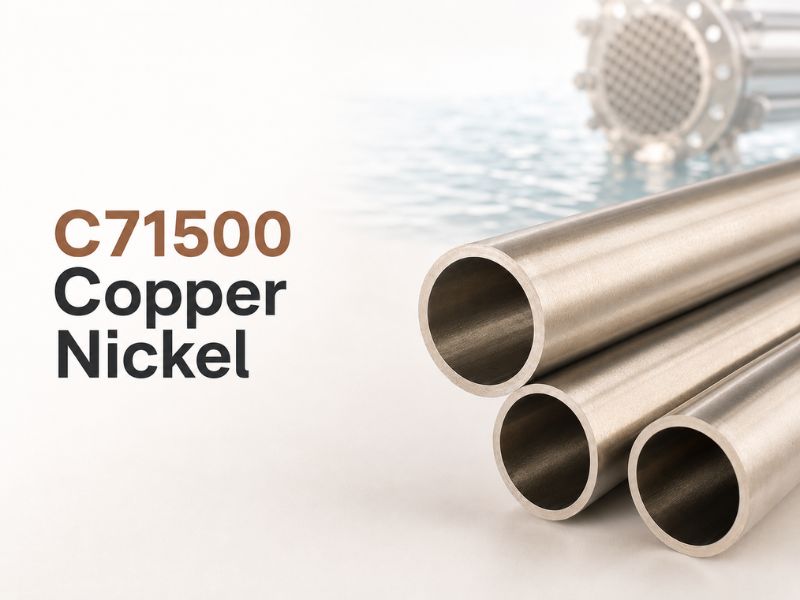
What Is C71500 Copper Nickel?
C71500 (UNS C71500) is a wrought copper-nickel alloy containing nominally 70% copper and 30% nickel, with controlled iron and manganese additions. Under ASTM B122 / B171, it sits alongside C70600 as the two primary CuNi grades for seawater service, with distinct property advantages: approximately 25% higher tensile strength, higher allowable seawater velocity, and better resistance to impingement attack.
The iron content (0.4–1.0%) forms a protective oxide film in flowing seawater. Without it, CuNi alloys fail quickly under erosion-corrosion. Manganese (up to 1.0%) acts as a deoxidizer and improves hot workability — a critical factor during plate and tube production.
C71500 Chemical Composition
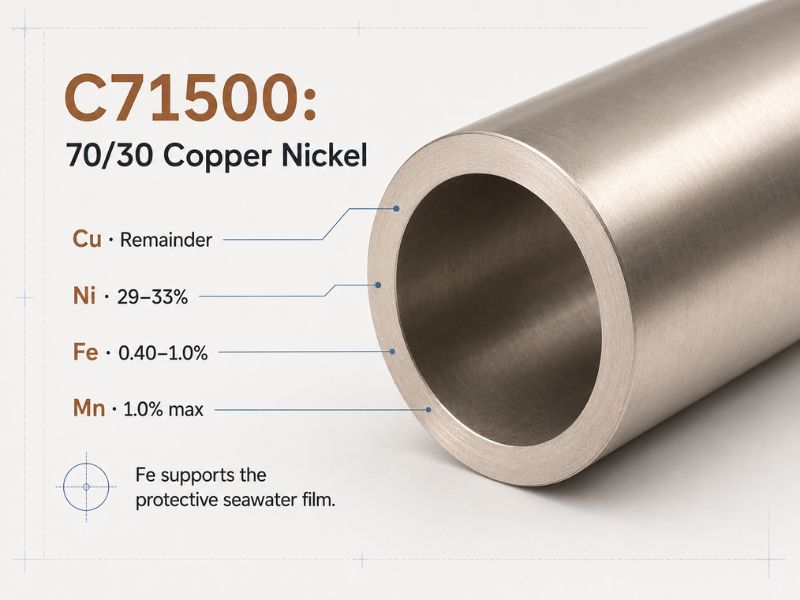
ASTM B122 sets the following limits (weight %):
| Element | C71500 Range |
|---|---|
| Cu (incl. Ag) | Remainder |
| Ni (incl. Co) | 29.0 – 33.0 |
| Fe | 0.40 – 1.0 |
| Mn | 1.0 max |
| Zn | 1.0 max |
| Pb | 0.05 max |
| Other (total) | 0.50 max |
The zinc and lead limits are tight — these elements degrade hot workability and weldability. A mill cert showing Zn or Pb above these thresholds indicates a rejectable lot. This is not a negotiable tolerance; it is a weld cracking risk.
Compared to C70600, C71500 carries approximately three times the nickel content. The higher nickel content provides the additional strength and velocity tolerance, and also makes the alloy 20–30% more expensive per kilogram.
Mechanical Properties
Annealed (OS025) and half-hard (H02) values per ASTM B122:
| Property | Annealed (OS025) | Half-Hard (H02) |
|---|---|---|
| Tensile Strength (MPa) | 345 min | 415 min |
| Yield Strength, 0.2% offset (MPa) | 125 min | 220 min |
| Elongation in 50mm (%) | 35 min | 15 min |
| Hardness (Rockwell B) | ~45 | ~70 |
C71500 work-hardens faster than C70600. Forming processes involving tight-radius bending or deep drawing require annealed temper. Half-hard tube can crack during flaring or expansion — a common failure mode on heat exchanger assembly lines.
At elevated temperatures, C71500 retains useful strength up to approximately 370°C (700°F). Beyond that, creep becomes significant. The alloy is not designed for high-temperature service; applications above 400°C require higher-nickel cupronickel grades or Monel as appropriate alternatives.
Electrical and Thermal Conductivity
| Property | Value |
|---|---|
| Electrical Conductivity (% IACS) | 4.6 |
| Thermal Conductivity (W/m·K) | 29 |
These values are low relative to pure copper (100% IACS, ~390 W/m·K). Nickel is a strong electron scatterer, and the reduced conductivity is an inherent consequence of the nickel addition. C71500 is specified for corrosion resistance, not electrical or thermal performance.
For heat exchanger design, the low thermal conductivity means C71500 tubes require more surface area than copper or brass tubes to achieve the same heat transfer rate. This must be factored into exchanger sizing calculations. Most OEMs compensate with smaller tube diameters or longer tube lengths.
Corrosion Resistance of C71500
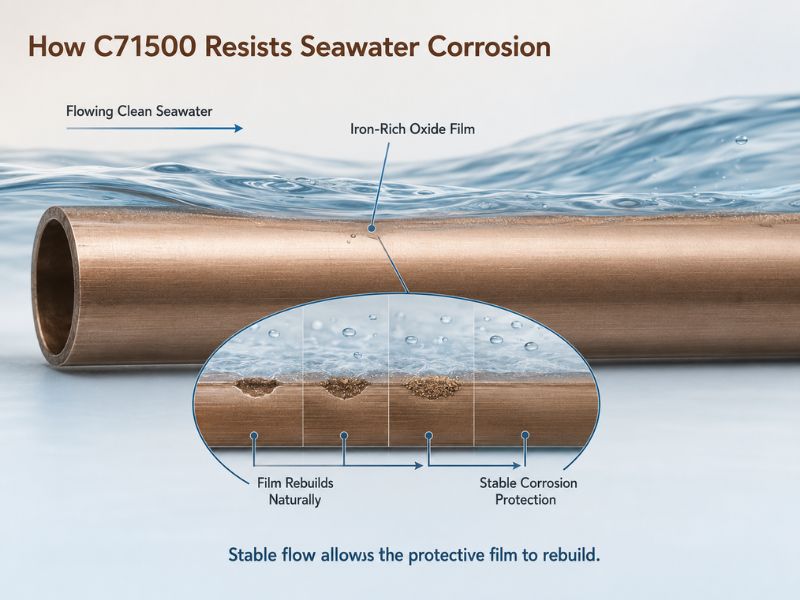
All corrosion behavior traces back to one mechanism: the iron-rich oxide film that forms and rebuilds in flowing seawater. The table below maps how this film dictates every outcome.
| Condition | Film behavior | Result | C70600 comparison |
|---|---|---|---|
| 1.5–4.5 m/s flow | Builds and self-repairs | Full corrosion resistance | C70600 safe only to ~3.0 m/s |
| < 1.5 m/s (stagnant) | Film starved, stops rebuilding | Pitting and crevice corrosion | Same vulnerability |
| > 4.5 m/s | Stripped faster than rebuilt | Impingement attack at inlets/U-bends | C70600 fails at ~3.0 m/s |
| H₂S in stagnant water | Film degraded chemically | Accelerated pitting | Same vulnerability |
Commissioning fix for low-flow or intermittent systems: a passivation run at 2.5 m/s for 48 hours in clean seawater builds the protective film before flow is reduced.
Film intact → two structural advantages:
- SCC immunity — C71500 is effectively immune to chloride stress corrosion cracking. 316L stainless steel cracks under the same conditions.
- Biofouling resistance — copper ions at the surface inhibit marine organism attachment. Initial rate is slightly slower than C70600 (higher nickel slows ion release); after several weeks in service, the difference is negligible.
Film bypassed by two chemical threats (regardless of velocity):
- Ammonium salts + oxygen → rapid corrosion. Clean ammonia alone is tolerated; ammonium salts with dissolved oxygen are not.
- Sulfide-polluted seawater (harbor zones, industrial outfalls) → film attacked directly. Options: upstream water treatment, or switch to a higher-nickel grade.
Common Forms and Availability
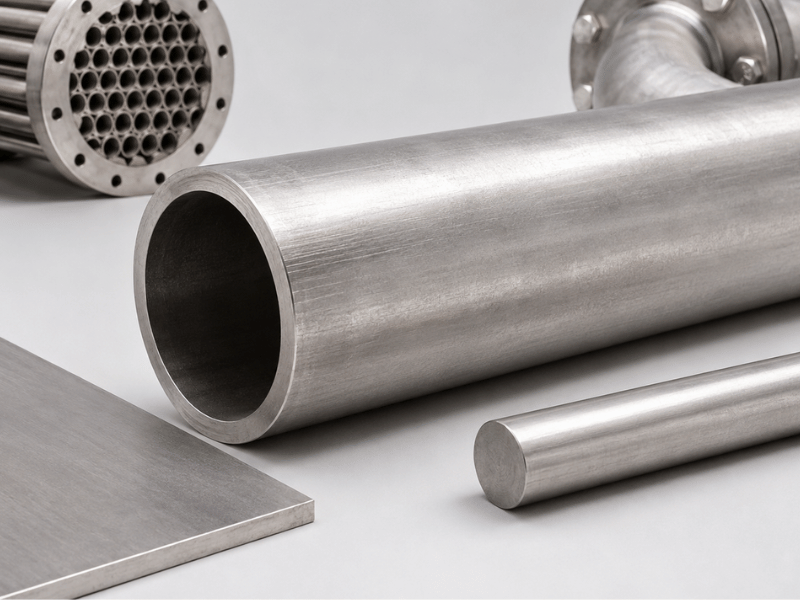
C71500 is produced in these standard forms:
- Seamless tube — ASTM B111 / B466, the most common form for heat exchangers and condensers
- Welded tube — ASTM B543, cost-effective for larger diameters
- Plate and sheet — ASTM B122, used for tube sheets and vessel cladding
- Pipe — ASTM B466, for larger-diameter seawater piping
- Bar and rod — ASTM B151, for machined fittings and flanges
Availability note: C71500 is less common in stock than C70600. Most service centers carry C70600 tube; C71500 is more frequently produced to order. Lead times for non-stock sizes typically range from 6 to 10 weeks. For projects specifying C71500 tube sheets or heavy plate, availability should be confirmed with the supplier before finalizing the BOM.
Linsy Copper supplies C71500 sheet, plate, and tube through its Shenzhen facility, with capability for custom dimensions at low minimum order quantities — suitable for prototype runs, replacement parts, or projects where full mill minimums are impractical.
C71500 vs C70600 — Quick Comparison
| Factor | C70600 (90/10) | C71500 (70/30) |
|---|---|---|
| Nickel content | 9–11% | 29–33% |
| Tensile strength (annealed) | 275 MPa min | 345 MPa min |
| Seawater velocity limit | ~3.0 m/s | 4.5–5.0 m/s |
| Thermal conductivity | 45 W/m·K | 29 W/m·K |
| Relative cost | Lower (baseline) | +20–30% |
| Stock availability | High | Moderate |
| Typical use | General marine piping, condensers | High-velocity seawater, desalination, offshore |
The selection criteria are straightforward: seawater flow velocity below 3 m/s with cost sensitivity favors C70600. Above 3 m/s, or in desalination brine service, C71500 is the appropriate grade.
C71500 Equivalent Grades (Cross-Reference)
| Standard | Designation |
|---|---|
| ASTM (UNS) | C71500 |
| EN / DIN | CW354H / CuNi30Mn1Fe |
| JIS | C7150 |
| GB (China) | BFe30-1-1 |
| BS (UK) | CN107 |
Material certified to EN CuNi30Mn1Fe or JIS C7150 shares the same nominal composition as ASTM C71500. Minor differences exist in Fe and Mn tolerance ranges between standards. The alloys are interchangeable in practice, provided the temper condition and product form match the specification. EN designations and ASTM temper codes do not always map one-to-one — the temper designation should be verified against the project drawing requirements.
Go/No-Go Limits
Use this quick-reference to decide whether C71500 fits your application.
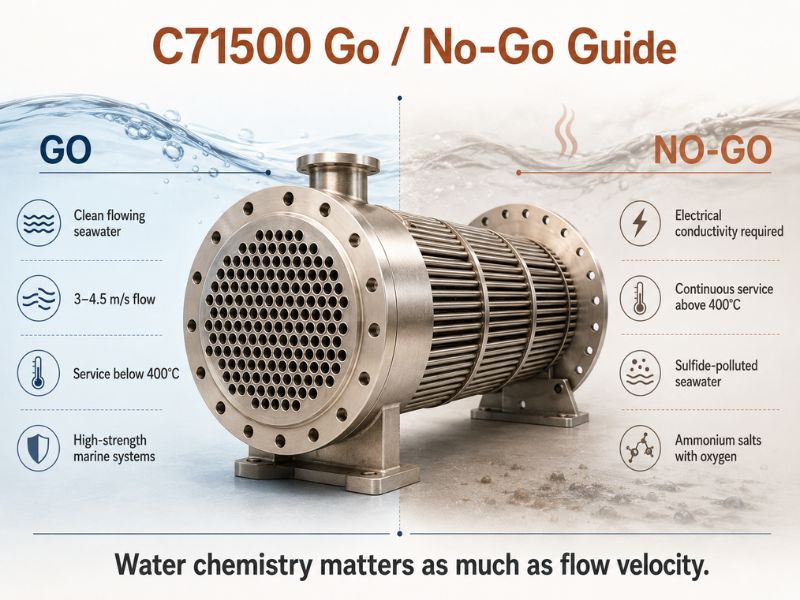
Go — use C71500 when:
- Seawater flow velocity is 3–4.5 m/s, with temperatures up to 150°C — the standard operating range for C71500 in clean seawater. Typical applications: condenser tubes, cooling loops, heat exchanger bundles in power plants and shipbuilding.
- C70600 velocity limit (~3 m/s) is exceeded — C71500 extends the safe range to 4.5 m/s. Typical applications: high-flow tubing in desalination plants (brine heaters, evaporator sections).
- Long design life with minimal maintenance is required — biofouling resistance and SCC immunity reduce lifecycle cost. Typical applications: offshore platform piping exposed to seawater spray, firewater systems.
No-Go — do not use C71500 when:
- High-conductivity electrical applications — pure copper or silver-bearing copper handles current transfer far more efficiently.
- Continuous service above 400°C — creep becomes significant; higher-nickel grades or Monel are the appropriate alternatives.
- Sulfide-polluted or ammonia-contaminated seawater without upstream treatment — the protective film fails and C71500 corrodes rapidly.
Applications
The Go/No-Go criteria above cover selection logic. The list below maps specific systems where C71500 is standard practice:
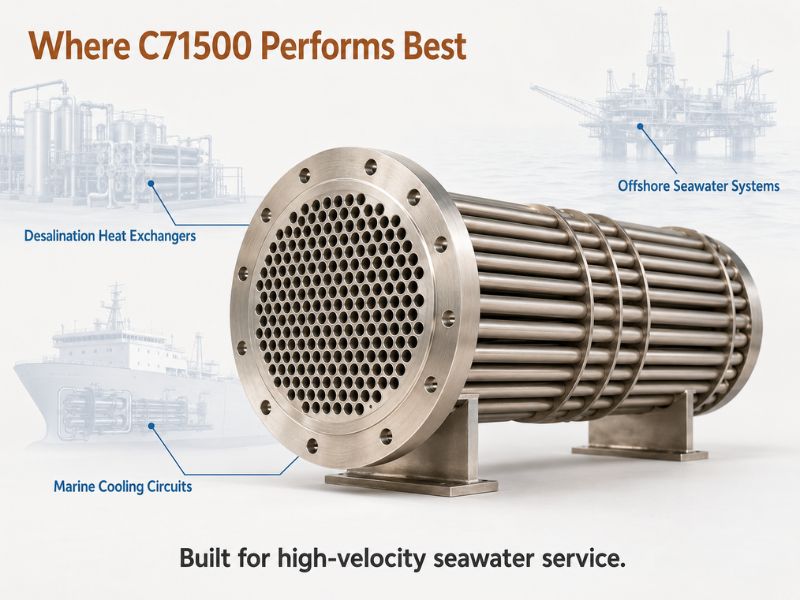
- Desalination plants — brine heater tubes, evaporator shells, heat recovery sections (MSF and MED processes)
- Offshore oil and gas — seawater cooling systems, firewater piping, splash zone piping on platforms
- Naval vessels — main seawater piping, heat exchangers, sonar dome components
- Power plant condensers — where brackish water or seawater is the cooling medium
- Shipbuilding — engine cooling, HVAC seawater circuits, ballast system piping
- Chemical processing — handling mildly acidic brines and corrosive process waters
Ordering C71500 — Specification Notes
The following ASTM standards govern C71500 products:
- ASTM B122 — Plate, sheet, strip, and rolled bar
- ASTM B171 — Plate and sheet for pressure vessels
- ASTM B111 — Seamless condenser and heat exchanger tube
- ASTM B466 — Seamless pipe
- ASTM B543 — Welded tube
- ASTM B151 — Rod and bar
A Material Test Report (MTR/EN 10204 3.1) should be requested, confirming chemical analysis and mechanical properties. For pressure vessel applications (B171), the plate should carry the appropriate stamp, and the mill should be ASME-certified.
Typical MOQ for custom C71500 plate or tube runs starts at 500 kg at most mills. Some specialized suppliers offer lower minimums for prototype and replacement-part orders.
Conclusion
C71500 is the 70/30 CuNi for seawater service where C70600 falls short — approximately 25% higher tensile strength, velocity tolerance up to 5 m/s, and SCC immunity in clean seawater. The trade-off is higher cost and tighter stock availability at most mills.
Linsy Copper stocks C71500 sheet, plate, and tube, and supplies custom dimensions at low minimum order quantities with full MTR documentation and competitive lead times — so the general stock constraint rarely blocks a project. When the specification demands C71500, send the drawing for a grade-fit review.
FAQ
-
4.5 m/s is the recommended design maximum in clean seawater. Some standards permit up to 5.0 m/s under ideal conditions, but impingement risk increases above 4.5 m/s, particularly at tube inlets and U-bends.
-
Yes. GTAW (TIG) is the preferred method, using ERCuNi or ERNiCu-7 filler. SMAW and GMAW are also used. Preheat is generally not required for sections under 12 mm thick.
-
Yes, both seamless (ASTM B111) and welded (ASTM B543). A seamless tube is the most common form and is widely used for heat exchangers and condensers.
-
Typically 20–30% more per kilogram, driven by the higher nickel content. The exact premium depends on the product form, order quantity, and current nickel market pricing.
-
ASTM B122 (plate/sheet), B171 (pressure vessel plate), B111 (seamless tube), B466 (pipe), B543 (welded tube), and B151 (bar/rod).
-
Most mills start at 500 kg for custom production. Linsy Copper supports lower minimums for prototype and small-batch orders with full MTR documentation.
-
The heat-affected zone (HAZ) near welds can experience slight film thinning, but C71500 recovers its protective oxide layer after a brief passivation period in flowing seawater. Using matching ERCuNi filler and proper joint preparation minimizes the effect. Post-weld cleanup (removal of oxidation scale) is important — residual scale creates crevice corrosion sites.

David Huang is a copper materials specialist and Sales Manager at Linsy Copper, with years of hands-on experience supporting global customers in copper and copper alloy sourcing.
He specializes in industrial copper products such as C11000 copper, C10200 oxygen-free copper, brass, bronze, copper sheets, plates, tubes, bars, and custom-processed copper components.
With a practical understanding of copper manufacturing, quality inspection, surface treatment, and export supply chains, David helps customers choose the right materials for electrical, mechanical, marine, construction, and industrial applications.