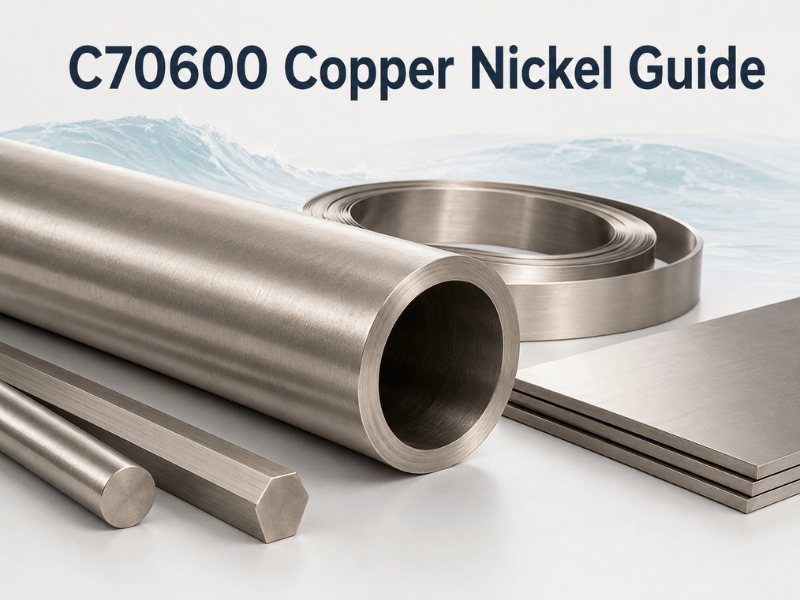
C70600 is a 90/10 copper nickel — 90% copper, 10% nickel — defined under ASTM B122/B122M (sheet, strip, and plate) and ASTM B151/B151M (rod, bar, and tube). The 10% nickel addition gives the alloy its defining property: resistance to flowing seawater corrosion at temperatures up to 150°C. Where carbon steel rusts and stainless steel pits in seawater service, C70600 maintains corrosion resistance over decades of service.
The nickel content also suppresses dezincification and stress corrosion cracking — the two failure modes that make ordinary brass unreliable in saline environments. The small iron addition (0.4–0.7%) further strengthens the passive film on the metal surface, extending service life in high-velocity seawater.
C71500 is the 70/30 copper nickel (30% Ni). C71500 has higher strength and better corrosion resistance at elevated temperatures, but at approximately 2–3× the raw material cost. The grade selection is determined by three parameters: seawater velocity (above or below 1.5 m/s), operating temperature (above or below 100°C), and material cost sensitivity.
C70600 Chemical Composition
ASTM B122 specifies the following composition limits for C70600:
| Element | C70600 (%) | C71500 (%) |
| Cu + elements | 99.5 min | 99.5 min |
| Ni + Co | 9.0–11.0 | 29.0–33.0 |
| Fe | 0.40–0.70 | 0.40–1.0 |
| Mn | 1.0 max | 1.0 max |
| Zn | 1.0 max | 1.0 max |
| Pb | 0.05 max | 0.05 max |
| C (impurity) | 0.05 max | 0.05 max |
The nickel content differential — 10% in C70600 vs 30% in C71500 — drives the divergence in corrosion resistance, mechanical strength, and cost between the two grades.
C70600 Mechanical and Physical Properties
Three conditions cover most C70600 specifications:
| Property | Annealed (O61) | Light Drawn (H55) | Hard Drawn (H80) |
| Tensile Strength (ksi) | 45–60 | 55–72 | 70–90 |
| Yield Strength, 0.2% offset (ksi) | 18–30 | 30–50 | 55–75 |
| Elongation in 2″ (%) | 30–45 | 15–30 | 3–10 |
| Hardness (Rockwell F) | 45–70 | 60–80 | 80–95 |
Physical constants:
| Property | Value |
| Electrical Conductivity (% IACS) | 4–6 |
| Thermal Conductivity (W/m·K) | 29–45 |
| Density (g/cm³) | 8.94 |
| Modulus of Elasticity (GPa) | 140 |
The conductivity gap relative to pure copper or phosphor bronze is substantial — approximately 5% IACS vs 50–100% IACS. Copper nickel is not selected for electrical performance. It is selected for thermal and corrosion performance in fluid-handling systems.
Go / No-Go Limits
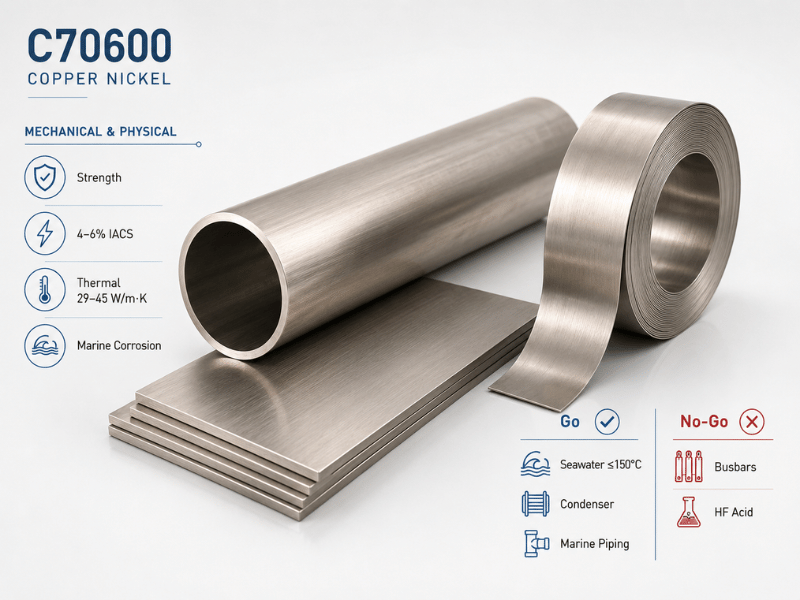
- Go: Seawater cooling and condenser service at operating temperatures up to 150°C, with velocity up to 3 m/s.
- Go: Dezincification or pitting resistance requirements in marine piping, heat exchangers, and desalination equipment — C70600 is the standard material.
- Go: Intermittent seawater exposure on offshore hydraulic and instrumentation lines; the passive film resists localized attack without additional protection.
- No-Go: High-conductivity electrical busbars or transformer windings. Pure copper or silver-bearing copper provides significantly higher current transfer efficiency.
- No-Go: Hydrofluoric acid or strong oxidizing acid environments. C70600 corrodes rapidly in HF; PTFE-lined piping is the appropriate alternative.
C70600 vs C71500 — Which Grade to Choose
Conductivity budget is not a differentiator here — both grades exhibit 4–6% IACS. The differentiating factors are corrosion margin, mechanical strength, and cost.
| Decision Factor | Stick with C70600 | Upgrade to C71500 |
| Seawater velocity | ≤ 3 m/s | 3–5 m/s, or tidal zone service |
| Operating temperature | Up to 150°C | 150–200°C, steam coils, high-T exchangers |
| Strength requirement | Moderate (45–70 ksiUTS) | High (70–90 ksiUTS), thinner wall = less flow restriction |
| Design life | 15–25 years (typical) | 25–40 years, or where replacement is costly |
| Material cost | Baseline | ~2–3× C70600 raw material cost |
| Typical application | Shipboard seawater piping, shore-based condensers | Offshore platforms, FPSO, nuclear seawater systems |
C70600 is the baseline grade for most shipboard and shore-based seawater applications. C71500 is specified when operating conditions exceed C70600’s service envelope — higher velocity, higher temperature, longer design life — or when engineering codes require the higher nickel grade.
C70600 Equivalent Grades (Cross-Reference)
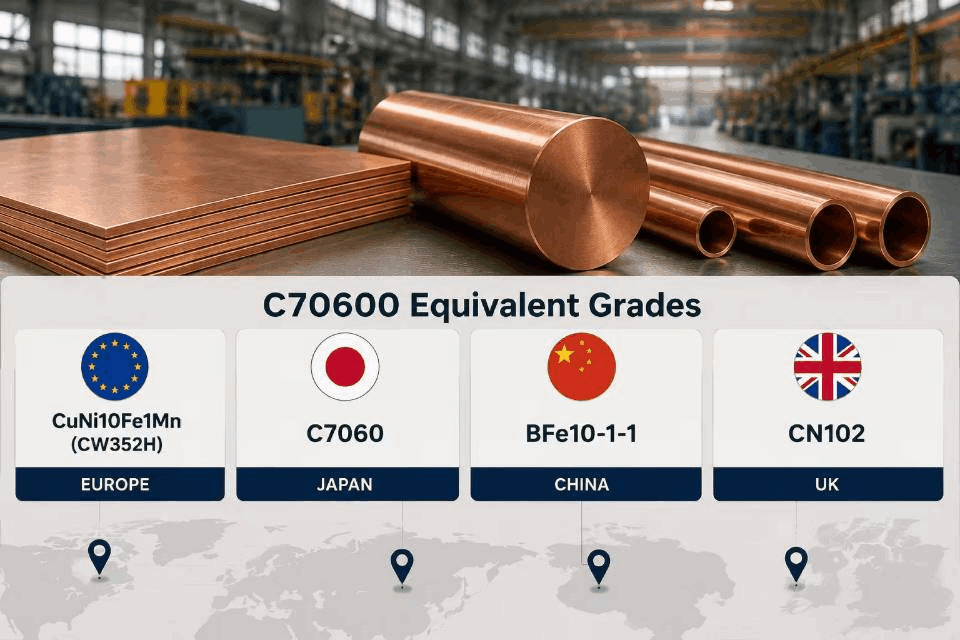
Multiple standards cover the same 90/10 copper nickel under different naming conventions.
| Standard | Designation | Region |
| EN 12449 / EN 12420 | CuNi10Fe1Mn (CW352H) | Europe |
| JIS H3300 / H3310 | C7060 | Japan |
| GB/T 2059 / GB/T 2060 | BFe10-1-1 | China |
| BS 2871 / BS 2874 | CN102 | UK |
ASTM designations for reference:
- ASTM B122/B122M (sheet, strip, plate)
- ASTM B151/B151M (rod, bar, tube)
Material certified to EN CuNi10Fe1Mn or JIS C7060 shares the same nominal composition as ASTM C70600. EN limits on Fe (1.0–2.0%) and Mn (0.5–1.5%) are slightly wider than ASTM (Fe 1.0–1.8%, Mn ≤ 1.0%), but alloy interchange is determined by temper and product form matching the specification.
EN standards may certify to CW352H with mechanical property ranges that differ slightly from ASTM B151, creating a documentation gap. When a project drawing calls out EN CuNi10Fe1Mn and the sourced material is ASTM C70600 tube, the temper condition (annealed vs light-drawn) requires verification — EN designations and ASTM H-temper codes do not always map one-to-one.
Common Applications of C70600
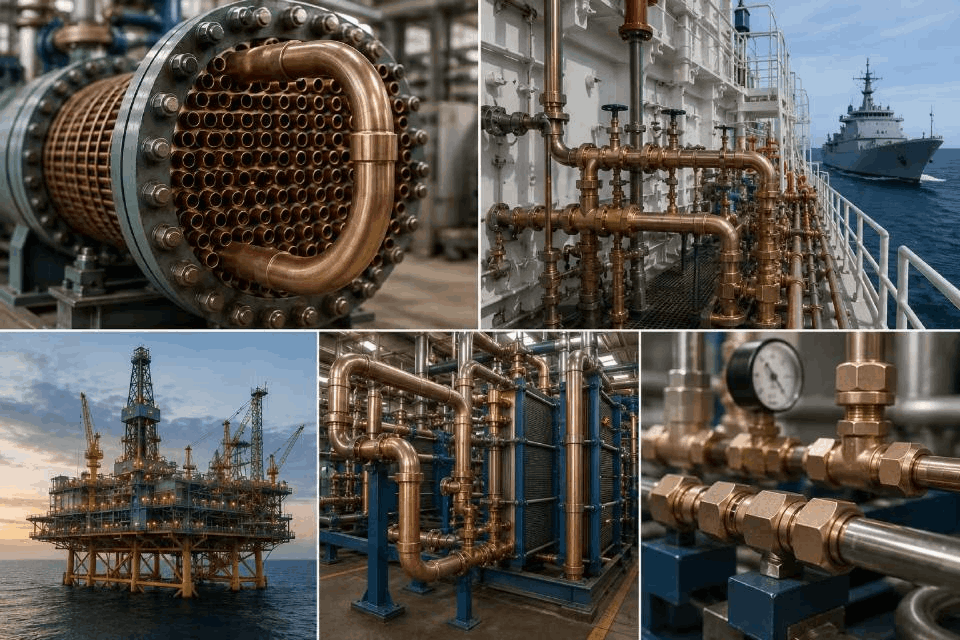
C70600 is specified across the following seawater-handling systems:
- Marine seawater condensers: Tube material for shipboard and shore-based power plant condensers. C70600 tube resists the combined effect of high velocity, elevated temperature, and biofouling that causes pitting in carbon steel and crevice corrosion in stainless steel.
- Shipboard piping: Seawater cooling lines, firemain saltwater, and sanitation piping on commercial and naval vessels. The alloy resists corrosion during dry-docking and refill cycles that cause fatigue in carbon steel weld seams.
- Offshore platform utilities: Instrument air cooling lines and process water piping on fixed offshore structures, where replacement cost drives material selection.
- Desalination plant heat exchangers: The thermal conductivity advantage over stainless (29–45 W/m·K vs 15 W/m·K) reduces the heat exchanger surface area required for a given duty.
- Hydraulic instrumentation: Offshore and marine hydraulic pressure lines carrying seawater-contaminated fluid, where resistance to under-deposit corrosion is critical.
Application Fit by Product Form
| Product Form | Typical Use |
| Tube | Condenser tubes, heat exchanger tubes, piping |
| Sheet / Plate | Heat exchanger headers, pressure vessel internals |
| Rod / Bar | Valve stems, pump shafts, marine hardware |
| Strip | Bellows, flexible couplings, gasket material |
Procurement Notes
C70600 is available in tube, sheet, plate, rod, bar, and strip. Most seawater condenser and piping projects specify tube or pipe form. Sheet and plate are common for heat exchanger headers and pressure vessel internals.
- Lead time: Standard inventory tube and plate ships in 2–4 weeks for domestic suppliers. Non-standard sizes, special wall tolerances, or alloy verification testing can extend lead time to 6–10 weeks. Custom-dimension tube orders can take 10–60 days depending on mill scheduling.
- Documentation: Every shipment includes a Material Test Report (MTR) showing chemical analysis, mechanical properties, and temper condition. Export orders require the MTR to list both the UNS designation and the customer’s local equivalent grade — for example, CW352H or C7060. Heat number traceability is mandatory for most marine and offshore project specifications.
- Surface condition: C70600 tube for condenser applications typically ships with an ID/OD surface finish requirement (Ra ≤ 0.8 µm for water-side surfaces). This requirement should be specified on the purchase order if it is not already on the project drawing.
- Linsy Copper: C70600 cupronickel (90/10) is in Linsy’s standard white copper supply range, alongside C71500. Available as tube, sheet, plate, rod, bar, and strip — with both stock and low-MOQ custom production options. Typical custom lead time is 10–60 days depending on dimensions and any special testing requirements.
Conclusion
C70600 is the 90/10 copper nickel for seawater service — the alloy maintains corrosion resistance where carbon steel is inadequate and where stainless steel incurs higher material cost. Seawater velocity, operating temperature, and design life determine whether C70600 is sufficient or whether C71500 is required. For parts still undecided between C70600 and C71500, send the drawing for a grade-fit review — Linsy Copper stocks C70600 tube, sheet, and bar with full MTR documentation. Get a quick quote now.
FAQ
C70600 is 90/10 copper nickel (10% Ni). C71500 is 70/30 copper nickel (30% Ni). The extra nickel in C71500 raises the maximum operating temperature from 150°C to 200°C, increases strength, and extends the corrosion margin in high-velocity or high-temperature seawater. The tradeoff is cost — C71500 raw material is priced at approximately 2–3× the cost of C70600.
In most shipboard and shore-based seawater applications, yes. C70600 has better flow velocity tolerance than standard 304/316 stainless and does not suffer from chloride stress corrosion cracking. However, in high-chloride (> 50,000 ppm Cl⁻) or high-temperature (> 150°C) seawater, C71500 or duplex stainless may be required. For low-velocity or stagnant seawater, 316L stainless remains a viable lower-cost option.
CuNi10Fe1Mn is the European (EN) designation for the same 90/10 copper nickel. EN CuNi10Fe1Mn specifies Ni 9.0–11.0%, Fe 1.0–2.0%, Mn 0.5–1.5% — the nominal composition matches ASTM C70600, with EN permitting wider Fe and Mn tolerances (ASTM C70600: Fe 1.0–1.8%, Mn ≤ 1.0%). Tube and pipe from European mills certified to CW352H is interchangeable with ASTM C70600 material from US or Asian mills, provided the temper condition matches the specification.
C70600 performs well in freshwater and low-salinity water (up to ~5,000 ppm Cl⁻), with corrosion rates well below 0.05 mm/year under normal flow conditions. In brackish water with variable salinity, the corrosion behavior tracks the higher salinity end of the range — still acceptable for most industrial applications. In deionized or low-conductivity water, C70600 corrosion rates are minimal but the material’s cost may not be justified.
GTAW (TIG) and GMAW (MIG) are the standard processes. Matching filler wire (ERNiCu-7 or AWS A5.7 ERCuNi) is used for joint welding. Preheat is not required. Post-weld stress relief at 400–450°C for 1 hour per 25 mm of thickness reduces the risk of stress corrosion cracking in the heat-affected zone. Oxyacetylene welding is not recommended for this alloy — it produces excessive grain growth and porosity.

David Huang is a copper materials specialist and Sales Manager at Linsy Copper, with years of hands-on experience supporting global customers in copper and copper alloy sourcing.
He specializes in industrial copper products such as C11000 copper, C10200 oxygen-free copper, brass, bronze, copper sheets, plates, tubes, bars, and custom-processed copper components.
With a practical understanding of copper manufacturing, quality inspection, surface treatment, and export supply chains, David helps customers choose the right materials for electrical, mechanical, marine, construction, and industrial applications.