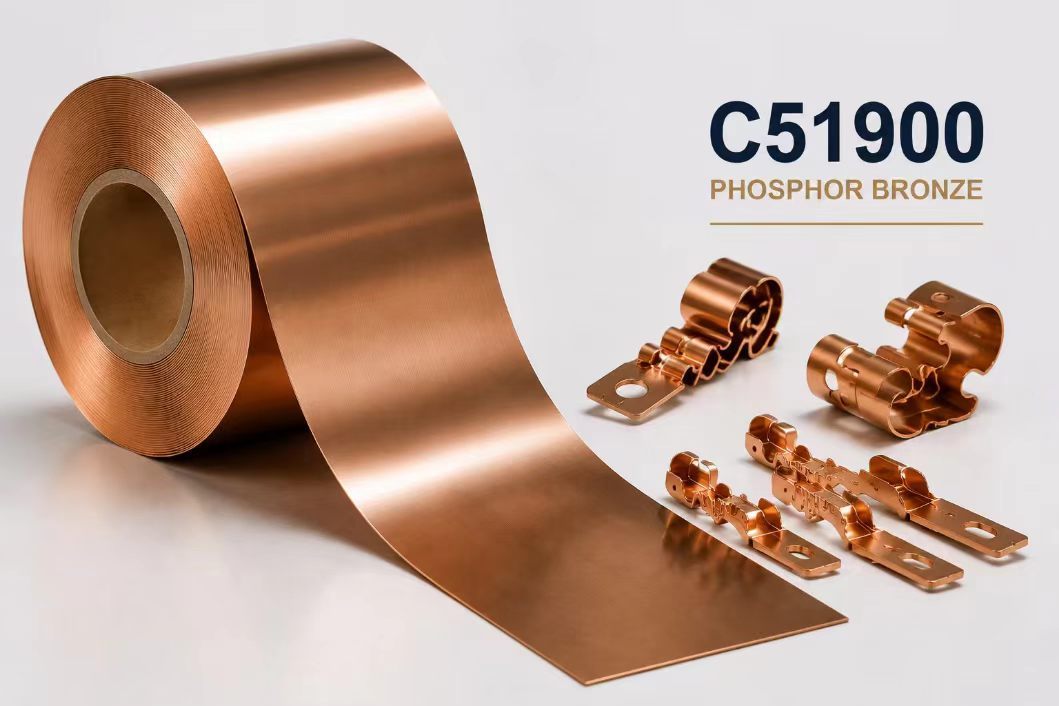
C51900 is the higher-tin workhorse in the phosphor bronze family. Where C51000 (5% Sn, 15% IACS) handles standard connector and spring-contact loads, C51900 (6% Sn, 11–13% IACS) adds the margin — higher spring force, better fatigue life, or a smaller cross-section for the same load.
The decision between C51000 and C51900 depends on whether the application requires conductivity headroom or mechanical headroom. Over-specifying C51900 adds material cost for strength that is not required. Under-specifying C51000, where cyclic stress exceeds its fatigue limit, causes contact force drift and field failures.
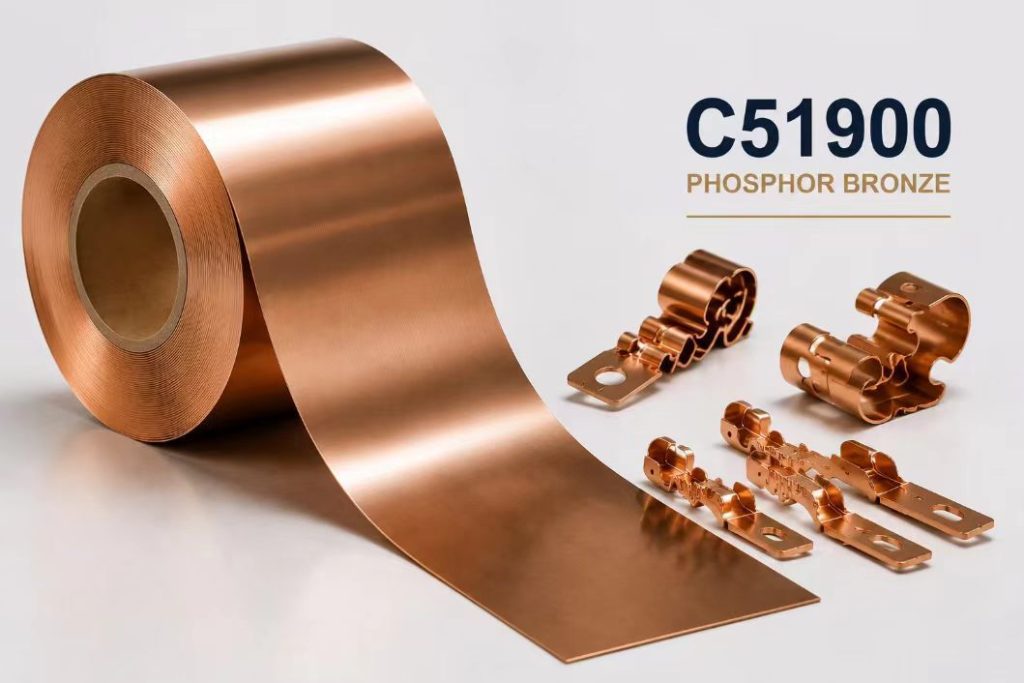
What Is C51900 Phosphor Bronze
C51900 is a wrought phosphor bronze in the UNS C50000 series, defined under ASTM B103/B103M (sheet and strip), ASTM B139/B139M (rod and bar), and ASTM B159/B159M (wire). Its tin content ranges from 5.0 to 7.0%. This places C51900 between C51000 (4.2–5.8% Sn) and C52100 (7.0–9.0% Sn) in the phosphor-bronze spectrum.
The higher tin content increases the alloy’s work-hardening rate. Cold-rolled tempers reach higher yield strengths than C51000 at the same reduction ratio. Applications that select C51900 prioritize spring force and fatigue resistance over electrical conductivity.
Phosphorus (0.03–0.35%) deoxidizes the melt during casting. It also contributes to wear resistance. Tin and phosphorus together form a fine distribution of Cu₃P particles. These particles increase stiffness and reduce adhesive wear in sliding contacts.
C51900 Chemical Composition
The ASTM B103 composition limits for C51900, alongside C51000 for direct comparison:
| Element | C51900 (%) | C51000 (%) |
| Cu + Sn + P | 99.5 min | 99.5 min |
| Sn | 5.0–7.0 | 4.2–5.8 |
| P | 0.03–0.35 | 0.03–0.35 |
| Fe | 0.10 max | 0.10 max |
| Pb | 0.05 max | 0.05 max |
| Zn | 0.30 max | 0.30 max |
Everything except tin falls in the same range. The only numeric difference between C51900 and C51000 composition limits is the tin window. The two alloys start from nearly identical melts. The tin level is what drives the performance split.
C51900 Mechanical and Physical Properties
Three tempers cover most strip and sheet specifications.
| Property | H02 (Half Hard) | H04 (Hard) | H08 (Spring) |
| Tensile Strength (ksi) | 70–85 | 85–100 | 95–110 |
| Yield Strength, 0.2% offset (ksi) | 55–75 | 75–95 | 85–105 |
| Elongation in 2″ (%) | 10–18 | 3–8 | 1–3 |
| Hardness (Rockwell B) | 80–89 | 92–98 | 97–102 |
Physical constants:
| Property | Value |
| Electrical Conductivity (% IACS) | 11–13 |
| Thermal Conductivity (W/m·K) | ~67 |
| Density (g/cm³) | 8.80 |
| Modulus of Elasticity (GPa) | 110 |
Conductivity is the tradeoff. C51000 runs around 15% IACS. C51900 drops to 11–13% IACS because the additional tin in solid solution scatters more electrons. For most spring-contact applications, 11–13% IACS is sufficient — connector resistance is dominated by contact interface resistance, not bulk resistivity. But for busbars or high-current-carrying springs, that 2–4% IACS gap matters.
Temper selection is critical. H08 spring temper delivers maximum strength, but elongation drops to 1–3%. Bending and forming operations at H08 require generous bend radii (≥ 3t for 90° bends). H02 half-hard provides a workable balance: enough strength for most relay and switch springs, with elongation high enough to survive secondary forming without cracking.
Go / No-Go Limits
- Go: Cyclic spring force degradation below 5% over the design life, at 11% IACS conductivity.
- Go: The same geometry needing 10–20% more spring force, or a form factor where C51000 stress limits are exceeded.
- No-Go: Continuous current above 5A through a small cross-section — C51900’s lower conductivity amplifies I²R heating.
- No-Go: Tight-radius bends at H08 spring temper. Forming cracks in spring-temper C51900 are a common field failure.
C51900 vs C51000 — When to Upgrade
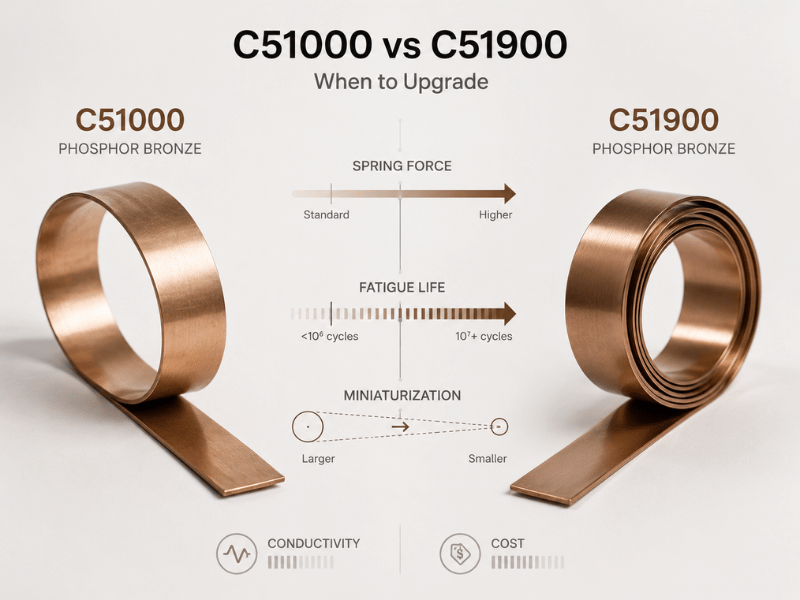
Conductivity budget, required spring force margin, and design cycle life determine the choice.
| Decision Factor | Stick with C51000 | Upgrade to C51900 |
| Spring force | Standard contact pressure adequate | 10–20% more force needed in same envelope |
| Fatigue life | < 10⁶ cycles acceptable | 10⁷+ cycles required, or safety margin needed |
| Conductivity budget | 15% IACS needed | 11% IACS acceptable |
| Miniaturization | Not in scope | Part getting smaller, C51000 yield too low |
| Material cost | Price-sensitive | Strength gain justifies premium |
The cost difference between C51000 and C51900 is modest — typically a single-digit percentage on the raw strip or wire price. The real expense comes from over-engineering (specifying C51900 when C51000 would work) or from field failures caused by under-specifying. Neither is worth the few dollars saved or spent on raw material.
The conservative approach defaults to C51000 for general-purpose connector springs. C51900 is specified when testing shows C51000 spring force drift exceeding 5% over the required life, or when design miniaturization pushes C51000 stress levels outside its safe fatigue envelope.
C51900 Equivalent Grades (Cross-Reference)
Multiple standards cover the same alloy under different names.
| Standard | Designation | Region |
| EN 1652 / EN 1654 | CuSn6 (CW452K) | Europe |
| JIS H3110 / H3130 | C5191 | Japan |
| BS 2870 / BS 2874 | PB103 | UK |
| GB/T 2059 / GB/T 2060 | QSn6.5-0.1 | China |
| ISO 1634 / ISO 1639 | CuSn6 | International |
Equivalent Chemistry Overlap Check
CuSn6 (EN CW452K) specifies Sn 5.5–7.0%, which is a narrower and slightly higher window than C51900’s 5.0–7.0%. C5191 (JIS) specifies Sn 5.5–7.0% as well. Material certified to either EN CuSn6 or JIS C5191 falls within ASTM C51900 limits. In practice, strip and wire sold under any of these names is interchangeable, provided the mechanical condition matches.
Material interchangeability does not guarantee documentation alignment.
Document trap: A European supplier certifying to EN 1652 may not list UNS C51900 on the MTR. Conversely, a US mill certifying to ASTM B103 may not reference CW452K. When a customer drawing calls out CuSn6 and the sourced material is a C51900 strip, the temper designation map must be verified — European R430 / R540 / R620 designations do not always have a one-to-one match with ASTM H02 / H04 / H08.
Common Applications of C51900
C51900 is specified wherever a spring cycles millions of times or a contact needs a consistent force over years of service. High elastic modulus, fatigue resistance, and moderate conductivity define the application envelope:
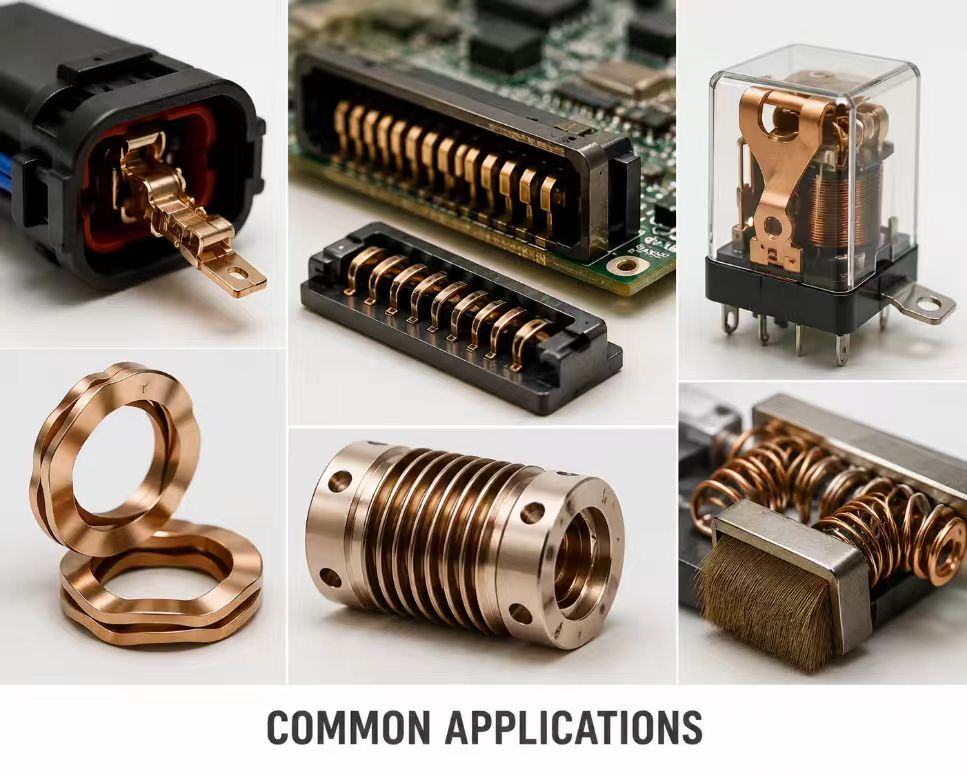
- Electrical connectors and contacts: Automotive connector terminals, board-to-board connectors, battery contacts. The alloy resists stress relaxation at elevated temperatures, maintaining contact force after years of thermal cycling.
- Switch components: Relay springs, microswitch blades, slide switch contacts. C51900 handles the repeated deflection cycles without taking a permanent set.
- Spring washers and wave springs: Where a thin cross-section must generate consistent axial force over the clamped joint’s service life.
- Bellows and flexible couplings: Phosphor bronze bellows in instrumentation and pressure-sensing devices rely on C51900’s fatigue performance and corrosion resistance.
- Wire brushes and mechanical springs: Industrial brushes operating under consistent mechanical load, where wear resistance and springback matter more than electrical performance.
Application Fit by Temper
| Temper | Typical Application Fit |
| H02 (Half Hard) | Relay springs, switch blades that need secondary forming |
| H04 (Hard) | Connector contacts, snap rings, flat springs |
| H08 (Spring) | Stamped contacts with no post-forming, wave washers, Belleville springs |
Procurement Notes
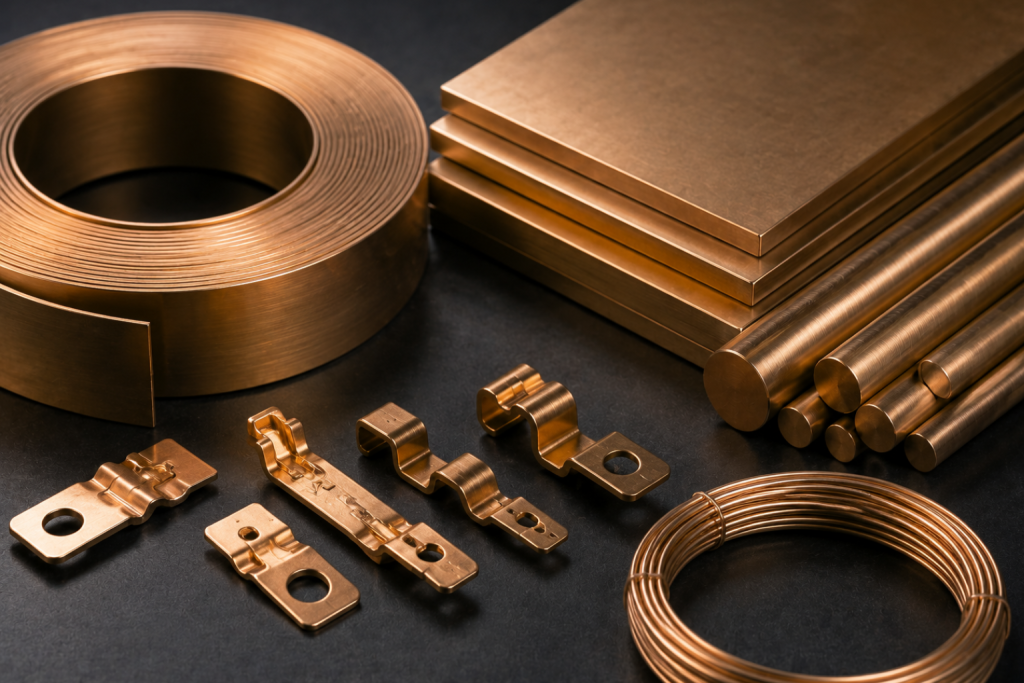
C51900 is available in all standard wrought copper product forms: strip, sheet, plate, rod, bar, wire, and tube. Most connector and spring applications start from cold-rolled strip or cold-drawn wire in the required temper.
- Lead time: Standard-temper strip from mill inventory typically ships in 2–4 weeks for domestic suppliers. Custom tempers, non-standard gauges, or special width/slit combinations can push lead time to 6–10 weeks.
- Documentation: Every shipment includes a Material Test Report (MTR) showing chemical analysis, mechanical properties, and temper designation. Export applications require the MTR to list both the UNS designation and the customer’s local equivalent grade.
- Linsy Copper: C51900 phosphor bronze is in Linsy’s standard bronze supply range, alongside C51000, C51100, C52100, and C54400. Available as strip, sheet, plate, rod, bar, and wire — with both stock and low-MOQ custom production options. Typical custom lead time is 10–60 days depending on dimensions and processing requirements.
Conclusion
C51900 is the right phosphor bronze when C51000 spring force or fatigue life comes up short. Conductivity budget (11% IACS vs. 15% IACS), required spring-force margin, and design cycle life determine the choice. When a connector design is getting smaller and C51000 cannot close the gap, C51900 (or its international equivalents, CuSn6 /C5191) is the logical upgrade. If your part is still between C51000 and C51900, send your drawing — we’ll check grade fit against your requirements.
FAQ
-
C5191 is the JIS (Japanese) designation; C51900 is the UNS (US) designation. Chemically and mechanically, they are interchangeable. The tin range for both is effectively identical. Check temper maps when cross-referencing — JIS uses “H” designations (similar to ASTM) but the specific strength ranges may differ slightly between standards.
-
In low-current signal connectors, yes — partially. C51900 cannot match the strength (175 ksi+) or conductivity (22%+ IACS) of beryllium copper, and its stress relaxation resistance at temperatures above 150°C is inferior. However, for ambient-temperature connectors requiring 1–5 A and standard contact forces, C51900 is a cost-effective alternate that avoids beryllium’s health/safety handling requirements.
-
No. C51900 is a cold-work-strengthened alloy and does not respond to precipitation hardening. Cold forming into the final shape introduces additional work hardening that can raise strength locally but also reduces residual ductility. Stress relieving at 200–250°C for 1–2 hours can reduce residual forming stresses without significantly softening the material.
-
Soldering is straightforward with rosin-based fluxes and Sn-Pb or Sn-Ag-Cu solders. Phosphorus content in the alloy (0.03–0.35%) can interfere with fusion welding — TIG welding is possible but may produce brittle weld zones due to tin segregation. Resistance welding (spot welding) works better for thin-gauge C51900 strip connections.

David Huang is a copper materials specialist and Sales Manager at Linsy Copper, with years of hands-on experience supporting global customers in copper and copper alloy sourcing.
He specializes in industrial copper products such as C11000 copper, C10200 oxygen-free copper, brass, bronze, copper sheets, plates, tubes, bars, and custom-processed copper components.
With a practical understanding of copper manufacturing, quality inspection, surface treatment, and export supply chains, David helps customers choose the right materials for electrical, mechanical, marine, construction, and industrial applications.