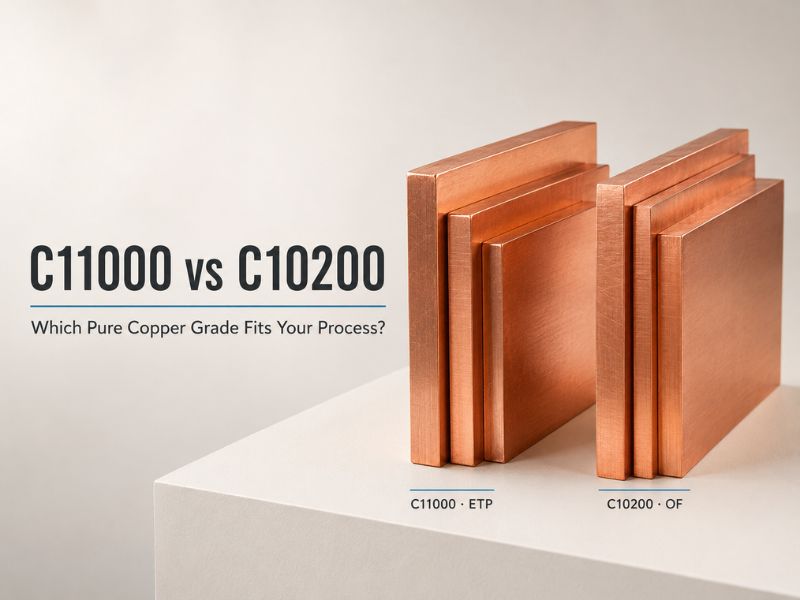
When selecting pure copper, the comparison almost always comes down to C11000 (ETP) versus C10200 (oxygen-free). Electrically and thermally, they’re nearly identical. The decision hinges on one element — oxygen — and whether the manufacturing process involves hydrogen at elevated temperature.
In most applications, C11000 provides equivalent performance at lower cost. But pick the wrong grade for the wrong environment, and hydrogen embrittlement creates failures that no post-processing can reverse.
What Are C11000 and C10200?
C11000 — Electrolytic Tough Pitch (ETP) Copper
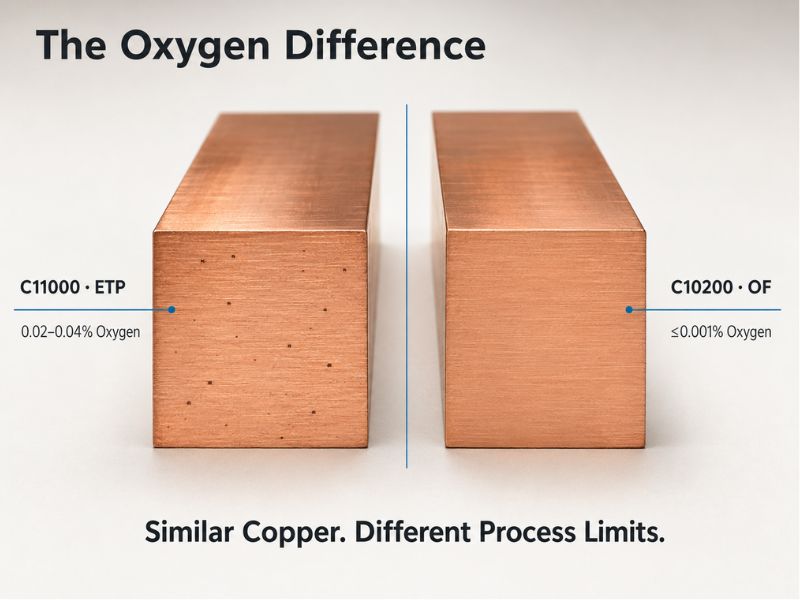
Minimum 99.90% copper, with a controlled oxygen content of 0.02–0.04%. The oxygen is deliberate — it ties up impurity elements as oxides, improving electrical conductivity. ETP copper accounts for the vast majority of copper busbar, wire, and general electrical applications.
C10200 — Oxygen-Free (OF) Copper
Minimum 99.95% copper, with oxygen held below 0.001% (10 ppm). Produced under a controlled atmosphere to prevent oxygen pickup during casting. The near-zero oxygen content is what gives C10200 its resistance to hydrogen embrittlement and its superior performance in high-temperature brazing and welding.
Chemical Composition — The Oxygen Difference
| Element | C11000 (ETP) | C10200 (OF) |
|---|---|---|
| Cu (min) | 99.90% | 99.95% |
| Oxygen | 0.02 – 0.04% | ≤ 0.001% (10 ppm) |
| Total impurities | ≤ 0.10% | ≤ 0.05% |
The 0.02–0.04% oxygen in C11000 isn’t an impurity — it’s a deliberate addition. During solidification, oxygen reacts with residual hydrogen to form steam (H₂O), preventing porosity. But that same oxygen becomes a liability in hydrogen-rich service, where it forms internal steam pockets along grain boundaries.
C10200’s oxygen ceiling of 0.001% is the threshold where hydrogen embrittlement ceases to be a practical concern. It’s also why OF copper is specified for vacuum applications — there’s nothing to outgas at high temperature.
Electrical Conductivity Comparison
| Grade | % IACS (Annealed) |
|---|---|
| C11000 | 100 – 101 |
| C10200 | 100 – 101 |
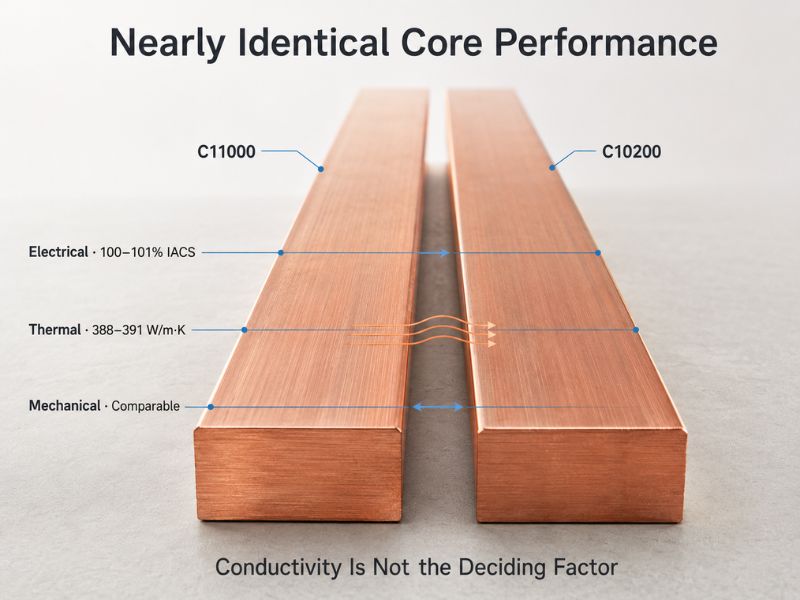
In annealed condition, both grades deliver 100% IACS or slightly above. The practical electrical performance is identical. If a supplier claims C10200 is “more conductive” than C11000, they’re selling oxygen-free on a non-existent electrical advantage.
The conductivity gap only appears in the cold-worked condition. C11000 loses slightly more conductivity after cold working than C10200 due to the oxygen content influencing dislocation density. The difference is typically 1–2% IACS — measurable in a lab but irrelevant for busbar design. In standard busbar and transformer winding applications, conductivity is not the reason to choose C10200 over C11000.
Mechanical Properties
| Property | C11000 (Annealed) | C10200 (Annealed) |
|---|---|---|
| Tensile Strength (MPa) | 220 – 250 | 220 – 250 |
| Yield Strength (MPa) | 69 – 75 | 69 – 75 |
| Elongation (%) | 45 – 50 | 45 – 50 |
| Hardness (Rockwell F) | 40 – 50 | 40 – 50 |
Mechanically, the two grades are interchangeable. Both anneal at similar temperatures (370–650°C) and work-harden at similar rates. If the only requirements are formability and strength, there’s no functional difference.
Thermal Conductivity and Heat Performance
| Grade | Thermal Conductivity (W/m·K) |
|---|---|
| C11000 | 388 – 391 |
| C10200 | 388 – 391 |
Same story as electrical conductivity: the gap is a rounding error. Design heat sinks, vapor chambers, or thermal management systems with C11000 unless the manufacturing process itself demands oxygen-free material (e.g., vacuum brazing in a hydrogen atmosphere).
Hydrogen Embrittlement — The Critical Differentiator
This is the single most important reason to choose C10200 over C11000.
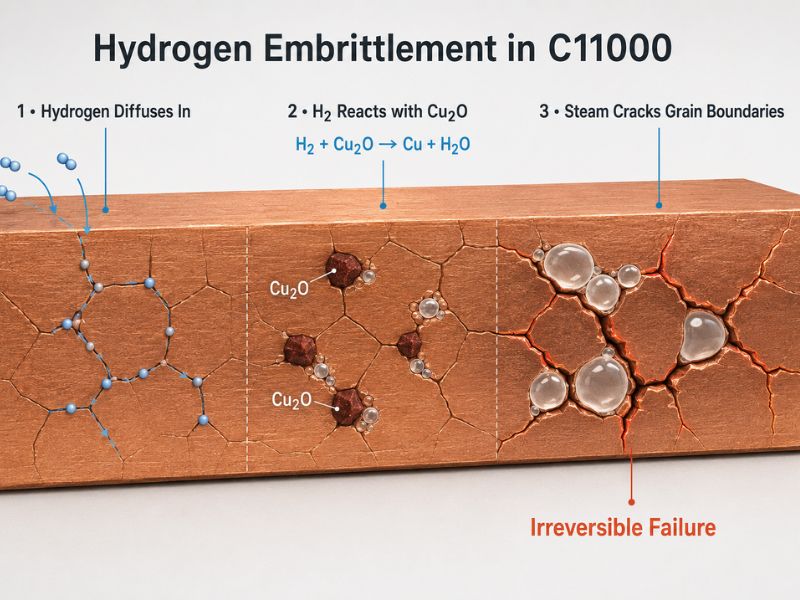
The failure mechanism:
When C11000 (with 0.02–0.04% O₂) is heated above roughly 370°C in a hydrogen-containing atmosphere, hydrogen diffuses into the copper and reacts with the internal cuprous oxide (Cu₂O) particles to form steam (H₂O). The steam pressure fractures the copper along grain boundaries. This is called “hydrogen embrittlement” or “steam embrittlement,” and once it happens, the material is scrap. No heat treatment or welding repair can reverse it.
Go/no-go rule:
- If the process involves hydrogen brazing, welding in a hydrogen atmosphere, or extended service above 370°C in hydrogen → C10200 is mandatory.
- If the process uses standard brazing fluxes in air, inert-gas welding, or operates below 370°C → C11000 is sufficient.
OF copper was developed for this reason. It’s not about conductivity — it’s about surviving manufacturing processes that ETP copper cannot.
Weldability and Brazing
Both grades weld well with GTAW (TIG), but for different reasons:
- C10200 gives clean, porosity-free welds in any atmosphere, including hydrogen shielding.
- C11000 welds well in inert gas (argon, helium) but will embrittle if hydrogen is present in the shielding gas or from contaminated filler. Even a 5% hydrogen mix in argon is enough to cause damage.
For furnace brazing with hydrogen atmosphere — common in electronics and vacuum component manufacturing — C10200 is the only acceptable choice. C11000 will fail during the brazing cycle.
Cost, Availability, and Procurement
| Factor | C11000 (ETP) | C10200 (OF) |
|---|---|---|
| Material cost | Baseline | +10–20% |
| Stock availability | Excellent | Good |
| Common forms | Sheet, plate, bar, tube, wire | Sheet, plate, bar, tube |
| Typical MOQ (mill direct) | 100 kg | 200 kg |
C11000 is the most widely produced copper grade globally. Every service center carries it. C10200 costs more because the oxygen-free production process requires controlled-atmosphere casting, higher-grade cathode selection, and lower production volumes.
When conductivity alone drives the selection, C11000 delivers identical performance at lower cost. The 10–20% premium for C10200 is non-negotiable only when the application genuinely requires OF copper (hydrogen brazing, vacuum service).
Linsy Copper stocks both C11000 and C10200 in sheet, plate, bar, and tube — contact Linsy for current stock availability and project-specific MOQ.
Application Decision Matrix
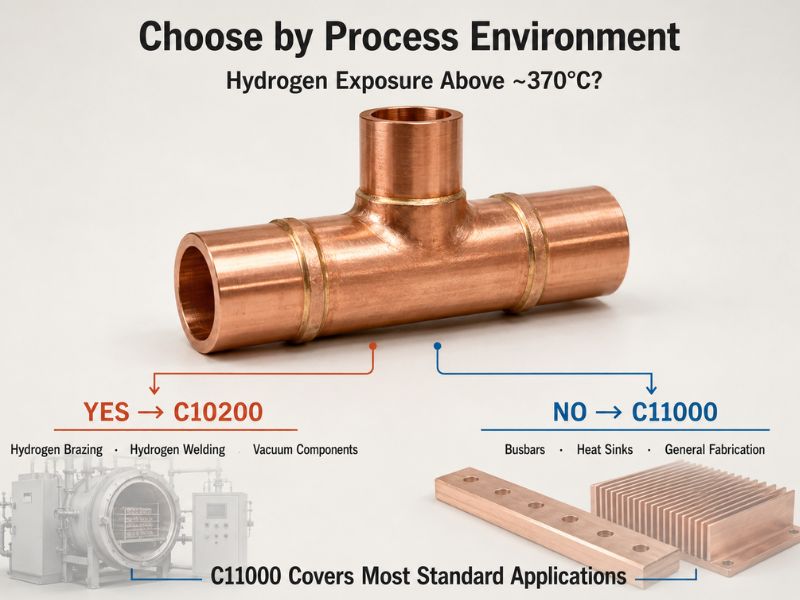
| Application | Recommended Grade | Reason |
|---|---|---|
| Electrical busbar | C11000 | Same conductivity, lower cost |
| Transformer winding | C11000 | No hydrogen exposure |
| Hydrogen furnace brazing | C10200 | C11000 embrittles |
| Vacuum components | C10200 | No outgassing |
| Welded pipe (GTAW/argon) | C11000 | Welds fine in inert gas |
| Heat sinks | C11000 | Same thermal, lower cost |
| Semiconductor lead frames | C10200 | Brazing + vacuum requirements |
| Architectural copper | C11000 | No technical reason for OF |
| Cryogenic applications | C10200 | Better low-temp ductility |
| General fabrication | C11000 | Covers 80%+ of applications |
Conclusion
C11000 and C10200 are functionally identical in conductivity, strength, and thermal performance. The decision hinges on one question: Does the manufacturing process involve hydrogen at elevated temperature? If yes, C10200 is mandatory. If no, C11000 does the job at 10–20% less cost with better availability. Linsy Copper supplies both grades with project-specific MOQ and grade-fit documentation. Send the drawing for a grade-fit review.
FAQ
-
No. Both reach 100–101% IACS when annealed. The real difference is oxygen content, not electrical performance.
-
When the copper is heated above ~370°C in the presence of hydrogen — typically during hydrogen furnace brazing, hydrogen-atmosphere welding, or vacuum component manufacturing.
-
Yes, using GTAW (TIG) with argon or helium shielding gas. Hydrogen-containing shielding gas or contaminated filler material will cause embrittlement in C11000 welds.
-
Generally no. The oxygen content in C11000 can outgas at high vacuum and elevated temperature. C10200 is preferred for vacuum chambers and components.
-
C11000. The electrical conductivity is identical to C10200 at a lower cost. Unless the busbar manufacturing involves hydrogen brazing, there’s no advantage to OF copper.

David Huang is a copper materials specialist and Sales Manager at Linsy Copper, with years of hands-on experience supporting global customers in copper and copper alloy sourcing.
He specializes in industrial copper products such as C11000 copper, C10200 oxygen-free copper, brass, bronze, copper sheets, plates, tubes, bars, and custom-processed copper components.
With a practical understanding of copper manufacturing, quality inspection, surface treatment, and export supply chains, David helps customers choose the right materials for electrical, mechanical, marine, construction, and industrial applications.