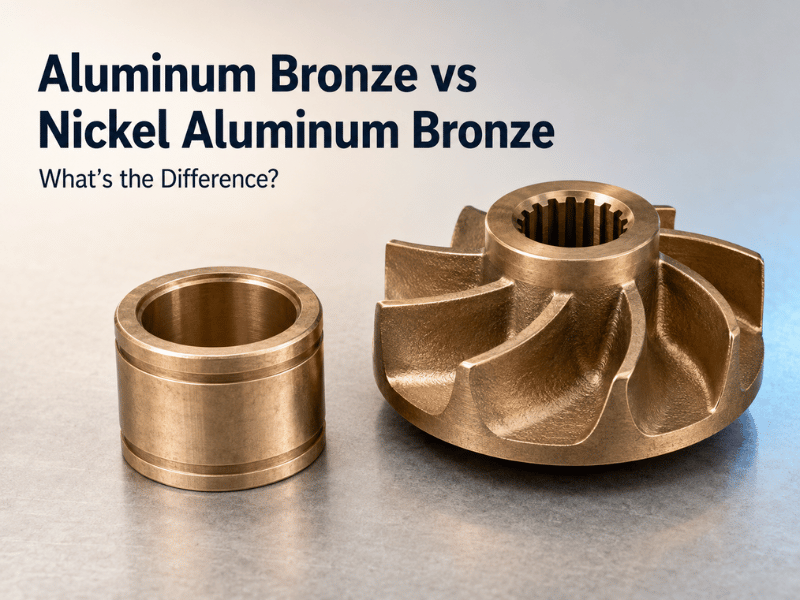
Aluminum bronze and nickel aluminum bronze (NAB) share the same Cu–Al–Fe base. NAB adds 4–5.5% nickel to suppress dealuminification and stabilize the microstructure in seawater — the failure mode that limits plain aluminum bronze to non-marine duty.
The practical question is not “which is better” but “does the application require the nickel addition, or does plain aluminum bronze meet the performance requirements at lower cost?”
What Each Alloy Is
Aluminum bronze is the umbrella term for copper-aluminum-iron (Cu–Al–Fe) alloys. They get their strength and wear resistance from aluminum and iron, with little or no intentional nickel.
Nickel aluminum bronze is the upgraded sub-family: copper-aluminum-iron-nickel (Cu–Al–Fe–Ni). Nickel is added on purpose — typically 4–5.5% — to refine the grain structure, stabilize the microstructure, and block a failure mode that plain aluminum bronze is prone to in seawater.
Simple hierarchy: Nickel aluminum bronze = nickel-strengthened aluminum bronze.
Composition: The Core Difference
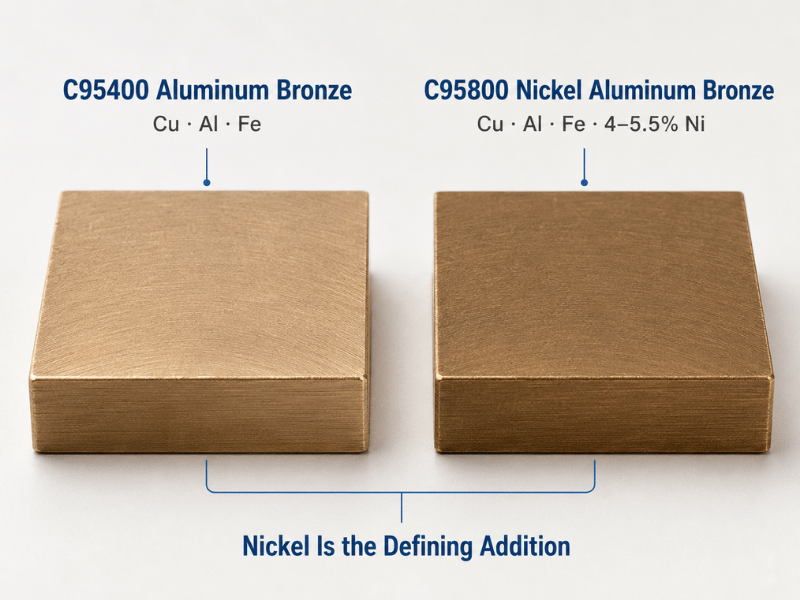
| Element | Plain Aluminum Bronze (e.g. C95400) | Nickel Aluminum Bronze (C95800 / C63000) |
| Copper | Balance | Balance |
| Aluminum | 10.0–11.5% | 8.5–11.0% |
| Iron | 3.0–5.0% | 3.5–4.5% |
| Nickel | ≤1.5% (trace, not intentional) | 4.0–5.5% (intentional) |
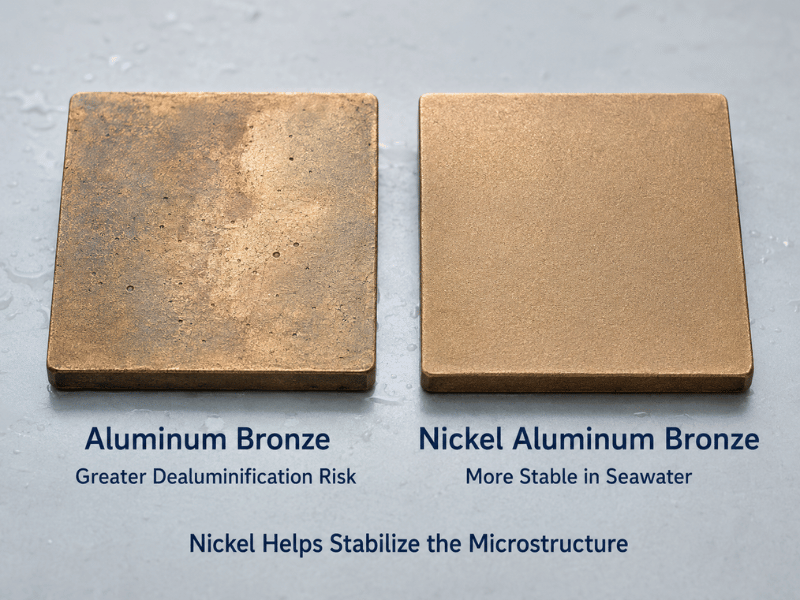
The nickel addition functions at the microstructural level, not merely the chemical level. It suppresses the precipitation of brittle corrosion phases and prevents dealuminification — the leaching of aluminum from the surface that destroys plain aluminum bronze in seawater. This effect is the reason NAB is a marine standard and plain aluminum bronze is not.
Physical & Chemical Properties Compared
| Property | Plain Aluminum Bronze | Nickel Aluminum Bronze |
| Density | ~7.5–7.6 g/cm³ | ~7.5–7.6 g/cm³ |
| Electrical conductivity | ~10–13% IACS | ~7–8% IACS |
| Thermal conductivity | ~33–38 W/m·K | ~36–40 W/m·K |
| Magnetic permeability | Non-magnetic | Non-magnetic (NAB <1.05) |
| Seawater corrosion | Weak — pitting, crevice, dealuminification | Excellent — immune to dealuminification |
| Biofouling | Susceptible | Both bronzes release copper ions to resist marine fouling; NAB performs better in long-term seawater service. |
| High-temperature stability | Moderate | Strong, low stress-relaxation |
Two points worth flagging for design:
- Neither is an electrical alloy. Both sit around 7–12% IACS — roughly a tenth of pure copper. Size cables and busbars accordingly; do not specify either for conduction.
- Plain aluminum bronze conducts heat better. The higher nickel content in NAB reduces thermal conductivity to ~36–40 W/m·K versus ~50–60 W/m·K for plain grades. For most parts this is irrelevant, but it matters in heat-path designs.
Common Grades
Plain aluminum bronze (cast-focused):
- C95400 — the general-purpose cast grade; bearings, bushings, valve bodies.
- C95200 / C95300 — lower-strength cast variants for lighter wear duty.
- C95500 — Medium nickel NAB grade with 3.0–5.5% Ni, balanced strength and corrosion resistance for general marine castings.
- C95800 — the cast marine grade (ASTM B148). Propellers, sea valves, pump casings.
- C63000 — the wrought grade (AMS 4640), strongest of the three, for precision machined high-load parts.
- C95900 — ultra-high-strength NAB for heavy-duty marine service.
The three grades that anchor most comparisons are C95400 (plain, cast), C95800 (NAB, cast), and C63000 (NAB, wrought).
Cast vs Wrought: NAB’s Two Forms
Plain aluminum bronze is almost always cast (C95400). The casting route is economical for large, complex shapes, but it carries slight porosity and looser dimensional control — acceptable for bushings, less suitable for tight-tolerance motion parts.
NAB covers both routes:
| Form | Grade | Best For | Key Advantage |
| Cast NAB | C95800 | Large, complex marine castings — propellers, seawater valve bodies, pump shells | Economical for big shapes; ASTM B148 compliant |
| Wrought NAB | C63000 | Precision-machined, high-load moving parts | Dense, uniform structure; tight tolerances; highest strength (AMS 4640) |
Use Scenarios
| Category | Alloy Family | Representative Grade | Environment | Typical Applications |
| Cost-driven, non-corrosive | Plain aluminum bronze | C95400 | Freshwater, oil, dry air | Pump bodies, gears, bushings, hydraulic valves, construction wear castings |
| Marine, large castings | Cast NAB | C95800 | Seawater, salt spray | Propellers, seawater valves, offshore piping, subsea hardware |
| Precision, high-load | Wrought NAB | C63000 | Seawater or high-stress | Aerospace hydraulic bushings, high-pressure valve stems, heavy-duty bearing shells |
| High-velocity flow | Cast or wrought NAB | C95800 / C63000 | Cavitation, erosion | Seawater pump impellers, high-flow fittings |
How to Choose
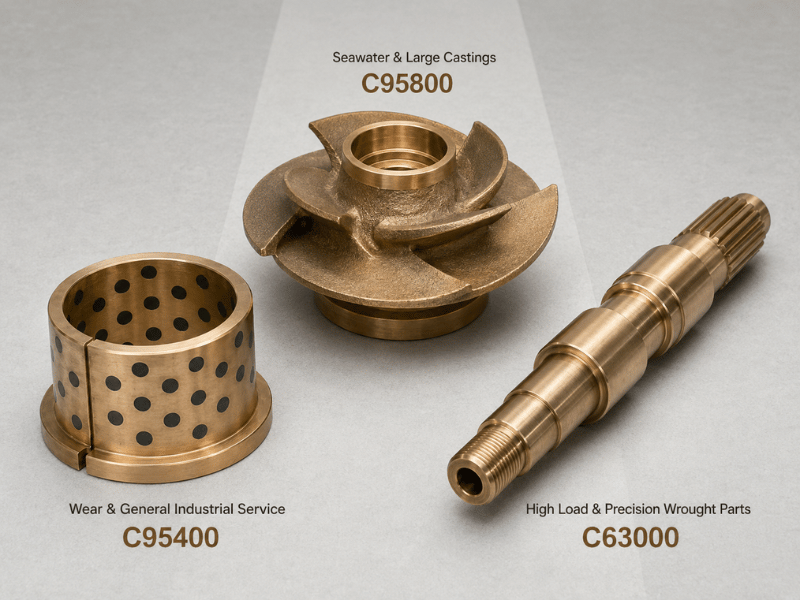
- Cost-driven + non-corrosive environment: plain aluminum bronze, C95400.
- Seawater exposure + large cast structure: cast NAB, C95800.
- Precision machined + high strength/load: wrought NAB, C63000.
If the part never sees salt, seawater, or high-velocity flow, the nickel addition in NAB adds material cost without delivering a performance benefit. If the part operates in seawater, plain aluminum bronze will fail by dealuminification — and the lower-cost alloy becomes the more expensive option over the service life.
Sourcing from Linsy
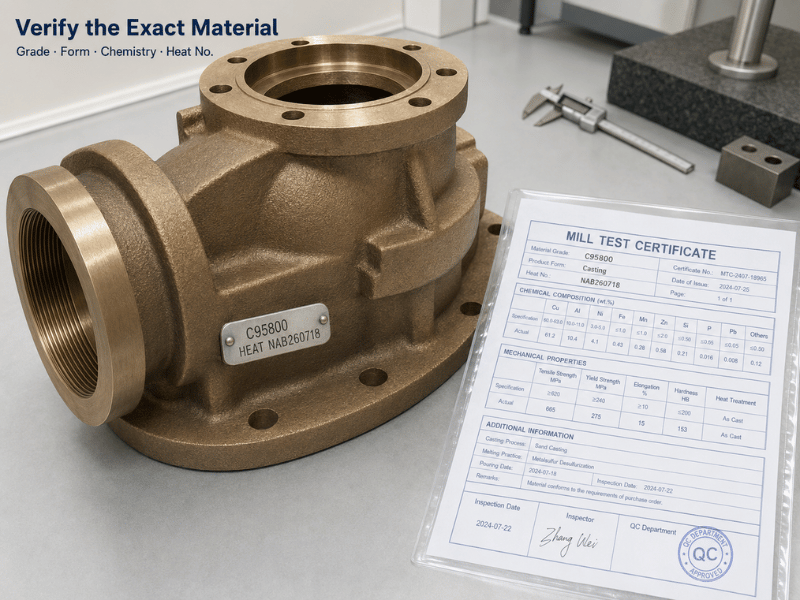
Linsy supplies C95400, C95800, and the wrought NAB C63000 in cast and wrought forms, with custom production available to match project requirements.
Every order ships with full MTR/MTC documentation. SGS chemical, mechanical, electrical-conductivity, and dimensional test reports are available on request. Production runs under ISO 9001 / 14001 / 45001, with low-MOQ custom production and a typical 10–60 day lead time.
Conclusion
Aluminum bronze and nickel aluminum bronze share the same copper-aluminum-iron base. The 4–5.5% nickel in NAB determines whether a part survives seawater or fails by dealuminification — but specifying NAB where plain aluminum bronze suffices adds material cost without performance benefit. Select plain C95400 when the environment is dry, fresh, or oil-based and cost matters; specify C95800 (cast) or C63000 (wrought) when seawater, cavitation, or heavy load enters the spec. Linsy supplies C95400, C95800, and C63000 with full MTR/MTC documentation per lot and low-MOQ custom production — send the drawing or specification for a grade-fit review, or request a side-by-side comparison of composition and property data.
FAQ
-
No. NAB is a nickel-strengthened sub-family of aluminum bronze. Same Cu–Al–Fe base, plus 4–5.5% intentional nickel. Treat it as an upgraded grade, not a separate class.
-
Not for long-term duty. In aerated seawater it suffers dealuminification, pitting, and crevice corrosion. NAB’s nickel content blocks that mechanism, which is why NAB is the marine standard.
-
C63000 (wrought NAB) is strongest. Heat-treated C63000 reaches tensile strength of 690–900 MPa, while annealed version has much lower tensile strength. C95800 and C95400 are cast grades in the 515–760 MPa band; strength alone rarely separates them, environment does.
-
No. Both families are non-magnetic. NAB typically measures below 1.05 permeability, which is why it is used in naval and sonar-adjacent components where magnetic signature matters.
-
Poorly. Both sit around 7–12% IACS — roughly a tenth of pure copper. Do not use either where electrical conduction is the primary function.

David Huang is a copper materials specialist and Sales Manager at Linsy Copper, with years of hands-on experience supporting global customers in copper and copper alloy sourcing.
He specializes in industrial copper products such as C11000 copper, C10200 oxygen-free copper, brass, bronze, copper sheets, plates, tubes, bars, and custom-processed copper components.
With a practical understanding of copper manufacturing, quality inspection, surface treatment, and export supply chains, David helps customers choose the right materials for electrical, mechanical, marine, construction, and industrial applications.