When designing electrical components or specifying thermal management systems, selecting the right copper grade is critical for performance. C11000 copper, also known as Electrolytic Tough Pitch (ETP) copper, is often the standard choice for these applications. It balances high electrical conductivity with good formability, making it a foundational material across industrial and manufacturing sectors.
What is C11000 Copper?
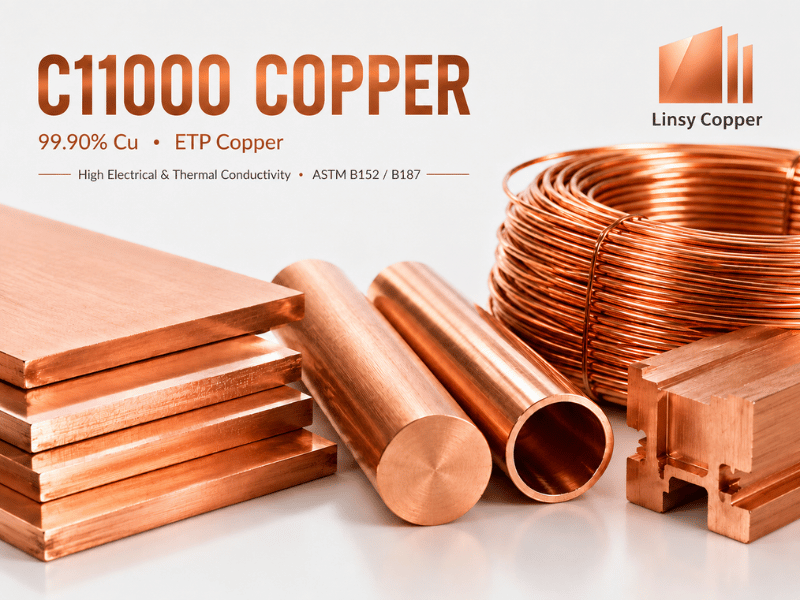
C11000 is a commercially pure copper grade containing a minimum of 99.90% copper. It includes a small, controlled amount of oxygen, typically between 0.02% and 0.04%, which classifies it as tough-pitch copper. This specific composition ensures excellent electrical and thermal conductivity while maintaining practical workability.
Reviewing the exact C11000 copper specification for a project helps ensure it meets the required mechanical and electrical baselines. It is typically supplied in accordance with ASTM standards, such as ASTM B152 for sheet and plate and ASTM B187 for bar and busbar.
Core Properties of C11000 Copper
Mechanical Properties
The mechanical properties of C11000 copper vary significantly with temper, whether the material is annealed (soft) or cold-worked (hard). C11000 copper hardness generally ranges from 35 on the Rockwell F scale for annealed material up to 90 for hard-drawn material. Tensile strength typically ranges from 30,000 to 55,000 psi, depending on the degree of cold working.
| Property | Annealed Temper (Soft) | Hard Drawn Temper |
| Tensile Strength | 30,000 – 38,000 psi (205 – 260 MPa) | 45,000 – 55,000 psi (310 – 380 MPa) |
| Yield Strength | 10,000 – 12,000 psi (70 – 85 MPa) | 40,000 – 50,000 psi (275 – 345 MPa) |
| Hardness (Rockwell F) | 35 – 45 | 80 – 90 |
| Elongation | 35% – 45% | 5% – 15% |
These parameters help determine the right temperature for stamping, bending, or machining operations.
Thermal Properties
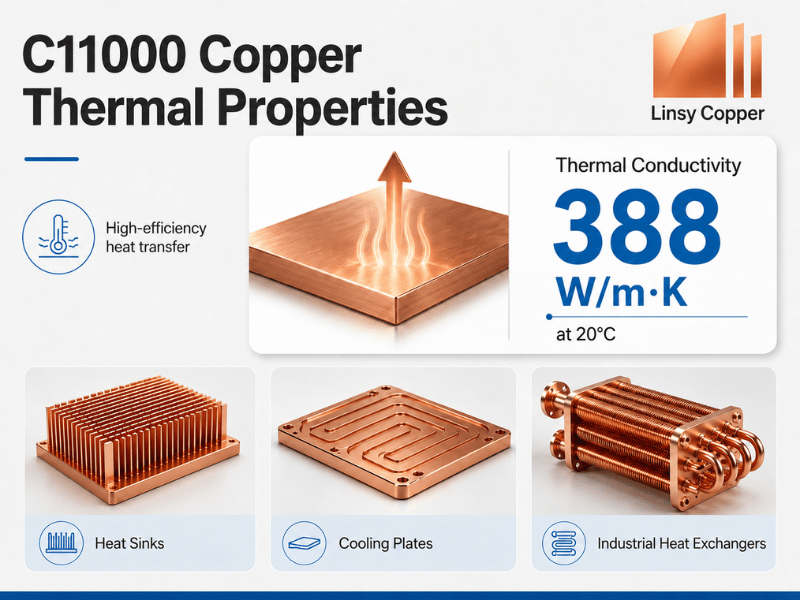
Managing heat dissipation requires materials with high thermal conductivity.
C11000 copper thermal properties are exceptional, with a thermal conductivity of approximately 388 W/m·K at 20°C. This efficient heat transfer makes it a standard choice for heat sinks, cooling plates, and industrial heat exchangers.
Electrical Conductivity
C11000 serves as the baseline standard for electrical conductivity testing. It is rated at 100% IACS (International Annealed Copper Standard) or slightly higher, depending on purity and temper. This exceptionally high rating minimises energy loss and heat generation in power transmission and switchgear applications.
C11000 Copper Machinability and Fabrication
C11000 copper’s machinability is approximately 20% that of free-cutting brass (C36000).The material is relatively soft and ductile, which can lead to stringy chips and buildup on cutting tools. Using sharp tools, appropriate cutting speeds, and proper coolant helps maintain dimensional accuracy and surface finish during CNC machining.
For joining operations, C11000 responds very well to soldering and standard silver brazing. However, it is not recommended for gas-shielded arc welding (TIG/MIG) or high-temperature brazing in reducing atmospheres. The oxygen content in the material can react with hydrogen at elevated temperatures, leading to porosity and hydrogen embrittlement.
Key Advantages of C11000 Copper
Good Corrosion Resistance
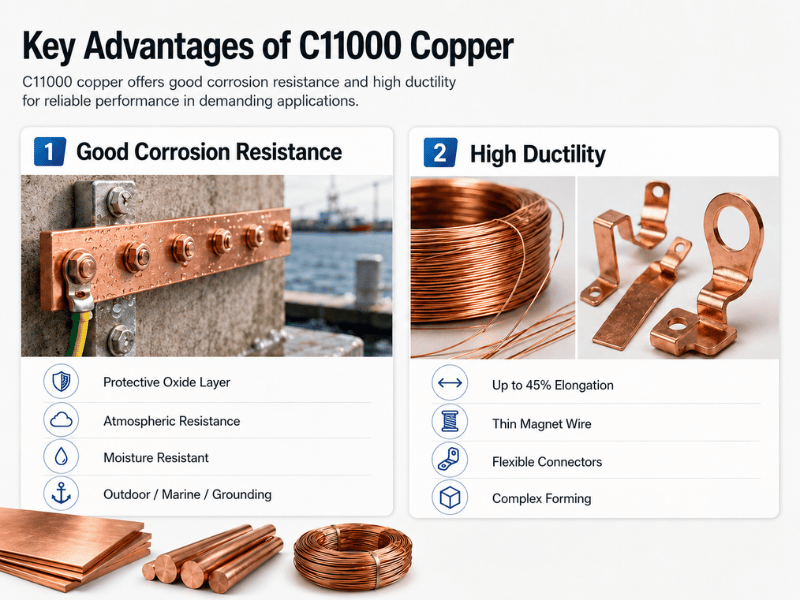
C11000 copper exhibits excellent resistance to atmospheric corrosion, moisture, and industrial environments. It forms a protective oxide layer on its surface when exposed to the elements. This characteristic makes it highly reliable for outdoor electrical installations, marine hardware, and exposed grounding systems without the risk of rapid degradation.
High Ductility
With an elongation rating of up to 45% in its annealed state, C11000 copper possesses high ductility. This allows the material to be drawn into extremely thin magnet wire or formed into complex, flexible electrical connectors without fracturing or losing structural integrity.
Longevity
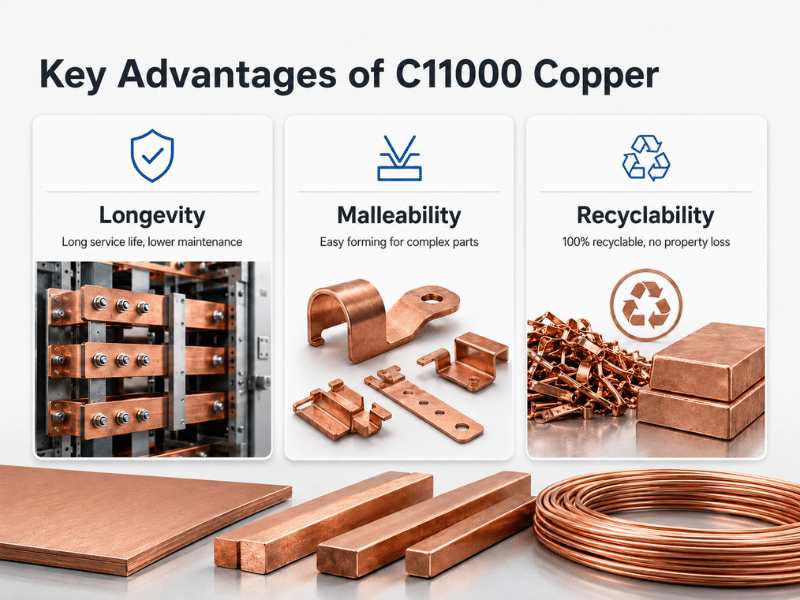
The inherent stability and wear resistance of C11000 copper ensure long-term performance in demanding applications. It guarantees virtually zero degradation in high-cycle electrical switchgear over decades of continuous electrical or thermal service. This longevity reduces maintenance costs and minimises the need for component replacement in industrial infrastructure.
Malleability
C11000 copper is highly malleable, meaning it can be easily hammered, rolled, or pressed into shape without cracking. This property simplifies the fabrication of intricate components such as custom- stamped electrical contacts, deep-drawn copper housings, and rigidly formed busbars. Precise dimensions can be achieved using standard cold-forming equipment.
Recyclability
C11000 copper is 100% recyclable with zero loss in its mechanical, electrical, or thermal properties. Scrap material from manufacturing processes can be fully recovered and remelted for new production runs. This high recyclability supports sustainable manufacturing of new electrical components and helps lower overall material lifecycle costs.
C11000 Copper Equivalent Grades
Cross-referencing international standards is necessary when sourcing materials for global projects or analysing imported assemblies. A direct C11000 copper equivalent varies depending on the regional standard specified on the engineering drawing. Understanding these equivalents streamlines international procurement and ensures material consistency across global supply chains.
| Regional Standard | Equivalent Grade Designation |
| European (EN) | Cu-ETP (CW004A) |
| Japanese (JIS) | C1100 |
| British (BS) | C101 |
| German (DIN) | E-Cu57 (2.0060) |
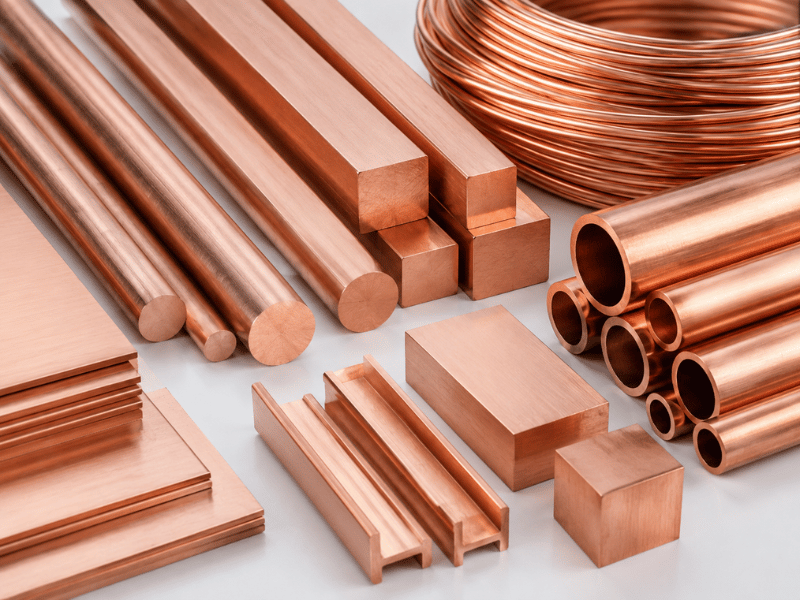
Common Forms: Sheet, Tube, Bar, Wire, and Profile
Different manufacturing processes and end-use applications require specific material shapes.
- C11000 copper sheet and plate: Frequently used for stamping electrical contacts, EMI shielding, and architectural roofing elements.
- C11000 copper bar: Commonly utilised in heavy electrical switchgear, busbar systems, and grounding applications.
- C11000 copper tube: Specified for fluid transfer, HVAC applications, and internal cooling lines.
- C11000 copper wire and coil: The primary form for power distribution networks, cables, and motor windings.
- C11000 copper profile and block: Custom extruded or machined for specialised electrical connectors, switchgear components, and thermal cooling blocks.
Sourcing from a Reliable C11000 Manufacturer
Selecting a C11000 manufacturer or supplier requires verifying their material traceability and processing capabilities. Reliable suppliers provide clear test documents confirming the chemical composition, mechanical properties, and conductivity ratings for the batch.
Sourcing directly from a factory that supports both standard forms and custom dimensions helps reduce material waste and machining time. Verifying whether the supplier offers in-house processing can further streamline and simplify the downstream supply chain.
Linsy Copper: Your Source for C11000 Materials
Linsy Copper is a Shenzhen-based copper factory with more than 20 years of industry experience. We supply a broad range of copper product forms, including C11000 copper sheet, plate, bar, tube, wire, coil, profile, and block.
For non-stock specifications or unique project requirements, we offer low-MOQ custom production, with typical lead times of 10 to 60 days, depending on the grade, dimensions, and processing requirements. In addition to material supply, our factory offers in-house processing services such as CNC machining, laser cutting, stamping and bending, and silver brazing.
We also provide surface-finishing options, including bright polishing, passivation, tin plating, and silver plating, to improve corrosion resistance or solderability. To ensure material reliability, we issue an MTR/MTC for every order, and SGS test reports are available upon request for an additional testing fee.
FAQ
Is C11000 copper suitable for welding?
C11000 is generally not recommended for TIG or MIG welding. The oxygen content of the material can cause porosity and hydrogen embrittlement when the material is heated during welding. Soldering and brazing are the preferred and most reliable joining methods for this grade.
What is the difference between C11000 and C10200 copper?
C11000 contains a small amount of oxygen (Electrolytic Tough Pitch), while C10200 is Oxygen-Free Copper (OFC). C10200 is required for applications involving high-vacuum environments or extensive high-temperature welding, where the oxygen in C11000 would cause structural issues.
Can C11000 be used outdoors?
Yes, C11000 has excellent corrosion resistance in typical atmospheric conditions. Over time, exposure to the elements will cause the surface to oxidise and develop a natural green patina, which further protects the underlying metal from degradation.
What tempers are available for C11000?
C11000 is available in a wide variety of tempers, ranging from soft annealed (O60) to hard drawn (H04). This ensures that mechanical strength and formability can be precisely matched to the requirements of the intended manufacturing process, whether it involves deep drawing, heavy stamping, or rigid busbar installation.

David Huang is a copper materials specialist and Sales Manager at Linsy Copper, with years of hands-on experience supporting global customers in copper and copper alloy sourcing.
He specializes in industrial copper products such as C11000 copper, C10200 oxygen-free copper, brass, bronze, copper sheets, plates, tubes, bars, and custom-processed copper components.
With a practical understanding of copper manufacturing, quality inspection, surface treatment, and export supply chains, David helps customers choose the right materials for electrical, mechanical, marine, construction, and industrial applications.