Introduction
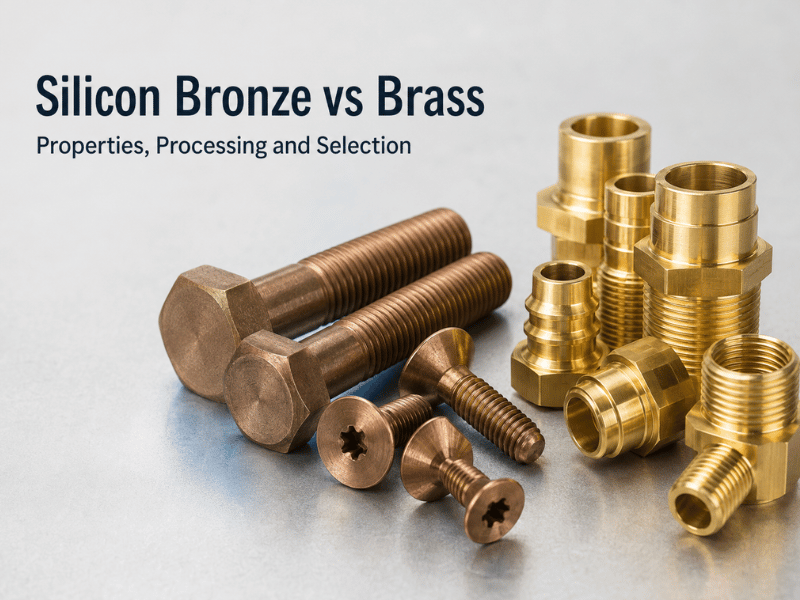
Silicon bronze and brass look similar — both are copper-based alloys with reasonable corrosion resistance and machinability. The practical question is straightforward: will the part face saltwater, chlorides, or acidic conditions?
If yes, silicon bronze resists dezincification and holds up in marine environments that quickly degrade standard brass. If the application stays mild and machining speed or raw material cost matters more, brass is the more practical choice.
What Is Silicon Bronze?
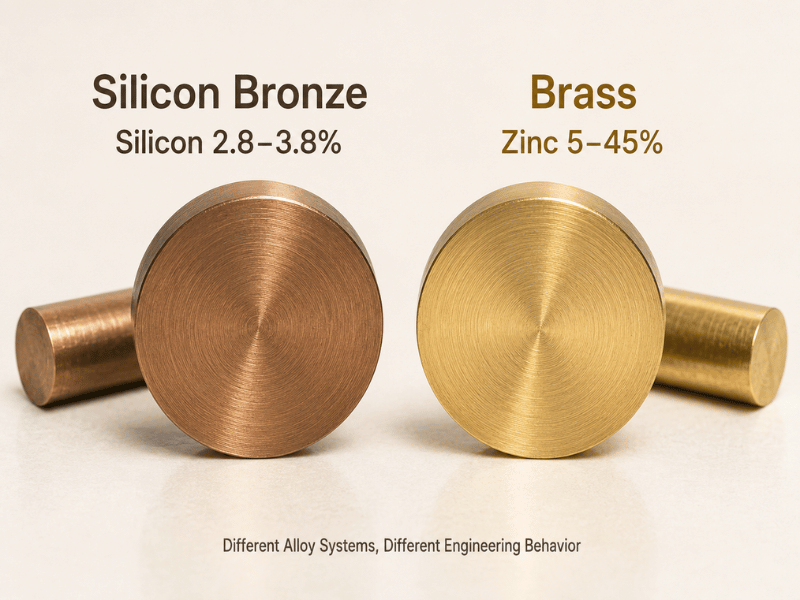
Silicon bronze is a copper alloy family with 2.8–3.8% silicon as the primary alloying element (per ASTM B98), plus small amounts of manganese, iron, or zinc. The most common grade is C65500 (Everdur). Silicon increases strength and hardness above plain copper and most brasses without heat treatment, and provides excellent corrosion resistance in marine and industrial atmospheres. It is one of the easiest copper alloys to TIG weld and is non-sparking — useful in hazardous environments. Over time, silicon bronze develops a stable protective patina that does not flake or pit.
What Is Brass?
Brass is a copper-zinc alloy family with zinc content from 5% to 45%. That percentage shifts nearly every property — color, strength, ductility, corrosion resistance, and machinability.
- C26000 (cartridge brass) — 70% Cu, 30% Zn. Good cold formability, used for drawn parts and ammunition cases.
- C36000 (free-cutting brass) — 60% Cu, 37% Zn, 3% Pb. The benchmark for high-speed copper machining.
- C46400 (naval brass) — 60% Cu, 39% Zn, 1% Sn. Added tin slows dezincification, making it the most marine-tolerant brass.
More zinc improves machinability and lowers cost, but raises dezincification risk in seawater, chlorides, or acidic environments.
Chemical Composition — Silicon vs Zinc as the Critical Difference
Silicon bronze strengthens the copper matrix with silicon — no corrosion penalty. Brass uses zinc, which improves formability and machinability but creates a chemical vulnerability. In aggressive environments, the zinc leaches out, leaving a porous, weakened structure (dezincification).
| Element | Silicon Bronze (C65500) | Brass (typical range) |
| Copper (Cu) | 91–96% | 55–95% |
| Silicon (Si) | 2.8–3.8% | — |
| Zinc (Zn) | ≤ 0.5% | 5–45% |
| Lead (Pb) | ≤ 0.05% | ≤ 3.5% |
| Iron (Fe) | ≤ 0.8% | ≤ 1% |
| Manganese (Mn) | ≤ 0.8% | Trace |
Mechanical Properties — Strength, Hardness, and What They Mean
Silicon bronze sits in the mid-to-high strength range with better hardness and wear resistance than most brasses, and holds its properties better at elevated temperatures — relevant for heat cycling or sustained thermal loads.
Brass spans a wider range. Low-zinc grades like C26000 are softer and more ductile; high-zinc machining brasses like C36000 push into higher hardness. Wear resistance across the brass family generally falls below silicon bronze.
For sliding contact, repeated loading, or thermal stress, silicon bronze is the more durable choice. For one-time formed shapes or high-volume machined components under low mechanical stress, brass works well.
| Property | Silicon Bronze (C65500) | Brass (C26000/C36000/C46400) |
| Tensile Strength (MPa) | 380–550 | 250–550 (varies by zinc content and temper) |
| Hardness (HRB) | 50–90 | 30–100 |
| Elongation | 15–40% | 10–55% |
| Density (g/cm³) | 8.82–8.92 | 8.4–8.7 |
| Magnetic | Non-magnetic | Non-magnetic |
Corrosion Resistance — The Key Differentiator
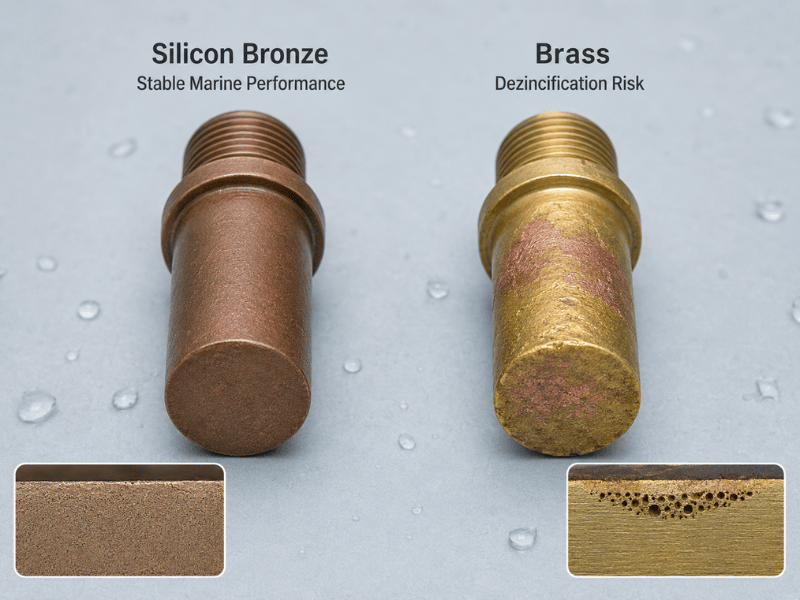
Corrosion resistance is the single biggest differentiator between these two alloy families.
Silicon bronze performs better in aggressive environments — its alloying elements form a dense, adherent oxide layer. No zinc means no dezincification. Brass performs well in mild indoor conditions and freshwater, but high-zinc grades degrade quickly in marine or industrial exposure. Dezincification creates subsurface porosity and weakness without visible warning until the part cracks or leaks. Naval brass (C46400) narrows the gap with added tin, but still falls short of silicon bronze in continuous saltwater service.
| Environment | Silicon Bronze | Brass |
| Seawater / salt spray | Excellent — resists dezincification | Poor to moderate — dezincification risk |
| Industrial atmosphere | Excellent — forms protective patina | Limited — susceptible to acidic attack |
| Freshwater | Good | Good |
| Chlorides / ammonia | Good | Sensitive — stress corrosion cracking risk |
| Long-term outdoor | Excellent — stable patina | Moderate — tarnishes, pitting possible |
Machinability, Weldability, and Processing Fit
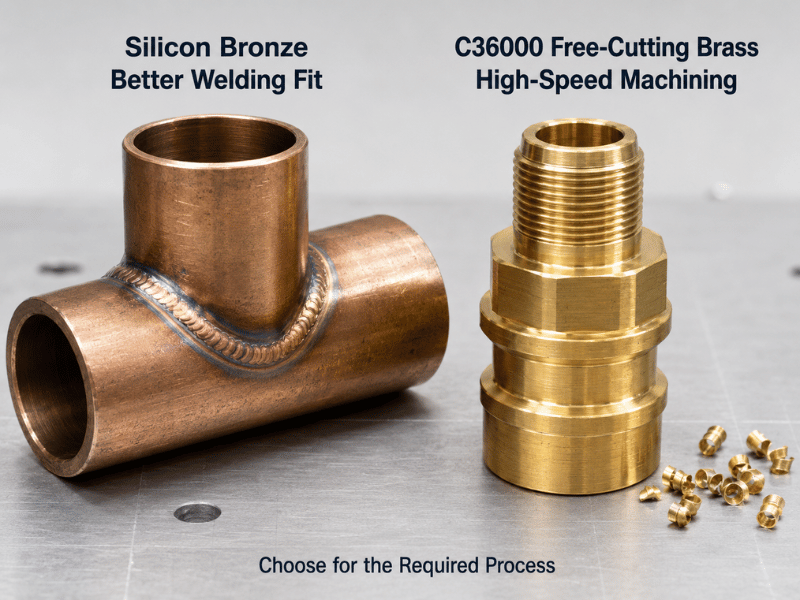
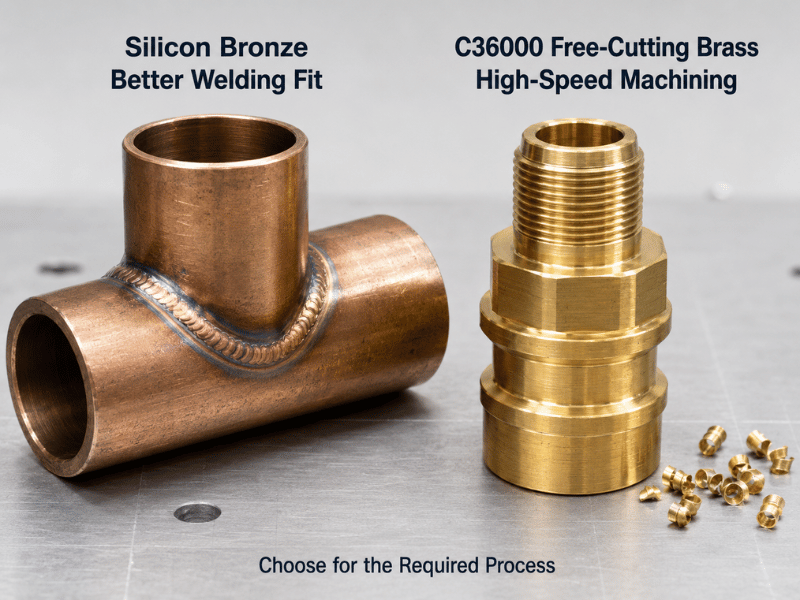
Brass — especially C36000 — is easier to machine at speed: clean chip control, low tool wear, good surface finish with standard tooling. Silicon bronze is tougher on tooling — lower cutting speeds, carbide recommended for production. The preference reverses for welded fabrications: silicon bronze TIG-welds cleanly with strong, corrosion-resistant joints; brass welding struggles with zinc fumes, porosity, and inconsistent joint strength.
For welded fabrications, silicon bronze is the clear preference. For high-volume machined parts with minimal secondary processing, brass is the more practical choice.
| Processing Factor | Silicon Bronze | Brass |
| Machinability | Moderate — higher tool wear | Excellent (C36000: 100% machinability rating) |
| Weldability | Excellent — easy to TIG weld | Poor to moderate — zinc fumes, porosity risk |
| Cold forming | Good | Excellent for low-zinc grades |
| Hot forming | Good | Good |
| Soldering / brazing | Good | Good |
Cost, Availability, and Sourcing Considerations
Brass is more economical — raw material costs less and machining runs faster. For high-volume parts under no corrosion stress, the cost advantage is significant.
Silicon bronze costs more upfront, but the premium is justified when corrosion failure is far more expensive than the material saving. In marine, chemical, or outdoor architectural use, the extra material cost is often a fraction of the long-term replacement cost avoided.
From a sourcing standpoint, Linsy Copper supplies standard brass grades (C26000, C36000, C46400) across common product forms. Custom production is available for silicon bronze grades (C65500, C65100) with low-MOQ and typical lead times of 10–60 days — buyers can source both materials through a single supplier when projects call for mixed-grade orders.
| Cost Factor | Silicon Bronze | Brass |
| Raw material | Higher (less common alloy family) | Lower (widely available) |
| Machining cost | Higher (slower speeds, more tool wear) | Lower (fast, clean machining) |
| Form availability | Sheet, plate, bar, tube, wire | Sheet, plate, bar, tube, wire, coil |
| Lead time | May be longer for non-stock grades | Generally shorter for standard grades |
Silicon Bronze vs Brass — Quick Decision Table
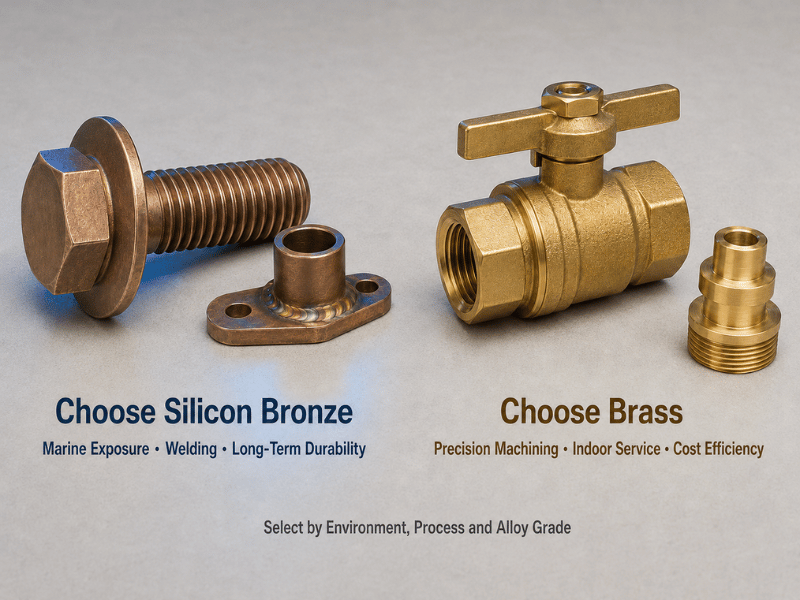
| Decision Factor | Choose Silicon Bronze If… | Choose Brass If… |
| Environment | Saltwater, chlorides, industrial exposure, long-term outdoor | Mild indoor, freshwater, dry air |
| Strength / wear | Sliding contact, repeated loading, thermal stress | Low mechanical stress, one-time forming |
| Machining | Part complexity is moderate; welding is needed | High-volume machining; fast throughput matters |
| Cost | Corrosion failure cost outweighs material saving | Budget is the primary constraint |
| Conductivity | Not a priority | Electrical or thermal conductivity matters |
Conclusion
The silicon bronze vs brass decision comes down to the service environment — saltwater, chlorides, and industrial atmospheres demand silicon bronze’s dezincification resistance and weldability; mild conditions favor brass’s machining speed and lower cost. Linsy Copper supplies standard brass grades (C26000, C36000, C46400) across sheet, plate, bar, tube, wire, and coil, and offers custom production for silicon bronze grades (C65500, C65100) with low-MOQ and full MTR documentation. Send the grade, dimensions, and quantity for a quote — brass or silicon bronze, material only or material plus processing.
FAQ
-
In the most common grades, yes. Silicon bronze delivers 380–550 MPa tensile strength with better hardness and wear resistance than standard brasses like C26000. High-zinc machining brasses can approach similar hardness but sacrifice corrosion resistance.
-
Only naval brass (C46400) is designed for it, and even then, performance falls below silicon bronze in continuous saltwater service. Standard brasses dezincify and fail. For critical marine hardware — fasteners, shafts, pump components — silicon bronze is the safer choice.
-
The alloy family is less common, silicon costs more than zinc, and machining runs slower with higher tool wear. The premium buys corrosion resistance and long-term durability — in marine or outdoor applications, the material cost is a fraction of avoided replacement cost.
-
Yes, but check galvanic compatibility. The two are close enough on the galvanic series that risk is low in most environments. In seawater, confirm based on specific grades and exposure conditions.
-
Silicon bronze welds cleanly and reliably with TIG. Brass welding is difficult — zinc fumes, porosity, and inconsistent joint quality make it a poor choice for welded fabrications.
-
Yes. Brass typically delivers 18–44% IACS conductivity, while silicon bronze sits in the 6–10% range. For electrical connectors, terminals, or bus bars, brass (or pure copper) is the better fit.

David Huang is a copper materials specialist and Sales Manager at Linsy Copper, with years of hands-on experience supporting global customers in copper and copper alloy sourcing.
He specializes in industrial copper products such as C11000 copper, C10200 oxygen-free copper, brass, bronze, copper sheets, plates, tubes, bars, and custom-processed copper components.
With a practical understanding of copper manufacturing, quality inspection, surface treatment, and export supply chains, David helps customers choose the right materials for electrical, mechanical, marine, construction, and industrial applications.