Introduction
Every fastener below a boat’s waterline faces the same three threats: saltwater, constant oxygenation cycles, and galvanic coupling between dissimilar metals. Selecting the wrong material can cause a keel bolt to dezincify from the inside out — no visible warning until the head snaps under load.
Silicon bronze has been the marine industry’s default fastener material for wooden and composite hulls for decades. It resists dezincification, handles cyclical hull flexing without brittle failure, and maintains a stable electrochemical profile across bronze-based underwater hardware systems.
This article covers the grades, performance limits, installation considerations, and where silicon bronze fasteners still make sense against stainless steel and Monel alternatives.
Why Silicon Bronze for Marine Fasteners?
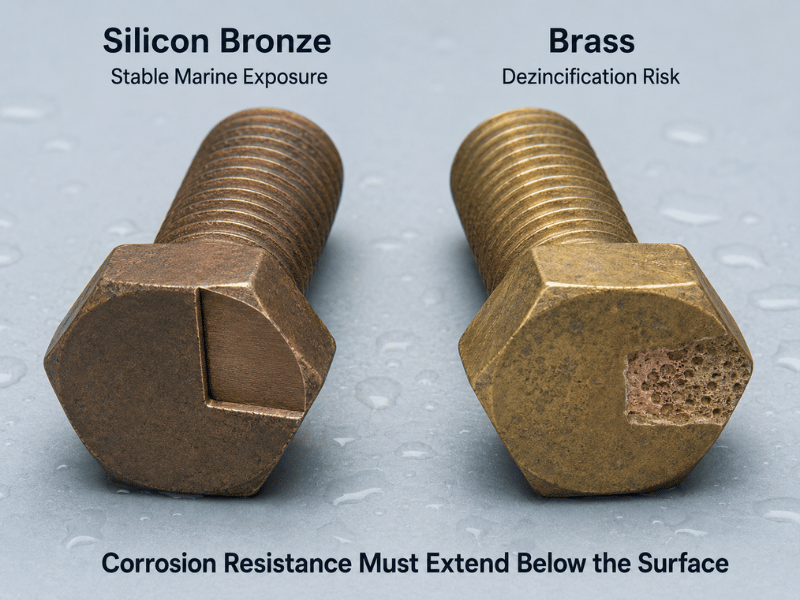
Four properties put silicon bronze ahead of brass and galvanized steel — and ahead of 316 stainless in many hull applications.
- Dezincification immunity. Brass fasteners lose zinc to seawater over time, leaving a porous copper skeleton with the strength of chalk. Silicon bronze contains less than 1.5% zinc, far lower than the 15% zinc threshold at which dezincification readily occurs in brass alloys. The alloy corrodes so slowly in seawater that a properly sized silicon bronze keel bolt can achieve a service life comparable to the hull’s design life.
- Ductility under cyclic loading. A boat hull flexes constantly — wave impact, rigging tension, thermal expansion. Silicon bronze yields and stretches before it breaks. A loose plank from a stretched bronze screw gives a visible warning. 316 stainless, by contrast, work-hardens under repeated flexing until it cracks suddenly — the fastener shows no visible warning before failure.
- Self-healing patina. In seawater, silicon bronze forms a dense, adherent green patina (verdigris) that seals the surface and slows further corrosion. Crevices and plugged fastener heads will rapidly degrade stainless steel by depriving its passive chromium oxide layer of oxygen, while silicon bronze suffers far less severe corrosion under identical low-oxygen confined conditions.
- Galvanic compatibility. If the boat already uses bronze seacocks, propellers, or shaft logs, adding silicon bronze fasteners keeps the underwater metals within a narrow galvanic potential band. Switching to stainless fasteners in a bronze-heavy system creates a voltage differential that accelerates anode depletion and risks localized pitting on the less noble component.
Common Marine Fastener Grades
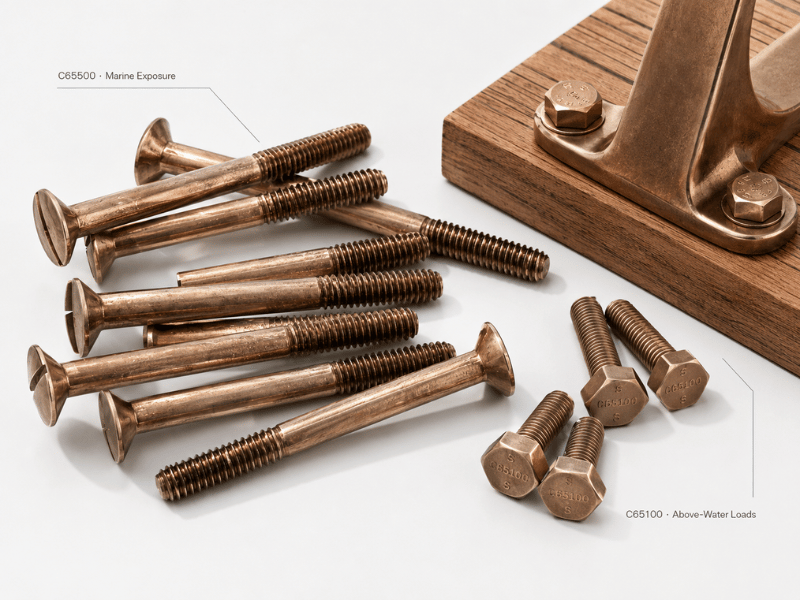
Two silicon bronze grades dominate marine fastener production.
C65500 is the workhorse for submerged and continuously wetted applications. Its higher silicon content maximizes seawater corrosion resistance and gives it enough elongation (18–35%) to handle hull flexing without cracking.
C65100 prioritizes strength over absolute corrosion resistance. It performs well above the waterline and in intermittently wetted areas where mechanical load matters more than long-term submersion protection.
They comply with ASTM F468 for bolts & screws and ASTM F467 for nuts, and are available in UNC, UNF, and metric thread forms. For mil-spec or DFARS-compliant projects, C65500 is the more commonly specified grade.
| Grade | Si Content | Common Name | Key Property | Typical Marine Use |
| C65500 | 2.8–3.8% | High Silicon Bronze A | Maximum corrosion resistance, high ductility | Keel bolts, thru-hull fasteners, rudder hardware, propeller shaft bolts |
| C65100 | ~1.5% | Low Silicon Bronze B | Higher tensile/yield strength, lower elongation | Deck screws, above-waterline hardware, structural framing bolts |
Mechanical Properties at a Glance
Silicon bronze does not match 316 stainless on raw tensile numbers. But tensile strength on the spec sheet and survivability in a wooden hull are two different things. The elongation and work-hardening behavior of silicon bronze — it stretches rather than snapping — matters more in a structure that moves.
| Property | C65500 | C65100 | 316 Stainless (for reference) |
| Tensile Strength (MPa) | 415–485 | 450–550 | 515–690 |
| Yield Strength (MPa) | 170–240 | 200–310 | 205–290 |
| Elongation (%) | 18–35 | 10–25 | 40–60 |
| Hardness (HB) | 100–120 | 90–110 | 150–190 |
| Electrical Conductivity (% IACS) | 6–10 | 7–12 | ~2 |
Advantages of Silicon Bronze Marine Fasteners
- Resists the corrosion mechanism that destroys brass. Dezincification is the primary failure mode for brass fasteners in seawater. Silicon bronze avoids this mechanism entirely because it contains almost no zinc.
- No crevice corrosion penalty. Stainless fasteners need oxygen to maintain their passive chromium oxide layer. A 316 screw buried in a plugged, sealed timber hole below the waterline loses oxygen access — pitting and crevice corrosion follow. Silicon bronze does not depend on an oxygen-renewal mechanism.
- Anti-biofouling. Copper ions released from the alloy surface discourage marine organism settlement. Fastener heads stay cleaner longer than stainless equivalents.
- Non-magnetic and non-sparking. Relevant for naval applications, compass proximity, and hazardous-environment installations.
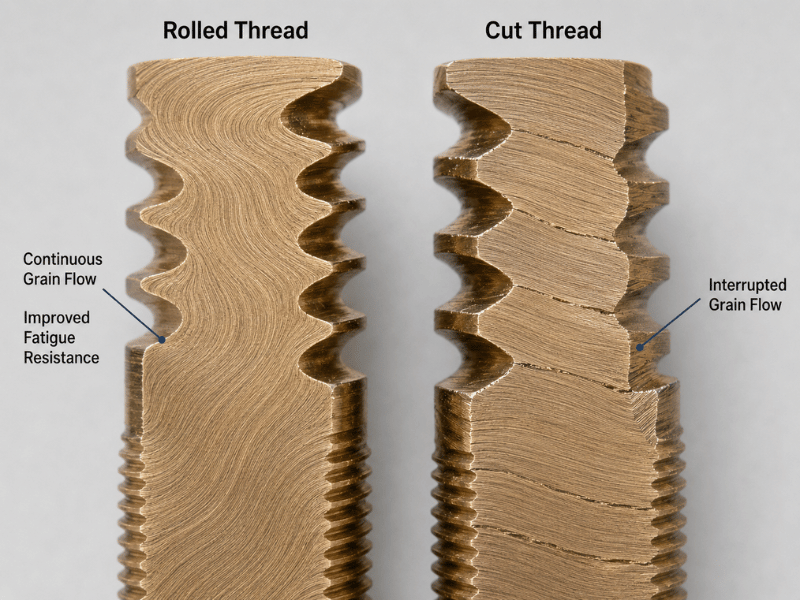
- Rolled-thread availability. Quality marine fastener suppliers offer silicon bronze screws with rolled threads rather than cut threads. Rolled threads align the alloy’s grain structure along the thread profile, improving fatigue resistance by a reported 20–30% compared to cut threads of the same diameter.
- Thread anti-galling. Silicon bronze threads resist cold-welding under friction — a common problem with stainless fasteners that gall and seize mid-installation. Bronze-on-bronze threading stays smooth even after repeated assembly cycles.
Disadvantages and Installation Risks
| Limitation | Detail |
| Higher material cost | Silicon bronze fasteners cost 2–4× more than equivalent 316 stainless sizes. The premium makes sense below the waterline; above deck, the cost-benefit calculation shifts. |
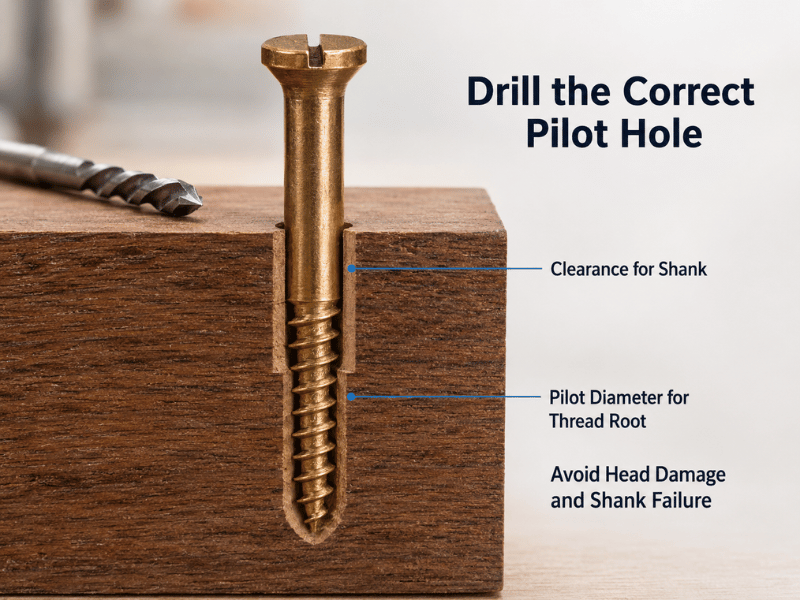
| Softer than stainless | Driving a silicon bronze wood screw into dense hardwood — teak, iroko, greenheart — without a properly sized pilot hole will strip the drive recess or shear the shank. Tapered step drills matched to the fastener’s root diameter are not optional. |
| Limited size range above M36 / 1-1/2″ | Large-diameter silicon bronze fasteners have longer lead times and fewer stocking suppliers than stainless equivalents. Plan procurement 4–8 weeks ahead for non-standard sizes. |
| Not the strongest option | Monel (Ni-Cu alloy) and titanium fasteners outperform silicon bronze on pure corrosion resistance and strength. But at 5–10× the cost, they are reserved for high-end racing yachts, superyacht deck hardware, and critical structural joints where failure is not an option. |
Go/No-Go: When Silicon Bronze Fasteners Make Sense
Use silicon bronze when:
- The fastener will be submerged or continuously wetted in seawater
- The hull or structure uses other bronze hardware (seacocks, struts, propellers) and galvanic consistency matters
- The joint experiences cyclical flexing — wood hulls, composite hulls, deck-to-hull connections
- The fastener head will be plugged, buried, or recessed with limited oxygen access
- The project requires non-magnetic, non-sparking fasteners for naval or hazardous-area compliance
Consider alternatives when:
- Pure mechanical strength drives the decision and the fastener stays above the waterline → 316 stainless may be adequate
- Budget is the primary constraint and corrosion exposure is mild → hot-dipped galvanized steel for heavy commercial timber framing
- The application demands maximum corrosion resistance with zero compromise → Monel K-500 or titanium
- The fastener size exceeds M36 and lead time is critical → check stainless or duplex availability first
Common Marine Fastener Applications
Silicon bronze fasteners appear throughout the boat — but the risk-reward calculation varies by location.
| Location | Fastener Type | Grade Preference | Why Silicon Bronze |
| Keel bolts | Hex head bolts, studs | C65500 | Continuous submersion, high structural load, no warning before failure |
| Hull planking | Wood screws, lag bolts | C65500 | Buried in timber below waterline, cyclic hull flexing |
| Rudder hardware | Hex bolts, machine screws | C65500 | Submerged, high cyclic load, galvanic consistency with bronze rudder stock |
| Propeller shaft coupling | Hex bolts, studs | C65500 | Submerged, vibration loading, bronze-to-bronze galvanic match |
| Deck hardware | Wood screws, machine screws | C65100 | Above waterline but exposed to spray; strength prioritized over max corrosion |
| Thru-hull fittings | Machine screws, hex nuts | C65500 | Constant seawater contact, accessibility for inspection is limited |
| Mast grounding | Hex nuts, washers | C65500 or C65100 | Electrical continuity + corrosion resistance; non-magnetic for compass proximity |
| Anode attachment | Hex bolts, nuts | C65500 | Submerged, galvanically matched to bronze anodes and hull fittings |
Sourcing Silicon Bronze Fasteners — What to Specify
When requesting a quote, the more detail upfront, the faster the response. Key specifications to include:
- Grade (C65500 or C65100)
- Fastener type (hex bolt, wood screw, machine screw, stud, nut, washer)
- Diameter and thread: metric (M6–M36) or inch (1/4″–1-1/2″, UNC/UNF)
- Thread form: rolled threads preferred for fatigue-critical joints
- Quantity per size
- ASTM standard: F467 for bolts/screws, F468 for nuts
- Any DFARS, mil-spec, or classification society requirements
Conclusion
Silicon bronze fasteners cost more upfront and require careful pilot-hole sizing, but the alternative is premature fastener replacement due to material misapplication — dezincification in brass, crevice corrosion in buried stainless, and brittle fatigue in work-hardened steel. Linsy Copper supplies bronze materials across sheet, plate, bar, tube, and wire, with custom production available for silicon bronze grades (C65500, C65100). In-house CNC machining, laser cutting, TIG welding, and surface finishing allow a single supplier to handle both material and fabricated marine components. If your project involves marine fasteners, custom bronze hardware, or replacement parts for a refit, send the grade, dimensions, and quantity for a quote — material only or material plus machining.
FAQ
Is silicon bronze better than stainless steel for marine fasteners?
Below the waterline, generally yes — especially when the fastener is buried in timber or paired with other bronze hardware. Above the waterline and in well-ventilated locations, 316 stainless is often an acceptable alternative at lower cost.
What is the difference between C65500 and C65100 for marine use?
C65500 has higher silicon content (2.8–3.8% vs ~1.5%) for maximum seawater corrosion resistance and higher ductility. C65100 prioritizes tensile and yield strength at a slight sacrifice in corrosion performance. C65500 for submerged, C65100 for above-waterline structural.
Why does silicon bronze not dezincify like brass?
Brass fasteners contain 15–40% zinc, which leaches out in seawater. Silicon bronze contains less than 1.5% zinc. Without a zinc-rich phase to attack, the dezincification mechanism does not apply.
Do silicon bronze fasteners require special installation?
Yes. The alloy is softer than stainless steel. Use tapered step drills for pilot holes matched to the fastener’s root diameter. Avoid impact drivers on smaller diameters. Rolled threads are preferred for fatigue-critical applications.
How long do silicon bronze fasteners last in seawater?
A properly sized C65500 keel bolt can achieve a service life comparable to the hull’s design life. The alloy corrodes at well under 0.025 mm/year in quiet seawater. Actual lifespan depends on water flow velocity, galvanic environment, and mechanical loading.
Can silicon bronze fasteners be used with pressure-treated wood?
Yes. Silicon bronze is compatible with most wood preservatives, including copper-based treatments (ACQ, copper azole). Unlike galvanized steel fasteners, there is no accelerated corrosion reaction with newer copper-based preservatives.

David Huang is a copper materials specialist and Sales Manager at Linsy Copper, with years of hands-on experience supporting global customers in copper and copper alloy sourcing.
He specializes in industrial copper products such as C11000 copper, C10200 oxygen-free copper, brass, bronze, copper sheets, plates, tubes, bars, and custom-processed copper components.
With a practical understanding of copper manufacturing, quality inspection, surface treatment, and export supply chains, David helps customers choose the right materials for electrical, mechanical, marine, construction, and industrial applications.