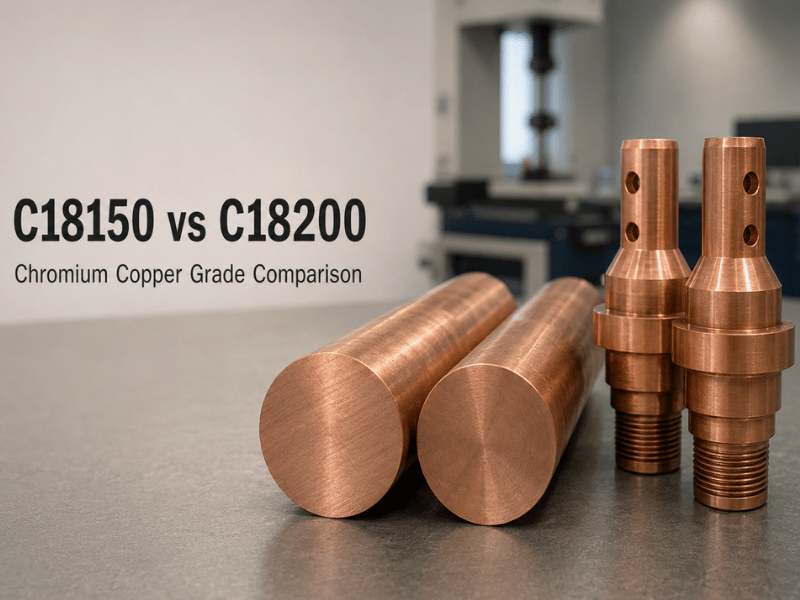
C18150 and C18200 are both age-hardened chromium coppers in the 78–85% IACS conductivity band with tensile strength near 500 MPa. The element that separates them — zirconium — determines which one survives sustained high-temperature, high-cycle service. Selection depends on the primary constraint: service temperature, duty cycle, and cost.
Composition: What Actually Separates Them
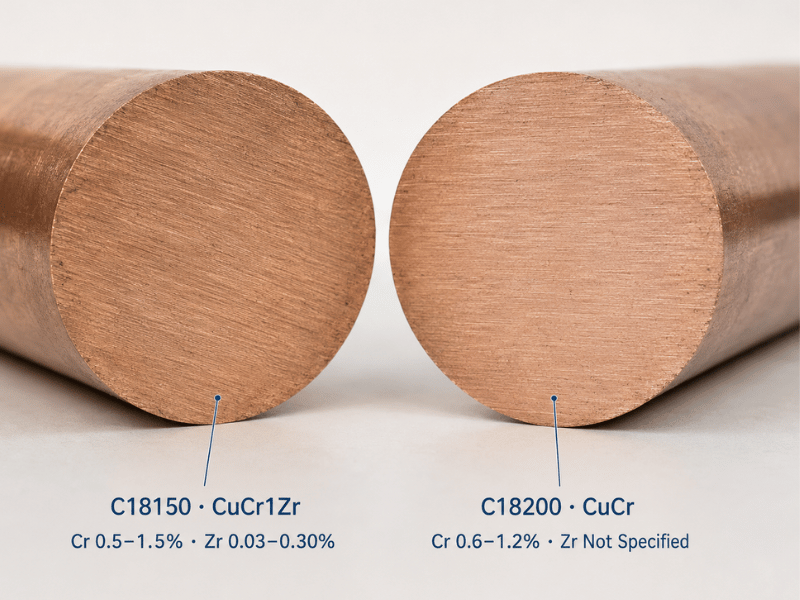
| Element | C18150 (CuCr1Zr) | C18200 (CuCr) |
| Chromium (Cr) | 0.5–1.5% | 0.6–1.2% |
| Zirconium (Zr) | 0.03–0.30% (required) | Not specified; commercial lots often 0.05–0.25% micro-alloyed |
| Iron (Fe) | ≤0.10% | ≤0.10% |
| Other impurities | ≤0.20% total(per ASTM B934) | ≤0.30% total(per ASTM B441) |
| Copper | Balance | Balance |
One element draws the line. C18150 is a chromium-zirconium copper — the 0.03–0.30% zirconium is a required, specified addition. C18200 is chromium copper by UNS: chromium alone does the work, and zirconium is not part of the spec (though many mills add a trace 0.05–0.25% to tighten the grain).That zirconium is what lifts C18150’s high-temperature performance — it raises the recrystallization temperature and slows stress relaxation, so the alloy holds strength and spring force where C18200 would start to soften.
Property Comparison (Age-Hardened Typical)
| Property | C18150 (CuCr1Zr) | C18200 (CuCr) |
| Tensile strength | 485–586 MPa | 440–550 MPa |
| Yield strength (0.2%) | 380–485 MPa | 350–480 MPa |
| Hardness | 70–82 HRB (≈135–180 HV) | 65–95 HRB (≈105–200 HV) |
| Electrical conductivity | 80–85% IACS | 78–85% IACS |
| Thermal conductivity | ~320–340 W/m·K | ~320–340 W/m·K |
| Density | 8.89 g/cm³ | 8.89 g/cm³ |
| Softening temperature | >500°C (up to ~550°C) | >500°C |
| Hot stress-relaxation resistance | Better (Zr raises recryst. temp) | Good |
| Elastic modulus | ~117 GPa | ~117–128 GPa |
| Machinability (vs brass 100) | ~20–30 | ~20–30 |
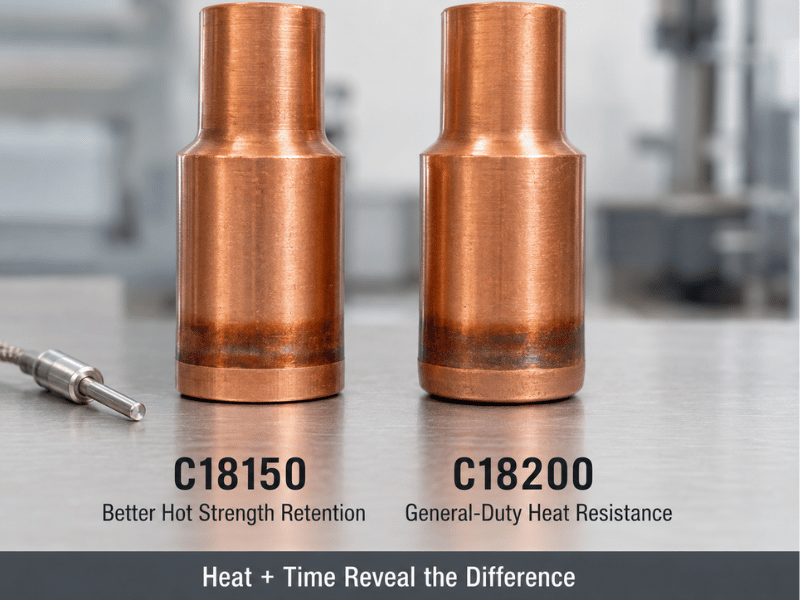
C18150 and C18200 share the same conductivity band, tensile ballpark, and hardness range. The split shows up under heat and time, not on a static tensile coupon. C18150’s zirconium keeps its strength and preload at elevated temperature and under thermal cycling; C18200 is the lower-cost option with nearly identical room-temperature numbers but a softer high-temperature ceiling.
The >500°C softening point in the table is a static coupon limit, not a duty rating. Under continuous load and thermal cycling, stress relaxation sets in well below that — design C18200 around 350–400°C and reserve C18150 for the hotter, longer cycles.
Go/No-Go: Which Grade for Your Job
Each entry lists the trigger condition rather than an application name; match the part’s service conditions against these criteria.
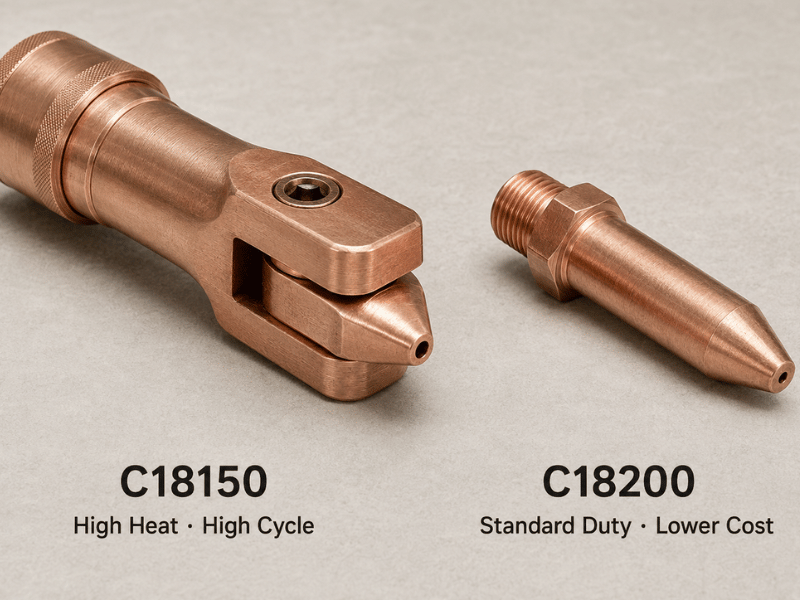
- Resistance-welding electrode running high duty cycles, or any component that must hold strength and preload above ~400°C for long periods → select C18150. Zirconium pushes the recrystallization temperature up, so it resists softening and stress relaxation where C18200 would drift.
- Standard resistance-welding electrode, conductive terminal, or bus component that stays below ~350–400°C and cost matters → select C18200. Same conductivity and near-identical room-temperature strength at a lower alloy cost.
- Continuous-casting mold, die-casting insert, or hot-die component where thermal shock and sustained heat dominate → select C18150. Its anti-softening margin protects dimensional stability over millions of cycles.
- High conductivity plus moderate strength required, but only intermittent or low heat exposure → select C18200. The part pays for chromium, not zirconium, and does not need the hot-duty margin.
- Replacement for a high-strength bronze spring in a hot environment → select C18150.Its ~500°C anti-softening far exceeds phosphor bronze (softens near 220°C). Unlike beryllium copper, it provides superior electrical conductivity while maintaining moderate high-temperature strength for spring applications.
Machining and Heat Treatment
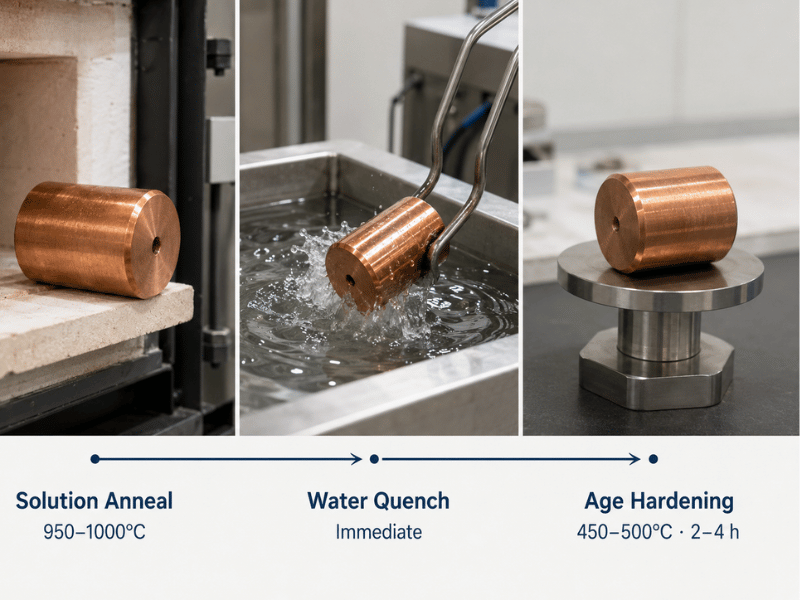
Both grades share the solution-anneal + age-hardening route, and the practical plan is the same as other precipitation-hardened coppers.
| Step | Temperature | Duration | Outcome |
| Solution anneal | ~950–1000°C | — | Soft, formable state — stamp, bend, draw, or cold-work |
| Water quench | — | Immediate | Locks supersaturated chromium (and Zr, in C18150) in solid solution |
| Age hardening | 450–500°C | 2–4 hours | Peak strength, hardness, and conductivity simultaneously |
| Air cool | — | — | Final temper ready for service |
Machining: In the aged state both cut like a medium-hard copper alloy — not free-machining, but they do not gum tools the way beryllium copper does, and there is no lead to manage. Plan for sharp tooling and moderate feeds. Welding or brazing softens the heat-affected zone; re-age the part to recover properties.
Dust note: Machining, grinding, or welding generates copper-and-chromium particulate — ventilate the work area. Finished solid parts are safe to handle; the hazard is airborne dust during fabrication, not the alloy in service.
Where They Land in Production
The Go/No-Go above answers “should I use it?” This section maps each grade to its typical deployment areas once the part function is known.
C18150 (CuCr1Zr, hot-duty chromium copper):
- Resistance-welding electrodes and holders for high-cycle lines
- Continuous-casting molds
- Die-casting and injection-mold inserts that need fast cooling
- Semiconductor fixtures
- Any high-temperature conductive structure where drift is not acceptable
C18200 (CuCr, general chromium copper):
- Resistance-welding tips and wheels
- Electrical contacts and switchgear
- Conductive rods and terminals
- High-current leads
- Mold inserts for less extreme thermal duty
Standards and Traceability
| Specification | C18150 (CuCr1Zr) | C18200 (CuCr) |
| UNS | C18150 | C18200 |
| RWMA Class | Class 2 | Class 2 |
| EN | CW106C | CW105C |
| ISO | CuCr1Zr | CuCr |
| DIN | 2.1293 | 2.1291 |
| BS | CC102 | CC101 |
| ASTM | B934 | B441 |
Specifications to confirm on order:
- Grade (C18150 or C18200)
- Temper (TB00 solution-annealed; TF00/TH04 age-hardened)
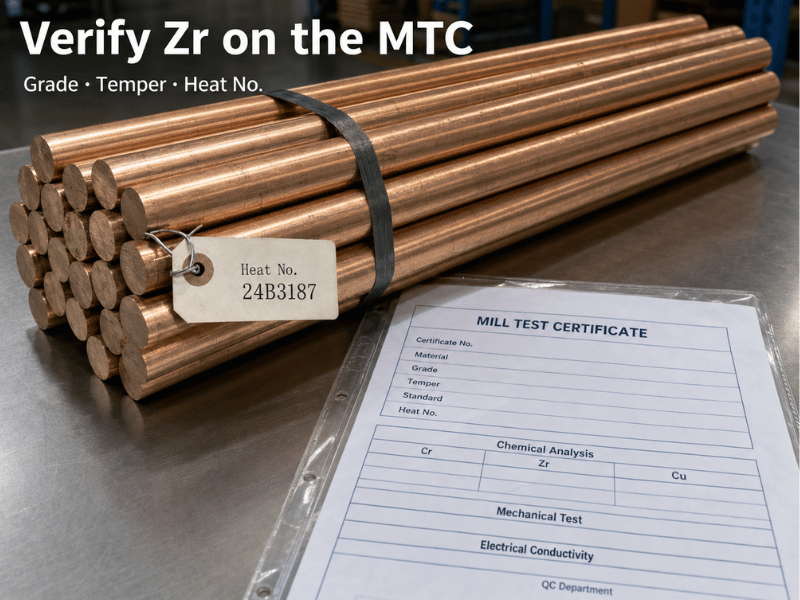
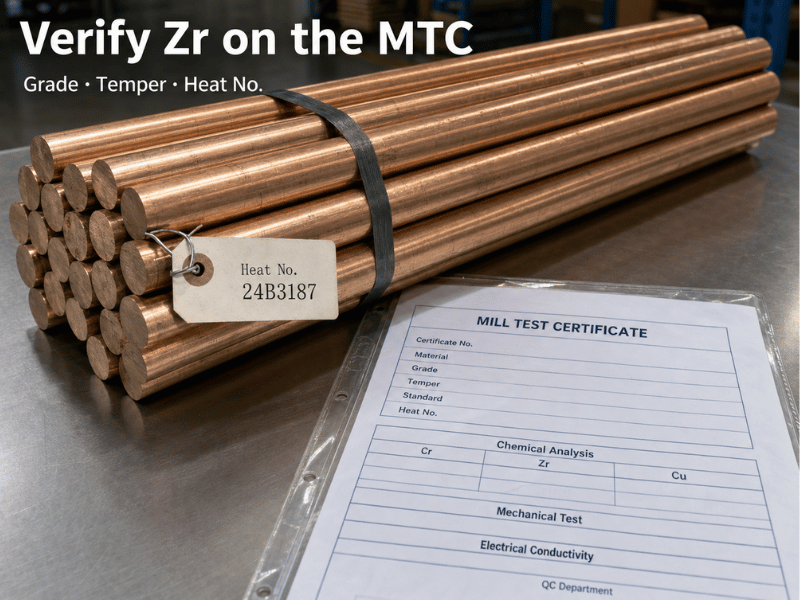
- MTR/MTC per lot — chromium (and zirconium where specified) content drive the aging response, so heat-lot traceability matters for reproducible strength
Composition and property ranges above are cross-checked against published mill data (IBC Advanced Alloys, Senor, Azom, Modison, 11467); confirm exact temper-specific values against the named mill certificate before release.
Sourcing Chromium Copper from Linsy
Linsy Copper supplies chromium copper and chromium-zirconium copper grades — the C18150 (CuCr1Zr) and C18200 (CuCr) family — as part of its special conductive copper line, available in sheet, plate, bar, and tube. Because chromium and zirconium content drive the aging response, heat-lot traceability matters: every order ships with full MTR/MTC documentation including chemical composition data, so the aging window is verifiable per lot. For C18150 specifically, confirming the actual zirconium content on the mill certificate matters — many C18200 lots carry trace Zr that pulls properties close to C18150, so the certificate is what separates them in practice. SGS chemical, mechanical, and conductivity reports are available on request. Low-MOQ custom production runs process in 10–60 days depending on grade, size, and specification — practical for trial batches of welding electrodes, mold inserts, or conductive terminals before volume commitment.
Conclusion
C18150 and C18200 are both high-conductivity (78–85% IACS), age-hardened chromium coppers near 500 MPa tensile, but the zirconium in C18150 is the deciding lever. It lifts the recrystallization temperature and stress-relaxation resistance, so C18150 is the choice when the part runs hot or cycles hard; C18200 drops the zirconium, keeps the conductivity and most of the strength, and costs less for mild duty. The trade-off is that chromium copper — especially C18150 with its specified zirconium — is tighter at most mills than standard conductive copper, and trial quantities are hard to source without a mill relationship.
Linsy stocks C18150 and C18200 in sheet, plate, bar, and tube, with low-MOQ custom production (10–60 day lead time) and full MTR/MTC documentation per lot — so the grade decision doesn’t stall on availability or traceability. Send the drawing or specification for a grade-fit review and quote, or compare C18150 and C18200 options side by side with Linsy’s technical team.
FAQ
-
Zirconium. C18150 (CuCr1Zr) specifies 0.03–0.30% Zr as a required addition; C18200 (CuCr) relies on chromium alone with no zirconium in the UNS spec. The zirconium raises the recrystallization temperature and slows stress relaxation, which is why C18150 holds up better under heat and time.
-
For conductivity, easily — chromium copper runs 78–85% IACS versus 18–28% for beryllium copper. For strength, no — beryllium copper reaches 1100+ MPa while chromium copper tops out near 500–600 MPa. Use chromium copper when high conductivity plus moderate strength is the job; reach for beryllium copper when maximum strength, elasticity, or fatigue life is required.
-
Both are RWMA Class 2 electrode materials. C18150 is the better pick for high-duty-cycle or high-temperature welding because it resists softening; C18200 covers general-purpose electrodes at lower cost. Match the grade to the duty cycle, not just the static numbers.
-
By the UNS definition, no — C18200 is chromium copper without specified zirconium. In practice many mills add a trace 0.05–0.25% Zr to C18200 to refine the grain, which pulls its properties close to C18150. Confirm the actual composition on the mill certificate before assuming equivalence.
-
Solution anneal at ~950–1000°C and water-quench to get the soft, machinable state. Then age at 450–500°C for 2–4 hours to hit peak strength, hardness, and conductivity. Any welding or brazing after aging softens the heat-affected zone — re-age the part to recover properties.
-
Yes — Linsy supplies C18150 (CuCr1Zr) and C18200 (CuCr) in sheet, plate, bar, and tube forms with full MTR/MTC documentation per lot. Reach out with your grade, form, and temper requirements for lead time and documentation options.

David Huang is a copper materials specialist and Sales Manager at Linsy Copper, with years of hands-on experience supporting global customers in copper and copper alloy sourcing.
He specializes in industrial copper products such as C11000 copper, C10200 oxygen-free copper, brass, bronze, copper sheets, plates, tubes, bars, and custom-processed copper components.
With a practical understanding of copper manufacturing, quality inspection, surface treatment, and export supply chains, David helps customers choose the right materials for electrical, mechanical, marine, construction, and industrial applications.