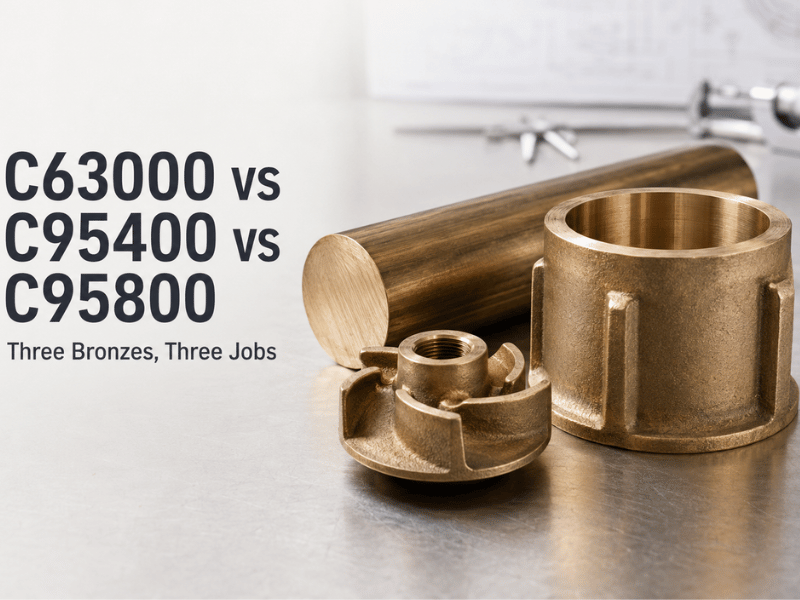
C63000, C95400, and C95800 all sit in the copper-aluminum-iron family, but they are not interchangeable. The split comes down to two factors: cast or wrought form, and whether nickel is a required addition. C95400 is plain aluminum bronze, cast, with no nickel. C95800 is nickel aluminum bronze (NAB), also cast, with 4–5% nickel. C63000 is the wrought form of NAB — same nickel benefit, but delivered as hot-worked bar and rod at the highest strength of the three. Selection depends on form first, then service environment and duty cycle.
Composition
| Element | C95400 (cast Al bronze) | C95800 (cast NAB) | C63000 (wrought NAB) |
| Copper (Cu) | Balance (83 min) | Balance (79 min) | Balance |
| Aluminum (Al) | 10.0–11.5% | 8.5–9.5% | 9.0–11.0% |
| Iron (Fe) | 3.0–5.0% | 3.5–4.5% | 2.0–4.0% |
| Nickel (Ni) | ≤2.0% (optional; many mills cap at 1.5%) | 4.0–5.0% (required) | 4.0–5.5% (required) |
| Manganese (Mn) | ≤0.50% | 0.8–1.5% | ≤1.5% |
Supplementary note: All grades contain limited trace impurities including silicon, lead and zinc with specified upper limits per ASTM standards.
The single line that separates the families is nickel. C95400 only allows trace nickel without mandatory addition; C95800 and C63000 make it a required constituent. That nickel is what lifts corrosion-fatigue strength, cavitation resistance, and dealuminification immunity in long-term seawater service.
Properties (typical)
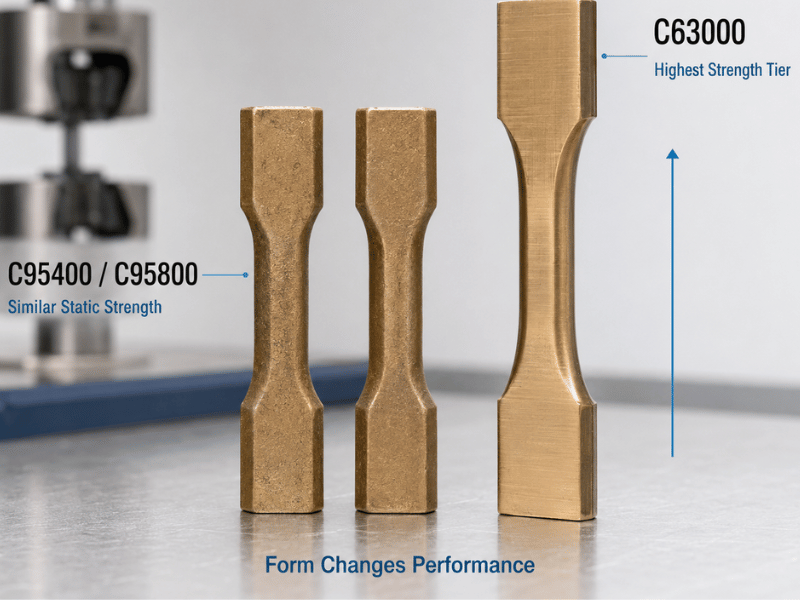
Values for C95400 and C95800 are as-cast; C63000 is HR50, the high-strength hot-worked-and-stress-relieved wrought condition.
| Property | C95400 (cast) | C95800 (cast) | C63000 (wrought HR50) |
| Tensile strength | 585–750 MPa | 585–760 MPa | 690–900 MPa |
| Yield strength (0.2%) | 240–345 MPa | 240–380 MPa | 345–550 MPa |
| Elongation | 12–25% | 15–25% | 5–15% |
| Hardness (Brinell) | 170–220 HB | 150–190 HB | 180–250 HB |
| Density | ~7.45–7.5 g/cm³ | 7.64 g/cm³ | 7.58 g/cm³ |
| Thermal conductivity | ~58 W/m·K | 36 W/m·K | 38–46 W/m·K |
| Electrical conductivity | ~13% IACS | 7% IACS | 7–9% IACS |
| Machinability (C36000 = 100) | ~60% | 20–50% | 20–30% |
| Form | Cast (sand / centrifugal / cont.) | Cast (sand / centrifugal / cont.) | Wrought rod / bar / shapes |
| Non-sparking / non-magnetic | Yes / Yes | Yes / Yes | Yes / Yes |
C95400 and C95800 overlap on static strength — the nickel does not buy raw tensile in the casting. The payoff is under cyclic load and long immersion, where C95800 holds and plain aluminum bronze can degrade. C63000 beats both on strength because it is wrought and heat-treated to the HR50 condition, not because it carries more nickel.
Key Differences
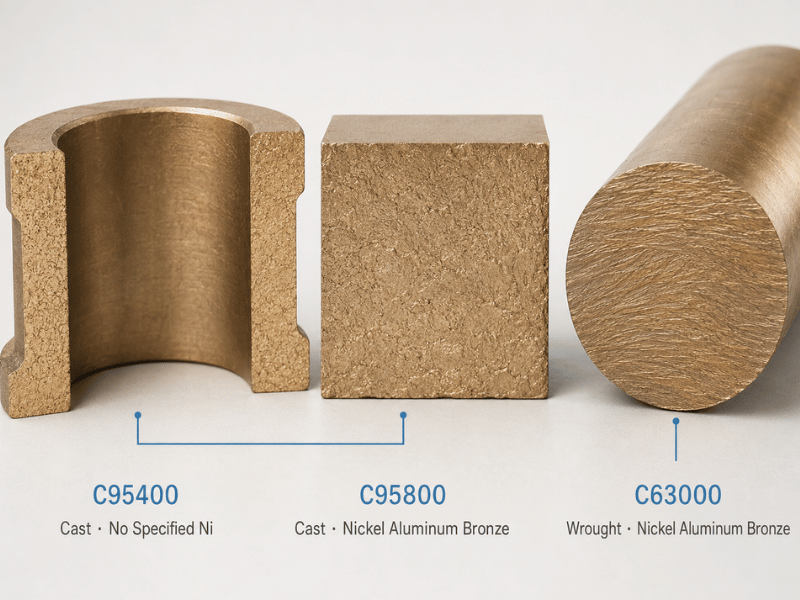
- Cast vs wrought. C95400 and C95800 are cast alloys — they are poured into a mold. C63000 is wrought bar and rod. If the part is a shaft, fastener, or precision bushing, casting is not economical; C63000 is the practical form.
- Nickel vs none. C95400 has no required nickel, so it machines faster (~60% of free-cutting brass) and costs less per kilogram. C95800 and C63000 require 4–5% nickel for seawater durability.
- Strength tier. C63000 tops the range at 690–900 MPa. C95400 and C95800 sit in the same 585–760 MPa band — close enough that strength alone rarely decides between them; environment does.
All three are non-sparking and non-magnetic, so any of them is safe near flammable vapor.
Go/No-Go: Which Grade for Your Job
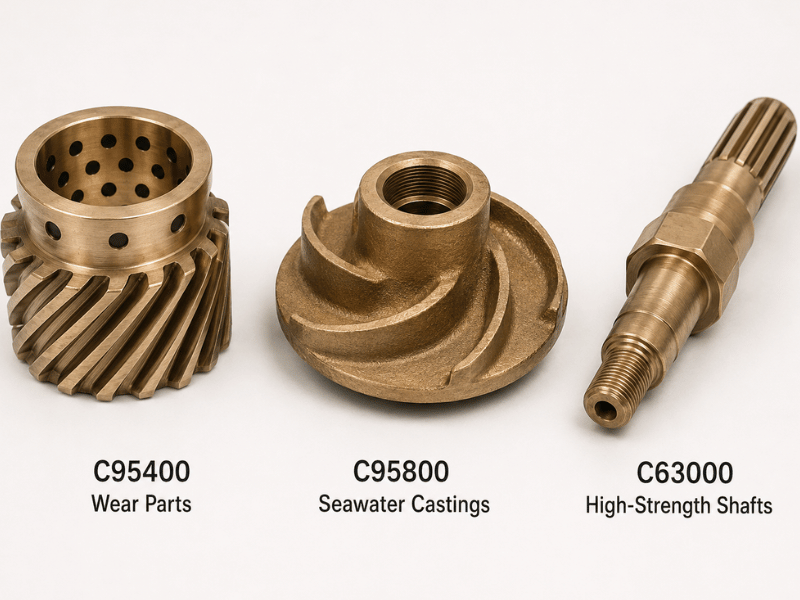
Each entry gives the trigger condition, not just an application name. Match the part’s service conditions against these criteria.
- Cast component immersed in seawater or brine for extended service under cyclic load → select C95800. The required nickel content prevents dealuminification and cavitation over long design life.
- Cast component for land-based or fresh-water wear duty where cost per kilogram is a primary constraint → specify C95400. Without required nickel content, machinability reaches ~60% of free-cutting brass, and strength and wear life remain sufficient outside seawater service.
- High-strength NAB required as bar or rod stock → select C63000 (HR50 wrought). Casting cannot deliver precision bar stock; C63000 provides the wrought route with strength up to 900 MPa.
- Maximum hardness and wear life required in a non-marine setting → specify C95400 (or C95500 for the top of the range). The strength is delivered without the cost of nickel that would not contribute to performance in this environment.
- Non-sparking property required near flammable vapor → any of the three qualifies. C95800 or C63000 is the appropriate selection when the same part is also exposed to seawater.
Machining and Heat Treatment
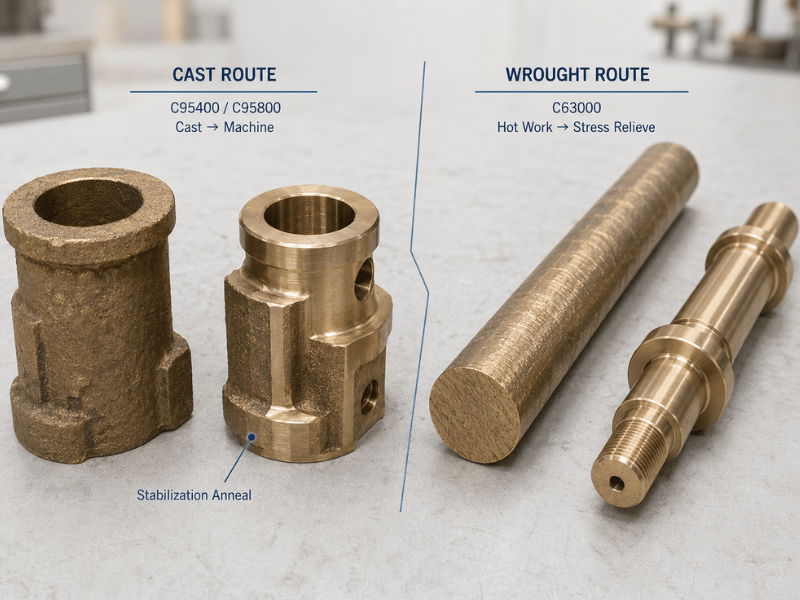
| Parameter | C95400 | C95800 | C63000 |
| Machinability (C36000 = 100) | ~60% — highest, due to absence of nickel | 20–50% | 20–30% |
| Supply condition | As-cast or heat-treated | As-cast | HR50 (hot-worked and stress-relieved) |
| Heat treatment | Optional heat treatment to raise strength | Temper anneal at Temper anneal at ~675°C / 1250°F for 6 h, air cool. This decomposes most unstable brittle beta phase into stable alpha + kappa microstructure, mitigating dealuminification and internal brittleness during decades-long service life | Hot-formed or forged; anneal at 593–704°C |
| Welding | Not specified | ERCuNiAl filler; preheat ~300°C; post-weld stress relief to avoid HAZ cracking | TIG/MIG recommended; oxyacetylene not recommended |
| Tooling guidance | Carbide tooling, ample coolant; shorter cycle times than NAB grades | Carbide tooling, lower speeds, ample coolant | Carbide tooling, lower speeds, ample coolant |
Where They Are Used
The Go/No-Go criteria above cover selection logic. The list below maps each grade to its typical deployment areas once the part function is known.
C95400:
- Pump casings and impellers
- Valve bodies
- Bearings and bushings
- Worm wheels and gears
- Wear plates
- Pickling hooks
- General industrial machinery where strength-plus-wear beats corrosion priority
C95800:
- Marine propellers and hubs
- Rudder stocks
- Seawater lift and firewater systems
- Subsea manifolds
- Desalination plant components
- Naval and submarine structures
C63000:
- Aerospace landing-gear bushings
- Marine propeller shafts
- Seawater fasteners and hardware
- Pump shafts
- Valve stems and seats
- Non-sparking safety tooling
- Heavy-duty gears or cams
Standards and Traceability
| Grade | ASTM | EN / BS / DIN |
| C95400 | B148 (cast), B505 (continuous cast), B271 (centrifugal) | EN 1982 CC333G; BS 1400 AB1; DIN 2.0940 |
| C95800 | B148 / B505 / B271 | BS 1400 AB2 (marine); DIN 2.0966 (cross-ref 2.0975); Def Stan 02-833 / 02-747 (naval) |
| C63000 | B150 (wrought rod/bar/shapes); AMS 4640 | EN 12163 CW307G; BS CA104 |
Specifications to confirm on order:
- Grade (C95400, C95800, or C63000) and form (cast, wrought rod/bar, HR50)
- Aluminum, iron, and nickel content set the corrosion and strength profile, so MTR/MTC per lot matters for reproducible seawater service
Conclusion
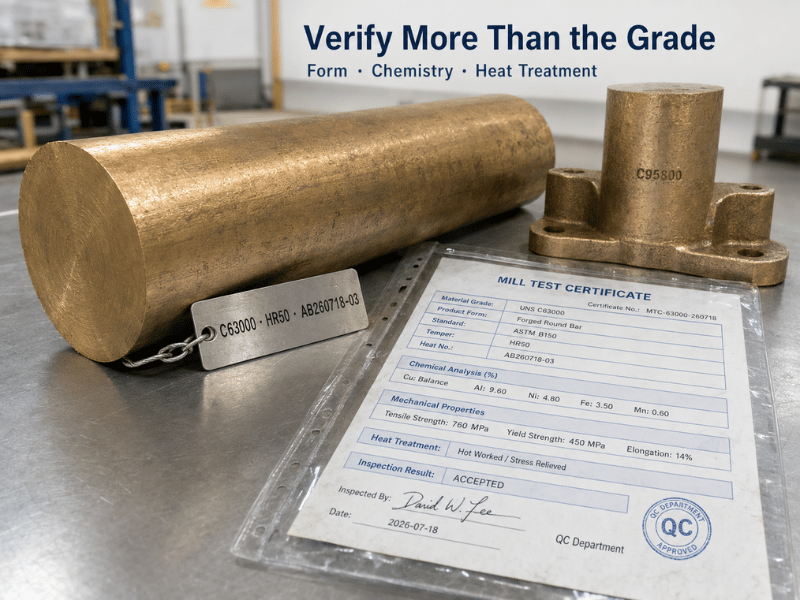
C95400, C95800, and C63000 divide into three tiers by nickel content and form: C95400 for no-nickel cast wear duty, C95800 for cast seawater NAB, and C63000 for wrought NAB at the highest strength (690–900 MPa). NAB casting quality and HR50 bar availability are tight at most mills, but Linsy supplies all three in cast, wrought bar, and HR50 conditions with full MTR/MTC documentation per lot and low-MOQ custom production (10–60 day lead time). Send the drawing or specification for a grade-fit review and quote, or compare C95400, C95800, and C63000 options side by side with Linsy’s technical team.
FAQ
What is the main difference between C95400, C95800, and C63000?
Form and nickel. C95400 is cast plain aluminum bronze with no required nickel. C95800 is cast nickel aluminum bronze (4–5% Ni) for seawater. C63000 is the wrought (rod/bar) form of NAB at the highest strength (690–900 MPa). Strength overlaps between the two cast grades, so environment and form — not raw tensile — decide the call.
Which is best for seawater service?
C95800 for cast seawater parts (propellers, valves, subsea fittings) and C63000 for wrought seawater parts (shafts, fasteners). Both carry required nickel that plain C95400 lacks, giving immunity to dealuminification and cavitation over decades of immersion. Use C95400 only where the part stays out of seawater.
Is C63000 the same as C63200?
They are similar wrought nickel aluminum bronze grades with nearly identical CuAl10Ni5Fe4 chemical composition. However, they follow separate ASTM specifications: C63000 complies with ASTM B150 only, while C63200 covers ASTM B150 and B124. Mechanical tolerance and supply temper standards differ slightly. If engineering drawings specify one exact grade, the alternative cannot be substituted arbitrarily, even though general corrosion and mechanical performance are close.
Are these alloys non-sparking?
Yes. All three are non-sparking and non-magnetic, so any of them is safe near flammable vapor. Note that non-sparking performance will degrade under extreme high-temperature working conditions.
How difficult are they to machine and weld?
C95400 is the easiest at ~60% of free-cutting brass. C95800 (20–50%) and C63000 (20–30%) machine as hard copper alloys — carbide tooling, lower speeds, ample coolant. C95800 welds with ERCuNiAl filler plus preheat and post-weld stress relief; C63000 welds well by TIG/MIG but not oxyacetylene.
Does Linsy supply all three grades?
Yes — Linsy supplies aluminum bronze and nickel aluminum bronze within its bronze range, including C95400, C95800, and C63000 (plus the C63200 wrought sibling) in cast, wrought bar, and HR50 conditions with full MTR/MTC documentation per lot.

David Huang is a copper materials specialist and Sales Manager at Linsy Copper, with years of hands-on experience supporting global customers in copper and copper alloy sourcing.
He specializes in industrial copper products such as C11000 copper, C10200 oxygen-free copper, brass, bronze, copper sheets, plates, tubes, bars, and custom-processed copper components.
With a practical understanding of copper manufacturing, quality inspection, surface treatment, and export supply chains, David helps customers choose the right materials for electrical, mechanical, marine, construction, and industrial applications.