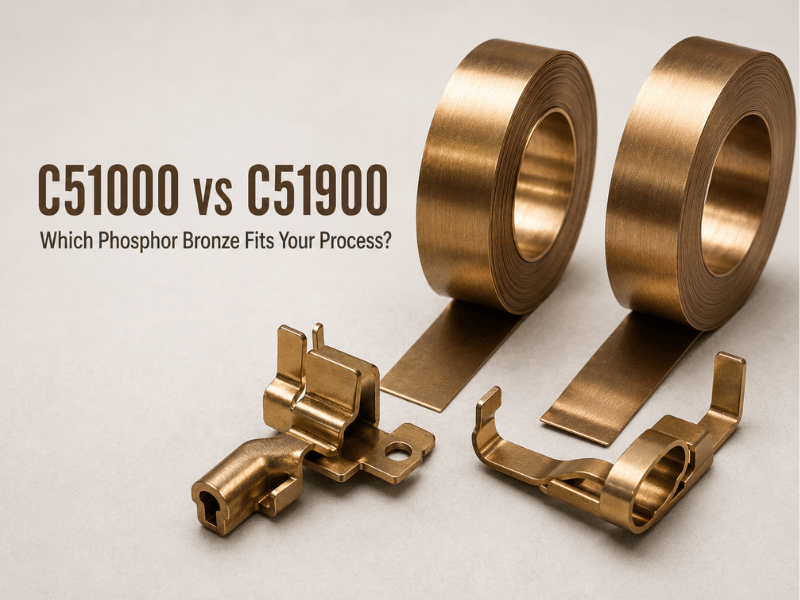
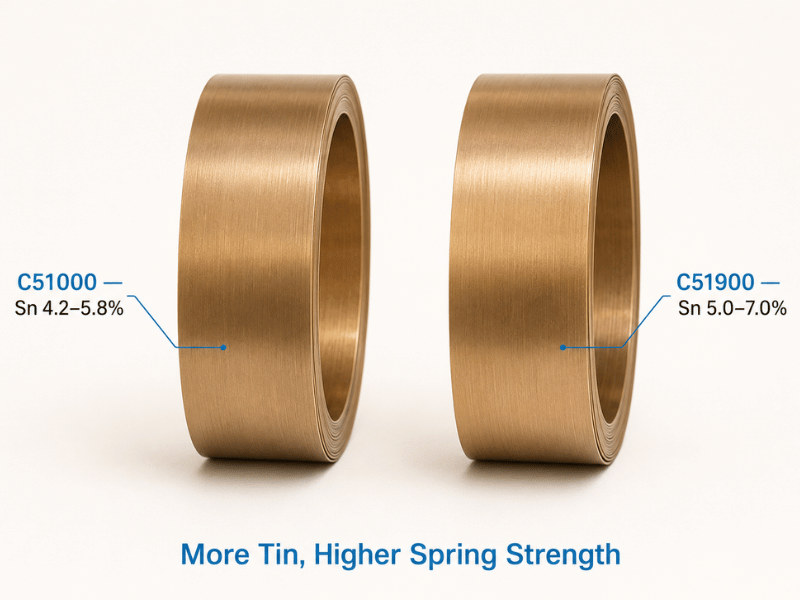
Both C51000 and C51900 are tin-phosphorus bronzes (phosphor bronze) built for spring, connector, and wear-resistance work. The difference that drives grade selection is tin content: C51000 runs 4.2–5.8% tin, C51900 runs 5.0–7.0%. That extra tin lifts strength and spring force but trims ductility and conductivity. Grade selection depends on the functional demands of the part, not on habitual specification.
Composition: What the Extra Tin Does
| Element | C51000 (Phosphor Bronze A) | C51900 (Phosphor Bronze C) |
| Copper (Cu) | Remainder (93.4–95.5%) | Remainder (92.2–95%) |
| Tin (Sn) | 4.2–5.8% | 5.0–7.0% |
| Phosphorus (P) | 0.03–0.35% | 0.03–0.35% |
| Iron (Fe), max | 0.10% | 0.10% |
| Lead (Pb), max | 0.05% | 0.05% |
| Zinc (Zn), max | 0.30% | 0.30% |
Phosphorus here is a deoxidizer and a strengthening agent — not a lubricant. Both grades share the same phosphorus band, so the tin spread is the lever that shifts strength, spring-back, and formability. When a spec lands between the two tin ranges, the application’s cyclic-load demand decides it.
Mechanical and Physical Properties
Temper (the cold-work level, from soft-annealed O60 to spring H08/H10) shifts these values significantly, so read the table as typical mill ranges, not fixed values. Electrical conductivity is shown as % IACS — a percentage of pure copper’s conductivity; both grades sit far below copper.
| Property | C51000 | C51900 |
| Tensile strength | 330–780 MPa | 350–760 MPa (H08/H10 spring tempers: ~690–760) |
| Yield strength (0.2% offset) | 130–750 MPa | 150–710 MPa (H08: ~710) |
| Elongation at break | 2.7–64% | 2–66% |
| Hardness (Rockwell B) | 26–97 | 42–91 |
| Density | 8.8 g/cm³ | 8.8 g/cm³ |
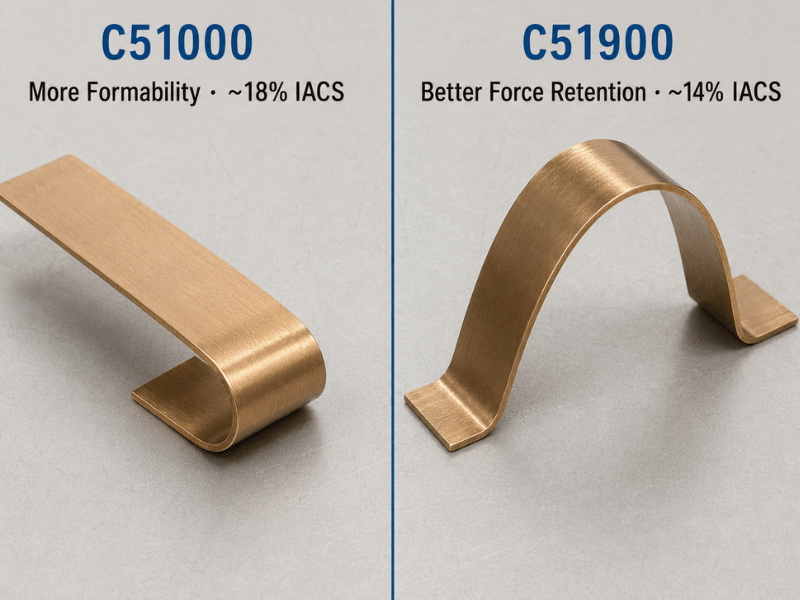
| Electrical conductivity | ~18% IACS | ~14% IACS |
| Thermal conductivity | ~77 W/m·K | ~66 W/m·K |
| Modulus of elasticity | ~110 GPa | ~110 GPa |
| Machinability (vs brass 100) | 20 | 20 |
C51900 is the stronger grade at a matched temper — its extra tin lifts tensile and yield through the H02–H08 range, reaching ~690–760 MPa tensile and ~710 MPa yield at spring H08/H10. Both grades peak near H10 (~760–780 MPa), but C51900 holds spring force and fatigue life better under cyclic load, which is what matters for contacts. C51000 keeps more elongation at a matched temper, which provides formability for tight-bend stamping. Neither is a conductor-first material — both sit well below pure copper on IACS, and neither is specified where current carry is the primary job.
Go/No-Go: Which Grade for Your Part
These rules provide a grade-selection framework before opening a supplier quote.
| Application | Grade | Reason |
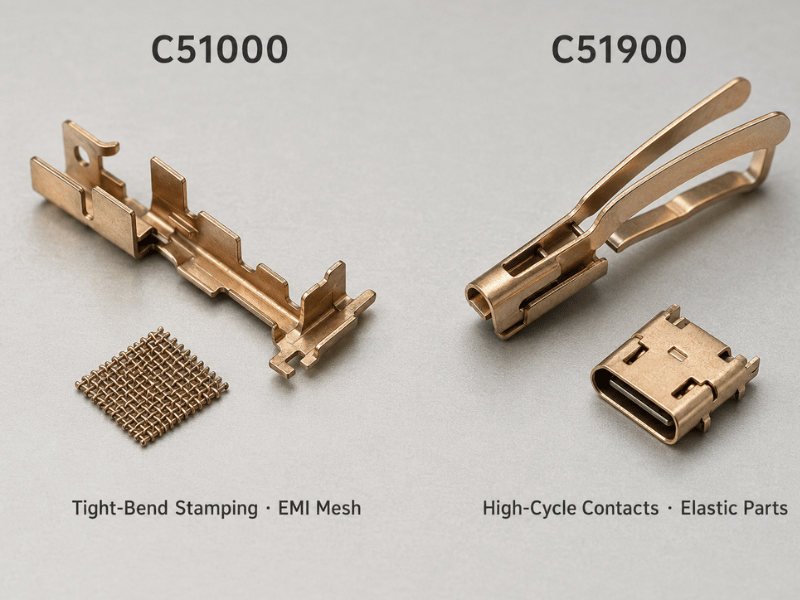
| High-cycle spring contacts (10,000+ mating cycles, USB-C, RF coaxial) | C51900 | Higher tin → more spring-force retention and fatigue endurance |
| Complex progressive-die stamping with tight bends | C51000 | More elongation at matched temper → survives tighter bend radii near the contact area |
| EMI woven mesh or fine screening where cost and weavability dominate | C51000 | Finer weavability, lower material cost |
| Acoustic mesh, SD/SIM tray contacts, general elastic components | C51900 | Best balance of spring performance and stampability |
| Bearings, bushings, worms, thrust washers | Either | C51900’s slightly higher strength favors heavier wear load |
Where Each Grade Lands in Production
The Go/No-Go list above sets the decision rule. This section maps grades to the parts they actually fill, so you can sanity-check the call.
C51000: electrical connectors, relay and switch contacts, fuse clips, precision springs and diaphragms, bearings and bushings, marine hardware, and fine EMI shielding mesh.
C51900: USB-C and card-tray spring contacts, acoustic speaker/mic mesh, flat/wave/spiral springs, instrument elastic elements (pressure-spring tubes), wear plates, gears and worm wheels, and corrosion-resistant instrument parts.
Failure Modes to Design Around
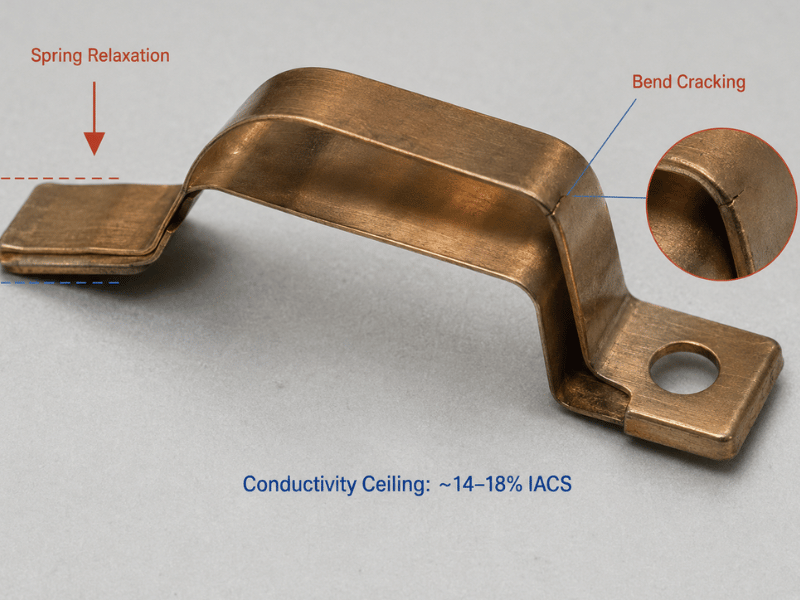
| Failure Mode | Mechanism | Design Guidance |
| Spring relaxation in contacts | C51000 loses spring force faster under high cycle counts | C51900 (or C52100) is the appropriate grade when insertion cycles exceed ~10,000 |
| Bend cracking at high temper | Both grades crack if bent too tight in H08/H10; C51000 tolerates smaller radii | Minimum bend radius ~2.5–3.5× thickness for good-way bending (bend axis parallel to rolling direction), ~50% added for bad-way bends |
| Conductivity shortfall | Neither grade replaces pure copper in high-current paths | Design must account for the ~14–18% IACS ceiling, not copper-level conduction |
Standards and Traceability
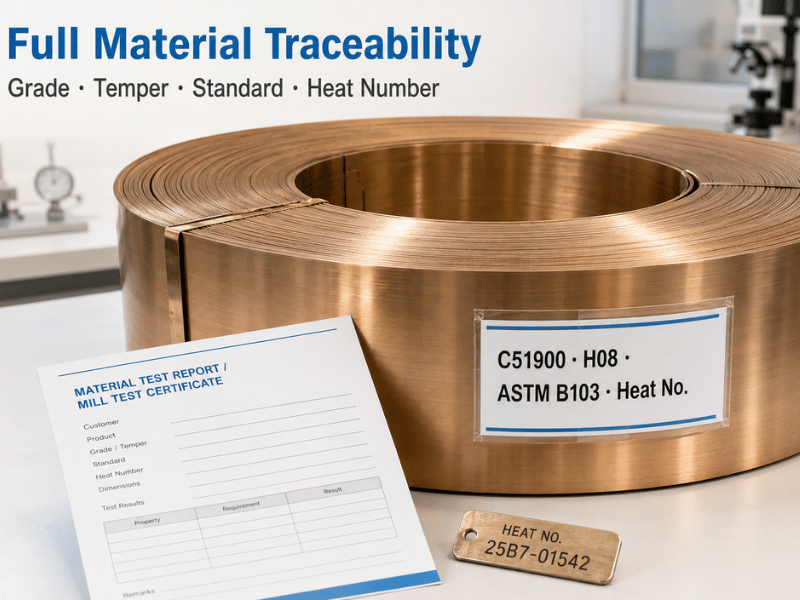
Both grades are covered by ASTM B103/B103M (plate, sheet, strip, rolled bar) and ASTM B139/B139M (rods and bars); European equivalents are CW451K (C51000) and CW452K (C51900) under EN 12163/12164. The temper must be stated on every drawing — “phosphor bronze” without a temper (O60, H04, H08) does not convey the required strength. A material test report / certificate (MTR/MTC) per lot ensures that composition and mechanicals trace back to the heat.
The property ranges above are typical mill values, cross-checked against CDA copper.org and multiple supplier datasheets (Jintian, Triangle Alloy, Mavmet). They span tempers O60 through H10, so they are not fixed design numbers — the exact values must be verified against the ASTM B103/B139 table for the specified temper before design release.
Sourcing C51000 and C51900
Linsy Copper is ISO 9001/14001/45001 certified and stocks both C51000 and C51900 bronze in sheet, plate, bar, wire, tube, coil, profile, and block forms, supplied to the applicable ASTM temper you specify. Each order ships with an MTR/MTC, and SGS chemical, mechanical, conductivity, and RoHS/REACH reports are available on request. Low-MOQ custom production runs 10–60 days depending on grade, size, and processing — useful when a new design needs a small trial batch before a full production commit.
Conclusion
C51000 and C51900 solve the same class of spring, contact, and wear problems, but C51900 carries more spring force and fatigue life while C51000 keeps the formability and conductivity edge for complex stamping. The risk is selecting the wrong grade and discovering relaxation or cracking only after tooling is committed. Linsy supplies both grades with ASTM temper control, full MTR/MTC documentation, and SGS test reports on request, so your grade call is backed by traceable material from the first prototype batch. Download the C51000/C51900 specification sheet, or request a side-by-side quote for both grades.
FAQ
Generally yes at a matched temper. C51900’s higher tin (5.0–7.0% vs 4.2–5.8%) gives it a higher strength floor and better spring-force retention at H08 — both grades top out near H10 (~760–780 MPa), but C51900 holds fatigue life better under cyclic load. The two range maxima are not directly comparable; comparison must be at the same temper. C51000 keeps more elongation at a matched temper, which matters for deep or tight-bend forming.
Only for low-cycle or low-force contacts. Above ~10,000 mating cycles, C51900 (or C52100) holds spring force better; substitution risks relaxation and contact-pressure loss.
H08 (spring temper) is the common choice for contact springs — it delivers the strength-to-formability balance. The temper must be stated on the drawing; “phosphor bronze” alone is not a complete call.
No. These are tin-phosphorus bronzes; copper-nickel alloys use nickel for seawater corrosion resistance and are a different family with different properties and uses.
C51900 is widely used in phosphor bronze spring and contact applications, which typically translates to shorter lead times and more competitive pricing. C51000 may need longer lead on non-standard thicknesses or widths.
Neither machines like free-cutting brass. Machinability rates around 20 vs brass 100, requiring slower feeds, sharper tooling, and possibly near-net shaping by stamping or forming instead of heavy machining.

David Huang is a copper materials specialist and Sales Manager at Linsy Copper, with years of hands-on experience supporting global customers in copper and copper alloy sourcing.
He specializes in industrial copper products such as C11000 copper, C10200 oxygen-free copper, brass, bronze, copper sheets, plates, tubes, bars, and custom-processed copper components.
With a practical understanding of copper manufacturing, quality inspection, surface treatment, and export supply chains, David helps customers choose the right materials for electrical, mechanical, marine, construction, and industrial applications.