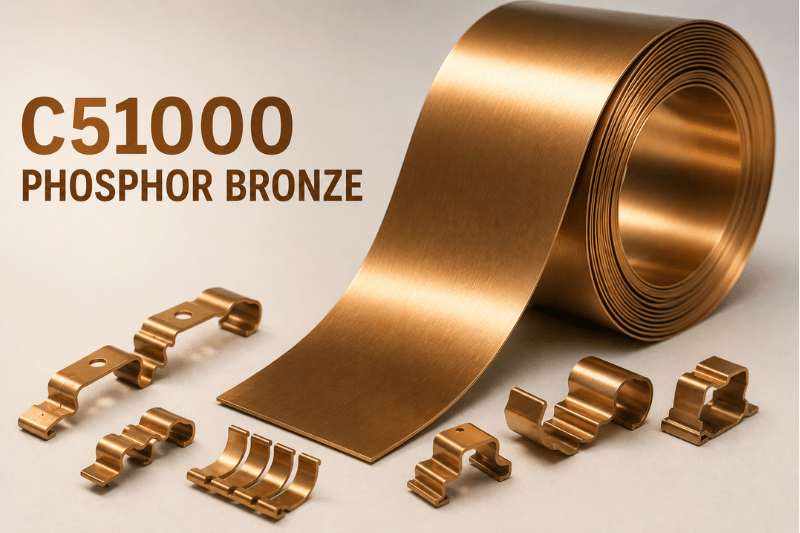
C51000 is a 5% tin phosphor bronze — the default choice for electronic spring contacts, connectors, and switch components. It sits between pure copper (high conductivity, low strength) and beryllium copper (extreme strength, higher cost).
What Is C51000 Phosphor Bronze?
At the core of C51000 (ASTM phosphor bronze Grade A): 5% tin for solid-solution strengthening and work-hardening capacity, plus a small phosphorus addition that acts as a deoxidizer and grain refiner — the latter directly improves fatigue life.
In strip and sheet form, C51000 appears in stamped connector terminals, relay springs, switch contacts, fuse clips, and EMI shielding fingers. Wire grades are used for springs, fasteners, and woven cloth. The alloy is sometimes called “phosphor bronze A” to distinguish it from C52100 (~8% tin).
C51000 Chemical Composition
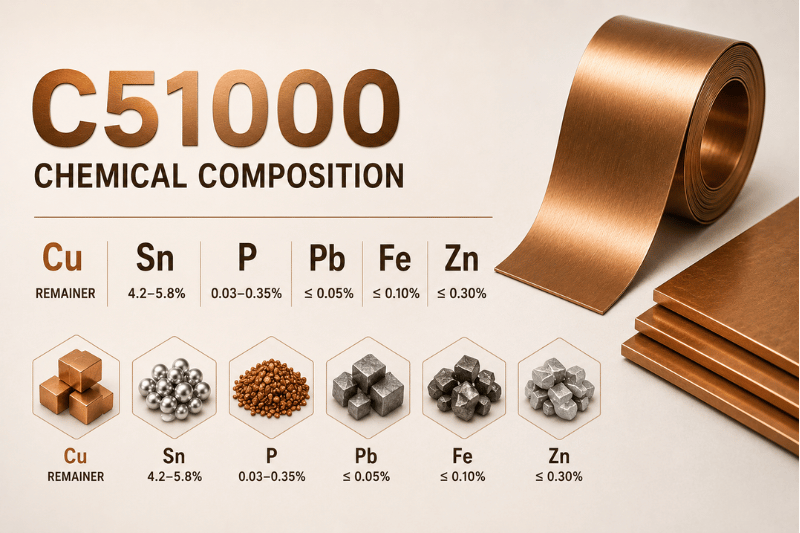
| Copper (Cu) | Remainder |
| Tin (Sn) | 4.2–5.8 |
| Phosphorus (P) | 0.03–0.35 |
| Lead (Pb) | ≤ 0.05 |
| Iron (Fe) | ≤ 0.10 |
| Zinc (Zn) | ≤ 0.30 |
Tin below 4% noticeably drops in strength. Above 6%, cold formability degrades — that’s C52100 territory. Phosphorus at 0.10–0.35% provides meaningful grain refinement. If fatigue life is critical, specifying phosphorus at the higher end of the range is worth negotiating.
Lead is kept below 0.05%, making C51000 RoHS-compatible.
C51000 Mechanical Properties by Temper
C51000 is supplied in cold-worked tempers. The alloy cannot be strengthened by heat treatment — it’s cold-work only.
| Temper | Tensile Strength (MPa) | Yield Strength(MPa) | Elongation (%) | Hardness |
| Annealed (O61) | 310–380 | 105–170 | 40–50 | 30–55 |
| H02 (Half Hard) | 420–520 | 310–415 | 20–35 | 60–75 |
| H04 (Hard) | 510–620 | 450–550 | 10–20 | 75–85 |
| H06 (Extra Hard) | 590–690 | 550–640 | 5–12 | 84–90 |
| H08 (Spring) | 650–760 | 600–700 | 3–8 | 88–94 |
| H10 (Extra Spring) | 690–830 | 640–760 | 1–4 | 91–97 |
Temper selection guide:
- O61 — Deep draw and complex forming. Not for parts seeing repeated loading without post-forming cold work.
- H02–H04 — The sweet spot for stamped connector terminals. Enough formability for 90° bends, enough strength for reliable contact force.
- H06–H08 — Flat springs and simple bends. At H08, limit bend radii to 2–4× material thickness and expect 10–15° springback.
- H10 — Maximum strength, minimal ductility. Flat parts only. Bends tighter than 4× thickness will crack.
If your design needs a post-forming strength boost, C51000 is the wrong alloy — switch to precipitation-hardening C17200 or C70250.
C51000 Electrical Conductivity and Thermal Properties
| Electrical Conductivity | 15% IACS (min), typically 15–17% |
| Electrical Resistivity | ~11.5 µΩ·cm at 20°C |
| Thermal Conductivity | ~70 W/m·K |
Conductivity-strength context:
| Grade | Electrical Conductivity (% IACS) | Typical Tensile Strength (MPa) |
| C11000 (Pure Cu) | 100 | ~250 |
| C26000 (Brass) | 28 | ~350 |
| C51000 | 15 | 450–550 |
| C52100 | 13 | 550–650 |
| C17200 (BeCu) | 22 | 1000+ |
C51000 provides conductivity adequate for signal and low-to-moderate-power contacts, paired with spring properties that hold up over thousands of cycles. For power contacts above 5 A continuous current, switch to a higher-conductivity alloy or increase the cross-section.
Conductivity drops roughly 10% per 100°C rise. Above 100°C operating, derate accordingly.
Formability and Fabrication
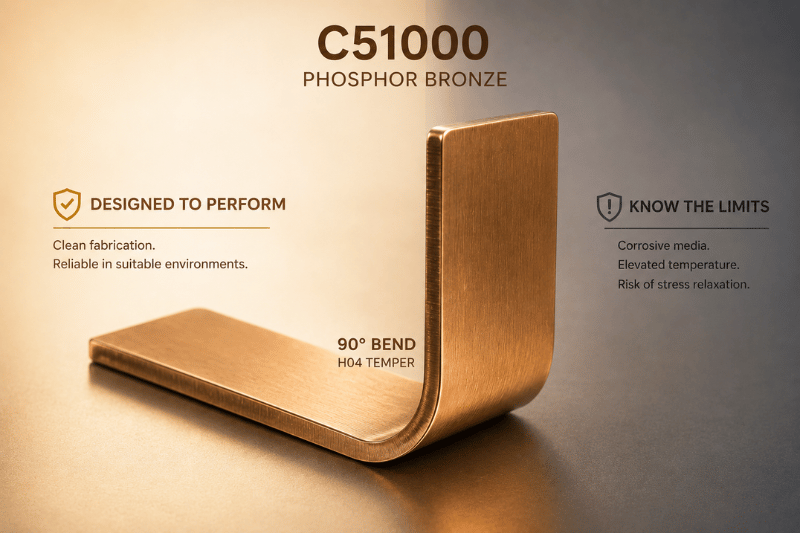
90° bend limits by temper and grain direction:
| Temper | Min. 90° Bend Radius Across Grain | Min. 90° Bend Radius With Grain | Typical Springback | Recommended Fabrication Use |
| H02–H04 | 1T | 2T | 5–8° | Stamped connector terminals |
| H06 | 1.5T | 3T | 10–12° | Simple-formed contacts |
| H08 | 2–4T | Avoid | 12–15° | Flat springs only |
| H10 | 4T minimum | Cracking risk | 15°+ | Flat parts only |
Springback varies ±3–5% across heats. Confirming with a trial strip from the production lot cuts tooling rework risk. At H06+, over-bend compensation in the progressive die is required.
Deep drawing. Only annealed temper (O61). C51000 work-hardens faster than cartridge brass — intermediate annealing may be needed for reductions above 40%. For stamped parts stored before assembly, VCI paper or sealed-bag packaging prevents surface oxidation that degrades solderability.
Joining and plating:
- Solder: compatible with standard Sn-Pb and lead-free solders
- Resistance welding: feasible, needs a higher current than copper. At higher temperatures, copper-tungsten electrodes are preferred.
- Plating: tin, silver, gold — all compatible. Low lead content simplifies bath management vs leaded brasses.
- Nickel underplate recommended for corrosive environments
Corrosion Resistance and Environmental Limits
C51000 has better atmospheric corrosion resistance than brass, forming a protective patina rather than dezincifying.
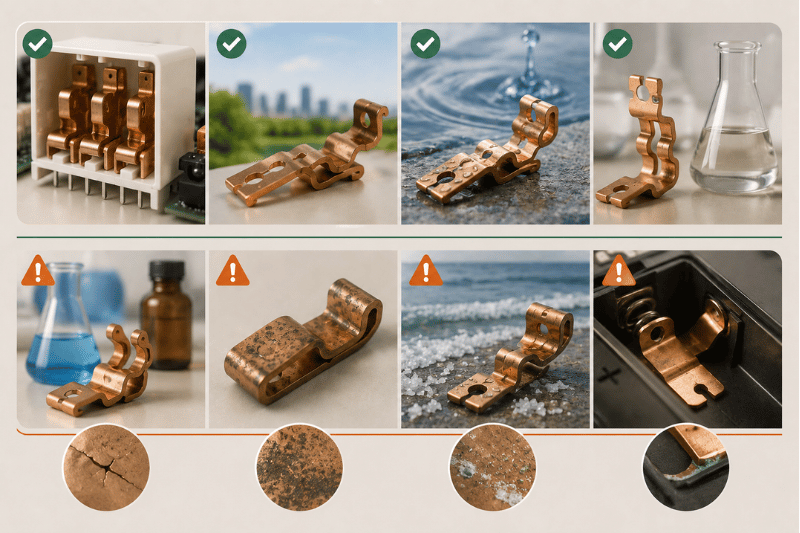
Safe conditions: indoor electronics, mild outdoor exposure, freshwater contact, most organic atmospheres.
Caution required:
- Ammonia/amines — Stress corrosion cracking risk, especially in H06+. Check proximity to cleaning chemicals or industrial atmospheres.
- Sulfide atmospheres — Accelerated tarnishing. Gold plating or seals may be necessary.
- Salt spray — Better than brass, worse than marine bronzes. Not for continuous marine exposure.
- pH below 4 — Tin oxide layer breaks down. Nickel barrier underplate recommended for battery compartment contacts.
Galvanic compatibility:
| Mating Material | C51000 Galvanic Role | Design / Corrosion Risk |
| Aluminum, steel | Cathodic | Mating part corrodes — avoid in wet conditions without coating |
| Gold, stainless steel | Anodic | C51000 self-sacrifices — gold plating recommended |
| Tin-plated brass | Near-neutral | Common, benign combination. Gold-plated C51000 + tin-plated brass pin works reliably |
Standards, Specifications, and Procurement Checklist
| Standard | Form |
| ASTM B103 | Phosphor bronze strip (primary for connector stock) |
| ASTM B139 | Sheet and plate |
| ASTM B159 | Wire |
Purchase order essentials:
- Alloy: C51000 (not just “phosphor bronze”)
- Temper: O61 / H02 / H04 / H06 / H08 / H10
- Thickness and tolerance (per ASTM B103)
- Width and edge condition
- Surface finish
- Quantity and coil/sheet dimensions
- MTR/MTC: per order, per heat, or per coil
A standard MTR covers chemical analysis (Cu, Sn, P, Pb, Fe, Zn), tensile properties (UTS, YS, elongation per ASTM E8), hardness, and grain size (for annealed temper). Conductivity testing, stress relaxation data, or fatigue S-N curves are supplementary — request these during quotation, not after the order is placed. For fatigue-critical or relaxation-critical applications, agree on test method, sample count, and acceptance criteria up front.
When C51000 Isn’t the Right Choice
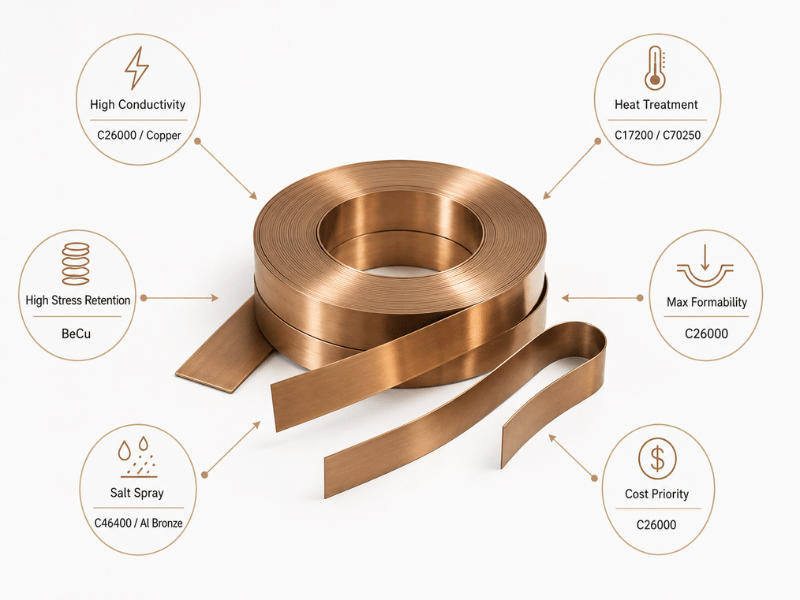
- Conductivity above 25% IACS needed → C26000 brass (28%) or pure copper (100%). I²R heating in C51000 at sustained currents above 5 A typically pushes the design toward higher-conductivity alloys.
- Post-forming heat treatment required for final strength → C17200 (BeCu) or C70250 (Cu-Ni-Si). C51000 has no precipitation-hardening response — all strength comes from cold work, which is lost if the part is annealed after forming.
- Stress retention > 80% after 1,000 hrs at 105°C → Beryllium copper or mill-hardened specialty alloys. C51000 at this temperature drops below 70% retention — normal force erodes to the point of unreliable contact.
- Maximum formability in as-supplied condition → C26000 cartridge brass, cheaper and with 50%+ elongation in annealed temper vs C51000’s ~40%.
- Continuous salt spray or acidic immersion → Marine bronze (C46400) or aluminum bronze. C51000’s tin oxide patina does not withstand continuous chloride attack.
- Cost is dominant, and performance margins are generous → C26000 brass at roughly half the material cost. Only pay for phosphor bronze when you need what phosphor bronze does.
Conclusion
C51000 earns its place by conducting electricity adequately and resisting fatigue and stress relaxation better than anything in its price range. Getting the temper wrong costs more in tooling rework than the material itself — H04 for stamped contacts, H08 for flat springs, annealed for deep drawing.
If your design requires C51000 in a specific temper, thickness tolerance, or slit width — with MTR documentation — send your specification for a technical quotation.

David Huang is a copper materials specialist and Sales Manager at Linsy Copper, with years of hands-on experience supporting global customers in copper and copper alloy sourcing.
He specializes in industrial copper products such as C11000 copper, C10200 oxygen-free copper, brass, bronze, copper sheets, plates, tubes, bars, and custom-processed copper components.
With a practical understanding of copper manufacturing, quality inspection, surface treatment, and export supply chains, David helps customers choose the right materials for electrical, mechanical, marine, construction, and industrial applications.