When specifying materials for hot forged components, the balance between forgeability and machinability often dictates the choice of alloy. C37700 brass forging is a standard choice for parts requiring intricate shapes and reliable mechanical strength. Accurate evaluation of material characteristics ensures long-term performance in the field. This guide covers the essential properties, chemical composition, and processing characteristics of C37700 to support practical material selection and purchasing decisions.
Understanding how this specific alloy responds to extreme heat and mechanical stress helps prevent costly die wear, minimize scrap rates, and ensure the final component meets field application standards.
What is C37700 Forging Brass?
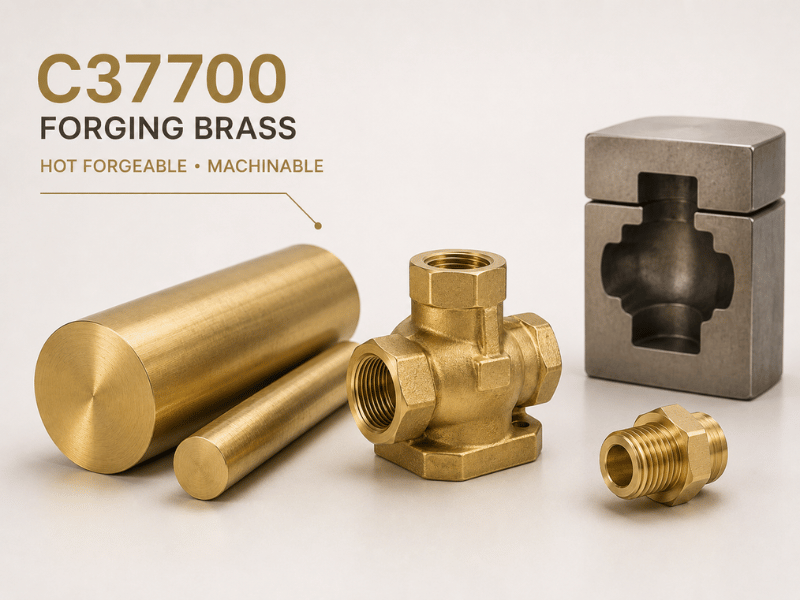
C37700 is a leaded brass alloy specifically optimized for hot pressing and forging. It is specified when a component requires the dense, leak-proof structure of a forging combined with high-speed machinability.
Unlike sand-cast alternatives, forged C37700 completely eliminates internal porosity. This structural integrity makes it the standard choice for pressurized fluid and gas control applications, where microscopic leak paths cannot be tolerated.
Beyond its excellent hot flow characteristics, C37700 provides a high machinability rating (80) after cooling. The controlled lead content ensures that secondary operations—such as deep drilling, tapping, or threading—produce short, manageable chips. This prevents metal stringers from tangling in CNC equipment, significantly reducing cycle times and preserving tool life.
C37700 Chemical Composition
The performance of C37700 forging brass relies on a specific ratio of copper, zinc, and lead. This precise metallurgical blend is what gives the alloy its distinct dual-phase behavior during manufacturing. The exact C37700 chemical composition ensures that the material flows easily when heated while remaining sufficiently brittle during machining to form short, manageable chips.
Maintaining these specific elemental tolerances is critical for consistent production runs.
| Copper (Cu) | 58.0 – 61.0 | Provides baseline corrosion resistance and structural strength. |
| Lead (Pb) | 1.5 – 2.5 | Acts as an internal lubricant to improve machinability and chip breakage. |
| Zinc (Zn) | Balance | Lowers the melting point and improves hot working characteristics. |
| Iron (Fe) | 0.30 max | Kept low to prevent hard spots that could damage machining tools. |
The tightly controlled lead content is particularly important for secondary manufacturing operations. Since lead does not fully dissolve into the solid copper-zinc matrix, it accumulates at the grain boundaries. When a cutting tool strikes the material, the lead causes the chip to fracture quickly rather than forming long, dangerous metal stringers. This mechanism significantly reduces the downtime required to clear tangled metal from the automated cutting zones.
C37700 Brass Material Properties
Evaluating C37700 brass material properties helps verify if the alloy meets the mechanical and thermal requirements of a specific project. These data points give product engineering and procurement teams the confidence to specify the material for high-stress plumbing, gas, or industrial applications.
Mechanical Properties
The mechanical properties of C37700 provide the necessary baseline strength to withstand high-pressure environments. The properties below reflect typical values for forged C37700 components.
| Tensile Strength | 345 – 415 MPa |
| Yield Strength | 140 – 180 MPa |
| Elongation | 25% (in 50mm) |
| Thermal Conductivity | 120 W/m·K |
The moderate elongation rating of 25% (in 50mm) indicates that the material can absorb some mechanical stress without brittle snapping, but it is not intended for heavy structural stretching.
Electrical Conductivity
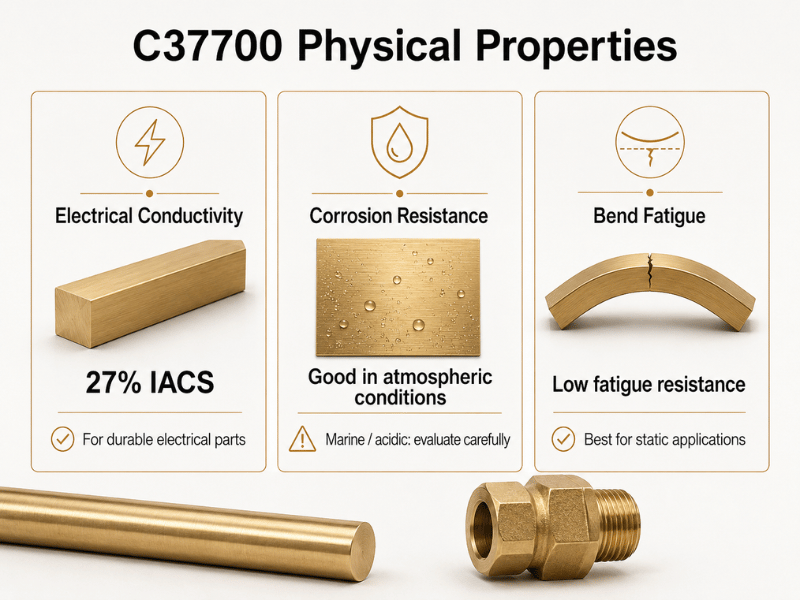
While primarily specified as a structural and fluid-control material, C37700 offers moderate electrical conductivity. It typically provides an electrical conductivity rating of approximately 27% IACS (International Annealed Copper Standard). This level of conductivity makes it suitable for heavy-duty electrical components, such as thick switchgear parts or solid grounding blocks, where the primary requirement is physical durability rather than maximum pure electrical transmission.
Corrosion Resistance
C37700 provides strong corrosion resistance in atmospheric and non-potable water conditions, though it should be evaluated carefully before use in highly acidic or marine environments. In standard indoor environments or normal outdoor exposure, the brass develops a protective patina that prevents further oxidation. However, due to its high zinc content, it can be susceptible to dezincification when exposed to harsh, acidic water for extended periods.
Bend Fatigue
The bend fatigue limits of C37700 require careful consideration before final material selection. This alloy has a low resistance to bending fatigue and repeated mechanical flexing. Because it is optimized for hot forging and subsequent machining, the metal grain structure does not support severe cold bending. If a component is subjected to continuous vibration or repeated bending forces, the material will experience rapid work hardening and eventually fracture. Parts made from C37700 should be designed strictly for static-pressure applications rather than dynamic or flexing environments.
Fabrication Properties
To ensure efficient manufacturing, material choice must align with the factory’s actual processing capabilities. C37700 is the industry standard against which other hot-forging brasses are measured, with a hot forgeability rating of 100. The table below outlines the primary fabrication properties of this alloy.
| Hot Forgeability | 100 (Excellent) | The baseline standard for hot pressing and complex die forming. |
| Machinability | 80 (Very Good) | Relative to free-machining brass (C36000 at 100). Produces short, manageable chips. |
| Cold Working | Poor | Not recommended. May cause severe cracking or stress fractures if cold formed. |
| Soldering | Excellent | Readily accepts standard soft solders for joining fluid and gas components. |
| Brazing | Good | Can be silver brazed effectively with appropriate temperature controls and flux. |
| Welding | Not Recommended | Lead content causes porosity and poor weld quality in standard arc or gas welding. |
Common Applications
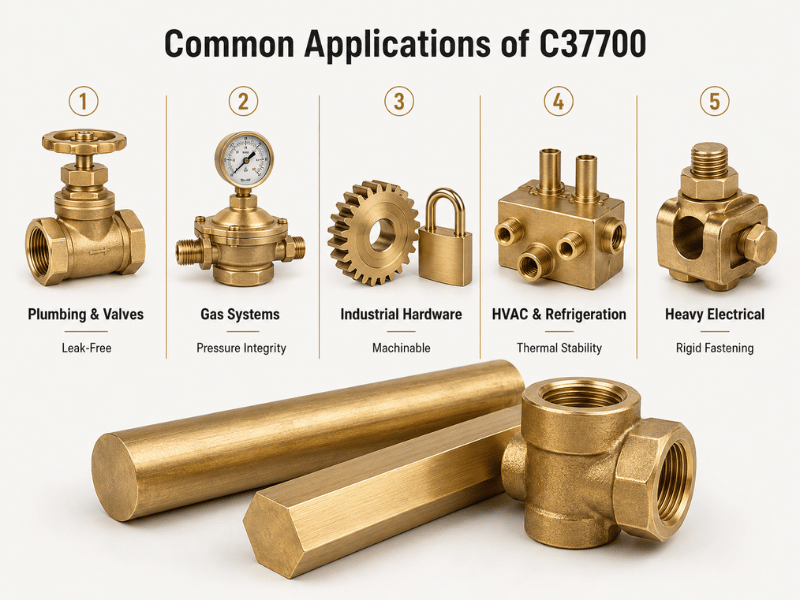
Because it forms a dense, leak-proof structure and allows for economical near-net-shape forging, C37700 is heavily specified across fluid-control and high-pressure industries:
- Plumbing & Valve Components: Heavy-duty ball valves, gate valves, and backflow preventers. Forging eliminates the internal porosity common in cast alternatives, ensuring leak-free performance under municipal water pressure.
- Gas & Pressurized Systems: High-pressure cylinder valves and regulator bodies. The impermeable grain structure provides the absolute material integrity required for safely handling compressed gases.
- Industrial Hardware: Gear blanks, lock bodies, and pump impellers. It combines baseline wear resistance for moving parts with excellent machinability for precision threading.
- HVAC & Refrigeration: Distributor blocks and heavy temperature-control housings. It delivers the exact pressure resistance and thermal stability required for long-term thermal regulation.
- Heavy Electrical Equipment: Thick switchgear parts and solid grounding clamps. Specified when physical rigidity and secure mechanical fastening take precedence over pure electrical conductivity.
Sourcing and Processing Support from Linsy Copper
Linsy Copper is a Shenzhen-based copper factory with more than 20 years of industry experience. Our business model focuses on factory-direct supply, broad inventory support, and practical low-MOQ custom production for buyers who need reliable material performance.
To support your specific engineering requirements, our capabilities include:
- Broad Material Forms: Supply of copper sheet, plate, bar, tube, wire, and coil.
- Custom Production: Typical lead times of 10 to 60 days for non-stock items, allowing you to secure exact shapes and volumes.
- In-House Processing: CNC machining, stamping and bending, laser cutting, TIG welding, and silver brazing.
- Surface Treatment: Bright polishing, brushed finish, sandblasting, passivation, tin plating, and silver plating.
- Quality Traceability: An MTR/MTC is issued for every order after production. For projects requiring third-party validation, SGS test reports are available on request at an additional cost.
FAQs
-
C37700 has poor cold working properties. It is specifically formulated to be heated and shaped via hot forging or hot pressing. If heavy cold forming is required, other alloys like C26000 may be a better choice. Attempting to cold-head or deep-draw C37700 will result in severe material fracturing.
-
Yes. With a machinability rating of 80, it allows for high-speed secondary machining operations, producing short chips that clear easily from cutting tools. This operational efficiency keeps CNC cycle times short and preserves the lifespan of cutting inserts.
-
Depending on the severity of the forging and the final application, stress relieving may be recommended to prevent stress corrosion cracking, especially in environments containing ammonia. Proper thermal stress relief guarantees long-term structural reliability.
-
No, it is highly recommended to avoid welding C37700. The lead content in the material vaporizes at standard arc- and gas-welding temperatures, creating significant porosity in the weld joint. However, the material can be effectively joined using soft soldering or silver brazing.

David Huang is a copper materials specialist and Sales Manager at Linsy Copper, with years of hands-on experience supporting global customers in copper and copper alloy sourcing.
He specializes in industrial copper products such as C11000 copper, C10200 oxygen-free copper, brass, bronze, copper sheets, plates, tubes, bars, and custom-processed copper components.
With a practical understanding of copper manufacturing, quality inspection, surface treatment, and export supply chains, David helps customers choose the right materials for electrical, mechanical, marine, construction, and industrial applications.