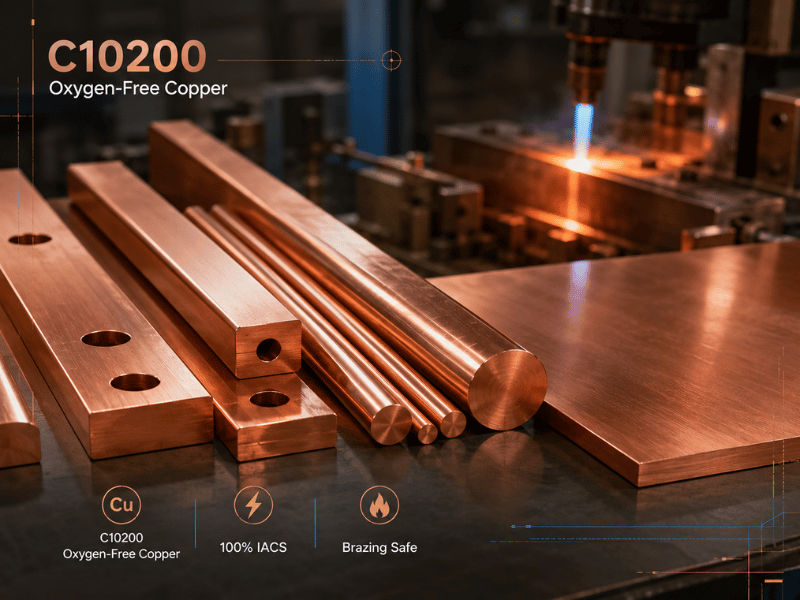
High-temperature brazing and welding can severely damage standard copper by causing hydrogen embrittlement. If your components are exposed to reducing atmospheres, C10200 oxygen-free copper is the practical solution. By removing trapped oxygen, it prevents internal micro-cracking while still delivering 100% IACS electrical conductivity. This guide breaks down the chemical composition, mechanical properties, and grade comparisons to help you specify C10200 correctly.
Key Takeaways
- Hydrogen Embrittlement Immunity: C10200 is virtually oxygen-free (oxygen ≤ 0.001%), eliminating the risk of internal micro-cracking and blistering during high-temperature brazing, welding, or operations in reducing atmospheres.
- Exceptional Conductivity: It guarantees a minimum electrical conductivity of 100% IACS, making it highly efficient for heavy-duty power transmission and busbars.
- Cost-Effective Selection: It is superior to C11000 for thermal joining while offering a much more practical and economical alternative to ultra-pure C10100 for standard industrial applications.
What is C10200 Oxygen-Free Copper?
C10200 oxygen-free copper is a high-purity copper alloy refined in a specialized, oxygen-free environment. This manufacturing process removes virtually all oxygen and volatile impurities from the metal. It is primarily specified for electrical and electronic applications where high conductivity and excellent formability must be maintained during and after high-temperature joining processes.
The defining feature of C10200 is its immunity to hydrogen embrittlement. When standard copper is heated in a hydrogen-rich atmosphere, the hydrogen reacts with trapped oxygen to form steam, causing internal micro-cracking. Because C10200 contains negligible oxygen, it can be safely subjected to high-temperature brazing and welding without compromising its structural integrity.
This characteristic makes the material indispensable for constructing vacuum tubes, glass-to-metal seals, and high-power radio-frequency components. The lack of microscopic oxide voids also ensures a superior, uniform surface finish after deep machining or bright polishing operations. By eliminating internal steam expansion, manufacturers reduce scrap rates and ensure long-term mechanical reliability.
How C10200 Copper Is Produced
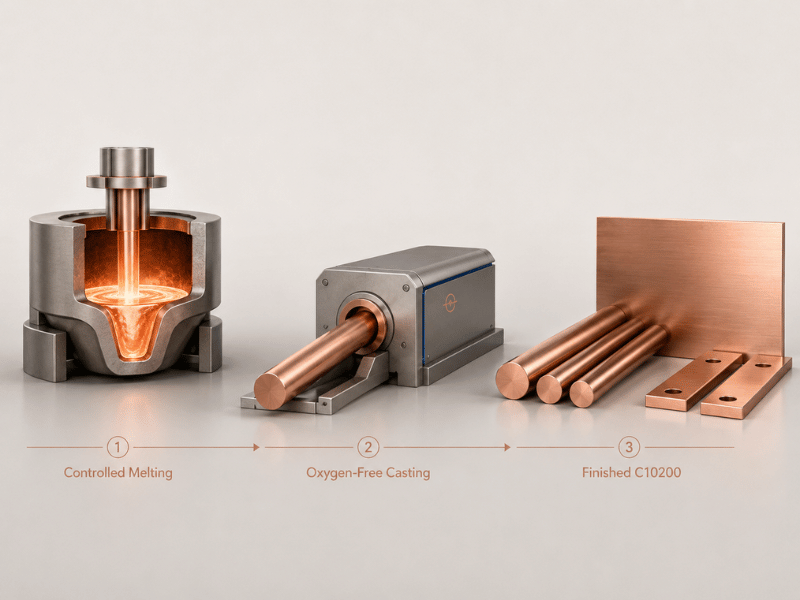
The production of C10200 copper requires strict atmospheric control to prevent oxygen contamination during melting and casting. The industrial manufacturing process follows these precise phases:
- Raw Material Selection: Manufacturers begin with extremely high-purity copper cathodes, which act as the primary, uncontaminated raw material for the alloy.
- Atmosphere-Controlled Melting: These cathodes are introduced into an induction furnace operating under a strictly controlled protective atmosphere. This enclosed environment typically utilizes carbon monoxide or inert nitrogen shielding gases to isolate the highly reactive molten metal from ambient air. During the melting phase, the protective atmosphere actively prevents the liquid copper from absorbing atmospheric oxygen. Unlike traditional electrolytic tough pitch copper production, no oxygen is intentionally introduced to burn off impurities. Instead, the inherent high purity of the starting cathode and the isolated melting environment maintain the required chemical baseline throughout the process.
- Closed-Loop Transfer: The molten copper is then safely transferred to a continuous casting machine through enclosed, atmosphere-controlled launders. This closed-loop transfer is essential to prevent secondary contamination before the metal solidifies.
- Continuous Casting & Forming: Continuous casting ultimately produces the large copper billets, cakes, or rods that serve as the starting point for downstream industrial processing. Because the material solidifies without exposure to oxygen, the internal grain structure remains completely free of cuprous oxide particles. From here, the solid cast shapes are hot-rolled or cold-drawn into the required final product dimensions.
C10200 Chemical Composition
The performance of C10200 relies on strict control of its purity levels. The material consists almost entirely of copper, with rigid maximum limits placed on trace elements. Maintaining this consistent composition requires rigorous spectrographic testing and material certification throughout the primary supply chain.
| Copper (Cu) + Silver (Ag) | 99.95% Min |
| Oxygen (O) | 0.001% Max (10 ppm) |
| Lead (Pb) | 0.005% Max |
| Bismuth (Bi) | 0.001% Max |
This precise C10200 chemical composition ensures consistent performance in both electrical transmission and thermal processing environments. Strict adherence to these trace element limits ensures predictable behavior during severe forming and thermal joining operations.
Key C10200 Copper Properties
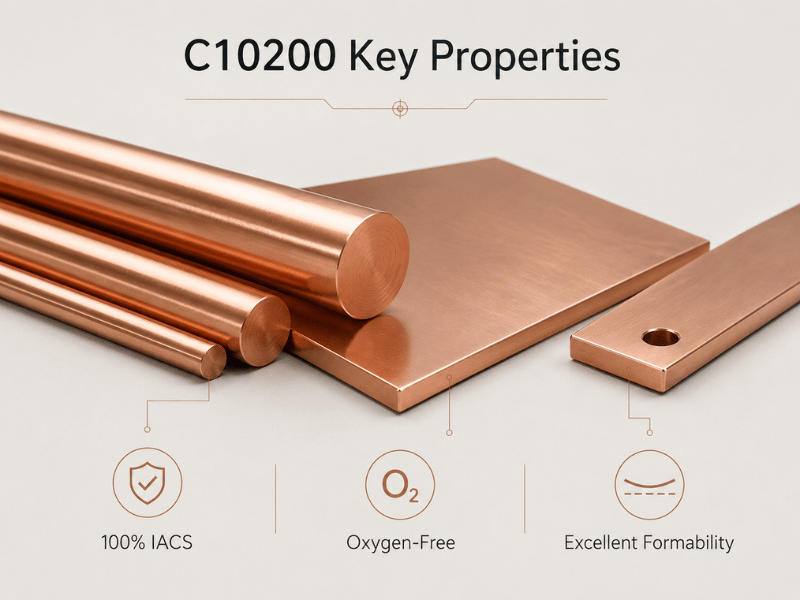
Evaluating the properties of C10200 copper helps engineers confirm its suitability for specific fabrication methods and end-use conditions.
- Electrical Conductivity: C10200 provides exceptional electrical performance, guaranteeing a minimum conductivity of 100% IACS (International Annealed Copper Standard). This makes it highly efficient for busbars and power transmission.
- Thermal Conductivity: The high purity of this grade ensures excellent heat transfer, making it a standard specification for heat sinks, cooling plates, and industrial thermal management systems.
- Formability: C10200 exhibits outstanding hot- and cold-workability. The material can undergo severe deep drawing, spinning, and bending without cracking or fracturing.
- Joinability: The absence of oxygen allows for reliable TIG welding, silver brazing, and soldering, ensuring high-integrity joints in complex assemblies.
- Corrosion Resistance: This grade offers highly reliable corrosion resistance against ambient atmospheric moisture, freshwater systems, and various non-oxidizing acids.
- Excellent Workability: The material’s excellent workability ensures it can be heavily reduced in cross-section during wire drawing or cold rolling operations.
Material Comparisons: C10200 vs. Other Pure Copper Grades
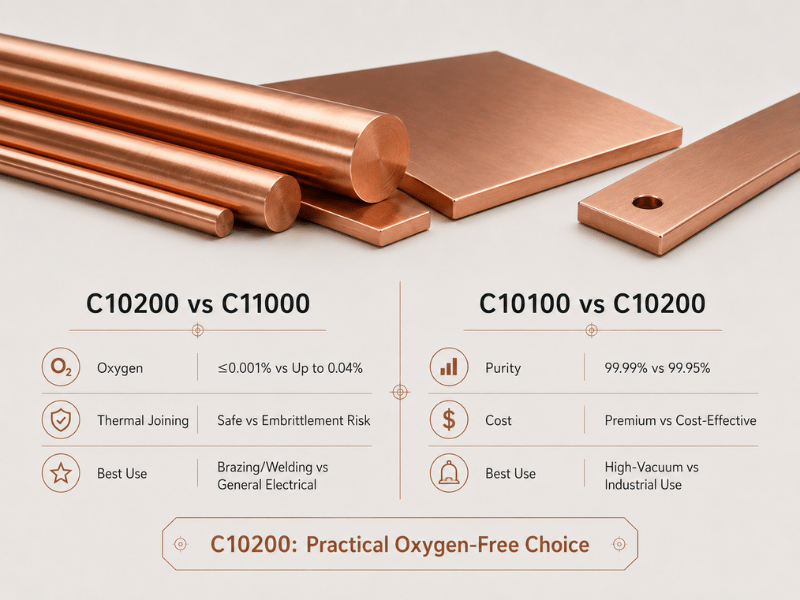
C10200 vs C11000
C11000 (Electrolytic Tough Pitch or ETP copper) is the standard grade for general electrical applications, but it contains up to 0.04% oxygen. If C11000 is heated above 370°C in a reducing atmosphere, it will suffer from hydrogen embrittlement and blistering. This internal blistering severely weakens the material and can cause catastrophic mechanical failure in high-stress environments.
When comparing C10200 vs C11000, the primary differentiator is this thermal processing capability:
Oxygen Content: C11000 contains up to 0.04% oxygen, whereas C10200 is virtually oxygen-free.
Thermal Joining Safety: C11000 is prone to hydrogen embrittlement; C10200 is specifically designed to eliminate this risk, safely supporting high-temperature brazing, glass-to-metal sealing, and welding.
While C11000 is highly effective for mechanically joined busbars, it cannot safely substitute C10200 in thermally joined assemblies.
C10100 vs C10200
While both are oxygen-free coppers, they are manufactured to different purity thresholds. C10100 (Oxygen-Free Electronic, or OFE) has a stricter minimum purity of 99.99% and tighter impurity limits, making it necessary for extremely high-vacuum electronics such as linear accelerators. These extreme applications cannot tolerate even the most minute levels of volatile metal outgassing under vacuum.
In the comparison of C10100 vs C10200, the differences come down to application scale and cost:
Purity and Precision: C10100 guarantees 99.99% purity for high-vacuum conditions; C10200 offers a highly practical 99.95% purity for general industrial applications.
Cost Efficiency: C10200 provides the necessary hydrogen embrittlement resistance without the premium costs associated with extreme vacuum-grade manufacturing control.
For most commercial busbar, heat exchanger, and heavy electrical component projects, C10200 remains the standard and most cost-effective engineering choice.
Common Forms: C10200 Copper Tube, Wire, and Sheet
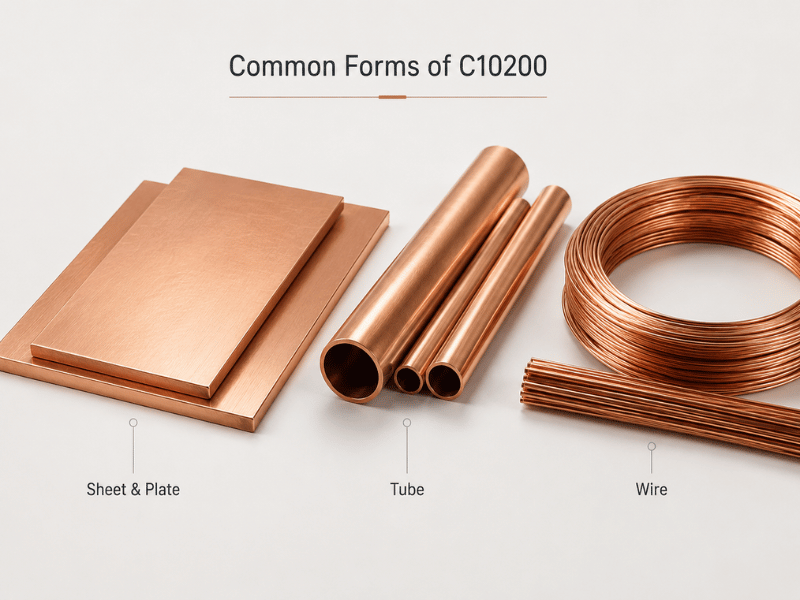
C10200 is highly versatile and can be drawn, rolled, or extruded into multiple product forms to match production requirements. Specifying the correct starting form significantly reduces raw material waste and minimizes downstream machining time.
C10200 Copper Sheet and Plate: Frequently specified for heavy-duty electrical contacts, switchgear components, and custom-stamped busbars. Plates are also heavily utilized as base substrates in the manufacture of large-scale industrial heat sinks.
C10200 Copper Tube: Used in waveguide components, coaxial cables, and high-performance industrial cooling systems where leak-free brazed joints are critical. The lack of internal oxides ensures that thin-walled tubes do not fracture during complex induction brazing processes.
C10200 Copper Wire: Common in sensitive electronic wiring, specialized cables, and telecommunications equipment. Its unique ability to be drawn into ultra-fine diameters without breaking is highly valued in the advanced wire and cable industry.
Sourcing with a Reliable C10200 Copper Manufacturer
Finding a practical C10200 copper manufacturer requires striking a balance among material availability, processing capabilities, and reliable quality documentation. Linsy Copper is a Shenzhen-based copper factory with over 20 years of industry experience, supporting customers who need both standard materials and project-based specifications.
We supply a broad range of copper products, including sheet, plate, bar, tube, wire, and coil. Our supply model combines practical stock coverage across pure copper, brass, and bronze with flexible, low-MOQ custom production for non-stock items. Typical custom lead times range from 10 to 60 days, depending on the grade, dimensions, and order complexity.
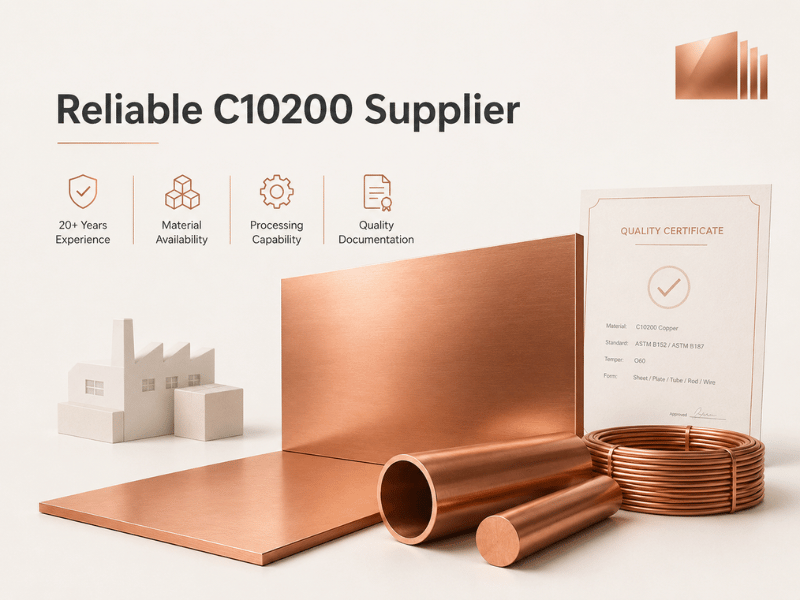
For projects requiring downstream manufacturing, our in-house processing services include CNC machining, laser cutting, stamping and bending, TIG welding, silver brazing, and surface finishing. Quality control is fully traceable; we issue an MTR/MTC under Linsy Copper for every order after production. For additional third-party verification, SGS test reports are available on request at an extra testing cost.
Contact Linsy Copper for Your Project Needs
If you need to verify C10200 specifications, check current inventory, or review options for custom copper processing, contact the Linsy Copper team. Send us your project dimensions, material requirements, or drawings for a practical stock review and fast quotation.
Frequently Asked Questions
-
Yes. C10200 provides an excellent base substrate for surface treatments. It readily accepts tin plating, silver plating, and bright polishing to enhance surface conductivity or improve anti-oxidation properties. Proper surface cleaning is required before plating to ensure uniform adhesion.
-
Yes. C10200 provides an excellent base substrate for surface treatments. It readily accepts tin plating, silver plating, and bright polishing to enhance surface conductivity or improve anti-oxidation properties. Proper surface cleaning is required before plating to ensure uniform adhesion.
-
C10200 is chosen primarily for its high conductivity and formability rather than its mechanical strength. If an application requires both high electrical conductivity and superior mechanical strength or wear resistance, a special conductive copper, such as chromium-zirconium copper, is usually the more appropriate choice. Pure copper generally lacks the yield strength required for heavy load-bearing structural frames.

David Huang is a copper materials specialist and Sales Manager at Linsy Copper, with years of hands-on experience supporting global customers in copper and copper alloy sourcing.
He specializes in industrial copper products such as C11000 copper, C10200 oxygen-free copper, brass, bronze, copper sheets, plates, tubes, bars, and custom-processed copper components.
With a practical understanding of copper manufacturing, quality inspection, surface treatment, and export supply chains, David helps customers choose the right materials for electrical, mechanical, marine, construction, and industrial applications.