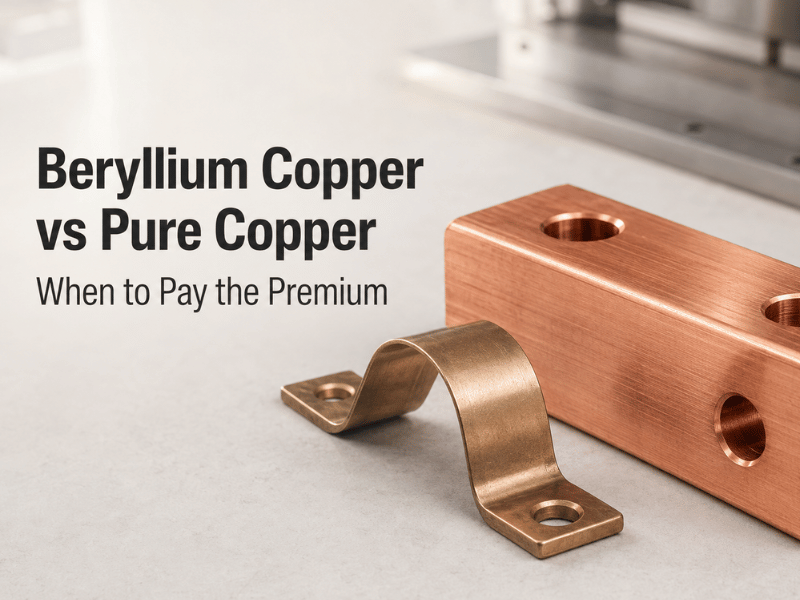
Beryllium copper and pure copper sit at opposite ends of the copper material spectrum. Pure copper is a ~99.9% Cu single-metal conductor. Beryllium copper is a high-performance alloy that trades most of that conductivity for strength levels that rival steel. If your part carries current, you reach for pure copper. If it must carry load, cycle millions of times, or work around explosive gases, you reach for beryllium copper. The cost premium is significant, so the decision is whether your part’s loads, cycles, or environment actually demand it.
Fundamental Difference: Composition and Why It Matters
| Property | Pure Copper (C11000 ETP) | Beryllium Copper (C17200) |
| Copper content | ≥ 99.90% | ~97.5% (balance) |
| Key alloying element | None | Beryllium 1.8–2.0% + Co/Ni |
| Strengthening mechanism | Cold work only | Precipitation (age) hardening |
| Grain structure after max strength | Work-hardened, distorted grains | Fine, uniform precipitate dispersion |
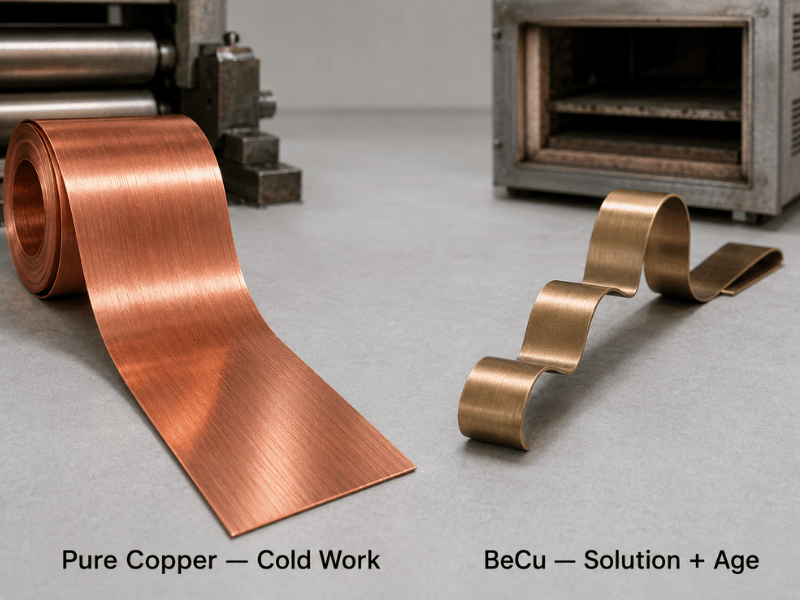
Pure copper can only get stronger through cold work — roll it, draw it, stamp it. The moment you anneal it, the strength disappears and you start over. Beryllium copper goes through solution annealing + aging: heat to ~790°C to dissolve the beryllium into the copper matrix, quench to lock it in solution (the soft, formable state), then age at ~315°C for 2–3 hours. During aging, nano-scale beryllium-rich precipitates form throughout the grain structure, pinning dislocations and driving tensile strength up to ~1,380 MPa — more than three times the hardest cold-worked pure copper. Once aged, the part holds its strength permanently below the aging temperature.
Property Comparison
| Property | Pure Copper (C11000, various tempers) | BeCu C17200 (age-hardened) | BeCu C17500 (age-hardened) |
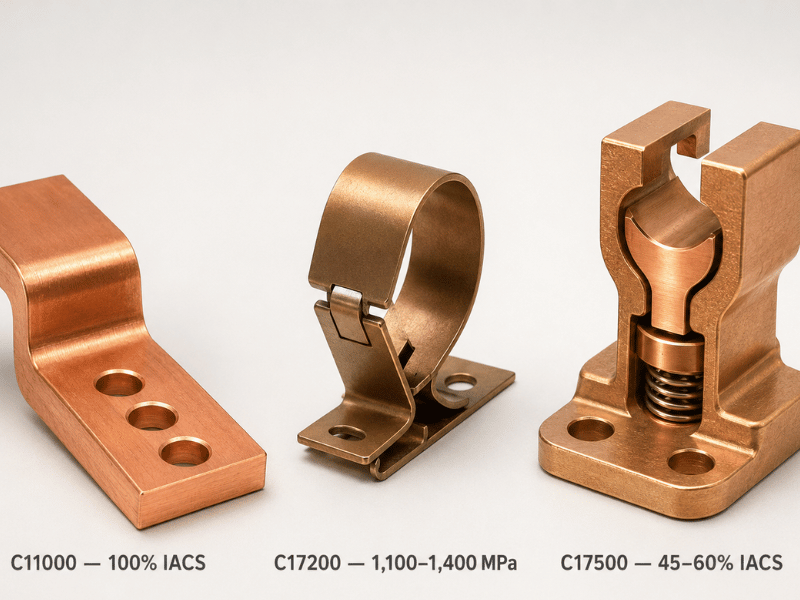
| Tensile strength | 210–400 MPa | 1,100–1,400 MPa | 690–1,100 MPa |
| Yield strength (0.2%) | 70–320 MPa | 758–1,200 MPa | 480–830 MPa |
| Elongation | 4–55% | 1–10% | 5–25% |
| Hardness | ~40–120 HV (annealed to full-hard) | HRC 38–44 (~280–420 HV) | HRC 32–38 (~220–300 HV) |
| Electrical conductivity | 100% IACS | 22–25% IACS | 45–60% IACS |
| Thermal conductivity | ~390 W/m·K | 105–120 W/m·K | 200–260 W/m·K |
| Density | 8.9 g/cm³ | 8.33 g/cm³ | 8.8 g/cm³ |
| Elastic modulus | 117 GPa | 128 GPa | 125 GPa |
| Machinability (vs brass 100) | ~20 | 30–40 | 30–40 |
| Heat-treatable | No | Yes (solution + age) | Yes (age-hardenable) |
| Non-sparking | No (may spark on impact) | Yes (ATEX Zone 0/1/2) | Yes |
| Non-magnetic | Yes | Yes | Yes |
Pure copper’s advantage is a single column — electrical and thermal conductivity at the top of the non-precious-metal chart. Beryllium copper wins every other column: strength, hardness, wear resistance, fatigue life, spring force, and safety in explosive atmospheres. C17500 sits in the middle — it sacrifices some strength for conductivity that approaches half of pure copper’s, making it the choice when you need both load-carrying and current-carrying in the same part.
Go/No-Go: When Beryllium Copper Is Worth the Cost
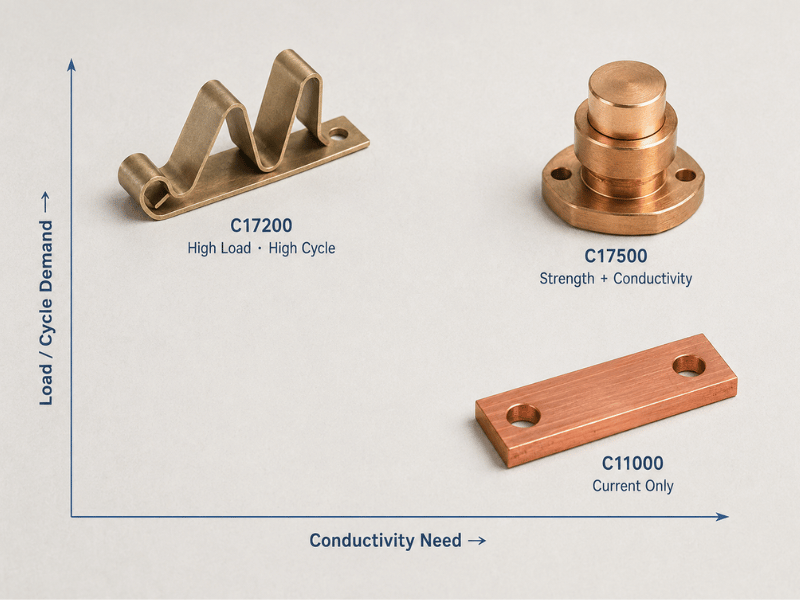
Each entry gives a decision condition, not just an application name. The decision hinges on whether your part hits these triggers.
| Application Condition | Grade | Reason |
| Cyclic loading above ~10⁴ cycles, no relaxation allowed | C17200 BeCu | Pure copper has no meaningful fatigue endurance — it deforms permanently. BeCu springs, contacts, and diaphragms hold spring force over millions of cycles |
| Explosive atmosphere (oil rigs, gas plants, grain elevators, solvent-handling) | C17200 BeCu | ATEX-certified non-sparking; pure copper can spark on impact. For hand tools in these environments, BeCu is the standard |
| Both high conductivity (>45% IACS) AND moderate strength (600+ MPa) | C17500 BeCu | Only copper-based material filling this gap. Resistance welding electrodes, high-current switch contacts, and automotive sensor terminals use C17500 for exactly this reason |
| Heavy machining from bar stock, tight tolerances after heat treatment | C17200 BeCu | Pure copper galls, smears, and moves during machining; BeCu in the solution-annealed state machines cleanly (30–40 vs brass 100), then ages to final dimensions with predictable, minimal growth |
| Moving current with minimal resistive loss (bus bars, cables, windings) | Pure copper (C11000) | No non-precious metal exceeds 100% IACS, and pure copper’s cost makes it the only practical choice at scale |
| Heat exchanger, plumbing tube, or architectural element with no structural load | Pure copper (C11000) | You are paying for thermal performance, formability, and corrosion resistance, not strength |
Where They Land in Production
Pure copper fills the large-volume, conductivity-first world. BeCu fills the high-value, load-and-life world.
Pure copper (C11000 ETP / C10200 OFHC): power bus bars, transformer windings, building wire, magnet wire, plumbing tube, roofing sheet, heat exchanger fins, grounding rods, electrical terminals and lugs, welding electrodes (low-stress), printed circuit foil, and RF shielding where conductivity is the driver.
C17200 (high-strength BeCu): precision springs and diaphragms, plastic injection mold cores and cavity inserts, non-sparking hand tools (wrenches, hammers, chisels), aerospace landing gear bushings, oil-and-gas downhole tool components, high-cycle connector contacts (USB-C, RF coaxial, pogo pins), valve seats and pump wear rings, and cryogenic structural parts (retains toughness to cryogenic temperatures).
C17500 (high-conductivity BeCu): resistance welding electrodes and backup bars, high-current relay and switch contacts, automotive sensor terminals, industrial automation probe contacts, and heat-sink clamping hardware where both thermal path and clamping force matter.
Processing: The Age-Hardening Step That Changes Everything
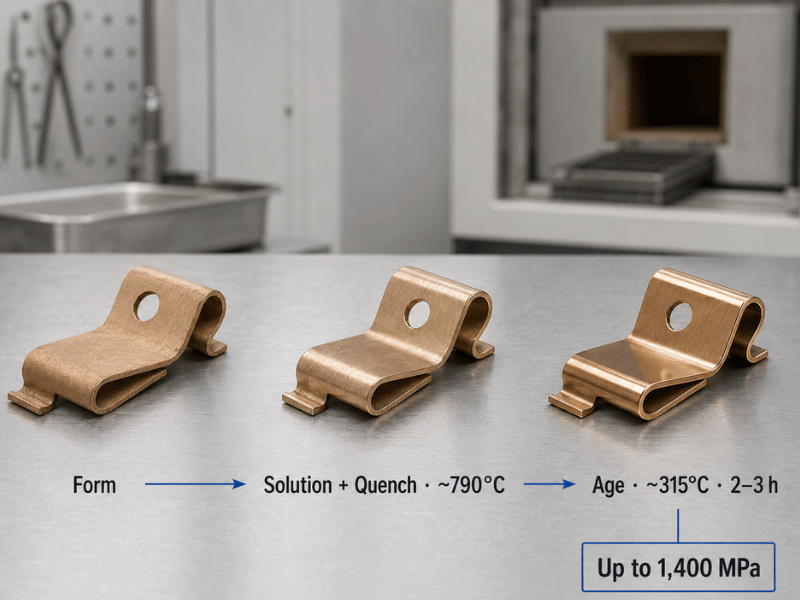
Pure copper fabricates simply — cut, form, braze, done. Beryllium copper adds a mandatory heat-treatment step that you must build into the manufacturing plan.
Solution anneal: Heat to ~790°C (C17200) and quench. The material is now soft (similar to half-hard pure copper), formable, and machinable. Stamping, bending, and rough machining are performed in this state.
Age hardening: Heat to ~315°C and hold 2–3 hours. Strength jumps from ~500 MPa to 1,100–1,400 MPa. Hardness climbs to HRC 38–44. Dimensional change is small and predictable — typically ~0.2% growth — so finish-machining undersized by that amount accounts for the growth, and aging brings the part to final tolerance. C17500 ages at a higher temperature (~425–480°C) and reaches its conductivity and strength peaks through the same precipitation step.
Safety note: Machining, grinding, or welding beryllium copper generates airborne beryllium particulate, which is a respiratory hazard. Proper ventilation and OSHA 29 CFR 1910.1024 compliance are required. Finished solid parts pose no health risk in normal handling.
Age-Hardening Process Summary
| Step | Material | Temperature | Duration | Result |
| Solution anneal | C17200 | ~790°C | Until uniform | Soft, formable state (~500 MPa) — stamping and machining performed here |
| Quench | C17200 | Rapid | Immediate | Beryllium locked in solid solution |
| Age hardening | C17200 | ~315°C | 2–3 hours | 1,100–1,400 MPa, HRC 38–44, ~0.2% dimensional growth |
| Age hardening | C17500 | ~425–480°C | 2–3 hours | 690–1,100 MPa, conductivity peak reached |
Standards and Traceability
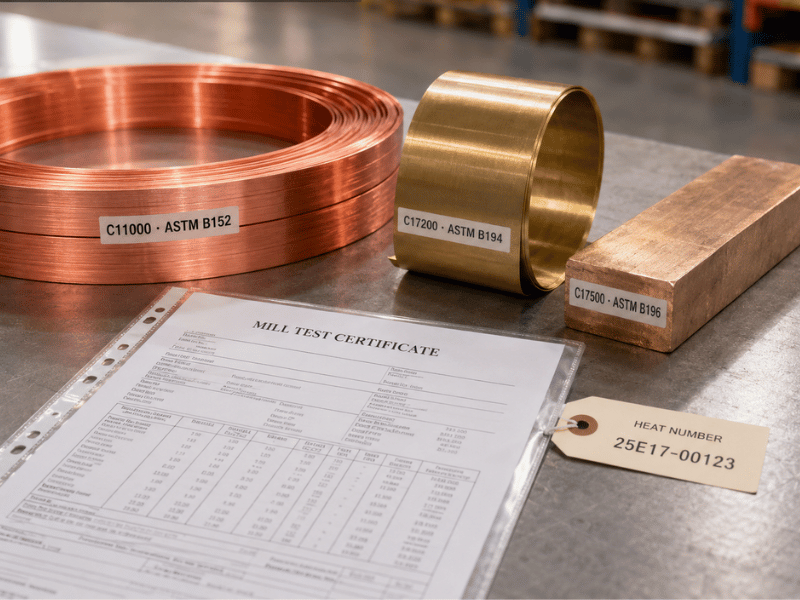
Pure copper is covered by ASTM B152 (sheet, strip, plate, rolled bar) and ASTM B187 (bus bar); C11000 ETP is the benchmark grade. Beryllium copper grades fall under ASTM B194 (C17200) and ASTM B196 (C17500). European equivalents are CW004A (pure copper), CW101C (C17200), and CW104C (C17500). Required specifications include:
Grade (C11000, C17200, C17500) Temper (O60, H04, H08 for pure copper; AT/solution-annealed or TH04/HT/age-hardened for BeCu) MTR/MTC requirement per lot — BeCu’s heat-lot traceability matters because the aging response is chemistry-dependent
Sourcing Copper and Beryllium Copper from Linsy
Linsy Copper is ISO 9001/14001/45001 certified and supplies both pure copper (C11000 ETP) and beryllium copper (C17200, C17500). Beryllium copper is a new product line at Linsy — grade availability, form options, and stock depth are expanding. Pure copper ships in sheet, plate, bar, tube, wire, coil, profile, block, and custom forms to the temper and size you specify. Every order — pure copper or beryllium copper — ships with full MTR/MTC documentation, and SGS chemical, mechanical, and conductivity reports are available on request. Low-MOQ custom production runs process in 10–60 days depending on grade, size, and specification — practical when your design needs a trial batch of bus bar, spring strip, or machined copper components before committing to volume.
Conclusion
Pure copper is the electrical conductor standard at minimal cost. Beryllium copper is the high-load, high-cycle, high-safety choice where no other copper alloy reaches its strength levels. If your part carries current and nothing else, pure copper is the answer. If it carries millions of cycles, explosive atmospheres, or loads that would fold pure copper, beryllium copper (C17200 for strength, C17500 for conductivity) earns its premium. Linsy supplies both pure copper and beryllium copper with full mill traceability from the first prototype to production volumes, so once you make the material call, sourcing is covered. Download the C11000 / C17200 / C17500 specification sheet, or request a side-by-side quote for the grades your project needs.
FAQ
-
No. Beryllium copper uses beryllium as the primary alloying element and achieves its strength through precipitation hardening. Phosphor bronze uses tin and phosphorus and relies on solid-solution strengthening plus cold work. BeCu can reach ~1.4–1.6× the tensile strength of the strongest phosphor bronze.
-
No. Thicker pure copper still lacks elasticity, fatigue resistance, and hardness. A thicker pure copper spring will just permanently deform at a higher force. The property gaps are intrinsic, not just geometry problems.
-
The material starts soft and formable after solution annealing. You shape it, then bake it — C17200 at ~315°C for 2–3 hours; C17500 at ~425–480°C. During the bake, beryllium-rich (C17200) or cobalt-rich (C17500) particles precipitate inside the grains and lock dislocations, tripling the strength. Dimensional change is small (~0.2% growth) and predictable.
-
Yes. Solid, finished beryllium copper parts pose no known health risk in normal handling. The hazard is airborne dust from machining, grinding, or welding. Ventilation and OSHA 29 CFR 1910.1024 compliance are required during fabrication.
-
Steel matches BeCu’s strength and hardness at lower cost, but steel lacks conductivity (BeCu conducts ~22–60% IACS; steel conducts ~3–15% IACS), sparks on impact, is magnetic, and corrodes without plating. If any of those four properties matter, steel is unsuitable.
-
Yes — beryllium copper (C17200, C17500) is a new product line at Linsy. Grade availability, form options, and stock depth are expanding. Pure copper (C11000 ETP), brass, bronze, and copper-nickel remain the core stocked categories with the broadest form and size range.

David Huang is a copper materials specialist and Sales Manager at Linsy Copper, with years of hands-on experience supporting global customers in copper and copper alloy sourcing.
He specializes in industrial copper products such as C11000 copper, C10200 oxygen-free copper, brass, bronze, copper sheets, plates, tubes, bars, and custom-processed copper components.
With a practical understanding of copper manufacturing, quality inspection, surface treatment, and export supply chains, David helps customers choose the right materials for electrical, mechanical, marine, construction, and industrial applications.