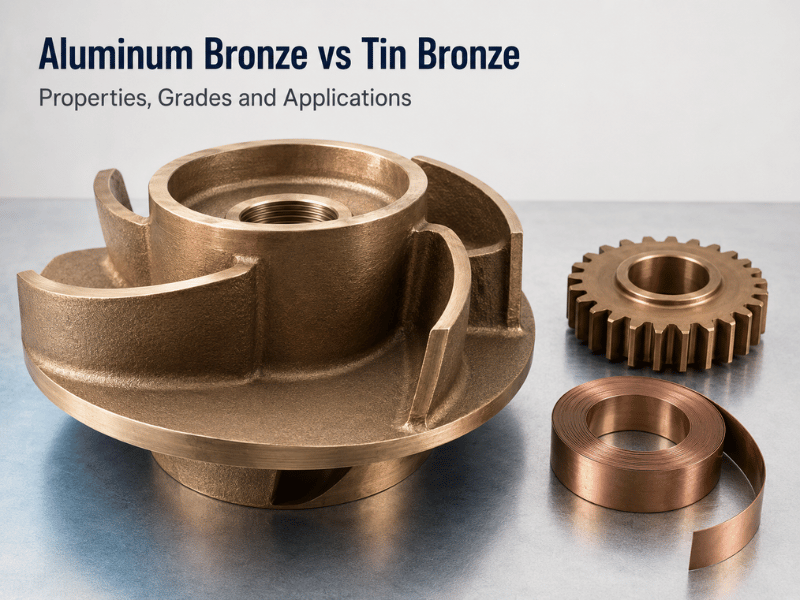
Key Distinction
Both are copper-based alloys, but the primary alloying element sets the whole performance profile — and the two are not interchangeable.
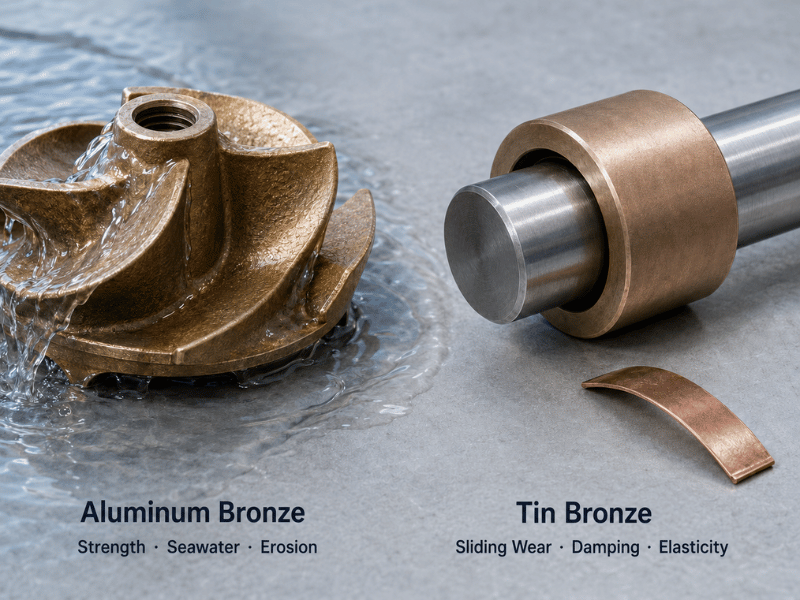
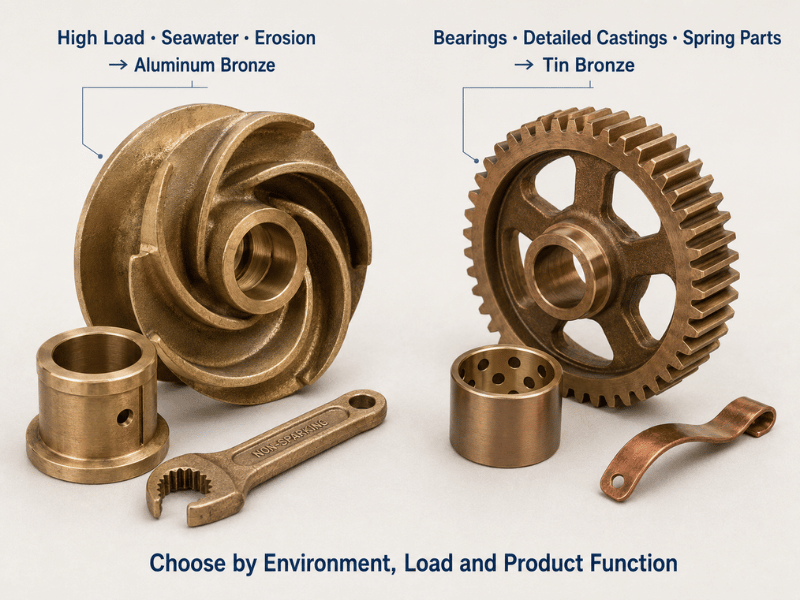
Aluminum bronze excels in high strength, seawater corrosion resistance, erosion resistance, high-temperature stability, and heavy-load wear. It is the engineering-grade bronze.
Tin bronze excels in castability, machinability, vibration damping, and elasticity. It is the general-purpose precision and spring bronze.
Alloy Systems and Common Grades
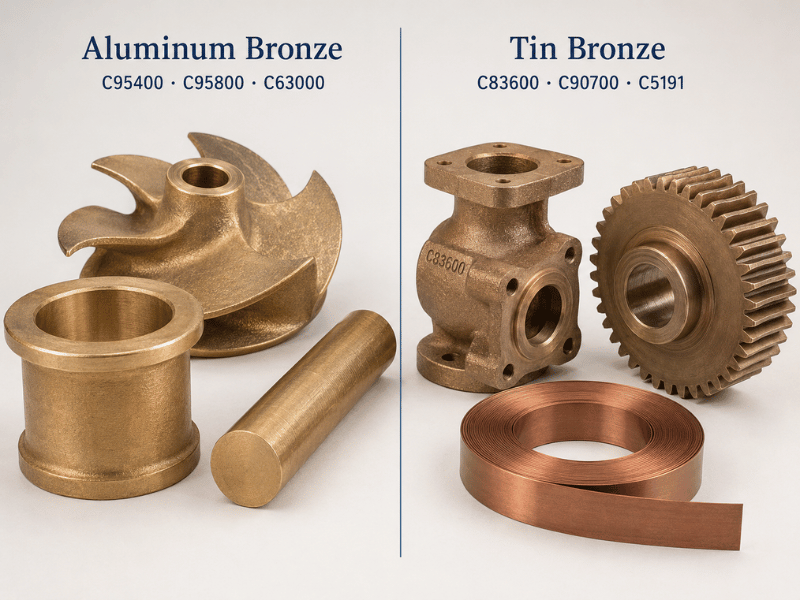
Aluminum Bronze — Cu–Al–Fe (+Ni)
Two sub-families:
- C95400 — standard cast aluminum bronze, no nickel. General freshwater and wear parts.
- C95800 — cast nickel aluminum bronze (NAB). The seawater and offshore standard.
- C63000 — wrought nickel aluminum bronze. Precision bushings, valve stems, heavy-duty bearings.
Tin Bronze — Cu–Sn (+P, Pb, Zn)
Two product forms:
- C83600 (gunmetal / leaded red brass) — general cast tin bronze for valves, fittings, and bearings.
- C90700 (high-tin gear bronze) — wear-grade cast bronze for gears, worm wheels, heavy-duty bearings.
- C5191 / C5210 (phosphor bronze) — rolled strip and bar for springs, contacts, and precision parts.
Property Comparison at a Glance
| Dimension | Aluminum Bronze (Al-primary) | Tin Bronze (Sn-primary) |
| Strength & hardness | Very high; C63000 cold-works to near-steel strength | Medium; phosphor bronze reaches high strength by cold work, but no heat-treatment route |
| Corrosion | Excellent; NAB for long-term seawater | Good in fresh water, steam, atmosphere; gunmetal sees mild/occasional seawater (through-hull fittings), not continuous high-velocity or offshore seawater |
| Wear & erosion | Superior against slurry, cavitation, high-velocity flow | Good self-lubricating low-speed bearing; not for high-velocity erosion or cavitation |
| High-temperature | Retains strength to higher temperature | Softens; phosphor bronze service limit is about 200°C |
| Castability | Higher shrinkage and hot-cracking risk; needs careful gating; best for thick, robust sections | Excellent fluidity and fine detail; ideal for thin-wall, complex small castings |
| Machinability | Harder, tool-welding tendency, higher cost | Excellent, especially lead-bearing gunmetal |
| Elasticity | Poor; not a spring or contact material | Excellent; the standard spring and electrical-contact bronze |
| Damping / noise | Moderate | Excellent; quiet-running bearings |
| Non-sparking | Yes — the classic certified safety-tool alloy | Yes — phosphor bronze is also spark-resistant and used in explosion-proof hardware |
Forming and Supply Forms
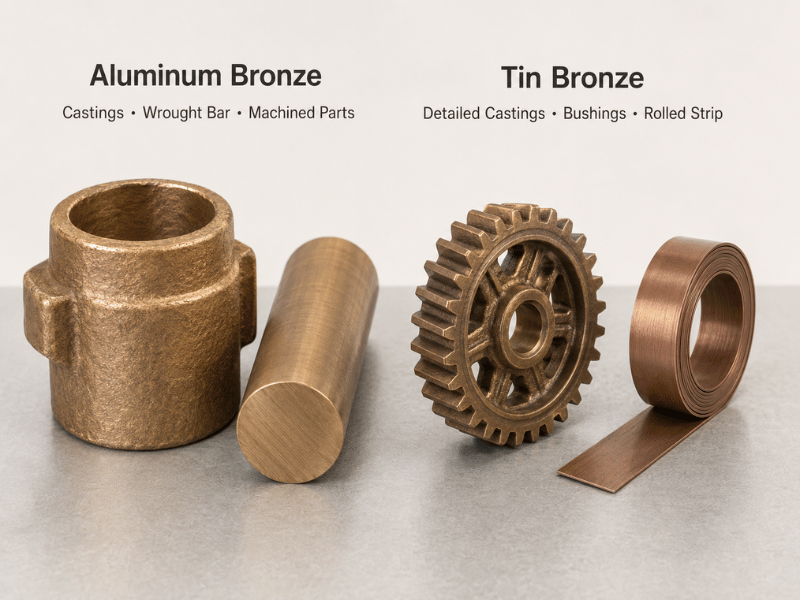
Aluminum bronze ships as cast (C95400, C95800) and wrought (C63000 bar, plate, forging). The cast versions need controlled gating because of shrinkage and hot-cracking tendency, but deliver thick, high-strength structures — pump casings, valve bodies, propellers.
Tin bronze ships as cast (gunmetal, high-tin bronze) and wrought strip or bar (phosphor bronze). The cast grades reproduce fine detail at low cost; the strip is cold-rolled to spring tempers for stamping and forming.
Application Range by Family
Aluminum Bronze — Corrosive, Erosive, Heavy, or Hot Duty
- Marine and offshore: seawater pumps, subsea valves, seawater piping, propeller hubs
- Heavy mechanical: high-pressure hydraulic bushings, heavy bearing shells, wear slides, impact-load gears
- Special service: oil-and-gas explosion-proof tools, high-temperature wear parts, cavitation-exposed impellers
Tin Bronze — Precision, Volume, Quiet, or Elastic Duty
- Fluid equipment: freshwater and steam valves, plumbing fittings, general-purpose pump castings
- Mechanical: low-speed quiet bearings, small gears, damping bushings
- Electrical: connector springs, switch contacts, terminal elastic elements (phosphor bronze)
When to Specify Each
The application ranges above map where each family is standard practice. The table below gives condition-first selection logic for quick decisions.
| Specify aluminum bronze when… | Specify tin bronze when… |
| The part sees seawater, cavitation, or slurry erosion | Service is fresh water, steam, or atmosphere |
| Load is heavy, impact, or high-temperature | Load is light-to-moderate and low-speed |
| A thick, high-strength cast or forged structure is required | Thin-wall, complex, or high-volume cast parts are required |
| Explosion-proof tooling is required | Springs, contacts, or stamped elastic parts are required |
| Long design life in marine or offshore service is the target | Quiet running and machinability drive the spec |
Specifying tin bronze in seawater, or aluminum bronze for a stamped spring, misapplies the alloy to the wrong service condition.
Conclusion
Aluminum bronze and tin bronze split cleanly by duty: aluminum bronze carries seawater, erosion, heavy impact, and heat; tin bronze carries precision casting, volume machining, damping, and elasticity. The trade-off is that aluminum bronze grades (C95400, C95800, C63000) have narrower general stock availability than the established tin bronze range, and the two families are not interchangeable. Linsy supplies both — phosphor and tin bronze (C51000–C54400) from established stock, and C95400, C95800, and C63000 with low minimum order quantities and full MTR/MTC on every order; certifications cover ISO 9001, ISO 14001, and ISO 45001, and SGS chemical, mechanical, and dimensional reports are available on request. When the project needs a bronze grade-fit review, send the target grade, form, and condition for a comparison and quote.
FAQ
-
For mild or occasional exposure — yes. Gunmetal (C83600) is common in through-hull fittings and seacocks. But tin bronze is not the material for continuous high-velocity or offshore seawater service; that is nickel aluminum bronze (C95800, C63000) territory.
-
Tin bronze, specifically phosphor bronze (C5191, C5210). Its fatigue life and elasticity make it the standard spring and contact material. Aluminum bronze has poor elasticity and is not used for springs.
-
Both. Aluminum bronze is the classic certified safety-tool alloy, and phosphor bronze is also spark-resistant and used in explosion-proof hardware. Either avoids the spark risk of steel in flammable atmospheres.
-
Tin bronze, by a wide margin. Lead-bearing gunmetal turns and bores cleanly at low cost; aluminum bronze is harder, tends to weld to the tool, and costs more to machine.
-
Tin bronze. Its fluidity reproduces thin walls and fine detail; aluminum bronze has higher shrinkage and hot-cracking risk, so it suits thicker, more robust sections.
-
Phosphor and tin bronze (C51000–C54400) is an established stocked line. Linsy supplies C95400, C95800, and C63000; confirm the target grade, form, and temper for availability. MTR/MTC and SGS reports are available on request.

David Huang is a copper materials specialist and Sales Manager at Linsy Copper, with years of hands-on experience supporting global customers in copper and copper alloy sourcing.
He specializes in industrial copper products such as C11000 copper, C10200 oxygen-free copper, brass, bronze, copper sheets, plates, tubes, bars, and custom-processed copper components.
With a practical understanding of copper manufacturing, quality inspection, surface treatment, and export supply chains, David helps customers choose the right materials for electrical, mechanical, marine, construction, and industrial applications.