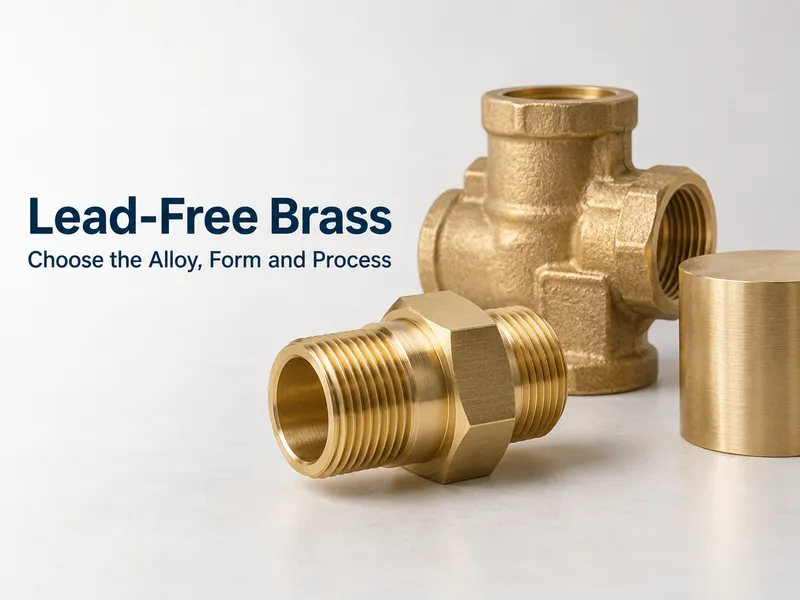
Lead did two jobs in free-cutting brass. It broke chips, and it stopped the metal from work-hardening mid-cut. Remove it and you have to replace both jobs — which is why “lead free” is not one material with one number attached, but a family of alloys that each give something different back.
The practical question is not which grade is lead free. Every one of them is. It is which capability you can afford to lose.
What Lead Actually Did in Yellow Brass
In C36000 Latón de Corte Libre, lead is not an impurity. It is added on purpose, as a third phase that does two things at once. It forms soft particles that fracture under the cutting edge and take the chip with them, and it keeps the surrounding grain from strain-hardening as the tool passes. That combination is why free-cutting brass is set at a machinability index of 100 and why nothing else reaches it easily.
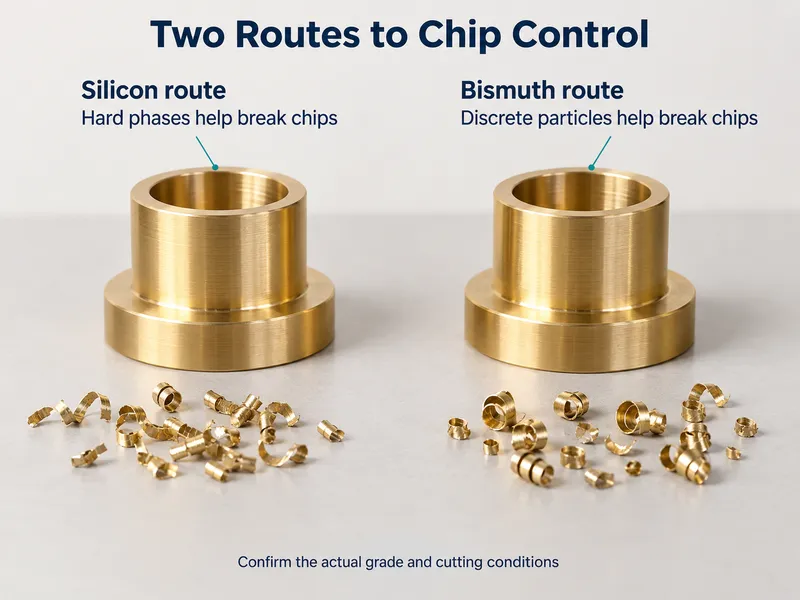
Substituting one element for lead does not reproduce both effects. Bismuth reproduces the first. Silicon reproduces something different — a harder, stronger matrix that resists the wear lead used to reduce. So the choice of substitute is really a choice about which of the two benefits matters more for your part.
One boundary worth setting: this covers wrought and cast copper alloys. “Lead free” also appears in tin bronze and aluminium bronze naming, where the lead figure is lower and the metallurgy is entirely different.
How to Read the Index Column
The machinability index is a relative production rate, not a hardness and not a price. It comes from the ASTM E618 test: bar one inch in diameter is machined under conditions adjusted until the tool reaches eight hours of life, and the rating is the number of in-tolerance parts per hour expressed as a percentage of what C36000 produces under the same test. C36000 is set at 100 by definition, so the figure answers one question — how many parts this alloy gives you for the same eight hours of cutting.
Two limits are worth carrying. The rating belongs to the form and temper tested, so a casting figure does not travel to bar. And ASTM withdrew E618 in 2023, which means most published values are legacy table figures rather than fresh test results.
The Two Substitution Routes
| Alloy | Pb max | Forms | Index | What it replaces | Uso típico |
| C69300 silicon 2.7–3.4% | 0.09% | Bar, rod | 80–85 | Strength and dezincification resistance, not chip breaking | European potable schemes, precision bar |
| C87850 silicon 2.7–3.4% | 0.09% | Bar, rod, castings | 70–80 | Same route at higher copper | North American potable, general lead-free bar |
| C87860 silicon + zirconium | 0.25% | Bar, forgings | 70 (forging 95) | Forging response rather than chip control | Forged fittings needing ductility |
| C27450 plain CuZn, no additive | 0.25% | Bar, rod | 70 | Nothing — the low-lead CuZn route | North American machined parts, plumbing |
| C89550 bismuth 0.6–1.2% + Se | 0.10% | Mainly castings | 75–97 by Bi content | Chip breaking, the closest match to lead | Cast valves and fittings where chip control counts |
| C89833 bismuth tin bronze | 0.09% | Castings | 81 | Cast bronze C836 — not a brass at all | Bronze parts carrying a lead-free label by mistake |
| C46400 / C46500 naval, Sn 0.5–1.0% | 0.20% | Sheet, rod | 30 | Nothing for machining; tin for seawater | Marine hardware; C46500 where seawater acts |
C69300 at 80–85 and C89550 at 75–97 both sit near the benchmark, but they get there differently and fail differently at the cutting edge.
Silicon
Silicon brass was not built around chip breaking. Adding silicon changes the alloy’s structure rather than adding a soft phase, and that produces a harder surface that resists abrasion and carries higher strength. It is why silicon brasses hold up in pressure fittings and why the alloy machines harder than free-cutting brass.
Two things follow. Silicon brasses give up some chip control, so cutting has to be set up differently. And the harder matrix is more abrasive on tooling, which is a tooling-cost question rather than a production-rate question.
For European work the alloy also has a published identity: EUPL entry 1658 = CW724R (CuZn21Si3P), valid to 31 December 2034. The EU list and the UNS grade carry slightly different lead maxima because they are two separate standards — a mismatch to expect rather than a discrepancy to worry about.
Bismuth and tin
Bismuth does the job lead did, more literally. It forms discrete soft particles at a low melting point, and a cutting edge breaks chips against them. This is the closest route to leaded behaviour, and the one to look at first if your rejection history is chip and tool-life related rather than corrosion related.
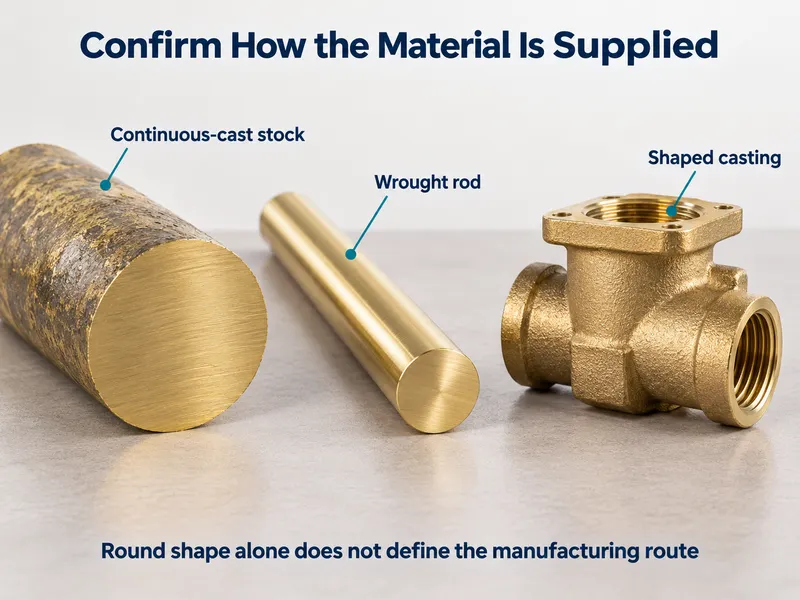
The trade is form. Most bismuth brass in commercial circulation is a casting alloy, and its machinability rises sharply with bismuth content — 75% at 0.7% Bi and 97% at 1.1% Bi, against C36000 as the 100 reference. Buying bar rather than castings narrows the range of available grades, so confirm the form before comparing prices.
Tin sits in the family for a different reason. It buys corrosion resistance in seawater and stabilises the alloy against dezincification, appearing as an addition rather than as lead’s functional replacement.
Two Grades That Are Not Substitutes
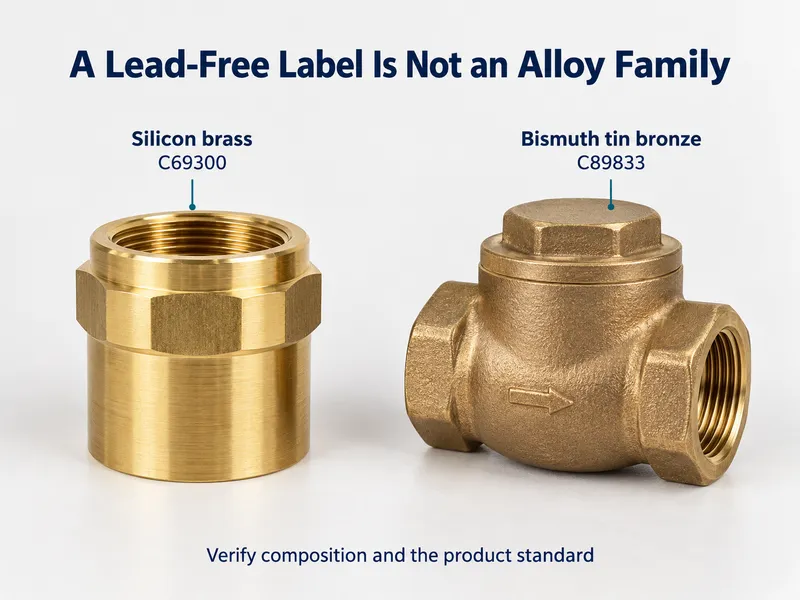
C89833 is routinely listed as “bismuth brass” in supplier catalogues and is not. It is a bismuth tin bronze — copper 86–91%, tin 4–6%, bismuth 1.7–2.7% — and it substitutes for cast bronze C836, not for free-cutting brass. Its machinability index of 81 is real, but it measures a different alloy family. Copy that index across from a “lead free brass” table and a bronze ends up specified where a brass was intended.
C46400 and C46500 are the same alloy chemically — copper 59–62%, tin 0.5–1.0%, lead at 0.20% maximum — and the only difference is that C46500 adds 0.02–0.06% arsenic as a dezincification inhibitor. Where the service is seawater, the arsenical grade is the one to specify, and that is C46500 Latón Naval. That 0.20% ceiling is what the grade is sold under; it is not evidence that the alloy was built to be machined.
What Replaces C36000 for Machined Parts
C36000’s 2.5–3.7% lead is the reason it sits at 100. There is no lead-free grade at 100, and any supplier quoting one is quoting leaded material.
| Candidate | What it costs you |
| C27450 | The closest match available. Still needs trial cuts — chip form and finish both move |
| C89550 | Bi content is the variable, so confirm the number rather than the trade name |
| C69300 | Shorter chips and more abrasive wear; re-set speeds, feeds and tool grade |
The pattern worth remembering: silicon buys machining index but charges abrasive wear; bismuth buys chip control at a narrower range of available forms. Which is cheaper means deciding which of those two penalties your operation absorbs better — a process-specific answer, not a general ranking.
C27450 carries its own caveat. It was developed against the California AB 1953 weighted-average 0.25% threshold, so it sits at the low-lead end of “lead free” rather than the zero-lead end. For most US potable work that satisfies the requirement; for a specification written as “zero lead” it does not, and a bismuth grade is the answer instead.
Selecting by Service Condition
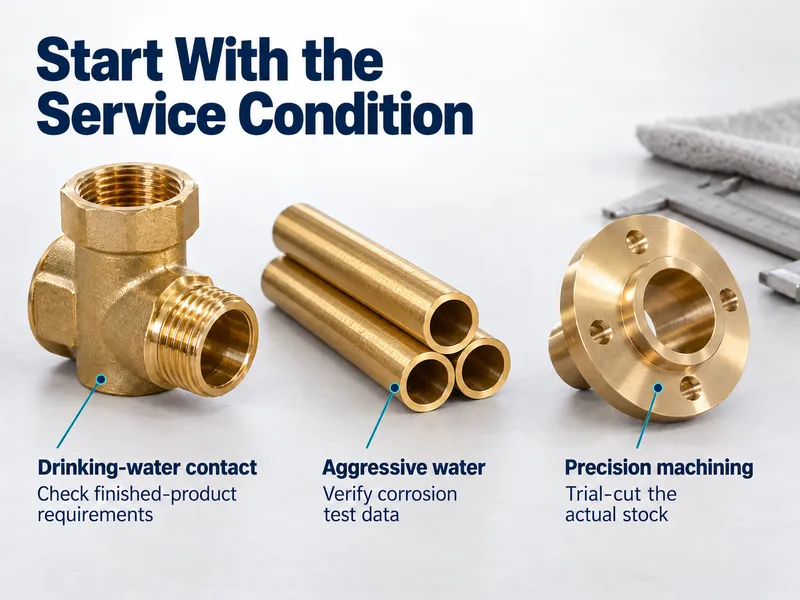
Two service conditions change the selection rather than the grade list. In seawater or aggressive water the criterion becomes dezincification behaviour, and the test data behind it is in Dezincification and Lead-Free Brass in Seawater. On a precision turned part the question is how the alloy behaves under a tool, and Lead-Free Brass for CNC Machining has the cutting data.
For a machined part, work from the two substitution routes rather than down a list of grades. The silicon route covers C69300 and C87850 in bar, and C87860 for forged work. The bismuth route is worth a look when the failure history is chip and tool life. Where these alloys sit in the wider copper range — the tin brasses, aluminium brasses and naval brasses that lead-free does not replace — is covered in Leaded vs Lead-Free Brass.
Conclusión
Most lead-free decisions fail on an assumption that the swap is free. It is not a like-for-like exchange: you choose which capability to give up, and the cost of that choice shows up in cutting, tooling or availability rather than on the material certificate.
We supply C87850 Latón sin plomo in bar and C87860 Latón fundido sin plomo for forged North American potable work, silicon brass in the C69300 / CW724R grade for European schemes, and C27450 for machined parts where the 0.25% weighted-average threshold is the governing rule. Each comes with composition documentation traceable to the heat.
Send us the drawings, the destination markets, and the fluid the part contacts, and we will tell you which grade each one needs and what changes in the machining.
Preguntas frecuentes
Should I quote brass by grade name or by composition range?
Grade name, and confirm the form at the same time. A composition range gives you the numbers, not process fit, and several of these alloys are cast-first.
Why is lead-free material quoted higher than the equivalent leaded grade?
Two reasons worth separating: bismuth and silicon cost more than lead with fewer melt sources, and harder silicon brasses need better tooling and conservative parameters — labour that often gets quoted as material. If a supplier’s gap exceeds what the alloy difference explains, ask which of the two you are paying for.
Can you supply a grade with certification already in place?
We supply composition documentation traceable to the heat. Certification is a different matter — it applies to the finished part, not the alloy, and belongs to whoever assembles it.

David Huang es un especialista en materiales de cobre y Gerente de Ventas en Linsy Copper, con años de experiencia práctica apoyando a clientes globales en el abastecimiento de cobre y aleaciones de cobre.
Se especializa en productos industriales de cobre como cobre C11000, cobre libre de oxígeno C10200, latón, bronce, láminas de cobre, placas, tubos, barras y componentes de cobre procesados a medida.
Con un conocimiento práctico de la fabricación de cobre, inspección de calidad, tratamiento de superficies y cadenas de suministro de exportación, David ayuda a los clientes a elegir los materiales adecuados para aplicaciones eléctricas, mecánicas, marinas, de construcción e industriales.