Shipping lead free brass fittings into more than one market means answering the same question five different ways. A part that clears the US requirement gets rejected in Germany. A grade your customer has used for years turns out not to be on a European list at all.
The rules do not contradict each other — they ask different questions. Once you can tell which question a market is asking, the rest is bookkeeping.
At the alloy level the choice is covered in Latão com Chumbo vs Latão sem Chumbo: Como Escolher por Aplicação; this one stays on destination-market compliance and the paperwork that travels with the part.
What “Lead Free” Actually Means
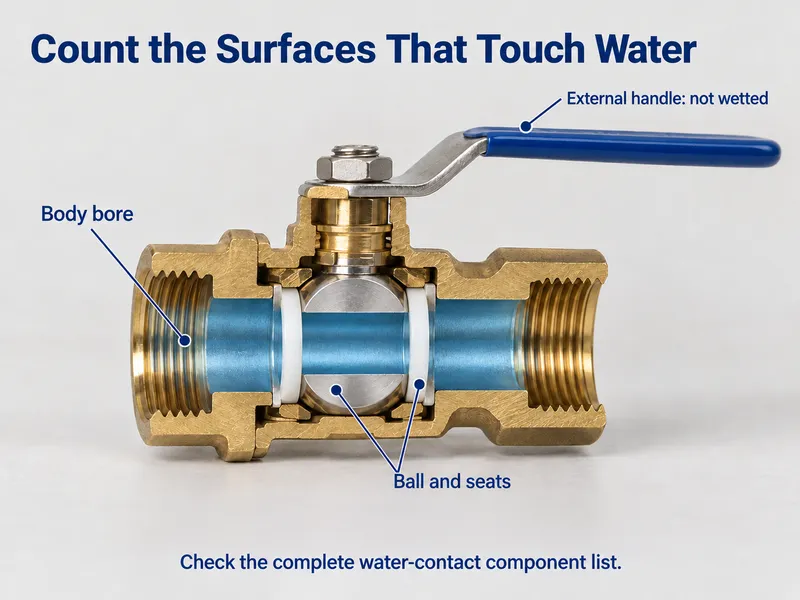
In the US, “lead free” has a legal meaning narrower than most people assume. It is not the lead content of the whole part: the Reduction of Lead in Drinking Water Act, effective 4 January 2014, defines it as a weighted average of 0.25% lead across wetted surface area — the surfaces that actually touch drinking water.
Weighting is what catches people out. A fitting may carry lead in a non-wetted decorative component and still comply, and a part that passes on paper can still fail if a large wetted area is high-lead while a small wetted area is low-lead. What counts is the ratio across the wetted surface, not any single material certificate.
One boundary worth setting: everything here covers copper alloy fittings. Searches for “lead pipe fittings” often return lead or PVC pipe and connectors, which follow entirely different rules.
Four Different Systems, Not One Global Number
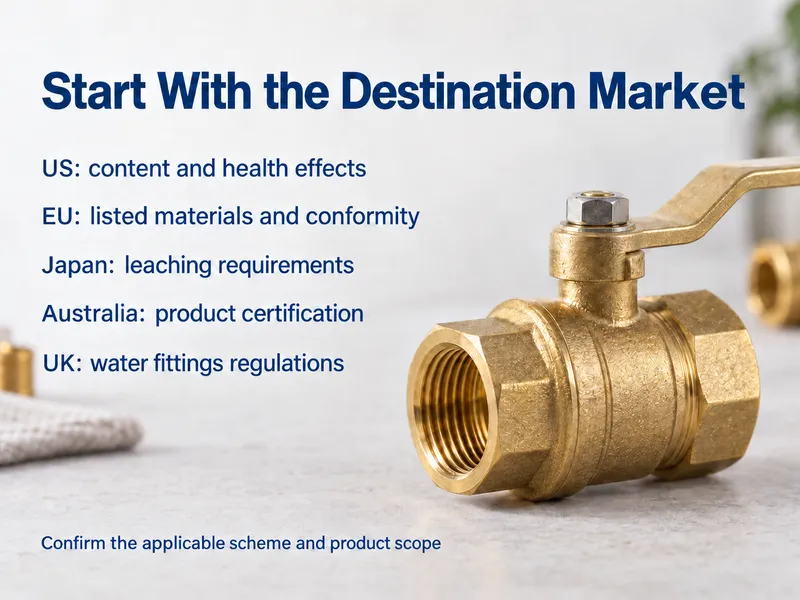
The “What it asks” column is the whole difference. Everything below it is what each of those answers costs you in paperwork.
| Mercado | What it asks | Limit | Key dates | Who verifies |
| US & Canada | How much lead is in the material | Wetted-surface weighted average ≤0.25% | In force since 2014-01-04 | NSF (372 + 61) |
| European Union | Is this alloy on a published list | Each EUPL entry has its own Pb limit | 2026-12-31 list applies 2032-12-31 transition ends | Member-state-recognised bodies |
| Japão | How much leaches into water | Terminal fittings ≤5 µg/L Non-terminal ≤50 µg/L | In force | MHLW leaching test |
| Australia & NZ | Does the part carry a certificate | Lead Free WaterMark mandatory | 2026-05-01 production ban 2028-05-01 installation ban | ATL + WaterMark |
| United Kingdom | Does it satisfy the 1999 Regulations | WRAS; voluntary but effectively required | Covered by the EU list from 2027 | WRAS / KIWA / DVGW |
Read down the “What it asks” column and the pattern is clear: every market applies its rules to the part, not to the alloy, and the material supplier is never the certifying party. The differences that follow are in what each of those parts must carry to prove it.
One limit applies to more than one row. Australia’s requirements reach copper alloy products only — brass and bronze fittings, valves, taps and meters. Shower heads, shower mixers, washing machines, dishwashers, commercial boilers and emergency deluge or eyewash equipment are exempt, so a supplier certificate for one of those parts does not carry a lead-free claim.
Content: What the US and Canada Ask For
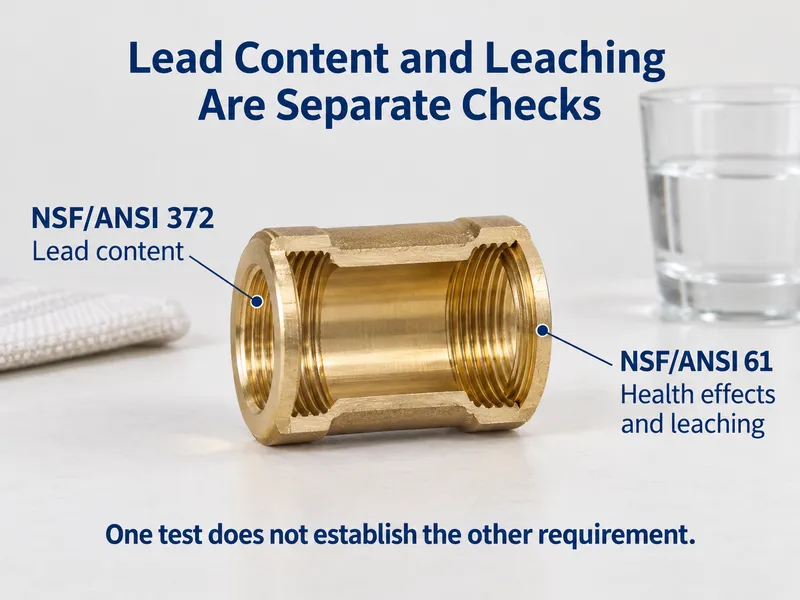
Two standards, routinely confused. NSF/ANSI 372 governs lead content in the material, verified by XRF or chemical digestion. NSF/ANSI 61 governs health effects and leaching across 150-plus substances. Passing one is not evidence of passing the other, and treating “61 certified” as if it implied “372 compliant” is the most common procurement error in this market.
Positive List: What the EU Asks For
The EU applies no lead percentage you can compare against the American 0.25%. It asks whether the alloy is on the European Positive List, established by Decision (EU) 2024/367 and applying from 31 December 2026.
The entry that matters for silicon brass is EUPL 1658 = CW724R (CuZn21Si3P): Cu 75.0–77.0%, Si 2.7–3.5%, Pb ≤0.10%, product groups B–D, valid to 31 December 2034.
The practical consequence is that leaded brasses are excluded outright. That is why the UK’s leaded CW602N DZR grade (1.7–2.8% Pb) — still accepted for potable water in Britain — cannot go to Europe or the US.
One trap worth naming: CW511L is widely described online as EU-approved and is not. A full-text search of the 375-page Decision returns no such entry. It is an arsenical grade, CuZn38As, usable only under national approvals granted between 13 July 2021 and 31 December 2026.
Leaching: What Japan Asks For
Japan is the outlier: it regulates by leaching, not composition. There is no lead percentage to compare and no certificate to obtain — the test is how much lead comes out of the part when it sits in water. The Ministry of Land, Infrastructure, Transport and Tourism sets two tiers: 5 µg/L for terminal fittings such as taps at the point of use, and 50 µg/L for non-terminal components like valves, couplings, and supply pipe.
JIS H3250 is not the compliance basis. It is a material standard for bar and rod composition, which is why its C2600/C2700 and C2800 lead figures describe alloys rather than permissible leaching.
Certification: What Australia and the UK Ask For
Australia does not ask for a number, it asks for a certificate. From 1 May 2026 no copper alloy product for drinking water above 0.25% weighted average lead may be produced; from 1 May 2028 only products carrying Lead Free WaterMark certification may be installed. Because the lead limit is verified against NSF/ANSI/CAN 372, a supplier’s 372 report is the document that closes it.
The UK runs a different model again. WRAS approval demonstrates compliance with the Water Supply (Water Fittings) Regulations 1999, covering neither the EU nor the US. The scheme is voluntary but in practice required, and it has to be renewed.
Where Certification Actually Sits
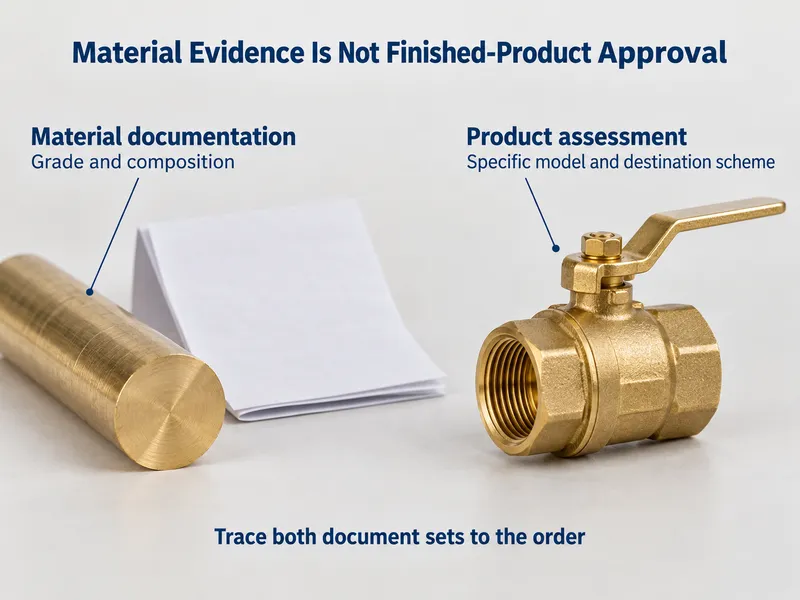
A material supplier can give you a mill test report or a third-party assay showing the alloy meets its lead limit. That is necessary but not sufficient, because the standard is applied to the assembled fitting with its specific wetted surface area, its soldered or brazed joints, and whatever secondary metals sit in the water path.
Verifying a certificate takes two minutes — certification bodies maintain public databases, and a number traces to the product it was issued for. For brass tube and fittings sourced against this article’s requirements, ask for the certificate at the same time as the material certificate, not after the first rejection.
Grade Routes for Potable Water Fittings
Two lead-free routes cover most potable water fittings, and which one applies is settled by the destination market.
| Grau | Pb | Route | What decides it |
| C6802 bismuth brass | ≤0,10% | North America | Lead-free machinability delivered through bismuth; standard choice in US and Canadian potable water products |
| C69300 silicon brass | ≤0.09% | Europa | EN equivalent CW724R, listed as EUPL 1658; dezincification-resistant by composition rather than arsenic, and machines harder than free-cutting brass — a quotation issue, not a compliance one |
Two grades that get grouped with the lead-free family are not. C44300 Admiralty Brass e C46500 Naval Brass are low-lead grades at roughly 0.07% and 0.20%, and calling them lead-free is wrong whichever market the part ships to. C36000 Latão de Corte Livre is the opposite case: at 2.5–3.7% lead it is the machinability benchmark and nowhere near any potable-water limit here.
Dezincification runs alongside all of this — a fitting can satisfy every lead rule and still fail in service if the alloy is not stabilised against zinc loss.
What to Ask a Supplier
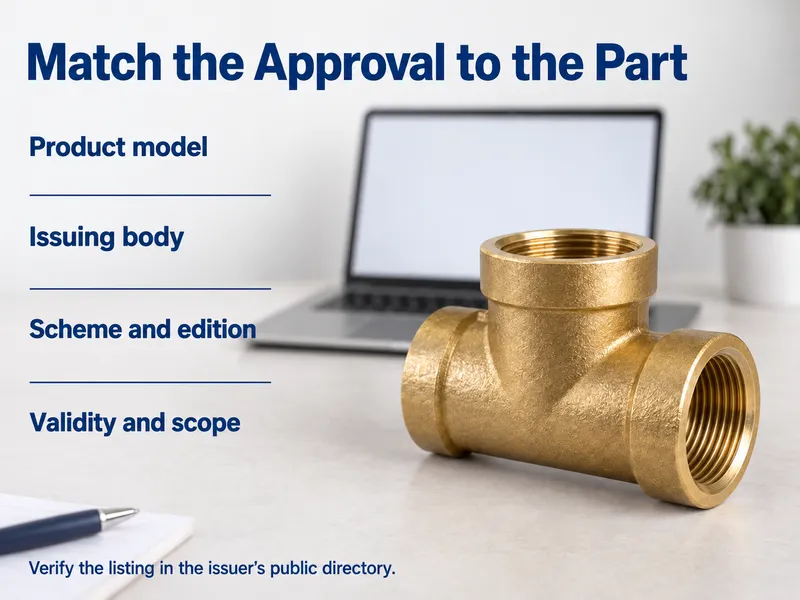
These five questions settle most ambiguity before it becomes a rejected shipment. The middle column is the part people skip; the right column is what a usable answer looks like.
| Ask | Why it matters | A usable answer |
| Which market’s scheme is the approval issued under? | Not which market it is sold into. A US approval is not a European one, and EU conformity satisfies neither NSF nor WaterMark. | Named scheme and market, with the certificate or declaration reference |
| Which components count as wetted surface? | On a valve the body and trim are both in the water path; on some fittings an internal seal or a second alloy sits inside the wetted area. | A component list marking which parts are counted and which are excluded |
| Which grade is on the wetted surface, by designation? | For Europe the EN designation and its EUPL entry decide compliance. “C69300, EU approved” answers a different question from “CW724R, EUPL 1658.” | Both designations, and the EUPL entry number for European shipments |
| What documents exist, under which numbers? | A certificate for a different part number, or one issued under a superseded standard, does not transfer to your order. | Document list plus certificate numbers traceable in the issuer’s public database |
| Who tested it, and is that body accredited? | A report is only as good as the body’s accreditation. In Japan the reference is the ministry’s own leaching test, not an equivalent third-party scheme. | Name and accreditation of the testing body, matched to the destination market |
One failure mode sits behind all five: mixing grades across a valve body, its couplings, and its connectors. Each component can pass individually while the assembly still fails a scheme that evaluates the complete fitting.
Conclusão
The cost of getting this wrong is rarely the material. It is the certification path, the timeline, and the shipment that has already left the warehouse. Four different mechanisms, four different sets of documents, and no global number that satisfies all of them.
Most of these decisions are made at the alloy stage, which is where we work. We supply C87850 Latão sem Chumbo e C87860 Latão Fundido sem Chumbo for North American potable applications, and silicon brass in the C69300 / CW724R grade for European schemes, each with mill documentation traceable to the heat. What that documentation does not do is certify the fitting, because every scheme in this article is applied to the assembled part rather than to the alloy.
Send the drawings and the destination markets you are shipping to, and we will tell you which grade each one needs and what documentation will be required at the fitting level.
FAQ
We already have a material certificate. Is that enough?
No. It covers composition only, and every scheme here is applied to the assembled fitting. Buyers who treat the mill report as compliance find the gap when a customer rejects the part — ask instead for the certificate covering the finished part under the destination market’s scheme.
Can we certify one part and sell it into several markets?
Usually not. Each scheme is independent: WRAS covers neither the EU nor the US, EU conformity does not satisfy NSF or WaterMark, and Japan needs its own leaching result. Where a group structure allows it, a single assessment can cover several markets — but you have to establish that up front, not assume it.
Our current part already ships to the US and Europe. What changes when we requalify?
Qualify the grade first, then the part, and expect a documentation timeline rather than a material one. Changing alloy can also change machinability and, if the part is dezincification-sensitive, its service behaviour — so treat requalification as a design review, not a paperwork exercise.

David Huang é especialista em materiais de cobre e Gerente de Vendas na Linsy Copper, com anos de experiência prática apoiando clientes globais na aquisição de cobre e ligas de cobre.
Ele é especializado em produtos industriais de cobre, como cobre C11000, cobre isento de oxigênio C10200, latão, bronze, chapas, placas, tubos, barras e componentes de cobre com processamento personalizado.
Com conhecimento prático em fabricação de cobre, inspeção de qualidade, tratamento de superfície e cadeias de suprimentos de exportação, David ajuda os clientes a escolher os materiais certos para aplicações elétricas, mecânicas, marítimas, de construção e industriais.